
News Detail
![[Translate to English:] Messkampagne im März 2018 auf dem Kivu-See, Ostafrika. (Foto: Eawag)](/fileadmin/_processed_/7/8/csm_teaser_810494771b.jpg "[Translate to English:] Messkampagne im März 2018 auf dem Kivu-See, Ostafrika. (Foto: Eawag)")
Lake Kivu: Danger of a lethal gas eruption is not increasing
October 22, 2020
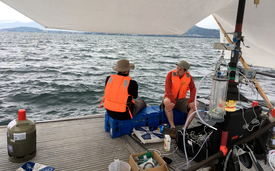
Photo story of the measurement campaign in March 2018 on Lake Kivu, East Africa. Please click on the photo. (Photos: Eawag)
In the depths of Lake Kivu in the East African Rift Valley, there are some 60 billion cubic metres of methane (CH4) and 285 billion cubic metres of carbon dioxide (CO2). This is unique worldwide and also arouses commercial interest. On the one hand, the methane concentration is so high that several hundred megawatts of electricity may be produced from it over decades. On the other hand, the gas reserves threaten the lives of approximately 2 million people living around the lake. A volcanic eruption in the depths of the lake could lead to a sudden mixing of the entire lake. The gas could suddenly escape and suffocate people and animals.
For many years now, the aquatic research institute Eawag and other institutions have thus been observing and researching how gas concentrations are developing in the lake. Measurements in 2004, in which Eawag was involved, indicated that CH4 concentrations in the lake were continuing to rise. For this reason, research has so far assumed that Lake Kivu could reach gas saturation towards the end of the 21st century and that the danger of spontaneous degassing would steadily increase.
Methane concentrations in the lake more stable than previously assumed
However, the latest measurements show that the methane concentration in the lake has been relatively stable since the 1970s or is rising only very slowly. The lake almost seems to be in equilibrium. Also, the lake is still far from CH4 saturation where spontaneous degassing can occur. The risk of a catastrophic gas eruption is therefore not increasing at present. However, the danger is not completely dispelled. An underground volcanic eruption could suddenly release the gas even at concentrations far below saturation.
But less encouraging are the new findings for the long-term use of Lake Kivu as an energy source. The two neighbouring countries, Rwanda and the Democratic Republic of Congo, have so far hoped that the gas taken from the lake will be renewed rapidly. This would enable them to continuously extract energy from the lake over a longer period of time. However, the new measurements mean that the energy source only slowly regenerates. Once the gas currently present in the lake has been used up, in the long-term much less energy than expected will be able to be used.
Measurement campaign provides reliable data
The new findings come from a measurement campaign carried out by Eawag in March 2018 together with the Helmholtz Centre for Environmental Research, the University of Grenoble Alpes and the Lake Kivu Monitoring Programme, Rwanda. The research groups used different measuring techniques. Eawag researchers continuously pumped the water-gas mixture upwards from the lake, separated it into a gas phase and water phase and determined the gas concentration with the Mini-Ruedi, a mobile mass spectrometer developed at Eawag. Researchers at the Helmholtz Centre filled their sample containers directly in the lake and investigated the gas using gas chromatography, and the group from the University of Grenoble Alpes recorded the methane directly in the lake using laser spectrometry. This enabled the researchers to collect and compare three independent data sets. Since the data sets are largely in agreement within the margins of error, the researchers assess them to be reliable. The researchers recently published the findings in the journal PLOS One.
Origin of the high methane concentrations in Lake Kivu
On the bottom of Lake Kivu, sources of CO2 are bubbling up. Because of the extremely stable vertical stratification of the lake and the high water pressure, the carbon dioxide (CO2) remains in the depths of the lake and accumulates there. Microorganisms, in turn, produce methane from the CO2 and sunken organic material. The methane also remains stored in the lake’s deep water because of its stable stratification.
Original publication
Cover picture: Eawag