News Detail

On the trail of symbiont diversity

June 3, 2020 | Stephanie Schnydrig

If one observes the competition between parasites and symbionts, much can be learned about the theory of evolution. Two Eawag researchers have thus shown in a new study that high parasite diversity promotes symbiont diversity.

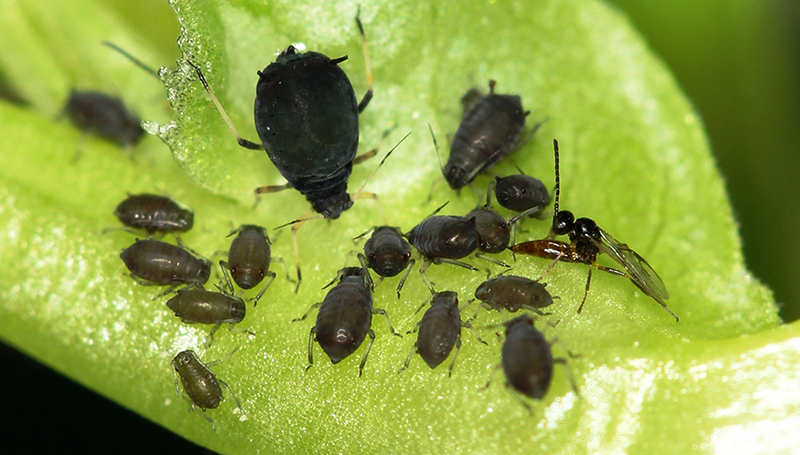
Parasitic wasps act as biological weapons against aphids in pest control. With the help of symbionts, however, some aphids try to defend themselves against the attacks. The struggle between these insects is one of the specialities of Christoph Vorburger, head of the "Aquatic Ecology" department and evolutionary ecologist Nina Hafer-Hahmann, postdoc in the same department. For instance, Vorburger's team has already shown in earlier experiments that wasps develop new genetic patterns to fight their enemy despite symbionts.

In a new study, Hafer-Hahmann and Vorburger have now uncovered another astonishing dynamic by means of selective breeding (called "experimental evolution" in technical circles). "If the wasps have high genetic diversity, this also promotes the genetic diversity of the symbiotic bacteria in aphids," says Nina Hafer-Hahmann, lead author of the study, which has been published in the journal "Ecology Letters".

On the trail of a mystery of evolution

With this knowledge, one mystery can be explained at least in part. In the wild, it is often observed that different organisms in the same habitat have different symbionts. Take aphids for example: individual aphids carry different symbionts than their fellow species. "From the perspective of the theory of evolution, it doesn't really make sense," says Nina Hafer-Hahmann. All aphids ought to have the same symbiont – namely one that protects best against voracious wasps. But this is only true if all wasps are the same. If there are genetically different wasps, aphids can gamble on carrying the right symbiont. Therefore, a variety of symbionts is maintained in a population so that it can protect itself against a wide variety of parasites.

The study by the research duo reveals interesting parallels with the human immune system. Because here too: the diversity of our immune system, i.e. the variety of antibodies, depends on how many pathogens it has to defend itself against.
 

Cover picture: Christoph Vorburger, Eawag

Original publication

Extbase Variable Dump
array(2 items)
   publications => '20706' (5 chars)
   libraryUrl => '' (0 chars)
Extbase Variable Dump
array(1 item)
   0 => Snowflake\Publications\Domain\Model\Publicationprototypepersistent entity (uid=20706, pid=124)
      originalId => protected20706 (integer)
      authors => protected'Hafer-Hahmann, N.; Vorburger, C.' (42 chars)
      title => protected'Parasitoids as drivers of symbiont diversity in an insect host' (62 chars)
      journal => protected'Ecology Letters' (15 chars)
      year => protected2020 (integer)
      volume => protected23 (integer)
      issue => protected'8' (1 chars)
      startpage => protected'1232' (4 chars)
      otherpage => protected'1241' (4 chars)
      categories => protected'adaptation; aphids; Aphis fabae; defensive symbiois; experimental evolution;
          immune system; Lysiphlebus fabarum; maintenance of diversity; parasitoid wa
         sps; specificity
' (168 chars) description => protected'Immune systems have repeatedly diversified in response to parasite diversity
         . Many animals have outsourced part of their immune defence to defensive sym
         bionts, which should be affected by similar evolutionary pressures as the ho
         st's own immune system. Protective symbionts provide efficient and specific
         protection and respond to changing selection pressure by parasites. Here we
         use the aphid <em>Aphis fabae</em>, its protective symbiont <em>Hamiltonella
          defensa,</em> and its parasitoid <em>Lysiphlebus fabarum</em> to test wheth
         er parasite diversity can maintain diversity in protective symbionts. We exp
         osed aphid populations with the same initial symbiont composition to parasit
         oid populations that differed in their diversity. As expected, single parasi
         toid genotypes mostly favoured a single symbiont that was most protective ag
         ainst that particular parasitoid, while multiple symbionts persisted in aphi
         ds exposed to more diverse parasitoid populations, which in turn affected ap
         hid population density and rates of parasitism. Parasite diversity may be cr
         ucial to maintaining symbiont diversity in nature.
' (1114 chars) serialnumber => protected'1461-023X' (9 chars) doi => protected'10.1111/ele.13526' (17 chars) uid => protected20706 (integer) _localizedUid => protected20706 (integer)modified _languageUid => protectedNULL _versionedUid => protected20706 (integer)modified pid => protected124 (integer)
Hafer-Hahmann, N.; Vorburger, C. (2020) Parasitoids as drivers of symbiont diversity in an insect host, Ecology Letters, 23(8), 1232-1241, doi:10.1111/ele.13526, Institutional Repository