
News Detail
The role of adaptive evolution in ecosystem collapse and recovery
October 5, 2021 |
Shallow lakes can remain clear and dominated by macrophytes (rooted aquatic plants) for years despite increasing nutrient inputs, but then suddenly, lose their macrophytes and become turbid. This collapse or abrupt transition to a completely different condition of the lake is a classic example of ecosystem tipping points. Tipping points have been documented in a variety of ecosystems including coral reefs, deserts, and oceans. In these ecosystems, researchers have observed abrupt transitions that have negative effects for the species that inhabit them, and for the people that receive benefits from them. In aquatic ecosystems, for example, tipping points have marked the collapse of fish populations with devastating socioeconomic impacts for the people whose livelihoods depends on the health of these populations. One of the main concerns is that once they happen, these transitions are difficult to reverse, even if stressors, such as nutrient inputs in shallow lakes, are removed. Hence, researchers have devoted much work to predict and prevent such transitions.
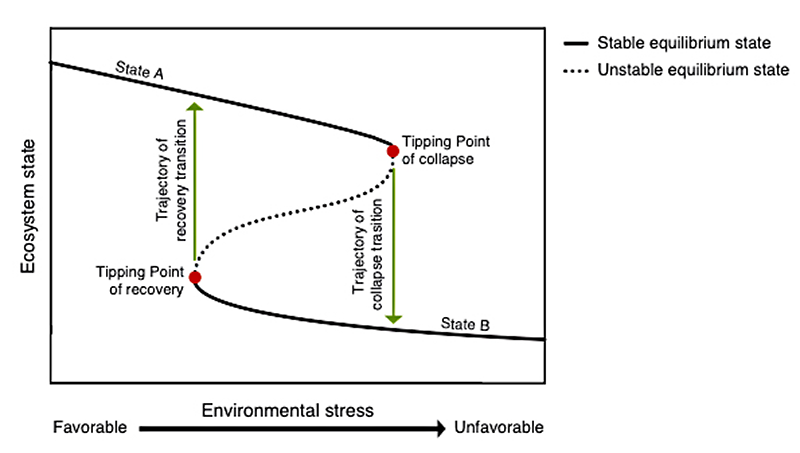
Tipping points in ecological theory: When environmental conditions are favourable (i.e. low environmental stress) the ecosystem is in the upper branch (state A). If conditions gradually deteriorate, the ecosystem follows the stable equilibrium line until conditions exceed the tipping point of collapse. At this point a slight increment in environmental stress causes the ecosystem to experience an abrupt regime shift to the lower branch (state B). Once the ecosystem tips, to restore the ecosystem state, it is not sufficient to reduce environmental stress below tipping point of collapse, but to a much lower level of stress indicated by tipping point of recovery.
(Graphic: Eawag, Catalina Chaparro)
Evolution can delay ecosystem collapses
Although ecologists have studied how environmental changes driven by human activities have produced evolutionary changes in ecosystems, until now, researchers did not know how evolutionary processes influence ecosystem tipping points. In two recent studies, researchers at Eawag together with international partners found that evolution may play in our favor or against.
In one of these studies, they challenge the idea that ecosystem collapses occur when tipping points are exceeded. According to the findings, fast environmental changes, like those currently occurring, increase the probability of ecosystem collapses, even before tipping points are exceeded. However, if evolution can help the species to adapt to the changing conditions, the collapse could be delayed.
Evolution could therefore play in our side to delay ecosystem collapses, but for that, the speed at which species adapt is crucial. The faster the adaptation process is, the higher are the chances to prevent ecosystem collapses. Maintaining high genetic variability is critical to enable fast adaptation, and thus to prevent ecosystem collapses.
Nonetheless, the speed of adaptation has limits; hence, if environmental changes occur at a pace much faster than species’ adaptation limits, collapses are inevitable. So a deceleration of environmental changes is urgently needed to reduce this risk.
Evolution may delay ecosystem recovery
Once an ecosystem collapses, researchers found in the second study, evolution may delay ecosystem recovery. Based on ecological processes only, ecologists predict that once the environmental stressor is reduced below the tipping point of recovery (figure 2), the ecosystem should return to its pre-collapse state. For instance, if the nutrient concentration in a shallow lake is reduced to very low levels, the lake should quickly transition back to the clear-water state dominated by macrophytes. However, this may not be the case when evolution enables species to adapt to the conditions in the collapsed ecosystem. If the species become adapted to these conditions, the ecosystem may take a long time to return to the pre-collapse state after stressors are removed. Adaptation is a process that requires time, therefore the longer the ecosystem passes in the collapse state the further the adaptation advances. To avoid such adaptation to unwanted conditions, restoration activities, such as the reduction in nutrient input in lakes, should be implemented as early as possible in the collapsed ecosystem to increase the chances of recovery.
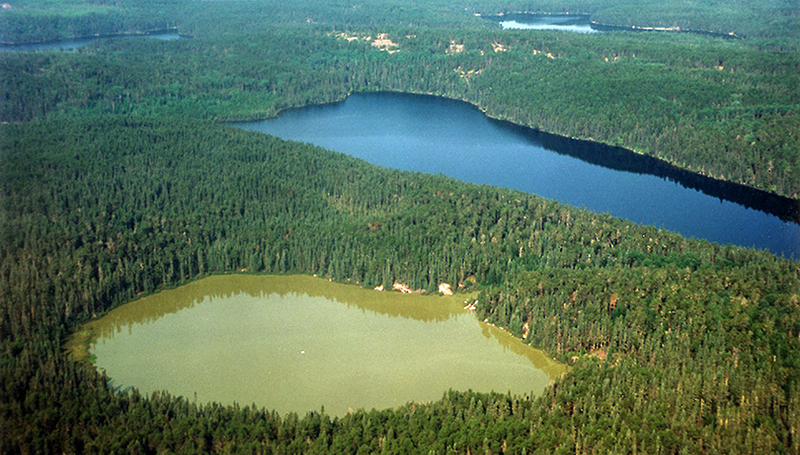
Cover Picture: International Institute for Sustainable Development IISD – Experimental Lakes Area ELA, Kanada
Original publications
Chaparro-Pedraza, C., Matthews, B., de Meester, L., Dakos, V. (2021). Adaptive evolution can both prevent ecosystem collapse and delay ecosystem recovery. The American Naturalist. https://doi.org/10.1086/716929
Funding / Cooperations
- FWO Support grant
- KU Leuven Research Fund
- Laboratory of Aquatic Ecology, Evolution and Conservation, KU Leuven, Leuven, Belgium
- Leibniz Institut für Gewasserökologie und Binnenfischerei (IGB), Berlin, Germany
- Institute of Biology, Freie Universität Berlin, Berlin, Germany
- Institute des Sciences de l’Évolution, Université de Montpellier, CNRS, IRD, EPHE, Montpellier,France.