News Detail

Using noble gases to track groundwater flows

November 9, 2023 | Andri Bryner

Over the next 20 years, Austria and Switzerland will be investing more than CHF 1.4 billion in flood protection and ecological enhancement measures on the Alpine Rhine. As well as protecting the Rhine valley against flooding, the aim is to promote careful management of groundwater resources. With a new method, scientists from Eawag and the University of Neuchâtel are providing support for International Rhine Regulation planners.

80 per cent of Switzerland’s drinking water is sourced from groundwater. Many important wells are to be found along the major rivers. If rivers are dammed for hydropower production or are modified by flood protection or ecological enhancement measures, this may affect the flow paths and the residence time of water underground between the river and the pumping station. There are concerns, for example, that excessive river water may suddenly infiltrate into the subsurface and then rapidly make its way to drinking water wells. The time taken by surface water to pass through the sandy‑gravelly substrate could then be too short to ensure adequate purification.

Complex investigations

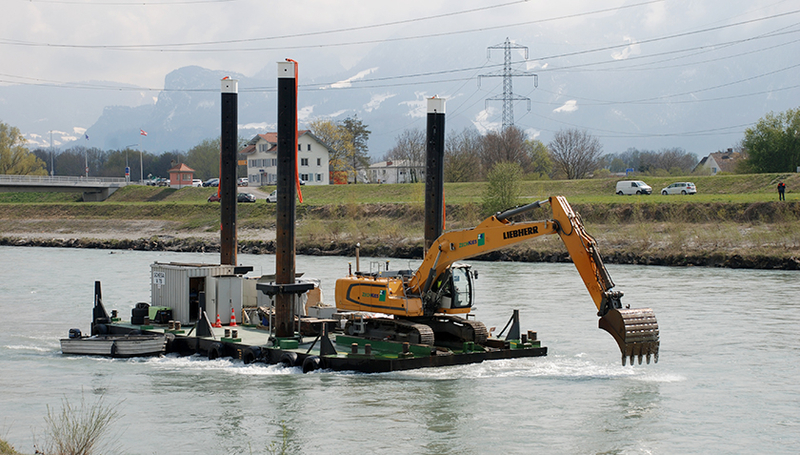
Determining where river water enters groundwater (or vice versa), and how much reaches a given well, how quickly, by what flow paths, is a complex matter. This is not only because what happens underground is obviously not visible but also because geological and hence physical conditions can vary almost metre by metre. Hydraulic models – such as that of the Alpine Rhine constructed on a scale of 1:50 in an old factory building at Dornbirn (Austria) – cannot replicate groundwater processes. There are also limits to what can be determined by computer modelling. Field studies are thus essential. On a short section of the Alpine Rhine, the riverbed was therefore excavated by a dredger in order to investigate what may happen when a heavily channelised river is widened.
 

Video on the portable mass spectrometer (GE-MIMS, “miniRuedi”) used for gas analysis on the Alpine Rhine.

Noble gases used instead of dyes or salt

In the past, such experiments involved injecting fluorescent dyes or adding large amounts of salt to river water. Based on dilution levels, it was then possible to calculate how much river water was flowing into pumping stations via groundwater, and how quickly. For some years now – as an alternative to dye or salt tracers – Eawag has been studying the use of small amounts of dissolved noble gases (e.g. helium, krypton or xenon) in river water and in some cases also in groundwater. Using a highly sensitive portable mass spectrometer also developed at Eawag (the GE-MIMS or “miniRuedi”), concentrations in pumped groundwater can be measured directly on-site, and travel times and relative proportions can be calculated.
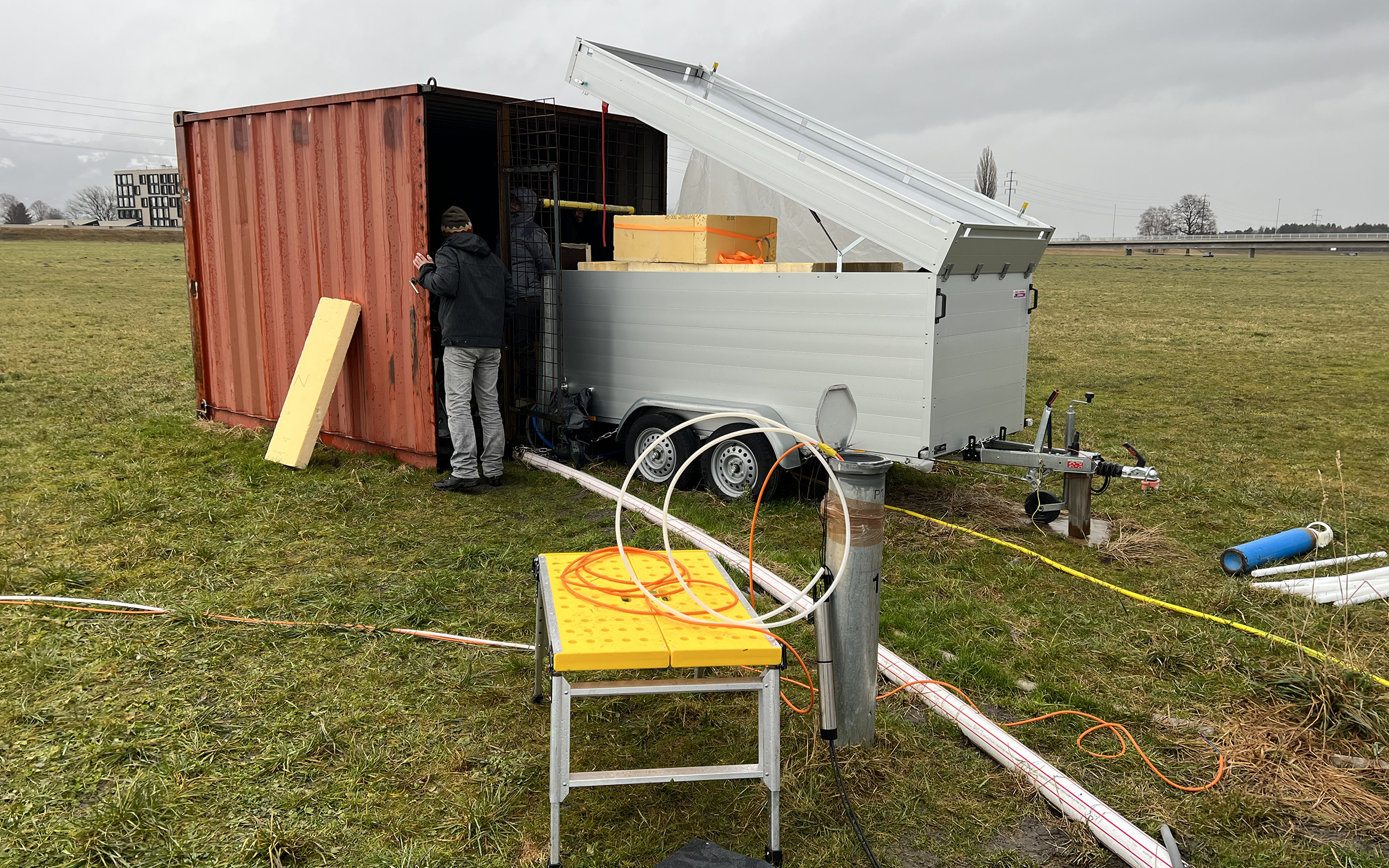
 

The groundwater was pumped up and analysed at such wells on the foreland.
(Photo: Int. Rhine regulation)

Several advantages

The new method offers several advantages: firstly, noble gases are not contaminants – they do not affect the odour, taste or biological activity of water. Secondly, water can be labelled with different gases simultaneously at different sites, and the measurements can then be used to study more complex situations. Thirdly, thanks to the mobile mass spectrometer, analysis is extremely rapid. It runs virtually in real time, with no need for samples to be transported and processed at a laboratory.

Healing of gashes over time

In tests carried out on the Alpine Rhine, labelling of water with noble gases proved effective. As reported in an article published in the journal Frontiers in Water, the results were consistent with those obtained in parallel experiments using dye tracers. In addition, the measurements performed over a period of more than half a year showed that the initial changes resulting from excavation of the river bed disappear over time, as large cavities are once again filled with fine material.
 

New applications for mobile gas analysis

Labelling of fluids with noble gases and rapid analysis during ongoing geochemical or geophysical processes opens up new possibilities in addition to groundwater monitoring. In a study just published in Nature, scientists from Eawag and other institutions describe how this method was used to study the migration of CO2–enriched fluid injected into deep rock strata. CO2 capture and storage (also known as CO2 sequestration) is widely regarded as an option for permanently removing this greenhouse gas from the atmosphere. If it is be effective, however, there must be no leakage through the overlying layer (cap rock). This can be monitored with the aid of in situ gas analysis.

Cover picture: A dredger excavates the river bed on the Alpine Rhine so that changes in groundwater flows can be observed. (Photo: Matthias Brennwald, Eawag)
 

Original articles

Extbase Variable Dump
array(3 items)
   publications => '32037,25085' (11 chars)
   libraryUrl => '' (0 chars)
   layout => '0' (1 chars)
Extbase Variable Dump
array(2 items)
   0 => Snowflake\Publications\Domain\Model\Publicationprototypepersistent entity (uid=32037, pid=124)
      originalId => protected32037 (integer)
      authors => protected'Weber, U. W.; Rinaldi, A. P.; Roques, C.; Wenning,&
         nbsp;Q. C.; Bernasconi, S. M.; Brennwald, M. S.; Ja
         ggi, M.; Nussbaum, C.; Schefer, S.; Mazzotti, M.; Wiemer
         , S.; Giardini, D.; Zappone, A.; Kipfer, R.
' (291 chars) title => protected'In-situ experiment reveals CO<sub>2</sub> enriched fluid migration in faulte
         d caprock
' (85 chars) journal => protected'Scientific Reports' (18 chars) year => protected2023 (integer) volume => protected13 (integer) issue => protected'1' (1 chars) startpage => protected'17006 (14 pp.)' (14 chars) otherpage => protected'' (0 chars) categories => protected'' (0 chars) description => protected'The sealing characteristics of the geological formation located above a CO<s
         ub>2</sub> storage reservoir, the so-called caprock, are essential to ensure
          efficient geological carbon storage. If CO<sub>2</sub> were to leak through
          the caprock, temporal changes in fluid geochemistry can reveal fundamental
         information on migration mechanisms and induced fluid–rock interactions. H
         ere, we present the results from a unique in-situ injection experiment, wher
         e CO<sub>2</sub>-enriched fluid was continuously injected in a faulted capro
         ck analogue. Our results show that the CO<sub>2</sub> migration follows comp
         lex pathways within the fault structure. The joint analysis of noble gases,
         ion concentrations and carbon isotopes allow us to quantify mixing between i
         njected CO<sub>2</sub>-enriched fluid and resident formation water and to de
         scribe the temporal evolution of water–rock interaction processes. The res
         ults presented here are a crucial complement to the geophysical monitoring a
         t the fracture scale highlighting a unique migration of CO<sub>2</sub> in fa
         ult zones.
' (1074 chars) serialnumber => protected'2045-2322' (9 chars) doi => protected'10.1038/s41598-023-43231-6' (26 chars) uid => protected32037 (integer) _localizedUid => protected32037 (integer)modified _languageUid => protectedNULL _versionedUid => protected32037 (integer)modified pid => protected124 (integer)
1 => Snowflake\Publications\Domain\Model\Publicationprototypepersistent entity (uid=25085, pid=124) originalId => protected25085 (integer) authors => protected'Brennwald,&nbsp;M.&nbsp;S.; Peel,&nbsp;M.; Blanc,&nbsp;T.; Tomonaga,&nbsp;Y.
         ; Kipfer,&nbsp;R.; Brunner,&nbsp;P.; Hunkeler,&nbsp;D.
' (130 chars) title => protected'New experimental tools to use noble gases as artificial tracers for groundwa
         ter flow
' (84 chars) journal => protected'Frontiers in Water' (18 chars) year => protected2022 (integer) volume => protected4 (integer) issue => protected'' (0 chars) startpage => protected'925294 (8 pp.)' (14 chars) otherpage => protected'' (0 chars) categories => protected'hydrogeology; recharge; groundwater test; travel time; dating; flow line' (72 chars) description => protected'Labeling groundwater by injecting an artificial tracer is a standard and wid
         ely used method to study groundwater flow systems. Noble gases dissolved in
         groundwater are potentially ideal artificial tracers, as they are not subjec
         t to biogeochemical transformations, do not adsorb onto the aquifer matrix,
         are colorless, and have no negative impact on the quality of groundwater res
         ources. In addition, combining different noble-gas species in multi-tracer t
         ests would allow direct analysis of the spatio-temporal heterogeneity of gro
         undwater flow systems. However, while the handling of noble gases is safe an
         d straightforward for injection into groundwater, conventional methods to an
         alyse dissolved noble gases tend to be impractical for groundwater tracer te
         sts. The sampling and subsequent lab-based analysis of dissolved noble gases
          are laborious, expensive and time intensive. Therefore, only researchers wi
         th access to specialized noble-gas labs have attempted such tracer tests. Th
         e recently developed gas-equilibrium membrane-inlet mass spectrometers (GE-M
         IMS) allow efficient on-site analysis of dissolved gases at high temporal re
         solution. The GE-MIMS instruments thereby eliminate most of the analytical a
         nd logistical constraints of conventional lab-based techniques and therefore
          provide new opportunities for groundwater tests using artificially injected
          gases. We used a GE-MIMS to systematically test the applicability of He, Kr
         , and Xe as artificial groundwater tracers. These gas species were injected
         into groundwater as Dirac-like pulses at three piezometers located at variou
         s locations upstream of a pumping well, where dissolved gas concentrations w
         ere continuously monitored with the GE-MIMS instrument. The groundwater trav
         el times observed in these tracer tests ranged from a few hours to several w
         eeks, and were consistent with the groundwater flow field at the experimenta
         l test site. Travel times determined from the noble gas tracer tests were al
         so consistent with those...
' (2034 chars) serialnumber => protected'' (0 chars) doi => protected'10.3389/frwa.2022.925294' (24 chars) uid => protected25085 (integer) _localizedUid => protected25085 (integer)modified _languageUid => protectedNULL _versionedUid => protected25085 (integer)modified pid => protected124 (integer)
Weber, U. W.; Rinaldi, A. P.; Roques, C.; Wenning, Q. C.; Bernasconi, S. M.; Brennwald, M. S.; Jaggi, M.; Nussbaum, C.; Schefer, S.; Mazzotti, M.; Wiemer, S.; Giardini, D.; Zappone, A.; Kipfer, R. (2023) In-situ experiment reveals CO2 enriched fluid migration in faulted caprock, Scientific Reports, 13(1), 17006 (14 pp.), doi:10.1038/s41598-023-43231-6, Institutional Repository
Brennwald, M. S.; Peel, M.; Blanc, T.; Tomonaga, Y.; Kipfer, R.; Brunner, P.; Hunkeler, D. (2022) New experimental tools to use noble gases as artificial tracers for groundwater flow, Frontiers in Water, 4, 925294 (8 pp.), doi:10.3389/frwa.2022.925294, Institutional Repository