News Detail

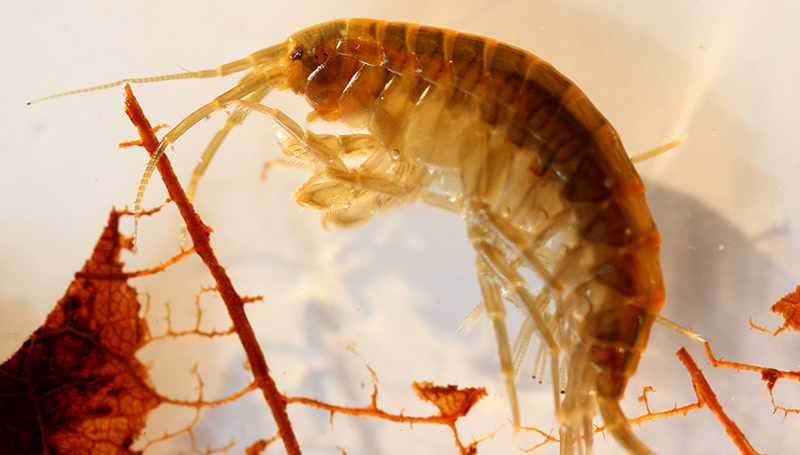
Surprising discovery of pollutants in gammarids

December 3, 2018 | Mirella Wepf, Stephanie Schnydrig

Amphipods in Swiss waters are exposed to insecticides, pharmaceutical residues and other trace substances, and accumulate these in their bodies. However, when water-treatment plants are upgraded, practically no trace substances are found in these organisms according to a new study carried out by Eawag researchers.

The water in Swiss streams is contaminated with numerous micropollutants. However, very little research has been carried out to determine how these trace substances affect organisms in bodies of water. An Eawag research group has been able to show for the first time on a large scale that such trace substances accumulate in gammarids and possibly have a negative effect on them.

“Because the trace substances are highly diluted, we didn’t know at the start whether we would find them at all in the gammarids,” says Juliane Hollender, head of the Environmental Chemistry department at Eawag. But her doctoral student Nicole Munz used innovative measuring methods and found a whole cocktail of substances in the organisms. Munz deployed a tried and tested method for detecting substances in fish, as well as methods from food analysis.

Encouraging data from Herisau

As part of the international EU “Solutions” project and Eawag’s “EcoImpact” research programme (see box), Munz took water samples above and below 13 water-treatment plants (WTP) and collected gammarids. Munz extracted 63 different substances from the animals she removed from around the WTPs. The samples above the WTP discharge sites contained four substances on average, while those below the WTPs contained an average of 14.
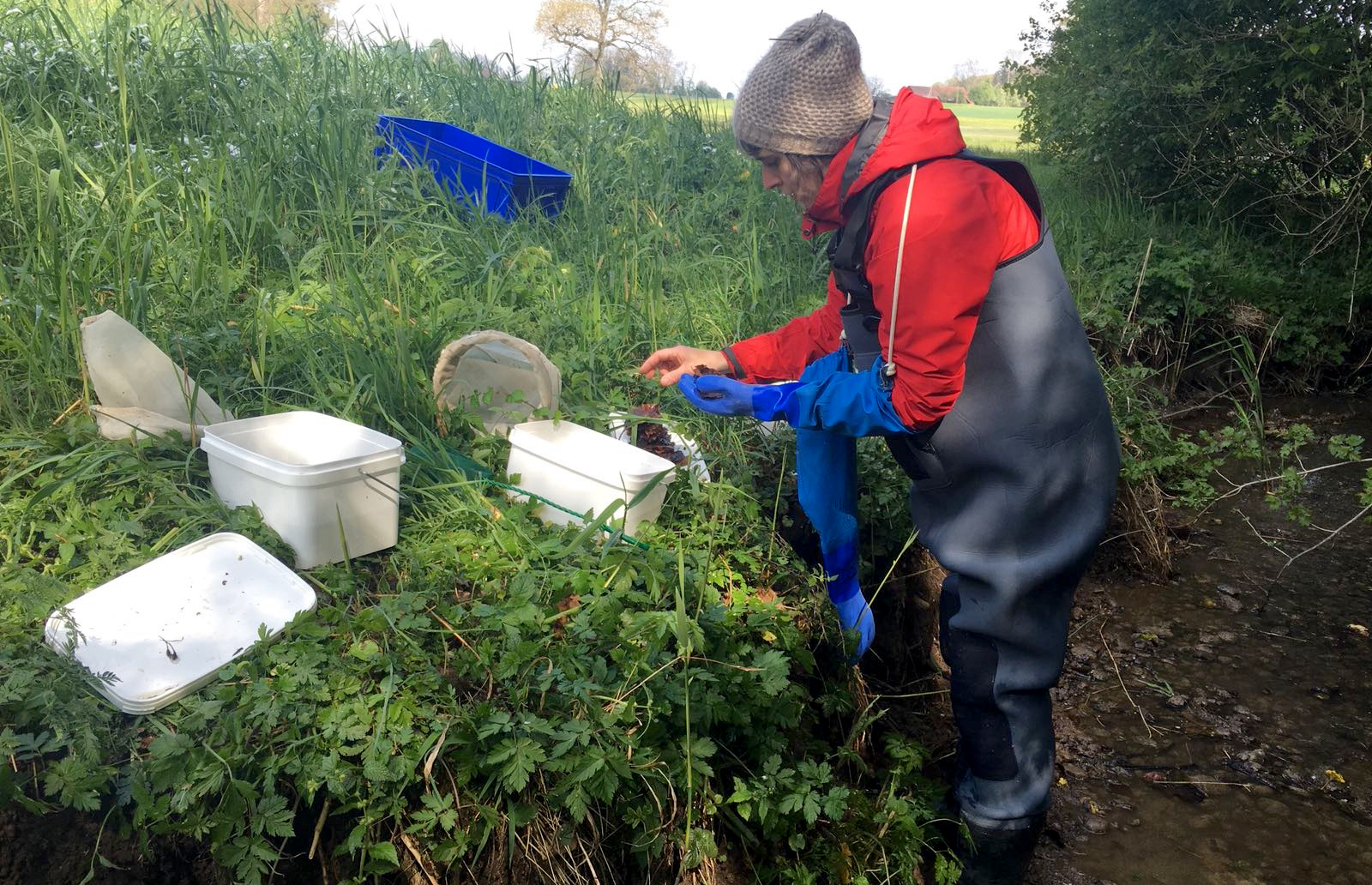
Nicole Munz taking samples in the Itziker Ried. The researcher found unaffected gammarids in these nearly natural waters for her comparative study of artificial channel systems.
(Photo: Eawag, Qiuguo Fu)

The case of the Herisau WTP was particularly interesting. During Munz’s research work this was upgraded with an additional purifying stage designed to eliminate micropollution. The findings showed that before the upgrade, one gram of gammarids contained nearly forty nanograms of trace substances, whereas afterwards none could be detected. “This result is very encouraging,” says Hollender, as the Swiss Water Protection Act calls for an additional purifying stage in about a hundred WTPs. 
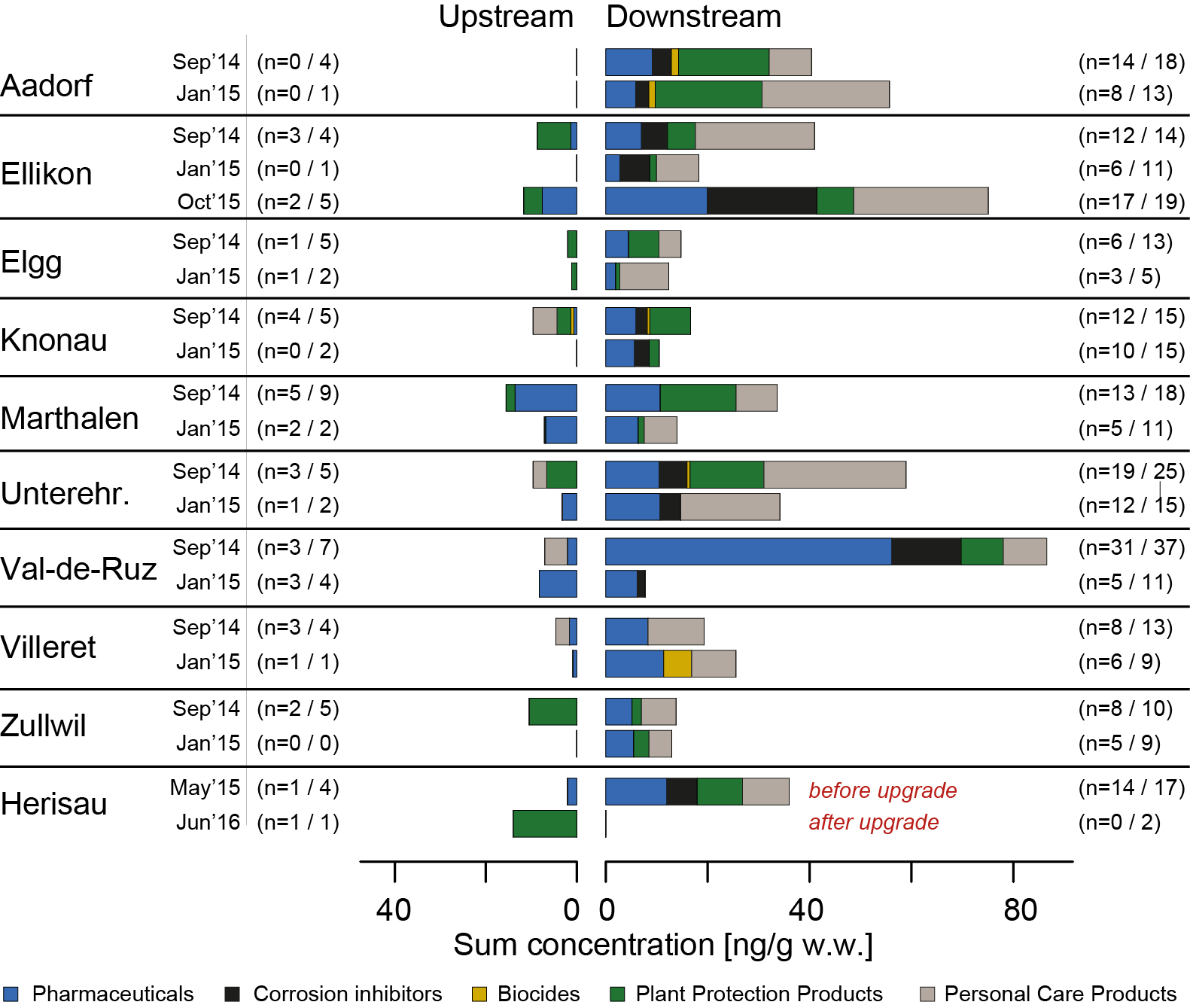
The graph shows how many nanograms of trace substances are found in one gram of gammarid, with the trace substance concentration markedly higher below the WTP outflows than above. Notably, during the period of research the Herisau WTP acquired an additional purifying stage. After the upgrade no micropollutatnts were found in the gammarids. 

Graph: Eawag/Nicole Munz, impression with the kind permission of Environmental Science & Technology.

Insecticides with toxic effects

The substances found most often in the gammarids were the antidepressant Citalopram, the UV filter Benzophenon, the metal-corrosion protection agent Benzotriazol and the insecticide Thiacloprid. The latter substance is known to have a toxic effect on gammarids and other invertebrates.

In addition to Thiacloprid, Munz found three other insecticides: Imidacloprid, Acetamiprid und Clodthianidin. Although these were only present in the water samples in low concentrations, or not at all, they were surprisingly prevalent the gammarids – indicating that the organisms accumulate the substances in their bodies.

In order to gain a more precise understanding of this accumulation process, Munz collected additional gammarids in nearly natural, uncontaminated waters. She placed the animals in an artificial channel system in order to ascertain how many trace substances would be accumulated by the gammarids within one month. Using this experiment with semi-realistic conditions she obtained data comparative to the field samples and thus gained a better understanding of the accumulation process.

The results do not, however, explain how the significant accumulation of insecticides in the gammarids arises. Juliane Hollender intends to investigate this question through further research. “It is possible that the gammarids take in these materials not only through water but also in their food,” says Hollender. “They eat fallen autumn leaves, for example, which could also be a factor.” For this reason, so-called biomonitoring, which measures the accumulation of substances in living things, becomes ever more important in aquatic risk management. According to Hollender the method developed by Munz is a major factor in showing how water pollution affects organisms.

The EcoImpact research project

With the decision to upgrade around 100 water-treatment plants with an additional purification stage for eliminating micropollution, Switzerland is an international pioneer in the water protection field. The move offers researchers a unique opportunity to investigate and compare the effects of these trace substances on aquatic ecosystems.

EcoImpact records molecular, physiological and ecological parameters in 24 selected stretches of streams in the Swiss Central Plateau and in the Jura. In parallel, the researchers are studying the effects of micropollution in controlled experiments using an experimental system with flumes in which micropollutants can be selectively added to the water. It is hoped that EcoImpact will provide clarity on what particular effects micropollutants have on aquatic ecosystems. In additions, studies are being carried out to ascertain whether different types of micropollution have different effects.

Publication

Extbase Variable Dump
array(2 items)
   publications => '17474' (5 chars)
   libraryUrl => '' (0 chars)
Extbase Variable Dump
array(1 item)
   0 => Snowflake\Publications\Domain\Model\Publicationprototypepersistent entity (uid=17474, pid=124)
      originalId => protected17474 (integer)
      authors => protected'Munz, N. A.; Fu, Q.; Stamm, C.; Hollender, J.' (70 chars)
      title => protected'Internal concentrations in gammarids reveal increased risk of organic microp
         ollutants in wastewater-impacted streams
' (116 chars) journal => protected'Environmental Science and Technology' (36 chars) year => protected2018 (integer) volume => protected52 (integer) issue => protected'18' (2 chars) startpage => protected'10347' (5 chars) otherpage => protected'10358' (5 chars) categories => protected'' (0 chars) description => protected'Internal concentrations link external exposure to the potential effect, as t
         hey reflect what the organisms actually take up and experience physiological
         ly. In this study, we investigated whether frequently detected risk-driving
         substances in water were found in the exposed organisms and if they are clas
         sified the same based on the whole body internal concentrations. Field gamma
         rids were collected upstream and downstream of ten wastewater treatment plan
         ts in mixed land use catchments. The sampling was conducted in autumn and wi
         nter, during low flow conditions when diffuse agricultural input was reduced
         . The field study was complemented with laboratory and flume experiments to
         determine the bioaccumulation potentials of selected substances. For 32 subs
         tances, apparent bioaccumulation factors in gammarids were determined for th
         e first time. With a sensitive multiresidue method based on online-solid pha
         se extraction followed by liquid chromatography coupled to high resolution m
         ass spectrometry, we detected 63 (semi-) polar organic substances in the fie
         ld gammarids, showing higher concentrations downstream than upstream. Intere
         stingly, neonicotinoids, which are particularly toxic toward invertebrates,
         were frequently detected and were further determined as major contributors t
         o the toxic pressure based on the toxic unit approach integrating internal c
         oncentration and toxic potency. The total toxic pressure based on internal c
         oncentrations was substantially higher compared to when external concentrati
         ons were used. Thus, internal concentrations may add more value to the curre
         nt environmental risk assessment that is typically based solely on external
         exposure.
' (1681 chars) serialnumber => protected'0013-936X' (9 chars) doi => protected'10.1021/acs.est.8b03632' (23 chars) uid => protected17474 (integer) _localizedUid => protected17474 (integer)modified _languageUid => protectedNULL _versionedUid => protected17474 (integer)modified pid => protected124 (integer)
Munz, N. A.; Fu, Q.; Stamm, C.; Hollender, J. (2018) Internal concentrations in gammarids reveal increased risk of organic micropollutants in wastewater-impacted streams, Environmental Science and Technology, 52(18), 10347-10358, doi:10.1021/acs.est.8b03632, Institutional Repository

Further publication

Preliminary study by Nicole Munz, in which she shows that pesticides present the greatest risk for gammarids in comparison with other micropollutants in water.

Extbase Variable Dump
array(3 items)
   user => '' (0 chars)
   publications => '14051' (5 chars)
   libraryUrl => '' (0 chars)
Extbase Variable Dump
array(1 item)
   0 => Snowflake\Publications\Domain\Model\Publicationprototypepersistent entity (uid=14051, pid=124)
      originalId => protected14051 (integer)
      authors => protected'Munz, N. A.; Burdon, F. J.; de Zwart, D.; Junghans,
          M.; Melo, L.; Reyes, M.; Schönenberger, U.; Singer,&nb
         sp;H. P.; Spycher, B.; Hollender, J.; Stamm, C.
' (219 chars) title => protected'Pesticides drive risk of micropollutants in wastewater-impacted streams duri
         ng low flow conditions
' (98 chars) journal => protected'Water Research' (14 chars) year => protected2017 (integer) volume => protected110 (integer) issue => protected'' (0 chars) startpage => protected'366' (3 chars) otherpage => protected'377' (3 chars) categories => protected'pesticides; pharmaceuticals; wastewater treatment plants; mixture toxicity;
         multi-substance potentially affected fraction (msPAF); risk assessment
' (146 chars) description => protected'Micropollutants enter surface waters through various pathways, of which wast
         ewater treatment plants (WWTPs) are a major source. The large diversity of m
         icropollutants and their many modes of toxic action pose a challenge for ass
         essing environmental risks. In this study, we investigated the potential imp
         act of WWTPs on receiving ecosystems by describing concentration patterns of
          micropollutants, predicting acute risks for aquatic organisms and validatin
         g these results with macroinvertebrate biomonitoring data. Grab samples were
          taken upstream, downstream and at the effluent of 24 Swiss WWTPs during low
          flow conditions across independent catchments with different land uses. Usi
         ng liquid chromatography high resolution tandem mass spectrometry, a compreh
         ensive target screening of almost 400 organic substances, focusing mainly on
          pesticides and pharmaceuticals, was conducted at two time points, and compl
         emented with the analysis of a priority mixture of 57 substances over eight
         time points. Acute toxic pressure was predicted using the risk assessment ap
         proach of the multi-substance potentially affected fraction, first applying
         concentration addition for substances with the same toxic mode of action and
          subsequently response addition for the calculation of the risk of the total
          mixture. This toxic pressure was compared to macroinvertebrate sensitivity
         to pesticides (SPEAR index) upstream and downstream of the WWTPs. The concen
         trations were, as expected, especially for pharmaceuticals and other househo
         ld chemicals higher downstream than upstream, with the detection frequency o
         f plant protection products upstream correlating with the fraction of arable
          land in the catchments. While the concentration sums downstream were clearl
         y dominated by pharmaceuticals or other household chemicals, the acute toxic
          pressure was mainly driven by pesticides, often caused by the episodic occu
         rrence of these compounds even during low flow conditions. In general, five
         single substances explai...
' (2427 chars) serialnumber => protected'0043-1354' (9 chars) doi => protected'10.1016/j.watres.2016.11.001' (28 chars) uid => protected14051 (integer) _localizedUid => protected14051 (integer)modified _languageUid => protectedNULL _versionedUid => protected14051 (integer)modified pid => protected124 (integer)
Munz, N. A.; Burdon, F. J.; de Zwart, D.; Junghans, M.; Melo, L.; Reyes, M.; Schönenberger, U.; Singer, H. P.; Spycher, B.; Hollender, J.; Stamm, C. (2017) Pesticides drive risk of micropollutants in wastewater-impacted streams during low flow conditions, Water Research, 110, 366-377, doi:10.1016/j.watres.2016.11.001, Institutional Repository