
News Detail
![[Translate to English:] Wärmetauscher, der z.B. im Ablauf einer Dusche dem Abwasser Wärme entzieht. (Foto: Joulia SA)](/fileadmin/_processed_/4/6/csm_teaser_58f19c873b.jpg "[Translate to English:] Wärmetauscher, der z.B. im Ablauf einer Dusche dem Abwasser Wärme entzieht. (Foto: Joulia SA)")
Reusing shower water
September 9, 2021 |
Waste water is not simply dirty water to be disposed of as expediently as possible. “It is replete with useful resources,” says Bruno Hadengue, “and so waste water treatment plants are expected to become increasingly part of the recycling economy.” Hadengue is a researcher in Eawag’s Urban Water Management Department, and has just successfully completed his PhD. For his dissertation he investigated the use of waste water as a heat source. And for good reason: Around 15 percent of a building's energy consumption goes to produce hot water – which then ends up as waste water.
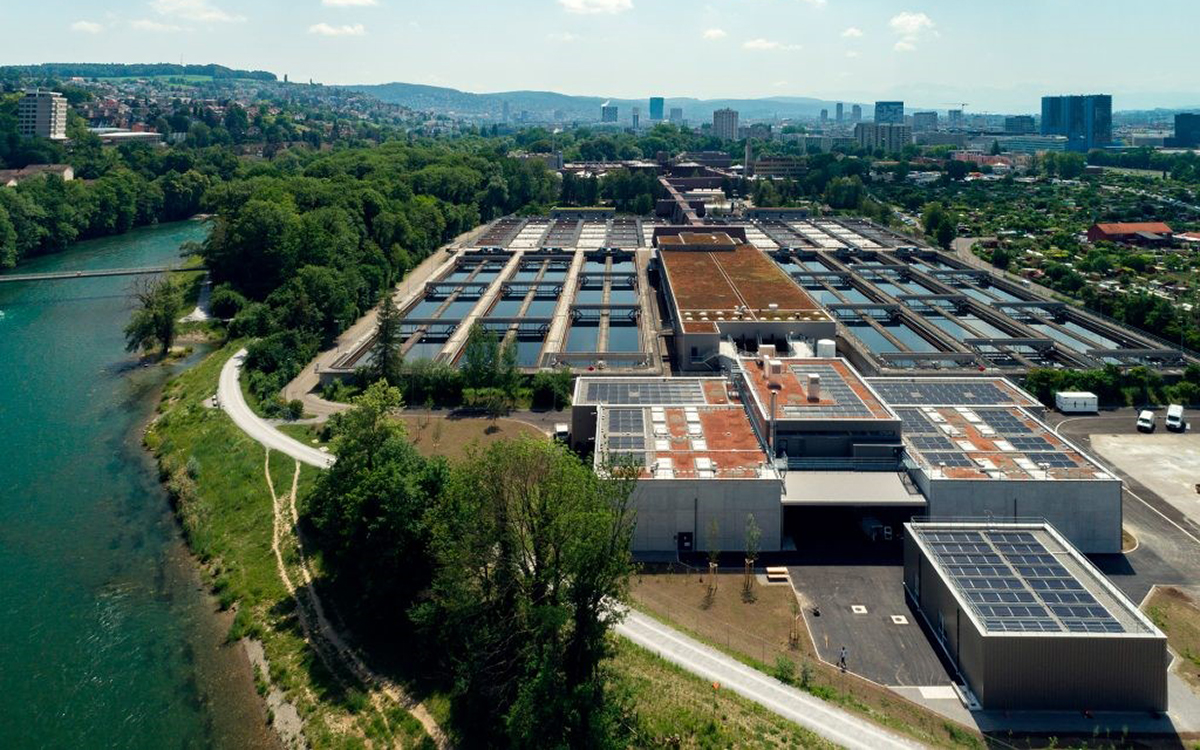
Waste water treatment plants (such as the Werdholzli treatment plant shown in the photo) have great potential for energy recovery. The heat recovered from the treated waste water is fed into a district heating network.
(Image: ERZ)
Waste water an increasingly important heat source
In some waste water treatment plants, heat has long been recovered from grey water and then fed into a district heating network. One such example is the City of Zurich's Werdhölzli waste water treatment plant. The use of waste water as a heat source will continue to gain in importance: the Verband Fernwärme Schweiz (Swiss District Heating Association) estimates that around 11 percent of the total potential renewable heating sources for district heating will come from waste water treatment plants.
Not under 10°C
In a study published in the journal “Water Research”, Bruno Hadengue and his co-authors evaluate the ideal point at which to recover heat from waste water on its journey from the plumbing installations in buildings to the waste water treatment plant. The question is significant, because overcooled water can have a negative impact on the biological breakdown processes in the waste water treatment plant. For this reason, heat recovery from waste water is only permitted in Switzerland if it is not cooled below 10°C. This is a restriction that may well prove to be a problem in winter.
Data from the Fehraltdorf waste water network
For his study, Bruno Hadengue developed a chain of models which can be deployed to carry out thermo-hydraulic simulations of households, domestic pipe connections and the public waste water network. Using actual data from the waste water network in Fehraltdorf, collected as part of the Eawag Urban Water Observatory (UWO) project, the researchers created a reference scenario to be used for comparison with the simulated scenarios. “Our aim is to evaluate the consequences of alternative energy technologies on the waste water system”, explains Bruno Hadengue. “In the long term we want to show exactly what happens at what point in the system when heat is recovered”.
Insignificant effects
The results obtained so far from the study are clear: Systems that recover heat within households, for example from a shower drain channel (e.g. the Joulia system, which is already available commercially), have an insignificant effect on the temperature of the waste water. On the other hand, systems installed directly in the sewer system do have an impact. Such heat recovery installations come into their own where the sewer system is close to a district heating network. This can avoid wasteful transit distances.
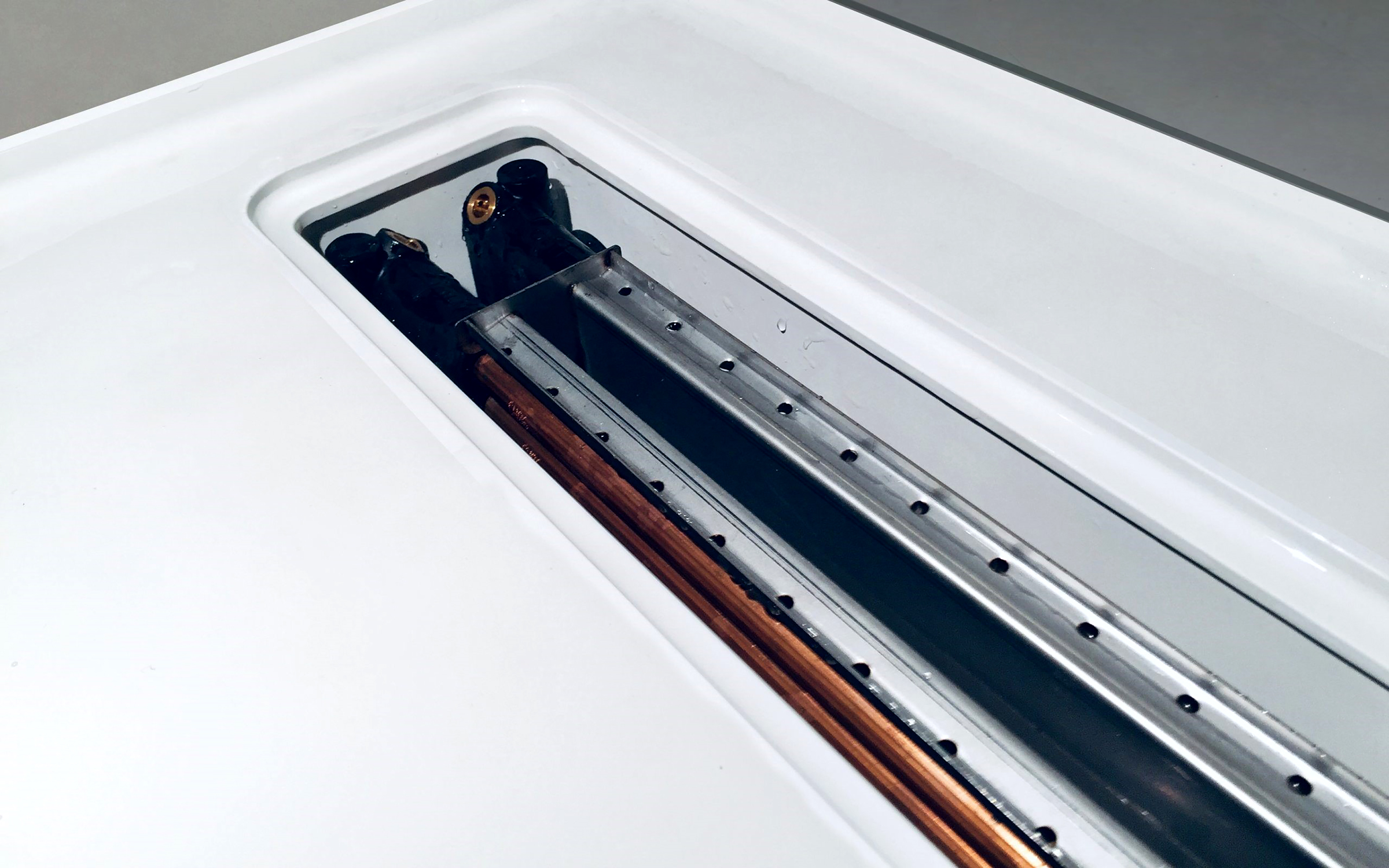
Heat recovery directly in the household – for example using heat exchangers in a shower drain channel – is efficient and does not present a challenge to the waste water treatment plant.
(Image: Joulia SA)
Reducing losses in domestic waste water systems
The reason why heat recovery within the household is a good idea comes down to the domestic pipes, in other words, the domestic portion of the sewer system as far as the bigger pipes on public land. A great deal of energy dissipates in these sections, as the waste water is still warm and the pipes generally have unfavourable dimensions. Domestic plumbing connections therefore play a significant role in the waste water system as a whole. If, on the other hand, the energy is recovered within the household, the waste water leaves the house at a lower temperature. This also reduces the energy losses from the domestic pipes accordingly.
Eawag Directorate member Tove Larsen is a co-author of the paper, having supervised the study together with Frank Blumensaat. She emphasises the practical relevance of the new findings: “We now know that it is better to recover heat from waste water right in the household, and if not there, then after treatment in the waste water treatment plant. This minimises any possible negative impacts on the waste water treatment plant.”
Cover picture: Joulia SA
Original paper
This study was supported by InnoSuisse under the auspices of the Swiss Competence Center for Energy Research.