NAWA SPEZ

Investigations into pesticide contamination in surface waters
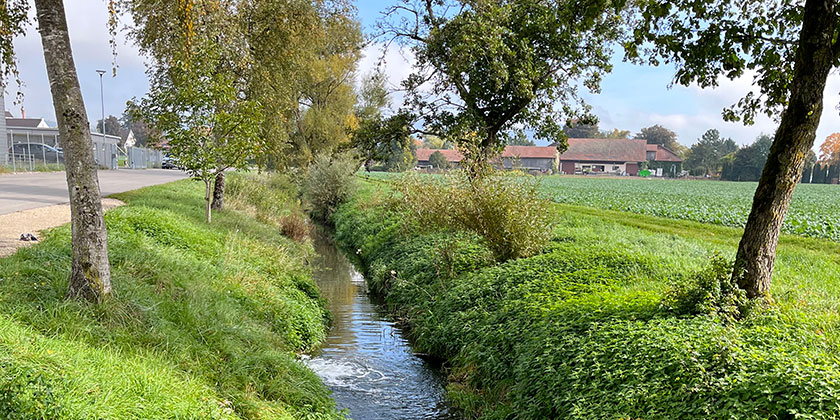
Pollution of our waters with organic micropollutants represents a challenge for water protection. The Federal Office for the Environment (FOEN) and the cantons have, together with the National Surface Water Quality Monitoring (NAWA), established a measurement programme to assess the status and development of pollution of Swiss surface waters. Special investigations are carried out on various aspects as part of this measurement programme. In 2012, 2015 and 2017, the type and extent of water pollution with biocides and plant protection products (PPPs) were investigated and assessed in three measurement campaigns.

Recent national and international studies have shown that in particular, pyrethroid and organophosphate insecticides, which are toxic to aquatic organisms, can have a negative impact on water quality, even at very low concentrations. For this reason, the federal government and the cantons have intensified measurements of these insecticides in Swiss waters in recent years. However, it is not yet fully understood to what extent other insecticides, and other active substances that have yet to be investigated in detail, occur in Swiss watercourses. In addition, it is not yet clear whether treated wastewater is a significant input pathway for these substances into water bodies. For this reason, a specific large-scale study will be carried out in 2023 at five locations in Switzerland (see overview map) to investigate as completely as possible a range of PPPs and biocides in agricultural and residential catchments for the duration of the project. In addition to the measurements in the watercourse, measurements will also be taken from treated wastewater of sewage treatment plants that discharge their wastewater into the watercourses of interest.

Locations NAWA Spez23
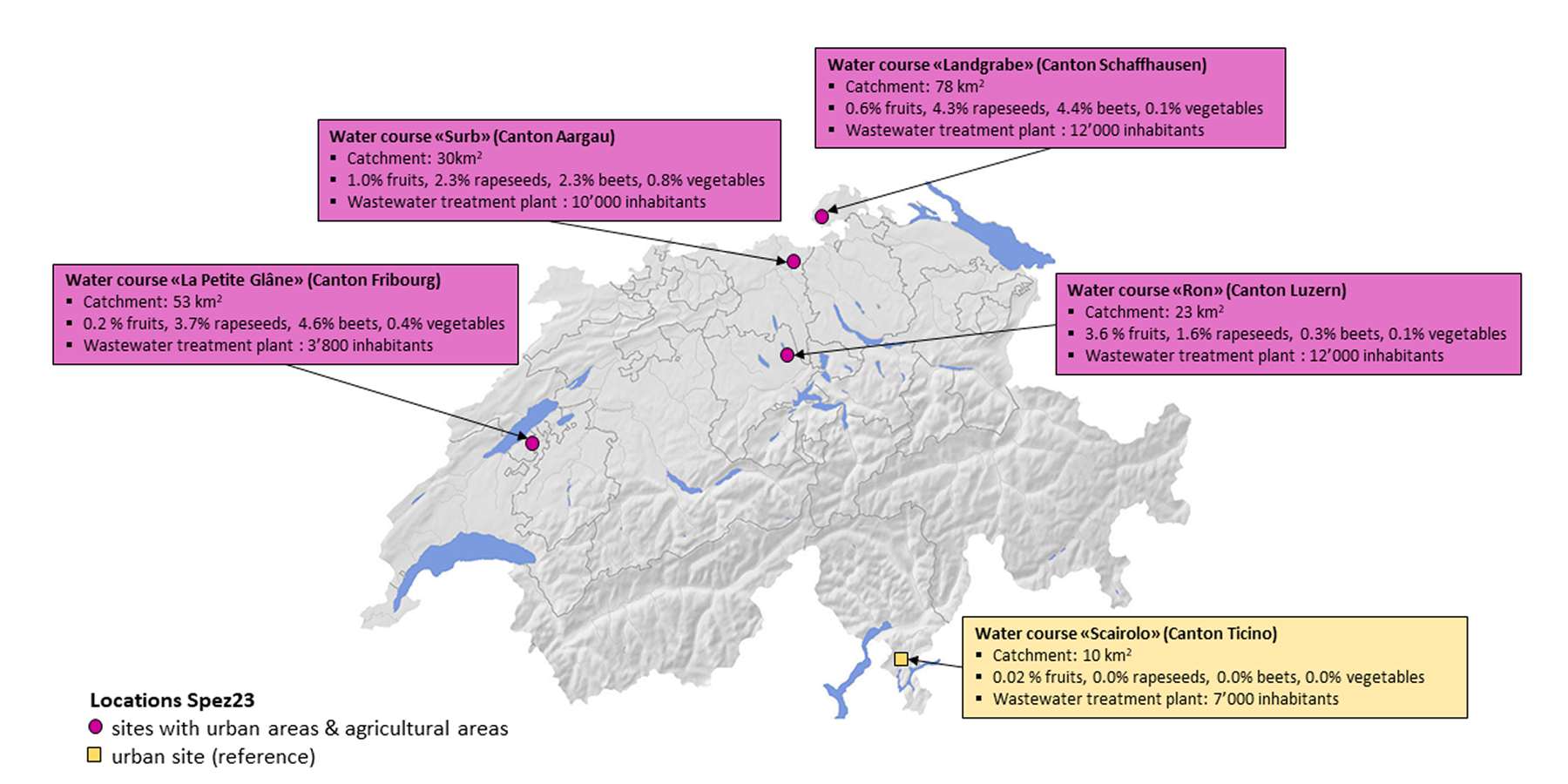
Map: Bundesamt für Landestopographie
catchment areas: BAFU 2019: Teileinzugsgebiete 2 km2
land use information: BAFU 2013: Gewässerabschnittsbasierte Einzugsgebietsgliederung der Schweiz
(GAB-EZGG-CH)
waste water treatment plan information: Kennzahlenerhebung Abwasserreinigung des Bundes, 2021

The goals of the NAWA Special Campaign 2023 are:

  • To determine as comprehensively as possible the pollution of small to medium-sized watercourses with plant protection products (PPPs) and biocides, especially insecticides
  • To investigate treated wastewater, in addition to diffuse inputs from agricultural land, as a possible input pathway for PPPs and biocides.

Together, these aims will provide information on the use of PPPs and biocides in agriculture and settlements. In particular, the focus on insecticidal active substances is intended to close observation gaps in the area of particularly toxic substances. To achieve this, firstly, complete sampling of the selected watercourses and sewage treatment plants will be carried out over the entire application period using two-week composite samples. Secondly, the latest trace analytical detection methods will be used for sensitive and comprehensive detection. The analytical methods used allow quantification in the low pg/L concentration range, and thus also enable detection of active substances that have a toxic effect on aquatic organisms, even at very low concentrations.

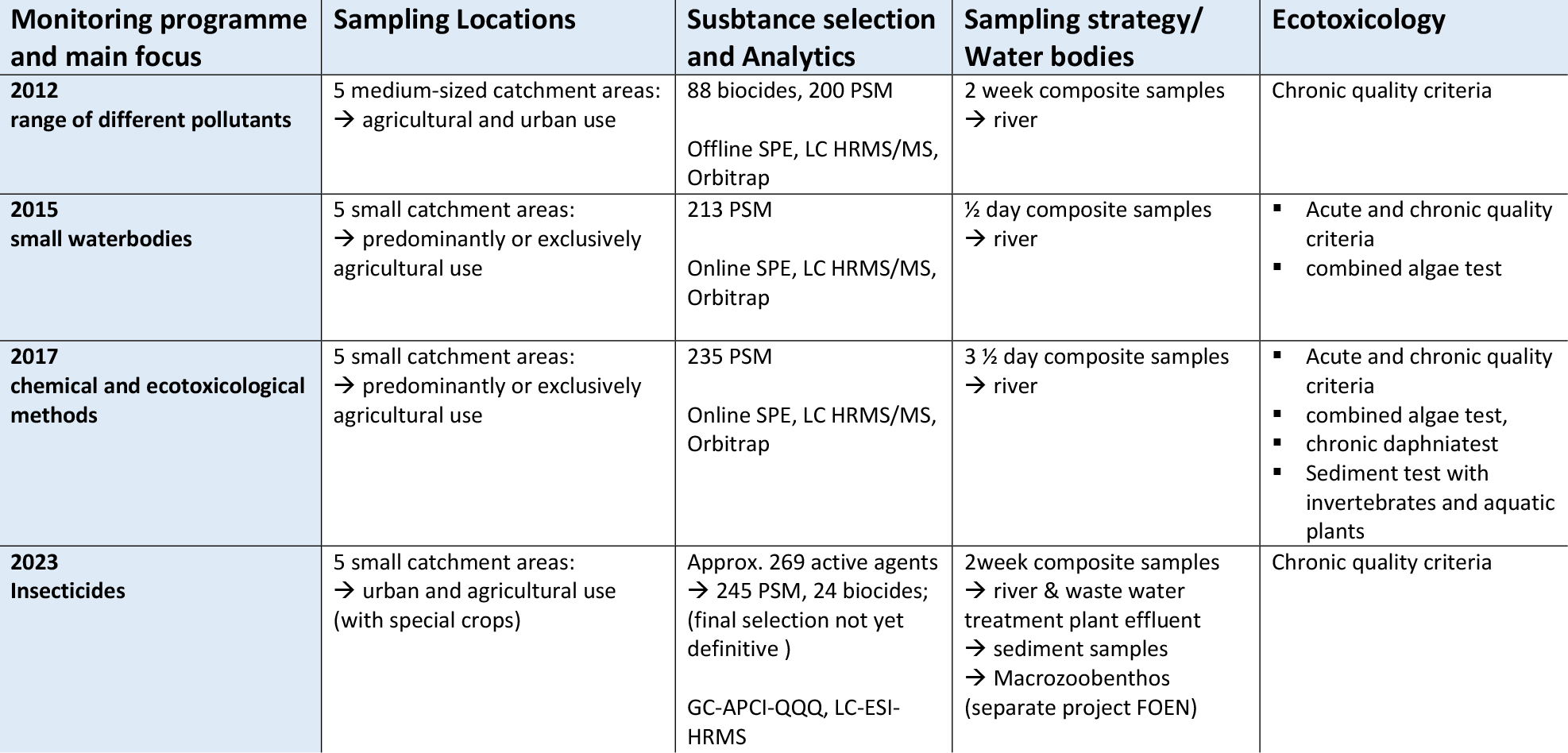
The following table summarises the focal points of all NAWA special studies carried out to date in the field of PPPs and biocides. The studies were conducted in close cooperation between Eawag, the cantons (via Cantonal Water Protection Agencies), the VSA, the Ecotox Centre and the FOEN, and are unique in their scope and depth. The assessment of the measurement results was carried out in each case on the basis of the valid legal requirements and ecotoxicologically derived quality criteria (QC).

Measurement campaigns and main focus
Publications

Extbase Variable Dump
array(3 items)
   publications => '35500,35502,35504' (17 chars)
   libraryUrl => '' (0 chars)
   layout => '0' (1 chars)
Extbase Variable Dump
array(3 items)
   0 => Snowflake\Publications\Domain\Model\Publicationprototypepersistent entity (uid=35500, pid=124)
      originalId => protected35500 (integer)
      authors => protected'Schorr, J.; Ganz, V.; Luong, K.; Ceppi, E.; Longree,&nbs
         p;P.; Beck, B.; Singer, H.; Barth, S.; Doppler, T.; Jung
         hans, M.; Holmes, B.
' (182 chars) title => protected'Pestizideinträge in Fliessgewässer. NAWA Spez 2023: Wirkstoffe, Ökotoxiko
         logisches Risiko, diffuse Eintragspfade vs. Einträge aus ARA
' (137 chars) journal => protected'Aqua & Gas' (10 chars) year => protected2025 (integer) volume => protected105 (integer) issue => protected'10' (2 chars) startpage => protected'70' (2 chars) otherpage => protected'78' (2 chars) categories => protected'' (0 chars) description => protected'Fünf Schweizer Fliessgewässer und die Ausläufe der einzigen Abwasserreini
         gungsanlage in ihren Einzugsgebieten wurden von März bis November 2023 auf
         Pestizide, mit Schwerpunkt auf Insektiziden, untersucht. Von 253 Substanzen
         wurden 135 nachgewiesen, wobei 23 – vor allem Insektizide – während meh
         rerer Wochen die ökotoxikologischen Qualitätskriterien überschritten. Die
          Einträge stammten sowohl diffus aus den Einzugsgebieten als auch punktuell
          aus den ARA.
' (469 chars) serialnumber => protected'2235-5197' (9 chars) doi => protected'' (0 chars) uid => protected35500 (integer) _localizedUid => protected35500 (integer)modified _languageUid => protectedNULL _versionedUid => protected35500 (integer)modified pid => protected124 (integer)
1 => Snowflake\Publications\Domain\Model\Publicationprototypepersistent entity (uid=35502, pid=124) originalId => protected35502 (integer) authors => protected'Barth, S.; Doppler, T.' (32 chars) title => protected'Ursachen der Pestizid-Verunreinigung. Mögliche Quellen und Eintragswege in
         Fliessgewässer eingrenzen
' (102 chars) journal => protected'Aqua & Gas' (10 chars) year => protected2025 (integer) volume => protected105 (integer) issue => protected'10' (2 chars) startpage => protected'80' (2 chars) otherpage => protected'88' (2 chars) categories => protected'' (0 chars) description => protected'Anhand schweizweiter Pestizidmessdaten sowie Angaben zu Verkaufsmengen von P
         
         
         hen Qualitätskriterien auf, welches die relevanten Anwendungen und Eintrags
         wege in Fliessgewässer sind.
' (333 chars) serialnumber => protected'2235-5197' (9 chars) doi => protected'' (0 chars) uid => protected35502 (integer) _localizedUid => protected35502 (integer)modified _languageUid => protectedNULL _versionedUid => protected35502 (integer)modified pid => protected124 (integer)
2 => Snowflake\Publications\Domain\Model\Publicationprototypepersistent entity (uid=35504, pid=124) originalId => protected35504 (integer) authors => protected'Barth, S.; Doppler, T.; Ganz, V.; Luong, K.; Singer,&nbs
         p;H.
' (80 chars) title => protected'Fipronil belastet die Fliessgewässer. Antiparasitäre Tierarzneimittel für
          Heimtiere als wahrscheinlichste Quelle
' (115 chars) journal => protected'Aqua & Gas' (10 chars) year => protected2025 (integer) volume => protected105 (integer) issue => protected'10' (2 chars) startpage => protected'90' (2 chars) otherpage => protected'95' (2 chars) categories => protected'' (0 chars) description => protected'Das Insektizid Fipronil gelangt in der Schweiz kontinuierlich über Abwasser
         reinigungsanlagen in die Fliessgewässer. Das zeigen Daten aus dem nationale
         n Fliessgewässermonitoring und aus einer Spezialmesskampagne der Eawag. Flo
         h- und Zeckenmittel für Katzen und Hunde sind die wahrscheinlichste Quelle
         für die Gewässerbelastung.
' (332 chars) serialnumber => protected'2235-5197' (9 chars) doi => protected'' (0 chars) uid => protected35504 (integer) _localizedUid => protected35504 (integer)modified _languageUid => protectedNULL _versionedUid => protected35504 (integer)modified pid => protected124 (integer)
Schorr, J.; Ganz, V.; Luong, K.; Ceppi, E.; Longree, P.; Beck, B.; Singer, H.; Barth, S.; Doppler, T.; Junghans, M.; Holmes, B. (2025) Pestizideinträge in Fliessgewässer. NAWA Spez 2023: Wirkstoffe, Ökotoxikologisches Risiko, diffuse Eintragspfade vs. Einträge aus ARA, Aqua & Gas, 105(10), 70-78, Institutional Repository
Barth, S.; Doppler, T. (2025) Ursachen der Pestizid-Verunreinigung. Mögliche Quellen und Eintragswege in Fliessgewässer eingrenzen, Aqua & Gas, 105(10), 80-88, Institutional Repository
Barth, S.; Doppler, T.; Ganz, V.; Luong, K.; Singer, H. (2025) Fipronil belastet die Fliessgewässer. Antiparasitäre Tierarzneimittel für Heimtiere als wahrscheinlichste Quelle, Aqua & Gas, 105(10), 90-95, Institutional Repository

NAWA SPEZ 2017: Small watercourses – chemical and ecotoxicological methods
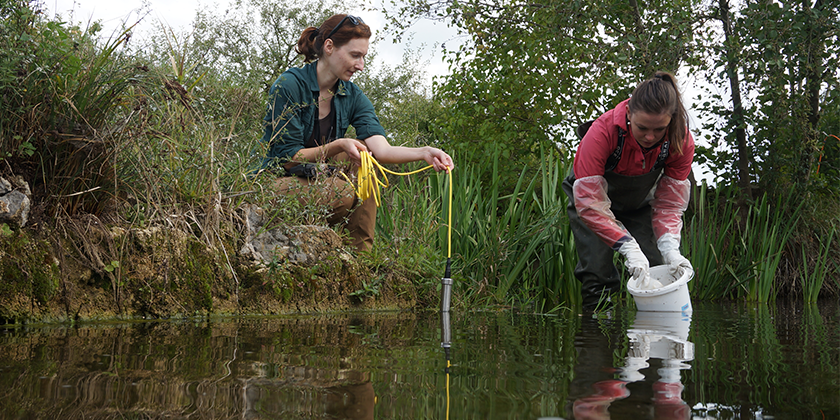
The focus of the NAWA SPEZ survey is once again on pollution from plant protection agents in small watercourses in areas with heavy agricultural use. Two out of the five areas are being surveyed for a second time, which will allow the researchers to make comparisons between the two survey years — something which has not been done previously. Experience gained through the previous two studies led the researchers to extend the 2017 monitoring period by two months, with measurements being taken between the beginning of March and the end of October. Three half-day mixed samples were taken and analysed for PPPs. The emphasis of NAWA SPEZ 2017 is being placed on the employment of further, supplementary chemical and biological methods.

NAWA SPEZ 2015: Small watercourses – an overview of pesticide contamination
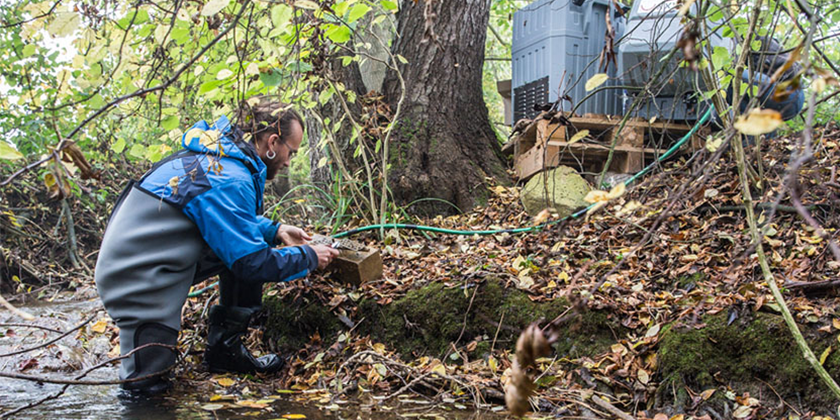
An initial evaluation of data collected in Switzerland on pesticide load revealed that only 20% of the data came from small watercourses, even though these make up 75% of the total distance covered by Switzerland’s network of watercourses (Munz et al. 2012). Moreover, the monitoring programmes were often temporally limited, or restricted to random sampling. The aim of the second NAWA SPEZ study was therefore to close these gaps.

Five small watercourses in areas with heavy agricultural use were screened for 213 active PPP substances. The work was carried out with a variable temporal resolution, whereby half-day mixed samples were taken during rainfall events, and longer mixed samples (from 24 hours to a maximum of 24 days) were taken during dry periods. The analytics employed enabled 70% of the PPPs permitted in 2015 to be measured. Also measured were numerous PPPs which were no longer permitted, but which were still found to be present in the environment because of their slow degradation times.

Altogether 128 PPPs were found to be present. Chronic quality criteria were exceeded in all of the catchment areas, and in four of the catchment areas acute quality criteria were also exceeded. The comparison with NAWA SPEZ 2012 showed that the peaks in contaminants in small watercourses are short-lived, but concentrations are, on the other hand, higher. A significant proportion of the instances of acute quality criteria being exceeded are attributable to this effect.

The catchment areas surveyed were all subject to a comparable level of agricultural use. Estimates indicated that although pollution levels may be lower in areas that are less heavily used for agricultural purposes, effects on sensitive aquatic organisms could not be ruled out in these areas. In terms of recommendations for routine monitoring going forward, it was shown that it is also possible to gather a substantial amount of pollution data with a reduced amount of effort: so, for the 41 PPP substances that were proposed in the Assessment Strategy for diffuse inputs, 72% of the chronic quality criteria, and 87% of the acute quality criteria were found to have been exceeded as a result of PPP inputs. It is important that measurements are taken over a sufficiently long period, as in some of the catchment areas the concentration levels were found to be increasing even at the end of the monitoring period.

Publications

Extbase Variable Dump
array(2 items)
   publications => '16820,14175' (11 chars)
   libraryUrl => '' (0 chars)
Extbase Variable Dump
array(2 items)
   0 => Snowflake\Publications\Domain\Model\Publicationprototypepersistent entity (uid=16820, pid=124)
      originalId => protected16820 (integer)
      authors => protected'Spycher, S.; Mangold, S.; Doppler, T.; Junghans, M.; Wit
         tmer, I.; Stamm, C.; Singer, H.
' (122 chars) title => protected'Pesticide risks in small streams - how to get as close as possible to the st
         ress imposed on aquatic organisms
' (109 chars) journal => protected'Environmental Science and Technology' (36 chars) year => protected2018 (integer) volume => protected52 (integer) issue => protected'8' (1 chars) startpage => protected'4526' (4 chars) otherpage => protected'4535' (4 chars) categories => protected'' (0 chars) description => protected'The risks associated with pesticides in small streams remain poorly characte
         rized. The challenges reside in understanding the complexities of (1) the hi
         ghly dynamic concentration profiles of (2) several hundred active substances
          with (3) differing seasonality. The present study addressed these three cha
         llenges simultaneously. Five small streams in catchments under intensive agr
         icultural land use were sampled using half-day composite samples from March
         to August 2015. Of 213 active substances quantified using liquid chromatogra
         phy–high resolution mass spectrometry, a total of 128 was detected at leas
         t at one of the sites. Ecotoxicological acute and/or chronic quality criteri
         a were exceeded for a total of 32 different active substances. The evaluatio
         n of risks over time revealed the necessity to evaluate the sequences of dif
         ferent active substances that are imposed on aquatic organisms. In contrast,
          a substance-specific perspective provides only a very limited assessment. S
         cenarios for reduction of either temporal resolution, number of substances o
         r seasonal coverage were defined. It could be shown that risks can be undere
         stimated by more than a factor of 10 in vulnerable catchments and that an in
         creased temporal resolution is essential to cover acute risks but that a foc
         used selection of substances is a possibility to reduce expenditures.
' (1361 chars) serialnumber => protected'0013-936X' (9 chars) doi => protected'10.1021/acs.est.8b00077' (23 chars) uid => protected16820 (integer) _localizedUid => protected16820 (integer)modified _languageUid => protectedNULL _versionedUid => protected16820 (integer)modified pid => protected124 (integer)
1 => Snowflake\Publications\Domain\Model\Publicationprototypepersistent entity (uid=14175, pid=124) originalId => protected14175 (integer) authors => protected'Langer, M.; Junghans, M.; Spycher, S.; Koster, M.; Baumg
         artner, C.; Vermeissen, E.; Werner, I.
' (129 chars) title => protected'Hohe ökotoxikologische Risiken in Bächen. NAWA SPEZ untersucht Bäche in G
         ebieten mit intensiver landwirtschaftlicher Nutzung
' (127 chars) journal => protected'Aqua & Gas' (10 chars) year => protected2017 (integer) volume => protected97 (integer) issue => protected'4' (1 chars) startpage => protected'58' (2 chars) otherpage => protected'68' (2 chars) categories => protected'' (0 chars) description => protected'In der vorliegenden Studie wurde für fünf kleine Schweizer Fliessgewässer
          anhand akuter und chronischer Risikoquotienten eine Risikobewertung für ch
         emisch analysierte Pflanzenschutzmittelmischungen durchgeführt. An vier der
          fünf Standorte wurde ein zeitweise hohes Risiko der Mischung für Pflanzen
          oder wirbellose Organismen nachgewiesen. Biologische Untersuchungen unterst
         ützen diese Risikoeinschätzung.
' (413 chars) serialnumber => protected'2235-5197' (9 chars) doi => protected'' (0 chars) uid => protected14175 (integer) _localizedUid => protected14175 (integer)modified _languageUid => protectedNULL _versionedUid => protected14175 (integer)modified pid => protected124 (integer)
Spycher, S.; Mangold, S.; Doppler, T.; Junghans, M.; Wittmer, I.; Stamm, C.; Singer, H. (2018) Pesticide risks in small streams - how to get as close as possible to the stress imposed on aquatic organisms, Environmental Science and Technology, 52(8), 4526-4535, doi:10.1021/acs.est.8b00077, Institutional Repository
Langer, M.; Junghans, M.; Spycher, S.; Koster, M.; Baumgartner, C.; Vermeissen, E.; Werner, I. (2017) Hohe ökotoxikologische Risiken in Bächen. NAWA SPEZ untersucht Bäche in Gebieten mit intensiver landwirtschaftlicher Nutzung, Aqua & Gas, 97(4), 58-68, Institutional Repository

NAWA SPEZ 2012: Medium-sized watercourses – overview of pesticide load

The aim of the first NAWA SPEZ study was to gain a thorough understanding of which particular substances were contributing the most to pollutant loads. Five medium-sized watercourses were screened for biocides and PPPs using two-week mixed samples. The comprehensive analytics employed enabled the researchers to measure 81% of all polar organic and synthetic biocides and 91% of all polar organic and synthetic PPPs.

Altogether 104 pesticides were identified as being present, of which 82 substances were purely PPPs, 20 were substances permitted for dual use (as PPPs as well as biocide) and two were purely biocides. Chronic quality criteria were exceeded in all of the catchment areas. The results of the study underline the prominence of PPPs in the material pollution of surface waters. The information thereby gleaned formed a core part of the Assessment Strategy for Micropollutants developed by Eawag and the Centre for Ecotoxicology, which determined the list of substances to be prioritised for evaluation within the routine monitoring programme.


Publications

Extbase Variable Dump
array(2 items)
   publications => '7654,7767,7592,14792' (20 chars)
   libraryUrl => '' (0 chars)
Extbase Variable Dump
array(4 items)
   0 => Snowflake\Publications\Domain\Model\Publicationprototypepersistent entity (uid=7654, pid=124)
      originalId => protected7654 (integer)
      authors => protected'Moschet, C.; Wittmer, I.; Simovic, J.; Junghans, M.; Pia
         zzoli, A.; Singer, H.; Stamm, C.; Leu, C.; Hollender,&nb
         sp;J.
' (157 chars) title => protected'How a complete pesticide screening changes the assessment of surface water q
         uality
' (82 chars) journal => protected'Environmental Science and Technology' (36 chars) year => protected2014 (integer) volume => protected48 (integer) issue => protected'10' (2 chars) startpage => protected'5423' (4 chars) otherpage => protected'5432' (4 chars) categories => protected'' (0 chars) description => protected'A comprehensive assessment of pesticides in surface waters is challenging du
         e to the large number of potential contaminants. Most scientific studies and
          routine monitoring programs include only 15–40 pesticides, which leads to
          error-prone interpretations. In the present study, an extensive analytical
         screening was carried out using liquid chromatography–high-resolution mass
          spectrometry, covering 86% of all polar organic pesticides sold in Switzerl
         and and applied to agricultural or urban land (in total 249 compounds), plus
          134 transformation products; each of which could be quantified in the low n
         g/L range. Five medium-sized rivers, containing large areas of diverse crops
          and urban settlements within the respective catchments, were sampled betwee
         n March and July 2012. More than 100 parent compounds and 40 transformation
         products were detected in total, between 30 and 50 parent compounds in each
         two-week composite sample in concentrations up to 1500 ng/L. The sum of pest
         icide concentrations was above 1000 ng/L in 78% of samples. The chronic envi
         ronmental quality standard was exceeded for 19 single substances; using a mi
         xture toxicity approach, exceedances occurred over the whole measurement per
         iod in all rivers. With scenario calculations including only 30–40 frequen
         tly measured pesticides, the number of detected substances and the mixture t
         oxicity would be underestimated on average by a factor of 2. Thus, selecting
          a subset of substances to assess the surface water quality may be sufficien
         t, but a comprehensive screening yields substantially more confidence.
' (1590 chars) serialnumber => protected'0013-936X' (9 chars) doi => protected'10.1021/es500371t' (17 chars) uid => protected7654 (integer) _localizedUid => protected7654 (integer)modified _languageUid => protectedNULL _versionedUid => protected7654 (integer)modified pid => protected124 (integer)
1 => Snowflake\Publications\Domain\Model\Publicationprototypepersistent entity (uid=7767, pid=124) originalId => protected7767 (integer) authors => protected'Moschet, C.; Vermeirssen, E. L. M.; Seiz, R.; Pfeff
         erli, H.; Hollender, J.
' (109 chars) title => protected'Picogram per liter detections of pyrethroids and organophosphates in surface
          waters using passive sampling
' (106 chars) journal => protected'Water Research' (14 chars) year => protected2014 (integer) volume => protected66 (integer) issue => protected'' (0 chars) startpage => protected'411' (3 chars) otherpage => protected'422' (3 chars) categories => protected'insecticides; gas chromatography mass spectrometry; silicone rubber; analyti
         cs; surface water; monitoring
' (105 chars) description => protected'Pyrethroids and organophosphates are among the most toxic insecticides for a
         quatic organisms, leading to annual-average environmental quality standards
         (AA-EQS) in the picogram per liter range in surface waters. For monitoring p
         urposes, it is therefore crucial to develop very sensitive analytical method
         s. Until now, it is very difficult to reach detection limits at or below giv
         en AA-EQSs. Here, we present a passive sampling method using silicone rubber
          (SR) sheets for the sampling of ten pyrethroids and two organophosphates in
          surface waters. An analytical method was developed, optimized and validated
          for the extraction of the insecticides from the SR sheets by accelerated so
         lvent extraction followed by clean-up on C18 and silica gel and detection wi
         th GC–MS/MS in positive ionization mode. Good precision (<20%) and absolut
         e recovery (>50%) was observed for all substances, accuracy was between 66%
         and 139%. Limits of detection between 6 and 200 pg/L were achieved for all
         substances in surface waters using average sampling rates for PCBs and PAHs.
          The lack of substance-specific sampling rates and missing performance refer
         ence compounds led to an uncertainty in the concentration estimation of fact
         or three in both directions. In a large field study, comprising 40 environme
         ntal samples from nine Swiss rivers, eight out of 12 substances were detecte
         d (most frequently: chlorpyrifos, cypermethrin). Most of the estimated organ
         ophosphate concentrations were between 0.1 and 1 ng/L, most pyrethroid dete
         ctions below 0.1 ng/L. Four substances (chlorpyrifos-methyl, cypermethrin,
         deltamethrin and lambda-cyhalothrin) showed exceedances of their respective
         AA-EQS in multiple samples, also when the uncertainties in the concentration
          estimation were considered. As pyrethroid and organophosphate detection by
         SR passive sampling is very practicable and allows sensitive analysis, it ha
         s the potential to become a new tool in the monitoring of non-polar pesticid
         es.
' (1979 chars) serialnumber => protected'0043-1354' (9 chars) doi => protected'10.1016/j.watres.2014.08.032' (28 chars) uid => protected7767 (integer) _localizedUid => protected7767 (integer)modified _languageUid => protectedNULL _versionedUid => protected7767 (integer)modified pid => protected124 (integer)
2 => Snowflake\Publications\Domain\Model\Publicationprototypepersistent entity (uid=7592, pid=124) originalId => protected7592 (integer) authors => protected'Wittmer,&nbsp;I.; Moschet,&nbsp;C.; Simovic,&nbsp;J.; Singer,&nbsp;H.; Stamm
         ,&nbsp;C.; Hollender,&nbsp;J.; Junghans,&nbsp;M.; Leu,&nbsp;C.
' (138 chars) title => protected'Über 100 Pestizide in Fliessgewässern. Programm NAWA Spez zeigt die hohe P
         estizidbelastung der Schweizer Fliessgewässer auf
' (126 chars) journal => protected'Aqua & Gas' (10 chars) year => protected2014 (integer) volume => protected94 (integer) issue => protected'3' (1 chars) startpage => protected'32' (2 chars) otherpage => protected'43' (2 chars) categories => protected'' (0 chars) description => protected'Fünf mittelgrosse Fliessgewasser wurden in Zusammenarbeit zwischen Eawag, B
         AFU und fünf Kantonen (AG, SO, TG, VD, ZH) auf möglichst alle polaren orga
         nisch-synthetischen Pflanzenschutzmittel und Biozide (ca. 300 Wirkstoffe) un
         tersucht. lnsgesamt konnten 104 verschiedene Pestizide, hauptsachlich Pflanz
         enschutzmittel, nachgewiesen werden. Die Konzentrationssumme war in 78% der
         Proben grosser als 1000 ng/l. Die numerische Anforderung der Gewässerschutz
         verordnung und ökotoxikologische Qualitatskriterien wurden von 31 bzw. 19 P
         estiziden überschritten.
' (557 chars) serialnumber => protected'2235-5197' (9 chars) doi => protected'' (0 chars) uid => protected7592 (integer) _localizedUid => protected7592 (integer)modified _languageUid => protectedNULL _versionedUid => protected7592 (integer)modified pid => protected124 (integer)
3 => Snowflake\Publications\Domain\Model\Publicationprototypepersistent entity (uid=14792, pid=124) originalId => protected14792 (integer) authors => protected'Wittmer,&nbsp;I.; Stamm,&nbsp;C.; Singer,&nbsp;H.; Junghans,&nbsp;M.' (68 chars) title => protected'Beurteilungskonzept für organische Spurenstoffe aus diffusen Einträgen. Mi
         kroverunreinigungen
' (95 chars) journal => protected'' (0 chars) year => protected2014 (integer) volume => protected0 (integer) issue => protected'' (0 chars) startpage => protected'105&nbsp;p' (10 chars) otherpage => protected'' (0 chars) categories => protected'' (0 chars) description => protected'Diffuse Einträge von Mikroverunreinigungen führen vor allem in kleinen, ab
         er auch in mittleren und zum Teil sogar in grossen Fliessgewässern zu Spitz
         enkonzentrationen, die teilweise massiv über den gesetzlichen Anforderungen
          und auch über ökotoxikologischen Qualitätskriterien liegen. Der hier vor
         liegende Bericht hat zum Ziel, praxistaugliche Empfehlungen für die Beurtei
         lung des Zustandes eines Fliessgewässers in Bezug auf die Belastung durch d
         iffuse Einträge von Mikroverunreinigungen zur Verfügung zu stellen. Der Be
         richt ist folgendermassen gegliedert:<br />1. Einleitung sowie Zielsetzung u
         nd rechtliche Grundlagen zur Beurteilung von diffusen Einträgen von Mikrove
         runreinigungen in Oberflächengewässern.<br />2. Hintergrundinformationen u
         nd bestehendes Fachwissen zu diffusen Einträgen von Mikroverunreinigungen.<
         br />3. Konzept zur Auswahl von Stoffen, sowie ein Vorschlag von 48 organisc
         hen, schweizspezifischen Mikroverunreinigungen aus diffusen Einträgen.<br /
         >4. Konzept zur Erhebung von diffusen Einträgen (Standortauswahl und Proben
         ahmekonzept).<br />5. Konzept zur Beurteilung der erhobenen Messresultate mi
         t ökotoxikologischen Qualitätskriterien. [...]
' (1188 chars) serialnumber => protected'' (0 chars) doi => protected'' (0 chars) uid => protected14792 (integer) _localizedUid => protected14792 (integer)modified _languageUid => protectedNULL _versionedUid => protected14792 (integer)modified pid => protected124 (integer)
Moschet, C.; Wittmer, I.; Simovic, J.; Junghans, M.; Piazzoli, A.; Singer, H.; Stamm, C.; Leu, C.; Hollender, J. (2014) How a complete pesticide screening changes the assessment of surface water quality, Environmental Science and Technology, 48(10), 5423-5432, doi:10.1021/es500371t, Institutional Repository
Moschet, C.; Vermeirssen, E. L. M.; Seiz, R.; Pfefferli, H.; Hollender, J. (2014) Picogram per liter detections of pyrethroids and organophosphates in surface waters using passive sampling, Water Research, 66, 411-422, doi:10.1016/j.watres.2014.08.032, Institutional Repository
Wittmer, I.; Moschet, C.; Simovic, J.; Singer, H.; Stamm, C.; Hollender, J.; Junghans, M.; Leu, C. (2014) Über 100 Pestizide in Fliessgewässern. Programm NAWA Spez zeigt die hohe Pestizidbelastung der Schweizer Fliessgewässer auf, Aqua & Gas, 94(3), 32-43, Institutional Repository
Wittmer, I.; Stamm, C.; Singer, H.; Junghans, M. (2014) Beurteilungskonzept für organische Spurenstoffe aus diffusen Einträgen. Mikroverunreinigungen, 105 p, Institutional Repository

Project Team

Heinz Singer Senior scientist / group leader Tel. +41 58 765 5577 Send Mail
Birgit Beck Technician Tel. +41 58 765 5316 Send Mail
Kim Luong Research Collaborator Tel. +41 58 765 5918 Send Mail
Dr. Tobias Doppler VSA-Platform "Waterquality" Tel. +41 58 765 5407 Send Mail