Département Sciences sociales de l’environnement

TREBRIDGE – Transformation vers des écosystèmes résilients : au-delà des frontières entre sciences naturelles et sociales
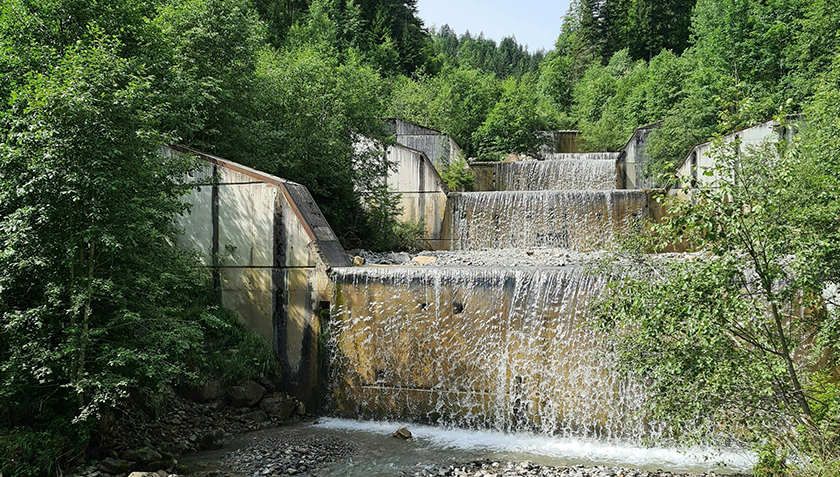
Image reproduite avec l'aimable autorisation d'Ariel do Prado

Aperçu du projet

Le projet de recherche TREBRIDGE porte sur la gestion des bassins versants dans les régions montagneuses en Suisse. Pour lutter contre l'érosion et les inondations, des barrages de retenue ont été construits dans les cours d'eau et des coupes à blanc ont été replantées avec des monocultures pendant des siècles. L'entretien des infrastructures de gestion des crues nécessite des investissements financiers élevés, tout en affectant la qualité, ainsi que la résilience des écosystèmes concernés. L'objectif de TREBRIDGE est d'identifier des approches politiques, de gestion de bassins versants et de forêts dans les régions alpines. Ces approches devraient, d'une part, accroître la résilience des écosystèmes de montagne face aux événements climatiques extrêmes et, d'autre part, répondre aux besoins sociétaux en matière d'utilisation et de protection des ressources naturelles. Le projet de recherche suit une approche interdisciplinaire en adoptant une vision holistique du fonctionnement des bassins versants et forêts, en réunissant des chercheurs inter- et transdisciplinaires, dont des géologues, géomorphologues, hydrologues, écologues, économistes, ainsi que des analystes politiques.

Le projet est divisé en cinq sous-projets de recherche :

   1. Intégration scientifique
Intégration des disciplines impliquées dans ce projet, afin d'assurer une approche holistique pendant la durée du projet, ainsi qu'élaborer une synthèse des résultats communs ;


    2. Processus participatif d'élaboration de scénarios
Grâce à un processus participatif de développement et d'évaluation de scénarios, création d'options alternatives de politique et de gestion pour des écosystèmes résilients et répondre aux besoins sociétaux et écologiques dans les régions alpines ;


    3. Production et transfert de sédiments
Évaluation des effets sur la production de sédiments et le ruissellement des pratiques de gestion actuelles et compaison de celles-ci à des pratiques alternatives moins axées sur une utilisation de technologies ;


    4. Explorer les conséquences hydrologiques et écologiques
Explorer comment les changements de la couverture végétale influencent la cascade sédimentaire et la stabilité des canaux, et quantifier l'importance relative du changement climatique par rapport aux pratiques de gestion forestière sur le transfert des sédiments ;


   5. Valeurs de la nature et politique environnementale
 Analyse des valeurs économiques et non économiques de solutions plus proche de la nature, ainsi que des préférences sociétales, dans un premier temps, puis, dans un second temps, élaborer des options de politique et gestion, ainsi qu'évaluer la répartition des charges et des avantages.

Les chercheurs de l'Eawag sont chargés des groupes de recherche 1 et 5, soit les groupes "Intégration scientifique" et "Valeurs de la nature et politique environnementale".


Contact

Dr. Sabine Hoffmann Chef de groupe, Groupe: ITD Tel. +41 58 765 6818 Envoyez un message
Dr. Ivana Logar Chef de groupe, Groupe: EnvEco Tel. +41 58 765 5504 Envoyez un message

Informations

Financement: Fond national suisse (FNS), dans le cadre du programme Sinergia – interdisciplinaire, collaborative et pionnière

Durée: 2022 à 2026

Le projet est dirigé par le groupe de recherche NARP de l'EPF Zurich.

Publications

Extbase Variable Dump
array(2 items)
   publications => '33938,34130,34096' (17 chars)
   libraryUrl => '' (0 chars)
Extbase Variable Dump
array(3 items)
   0 => Snowflake\Publications\Domain\Model\Publicationprototypepersistent entity (uid=33938, pid=124)
      originalId => protected33938 (integer)
      authors => protected'Hofmann, B.; Salomon, H.; Hoffmann, S.' (53 chars)
      title => protected'Roles of researchers in inter- and transdisciplinary sustainability research
         : a reflection tool
' (95 chars) journal => protected'Sustainability Science' (22 chars) year => protected2025 (integer) volume => protected20 (integer) issue => protected'' (0 chars) startpage => protected'777' (3 chars) otherpage => protected'792' (3 chars) categories => protected'roles of researchers; tool; inter- and transdisciplinary research; sustainab
         ility science; operationalization; reflection
' (121 chars) description => protected'Inter- and transdisciplinary (ITD) research is increasingly called for and s
         upported to promote sustainable transformation through knowledge co-producti
         on, knowledge integration, and solution development. The paper explores what
          is needed to support researchers in reflecting on their new roles in ITD re
         search. We introduce a reflection tool that makes the growing literature on
         researchers’ roles in sustainability science applicable to ITD projects. I
         ts design is based on the arguments that each researcher can have several ro
         les within one research project and that focusing on a few key roles increa
         ses clarity compared to differentiating many specialized roles. The tool con
         sists of (1) a researcher survey that operationalizes six prominent roles (t
         raditional scientist, self-reflexive scientist, knowledge integrator, knowle
         dge broker, process facilitator, and change agent), (2) a visualization of r
         ole profiles from the survey, and (3) a set of reflection questions on relat
         ed opportunities, challenges, and coping strategies on individual and projec
         t level. We empirically applied the tool in two ITD research projects focuse
         d on sustainable food production and water and forest ecosystem management.
         Comparative application of the tool yielded diverse role profiles of researc
         hers in both projects, with different patterns for senior and junior researc
         hers as well as natural and social scientists. The reflection produced a col
         lection of opportunities, challenges, and coping strategies that corroborate
         s and extends insights from ITD literature. We discuss how the tool triggers
          multi-dimensional reflection on roles (individual and project level, role c
         ombinations, self-perception and external perception) and outline opportunit
         ies for further strengthening such reflection in ITD research.
' (1810 chars) serialnumber => protected'1862-4065' (9 chars) doi => protected'10.1007/s11625-024-01619-x' (26 chars) uid => protected33938 (integer) _localizedUid => protected33938 (integer)modified _languageUid => protectedNULL _versionedUid => protected33938 (integer)modified pid => protected124 (integer)
1 => Snowflake\Publications\Domain\Model\Publicationprototypepersistent entity (uid=34130, pid=124) originalId => protected34130 (integer) authors => protected'Lieberherr, E.; Dölker, J.; Salomon, H.; Schick, V.; Lo
         gar, I.; Bugmann, H.; Schlunegger, F.; König, L.; Kräh
         enbühl, J.; McArdell, B.; Molnar, P.; Schmidt, C.; Quat
         rini, S.; Zabel, A.; Zhang, J.; Hoffmann, S.
' (292 chars) title => protected'Science integration and a participatory scenario process. An inter- and tran
         sdisciplinary study from the Alps
' (109 chars) journal => protected'GAIA: Ecological Perspectives for Science and Society' (53 chars) year => protected2025 (integer) volume => protected34 (integer) issue => protected'1' (1 chars) startpage => protected'35' (2 chars) otherpage => protected'41' (2 chars) categories => protected'Alpine ecosystems; design report; inter- and transdisciplinary research; par
         ticipatory scenario process; science integration; stakeholder engagement; tr
         ansformation
' (164 chars) description => protected'Highly engineered Alpine watersheds and forests face growing risks, requirin
         g shifts in management and research. We use science integration and a partic
         ipatory scenario process to integrate disciplines and co-create knowledge wi
         th stakeholders. We thus develop pathways for rethinking future management,
         aiming for higher resilience of Alpine ecosystems and delivering greater soc
         ietal value than current systems.<br /><br />Given highly engineered Alpine
         ecosystems with monocultures and channelized streams, this project proposes
         radical changes to enable increased ecosystem resilience and societal wellbe
         ing. We propose to rethink 1. management by including ecological and socio-e
         conomic aspects and 2. research by integrating natural, engineering, and soc
         ial sciences. In this inter- and transdisciplinary project, we develop quali
         tative scenarios as storylines for future Alpine watershed and forest manage
         ment. These scenarios serve as parameters for, on the one hand, the biophysi
         cal modelling of ecological quality (biodiversity, ecosystem function, ecolo
         gical integrity) in Swiss case study regions. On the other, we assess reside
         nts’ preferences for the scenarios in relation to Nature’s Contributions
          to People and aspects of justice. We thus use science integration and a par
         ticipatory scenario process to enable integration across disciplines as well
          as co-create knowledge with stakeholders throughout the research process. W
         hile this approach facilitates working across disciplinary boundaries and in
         cludes stakeholders from the onset, it also comes with challenges: finding a
          common language across disciplines and engaging meaningfully with stakehold
         ers takes time and simultaneously does not cater to the traditional metrics
         in academia.
' (1760 chars) serialnumber => protected'0940-5550' (9 chars) doi => protected'10.14512/gaia.34.1.4' (20 chars) uid => protected34130 (integer) _localizedUid => protected34130 (integer)modified _languageUid => protectedNULL _versionedUid => protected34130 (integer)modified pid => protected124 (integer)
2 => Snowflake\Publications\Domain\Model\Publicationprototypepersistent entity (uid=34096, pid=124) originalId => protected34096 (integer) authors => protected'Hofmann,&nbsp;B.; Fischer,&nbsp;M.; Ingold,&nbsp;K.; Lieberherr,&nbsp;E.; Ho
         ffmann,&nbsp;S.
' (91 chars) title => protected'Knowledge cumulation at science‐policy interfaces: opportunities for envir
         onmental governance research
' (104 chars) journal => protected'Environmental Policy and Governance' (35 chars) year => protected2025 (integer) volume => protected35 (integer) issue => protected'3' (1 chars) startpage => protected'538' (3 chars) otherpage => protected'546' (3 chars) categories => protected'environmental governance; environmental policy; knowledge cumulation; knowle
         dge integration; knowledge use; science-policy interfaces; synthesis
' (144 chars) description => protected'To increase the societal impact of environmental governance research, schola
         rs have called for knowledge cumulation, meaning that scientific evidence bu
         ilds more systematically on previous findings. Our article develops the pers
         pective that such knowledge cumulation takes place not only within academia
         but also at science-policy interfaces (SPIs). Drawing on literature on knowl
         edge integration, synthesis, and use as well as science-policy literature, w
         e outline five opportunities for knowledge cumulation at SPIs: (1) proximity
          to democratic discourse and decision-making; (2) suitability for inter- and
          transdisciplinary integration; (3) combined problem and solution focus; (4)
          potential to increase the generality of scientific findings; and (5) creati
         on of targeted synthesis products. We illustrate their respective benefits a
         nd challenges with empirical examples from SPIs for climate change, biodiver
         sity and natural resources, and food systems. We conclude that SPIs are an i
         mportant locus for cumulating knowledge used in complex environmental govern
         ance and that future research could explore how this interacts with knowledg
         e cumulation in the academic realm.
' (1175 chars) serialnumber => protected'1756-932X' (9 chars) doi => protected'10.1002/eet.2155' (16 chars) uid => protected34096 (integer) _localizedUid => protected34096 (integer)modified _languageUid => protectedNULL _versionedUid => protected34096 (integer)modified pid => protected124 (integer)
Hofmann, B.; Salomon, H.; Hoffmann, S. (2025) Roles of researchers in inter- and transdisciplinary sustainability research: a reflection tool, Sustainability Science, 20, 777-792, doi:10.1007/s11625-024-01619-x, Institutional Repository
Lieberherr, E.; Dölker, J.; Salomon, H.; Schick, V.; Logar, I.; Bugmann, H.; Schlunegger, F.; König, L.; Krähenbühl, J.; McArdell, B.; Molnar, P.; Schmidt, C.; Quatrini, S.; Zabel, A.; Zhang, J.; Hoffmann, S. (2025) Science integration and a participatory scenario process. An inter- and transdisciplinary study from the Alps, GAIA: Ecological Perspectives for Science and Society, 34(1), 35-41, doi:10.14512/gaia.34.1.4, Institutional Repository
Hofmann, B.; Fischer, M.; Ingold, K.; Lieberherr, E.; Hoffmann, S. (2025) Knowledge cumulation at science‐policy interfaces: opportunities for environmental governance research, Environmental Policy and Governance, 35(3), 538-546, doi:10.1002/eet.2155, Institutional Repository

Team

Dr. Sabine Hoffmann Chef de groupe, Groupe: ITD Tel. +41 58 765 6818 Envoyez un message
Dr. Ivana Logar Chef de groupe, Groupe: EnvEco Tel. +41 58 765 5504 Envoyez un message
Hanna Salomon Doctorant, Groupe: ITD Tel. +41 58 765 5187 Envoyez un message
Julie Dölker Doctorante, Groupe: EnvEco Tel. +41 58 765 6414 Envoyez un message