Département Ressources aquatiques et eau potable
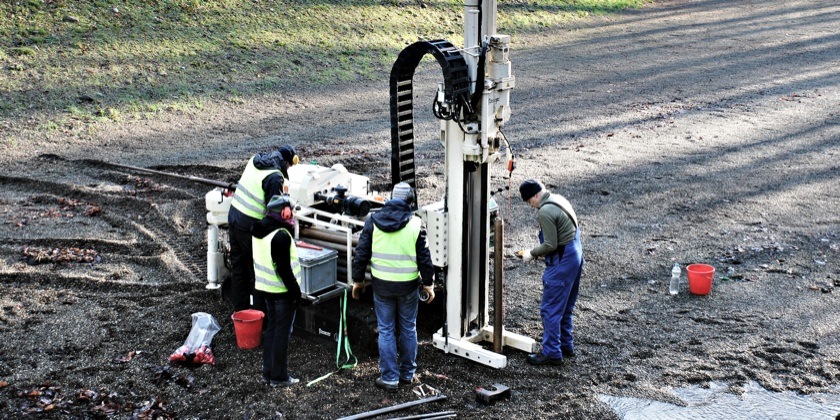
Ressources aquatiques & eau potable

Nous étudions les processus essentiellement physiques et chimiques des eaux souterraines, des eaux de surface et de l’eau potable. Notre recherche fondamentale et nos études appliquées sur les ressources aquatiques, la pollution et le traitement des eaux contribuent notablement à une gestion durable de l’eau dans un contexte national et international.

En savoir plus

Publications

Kim, Y. J., Kipfer, R., Kaown, D., Kim, J., Shin, J. Y., Lee, S. S., & Lee, K. K. (2026). Quantification of residual DNAPL within aquifer system using atmospheric noble gases and radon: partitioning behavior and field application. Journal of Hazardous Materials, 502, 140984 (11 pp.). doi:10.1016/j.jhazmat.2025.140984, Institutional Repository
Kaegi, R., Sinnet, B., Tolu, J., Kroll, A., Bette, J., Eugster, F., … Durisch-Kaiser, E. (2026). Seltene-Erden-Elemente in Zürcher Abwasser und Gewässern. Aqua & Gas, 106(2), 32-38. , Institutional Repository
Li, K. Y., Podgorski, J., Liang, C. P., Chen, J. S., Chang, J. Y., & Berg, M. (2026). Groundwater arsenic in Taiwan: from mid-20th-century crisis to predictive models for risk mitigation strategies. Environment International, 207, 110049 (12 pp.). doi:10.1016/j.envint.2026.110049, Institutional Repository
Scheidler, S., Christe, P. G., Zechner, E., Walde, M. A., Schilling, O. S., & Epting, J. (2026). 3D thermohydraulic modelling of geologically complex Alpine systems: insights for geothermal resources exploration from simulating the Upper Aarmassif, Switzerland. Hydrogeology Journal. doi:10.1007/s10040-025-02998-w, Institutional Repository

Nouvelles

1 décembre 2025

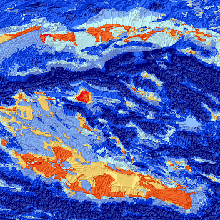
Des scientifiques de l’Eawag ont cartographié la contamination des eaux souterraines suisses par les nitrates à l’aide de l’apprentissage machine. Cette approche permet de combler les lacunes entre les mailles du réseau de mesures et d’identifier les causes d’excès de nitrates. Cette étude s’inscrit dans un projet plus large dédié à l’analyse du cycle de l’azote en Suisse.

En savoir plus
More news
Événements

Projets de recherche

This project facilitates the exchange of data, maps and information on geogenic contaminants (focussing on arsenic and fluoride) via the web-based Groundwater Assessment Platform (GAP)
ReCLEAN étudie les effets de la décarbonisation de la production énergétique sur le bilan azoté des écosystèmes suisses.
By taking into account the interactions between surface waters and groundwater in real time, we improve operational groundwater modeling for drinking water, energy and agriculture.
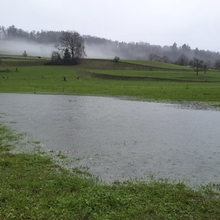
This project explores how periodic waterlogging may promote the seasonal release of trace elements from soils into water resources under changing climatic conditions.
This project assesses trace element leaching from excavated rocks and risks to water resources linked to rock reuse for restoration.
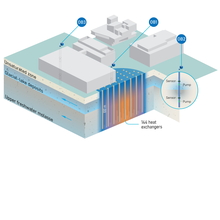
The project investigates the impact of underground heat storage on the subsurface, with focus on groundwater chemistry, microbial activity, and groundwater fauna.
Exploring microbial CO₂ mineralization to achieve safe, permanent carbon storage in deep aquifers under extreme conditions.
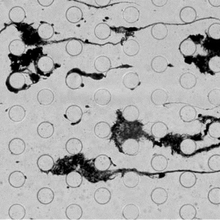
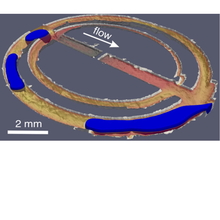
Unraveling how microscale fluid–solid interactions shape contaminant transport and mineral reactions in support of clean solutions.
Assessing the effects on water resources and greenhouse gas emissions of fallow versus cover crops.
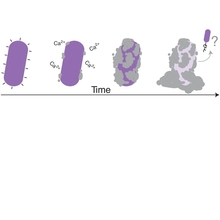
Microbes meet moving worlds: uncovering how tiny organisms shape and respond to dynamic soils and aquifers to drive Earth’s hidden chemistry.
Characterizing groundwater circulation and glacier and snowmelt effects on water availability in the Upper Engadine using multi-tracers and models.
This project uses machine learning to model spatial and temporal occurrence of nitrate in groundwater
Evaluating spatial patterns of soil arsenic and micronutrients to strengthen environmental risk assessment and guide sustainable agricultural planning.
National monitoring program for substance load in Swiss watercourses (NAWA-Fracht)
An interactive web-based tool to analyze groundwater time series, revealing droughts, extremes, trends, and human impacts.
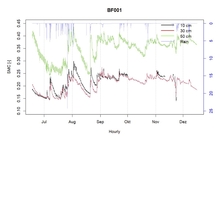
Retain rain with keylines: We measure soil moisture and subsurface processes to improve agricultural water retention.
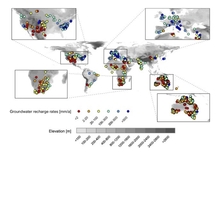
Mapping how climate variability and rising aridity reshape global groundwater recharge—from monthly extremes to decadal trends.
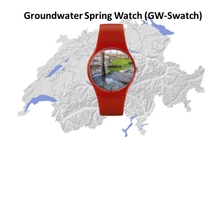
Monitoring and modelling groundwater springs across Switzerland to assess climate vulnerability and support sustainable water management.
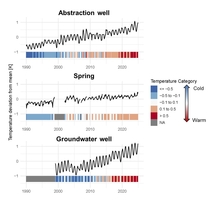
Long-term observations reveal widespread groundwater warming in Switzerland and its links to climate, hydrogeology, and subsurface processes.
How do droughts and climate change affect groundwater recharge? This project quantifies recharge sensitivity using models of varying complexity.
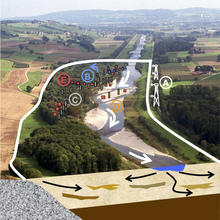
Real-time tools and tracers reveal MAR performance and contaminant pathways, improving safe groundwater recharge and abstraction.
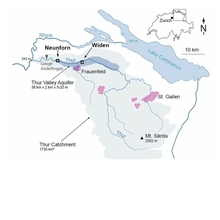
Large-scale artificial groundwater recharge for water supply in a complex environment.
The RECONECT project demonstrates, references and upscales Nature based Solutions in rural and natural areas.
River restoration as essential instrument to achieve “good ecological status” of water courses and fight flooding.
Flussrenvitalisierung auf Einzugsgebietsebene zur Erreichung eines „guten ökologischen Zustands” der Gewässer und zur Bekämpfung von Flutereignissen.
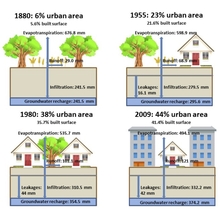
The study highlights a strong positive correlation between groundwater recharge rates and the extent of the urban area.
Interactions between precipitation, groundwater, surface water and the sewer system in an urban catchment
Against common belief, groundwater recharge increases with increasing urbanization.
Water is harvested in times of high flow, stored in basins or as groundwater, to be used at times of water scarcity.