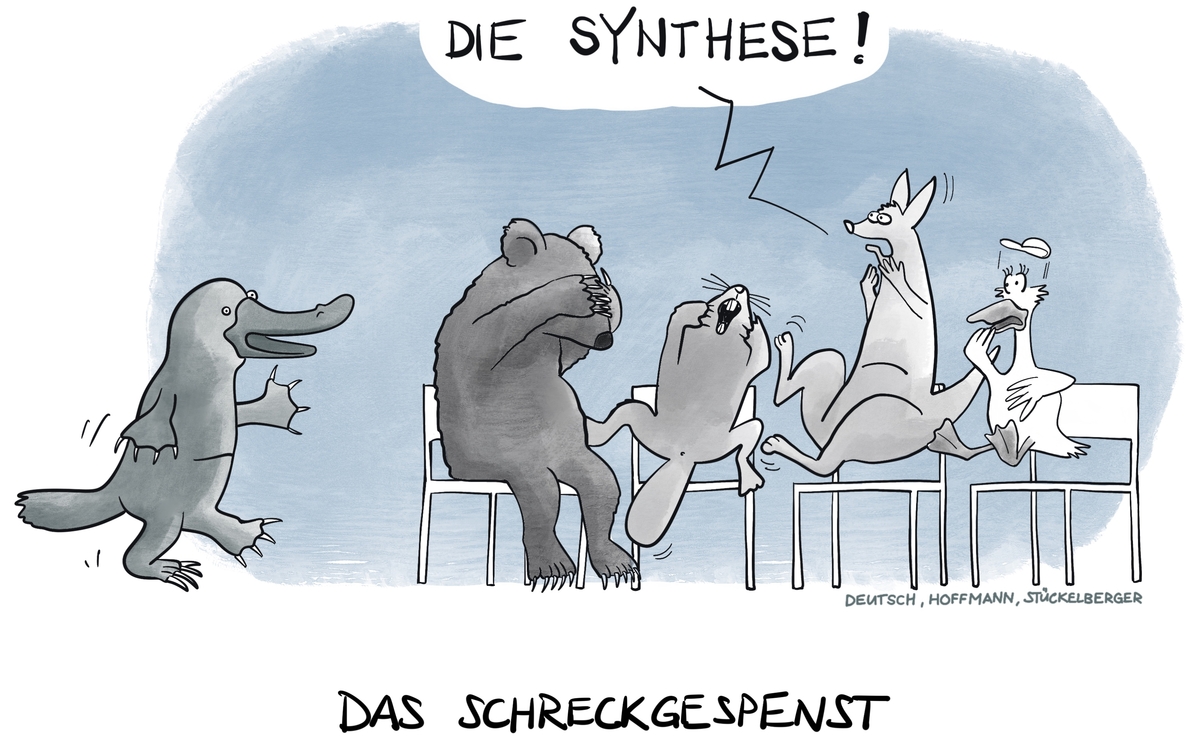
Bandes dessinées: illustrer le meilleur moyen de vouer la recherche inter et transdisciplinaire à l’échec?
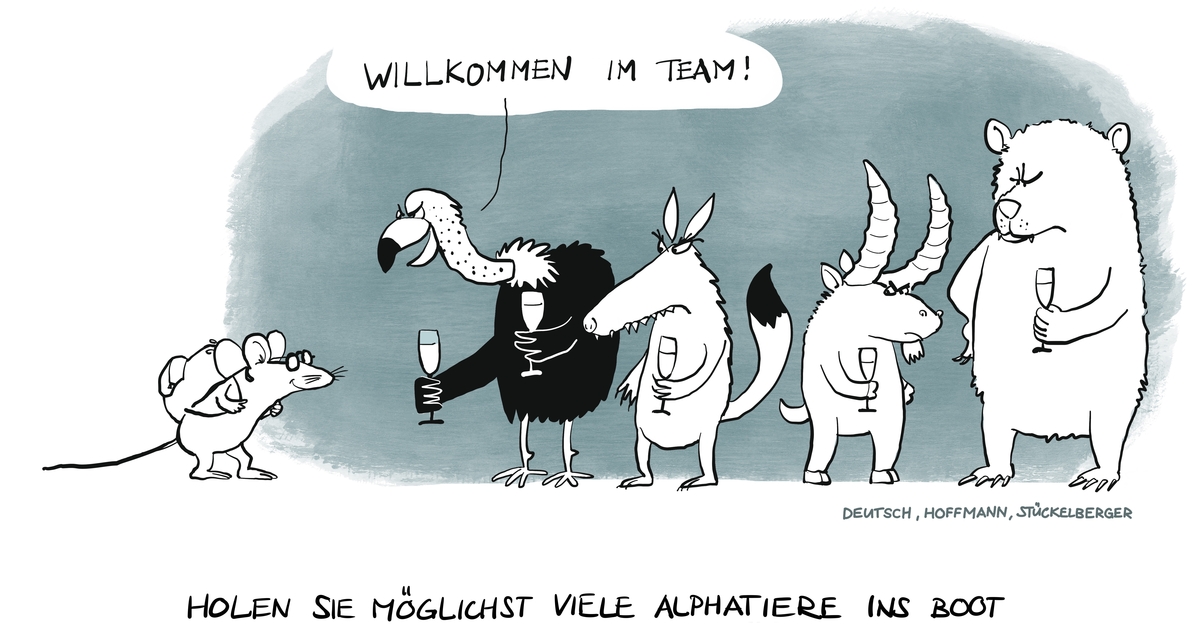
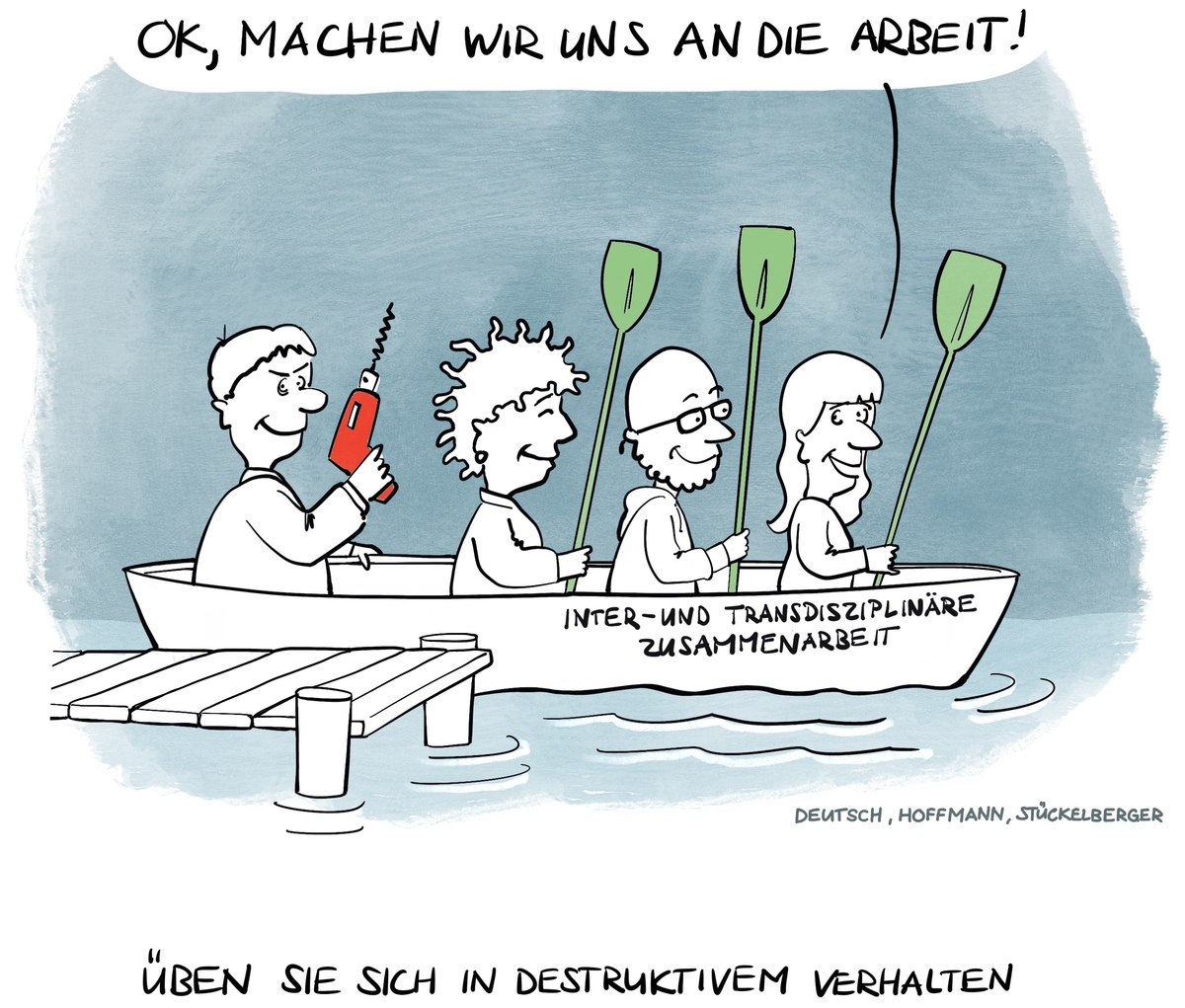
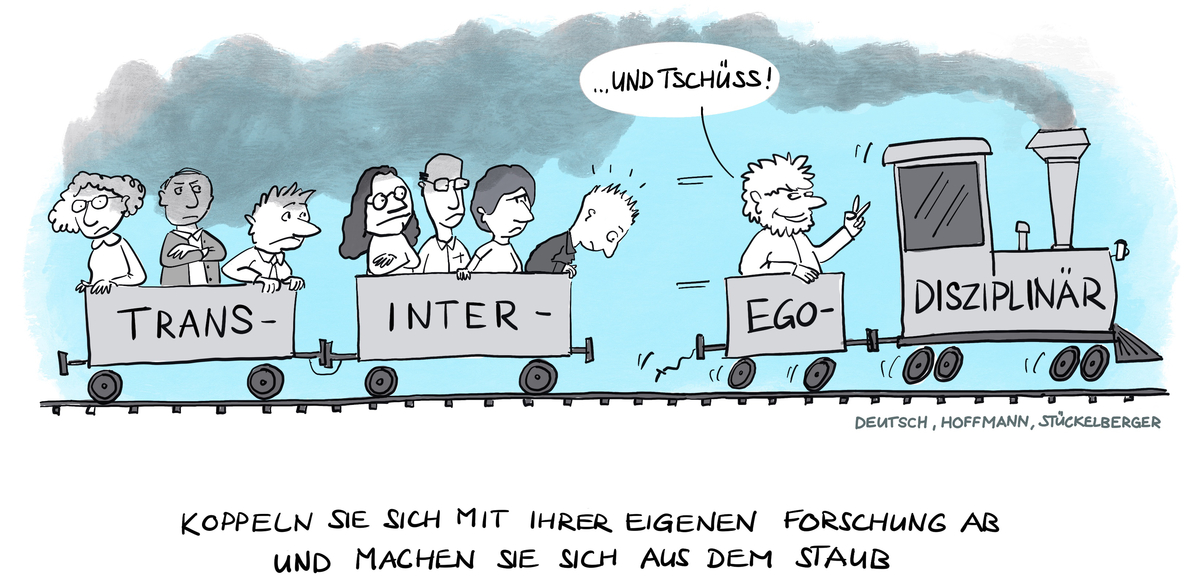
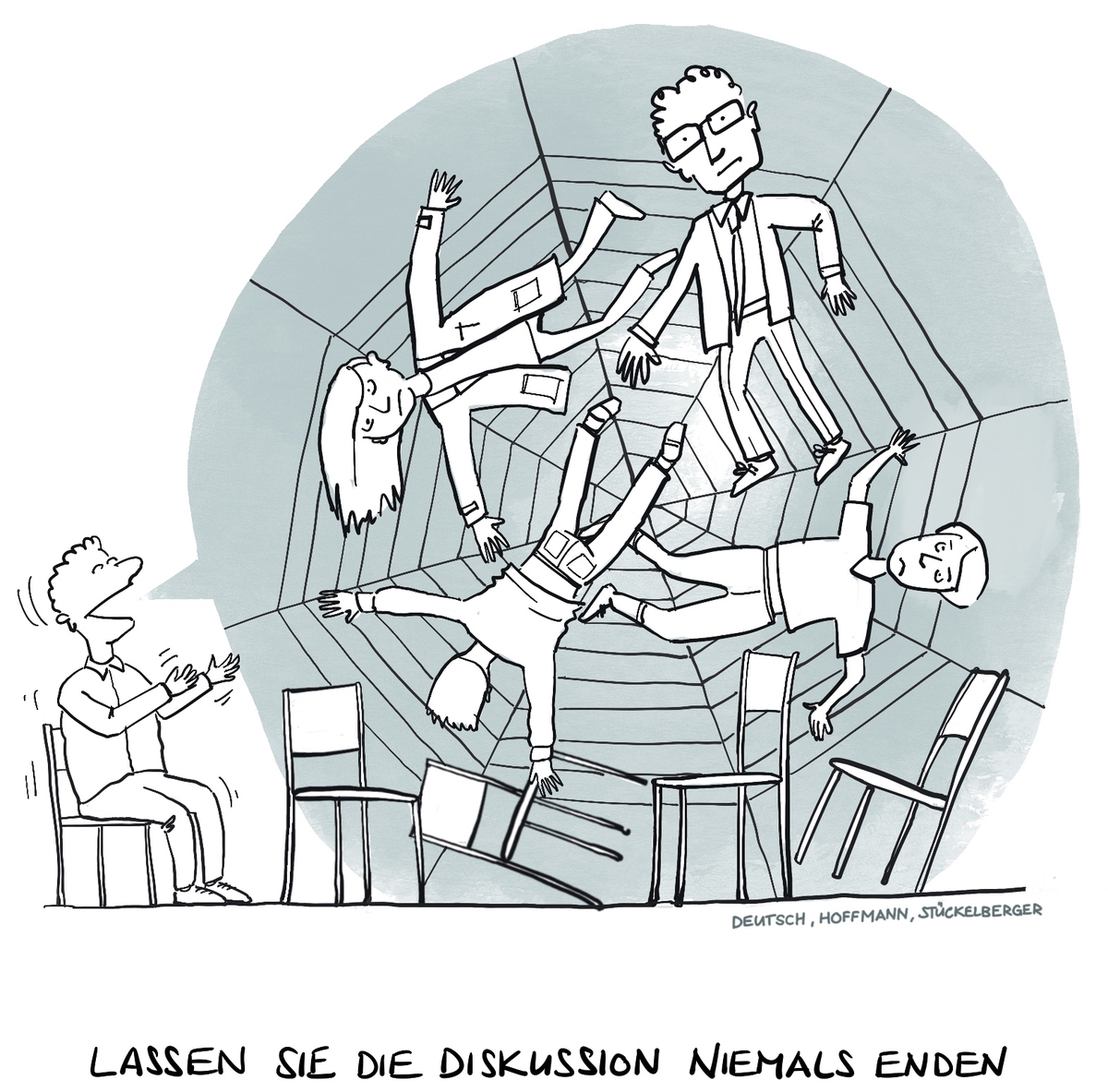
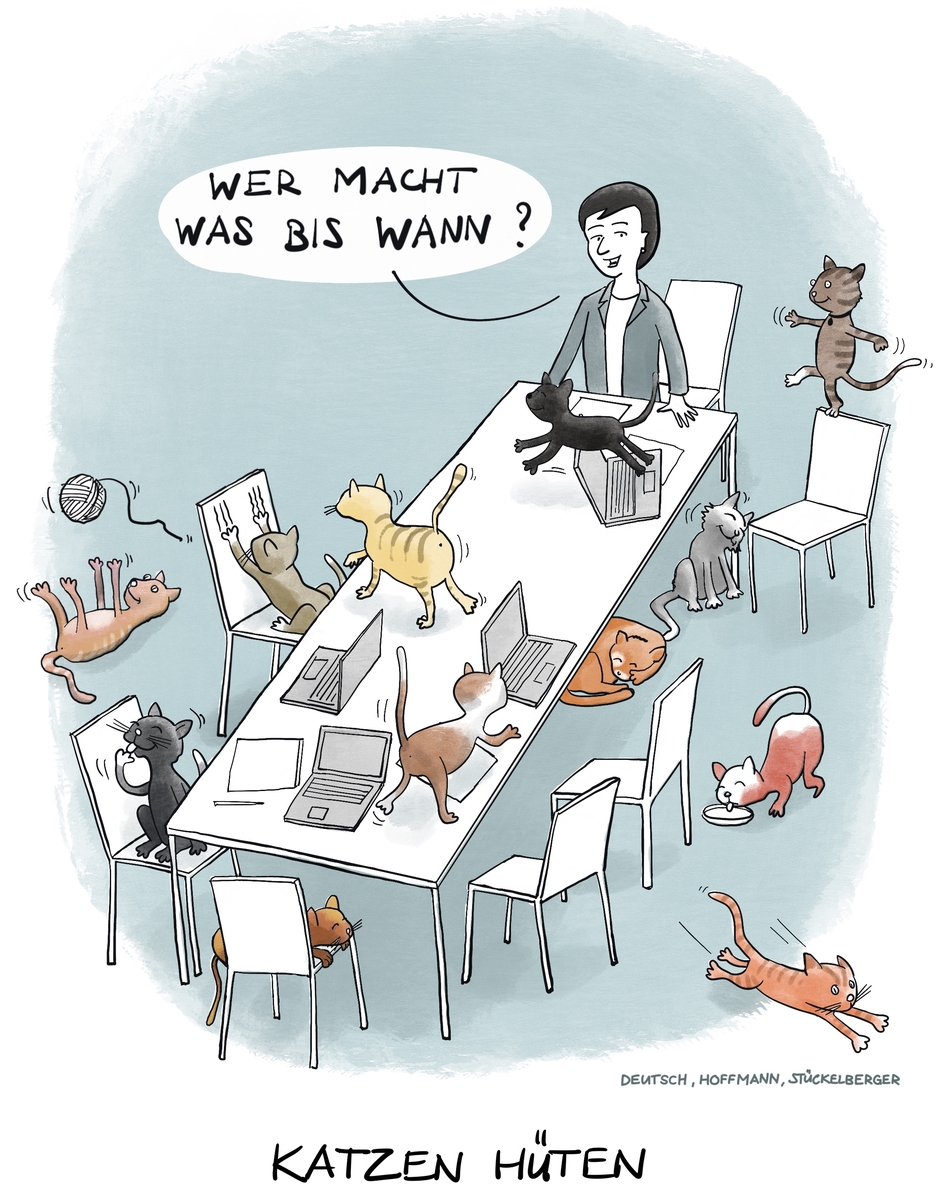
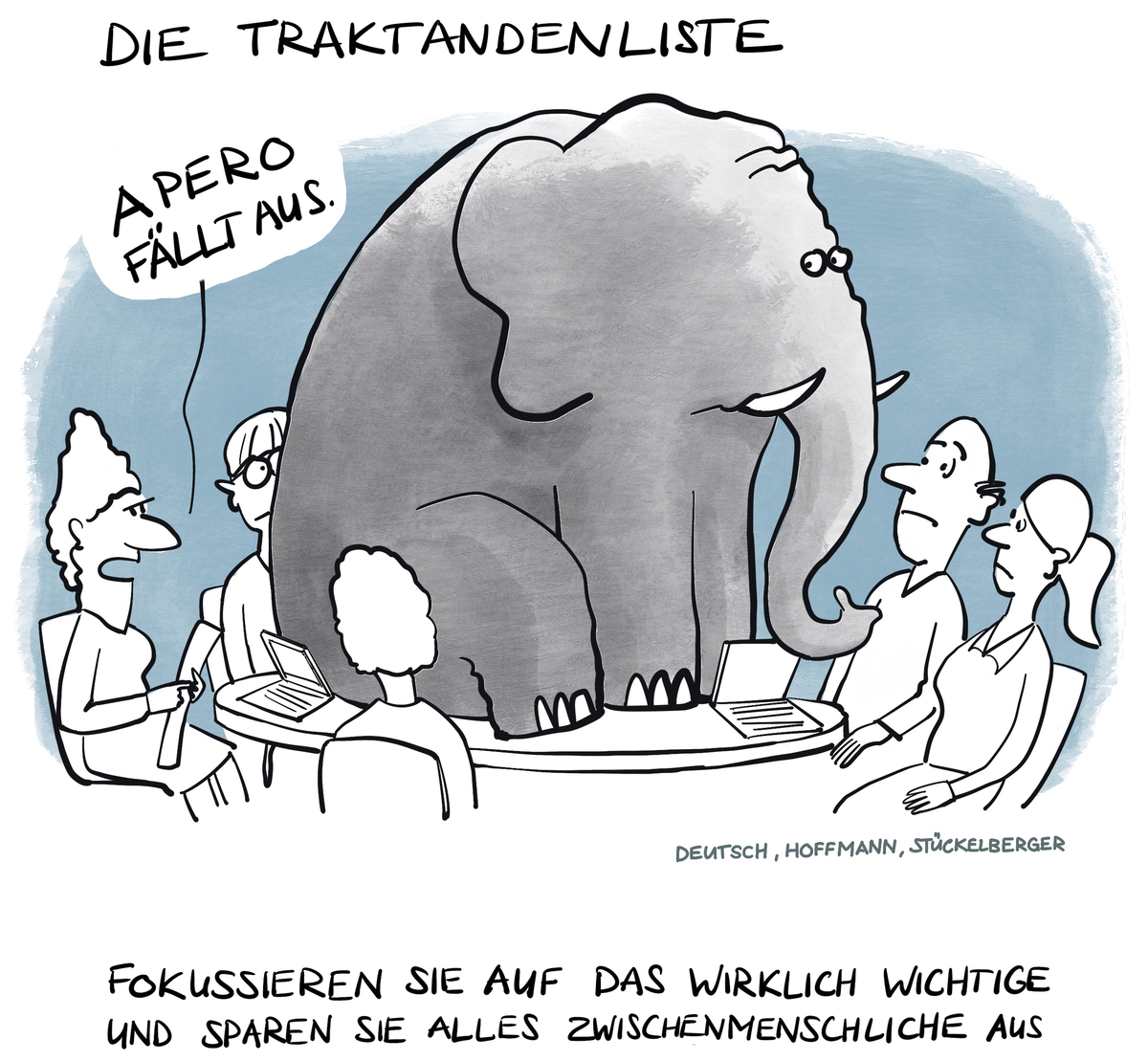
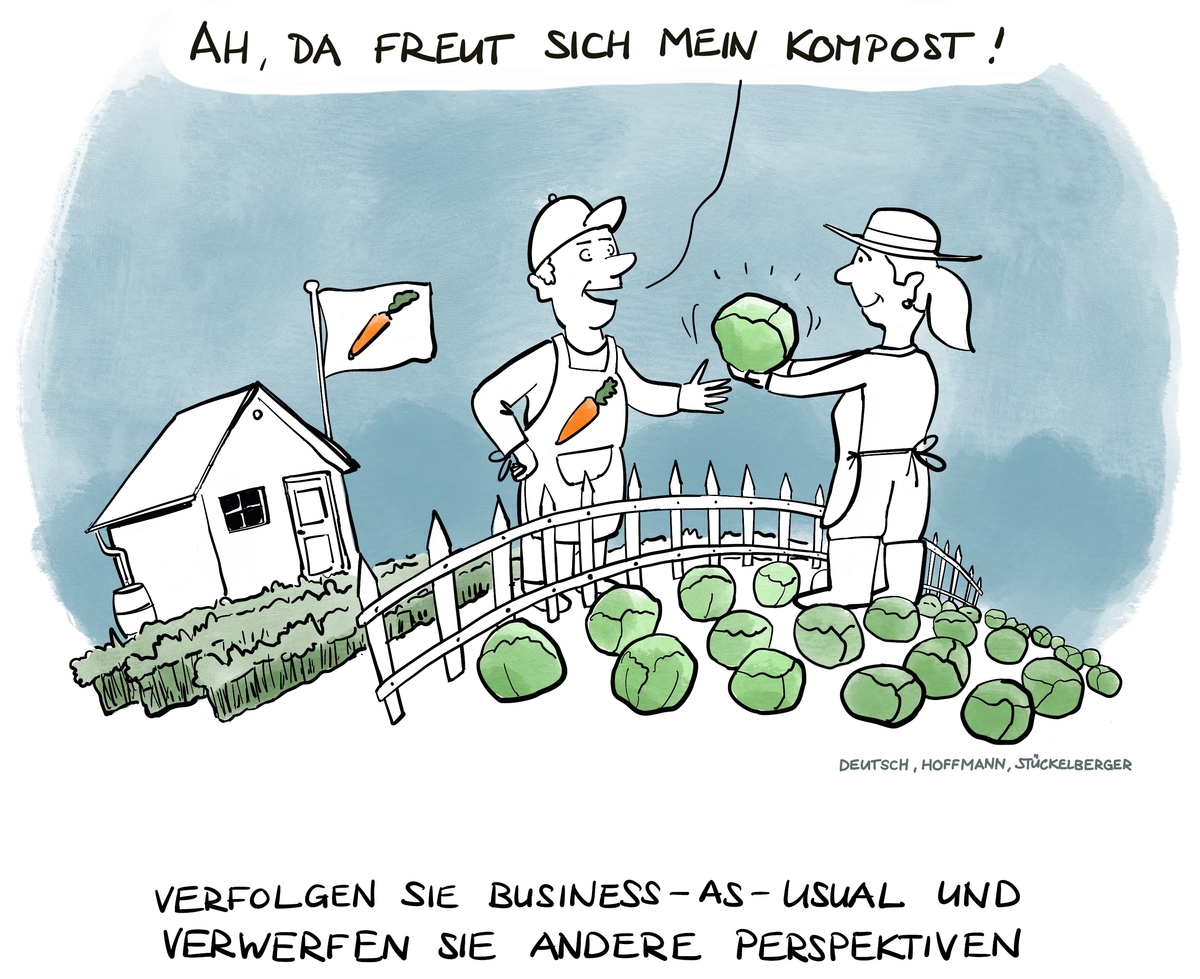
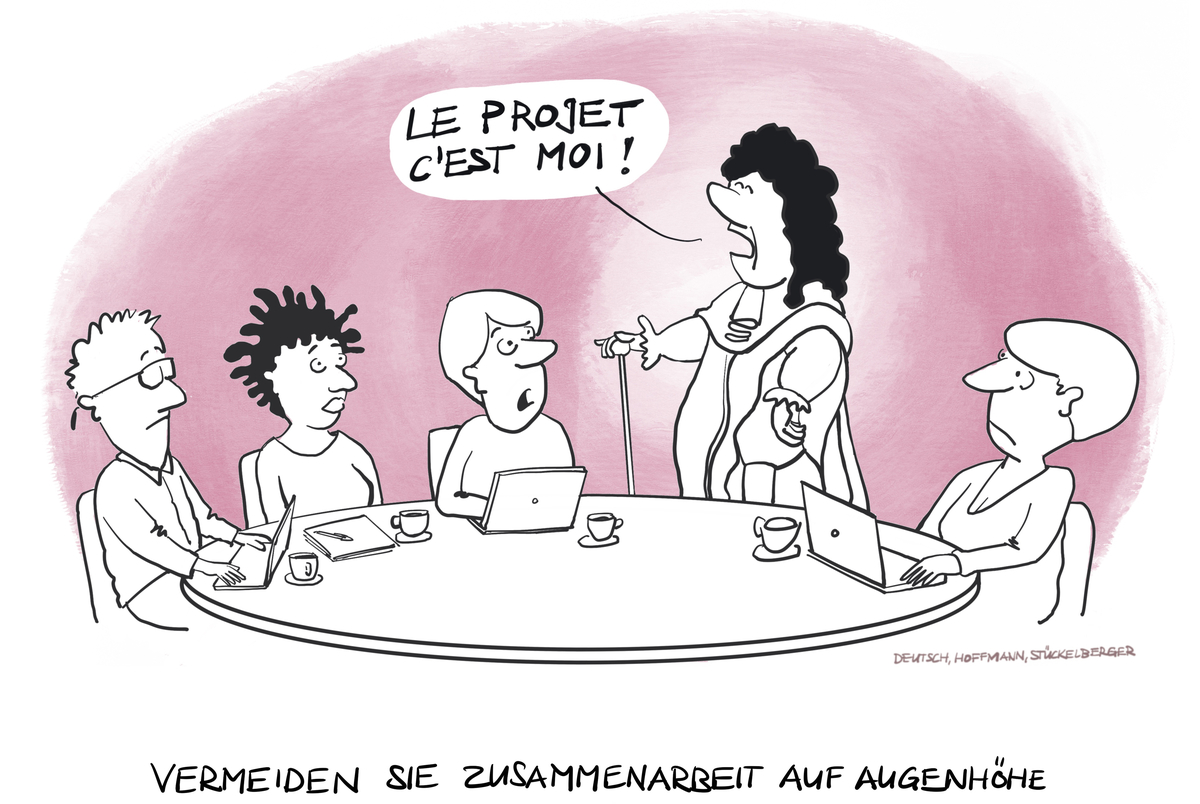
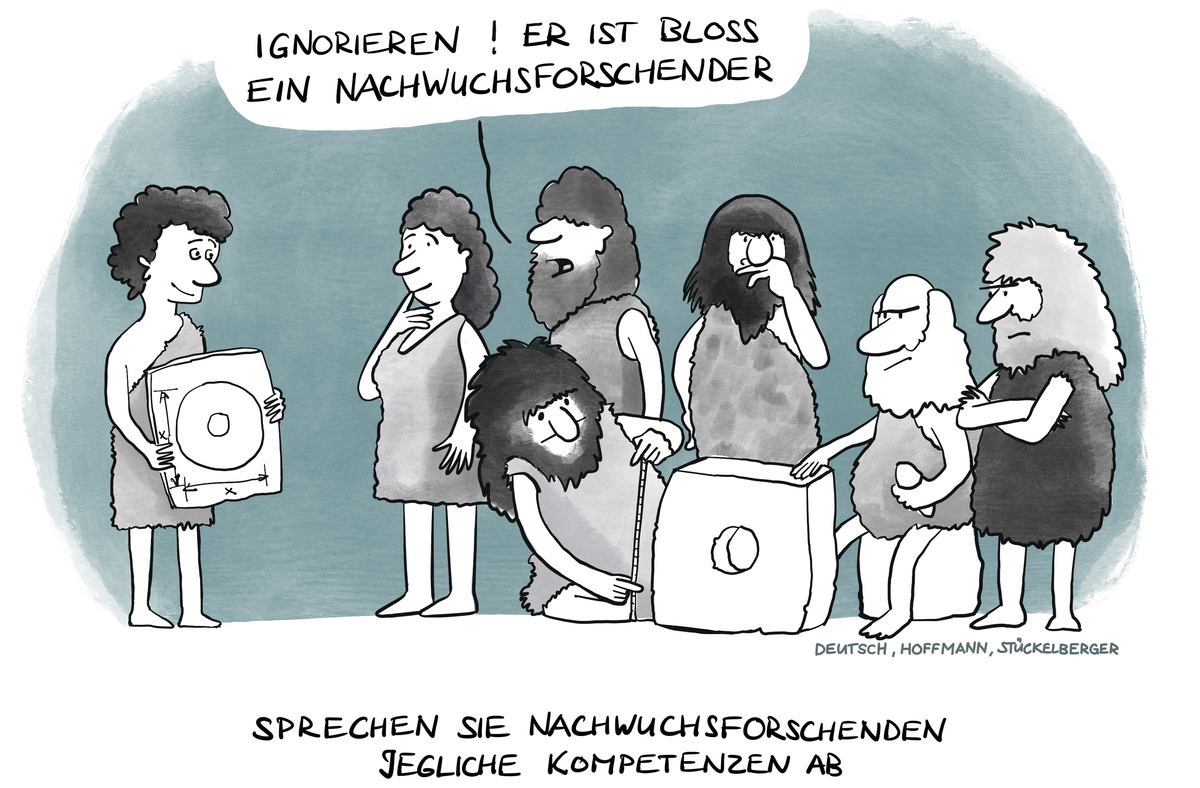
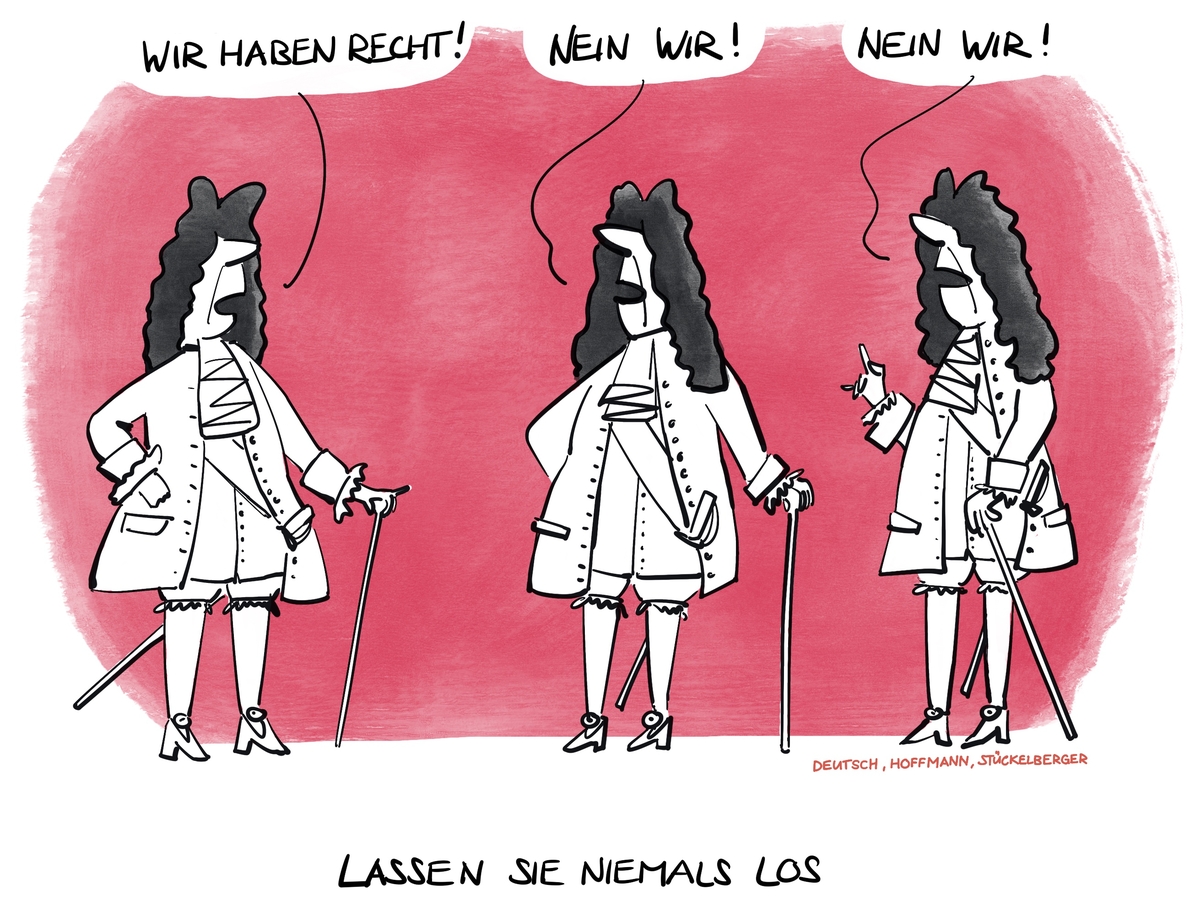
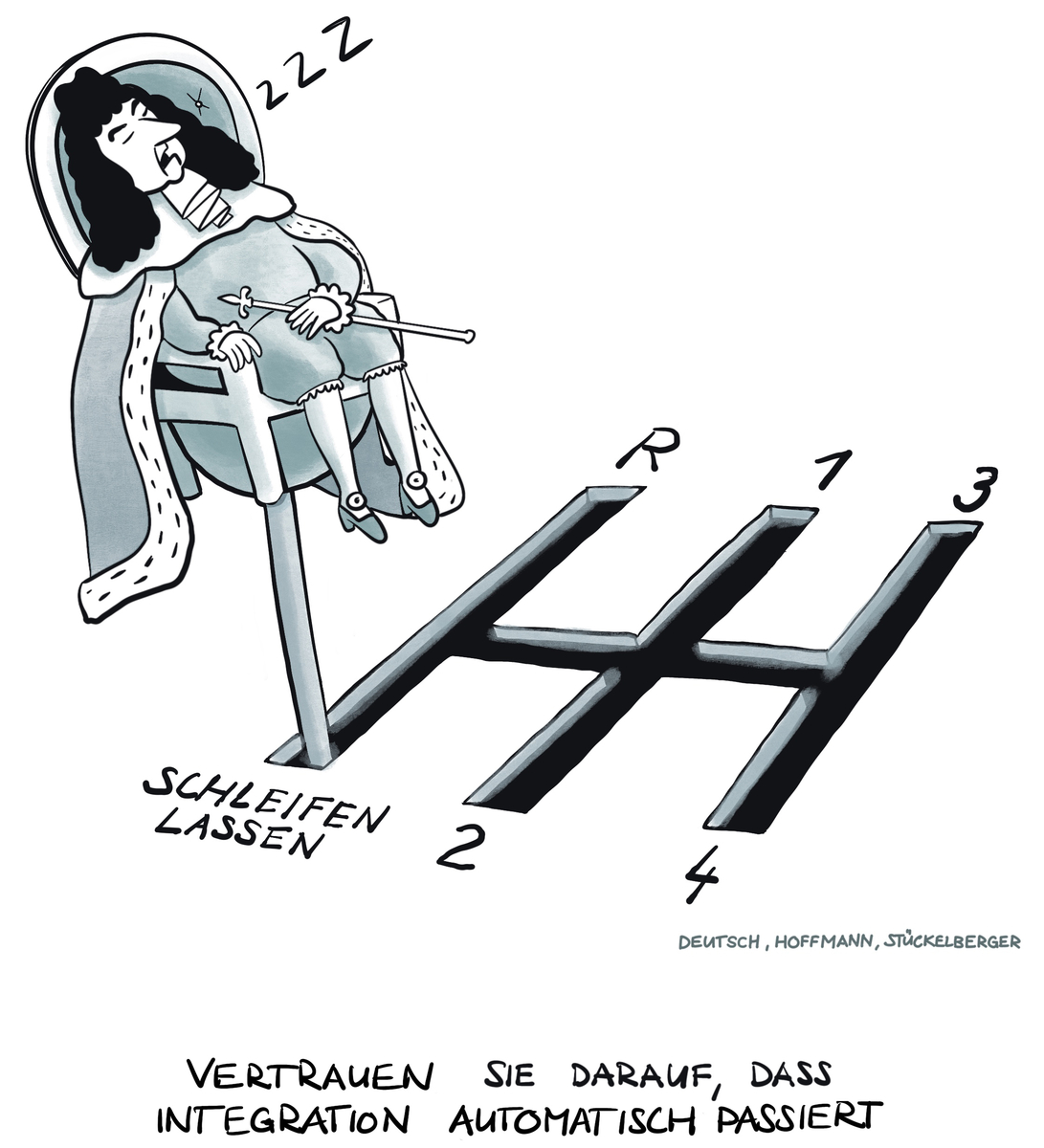
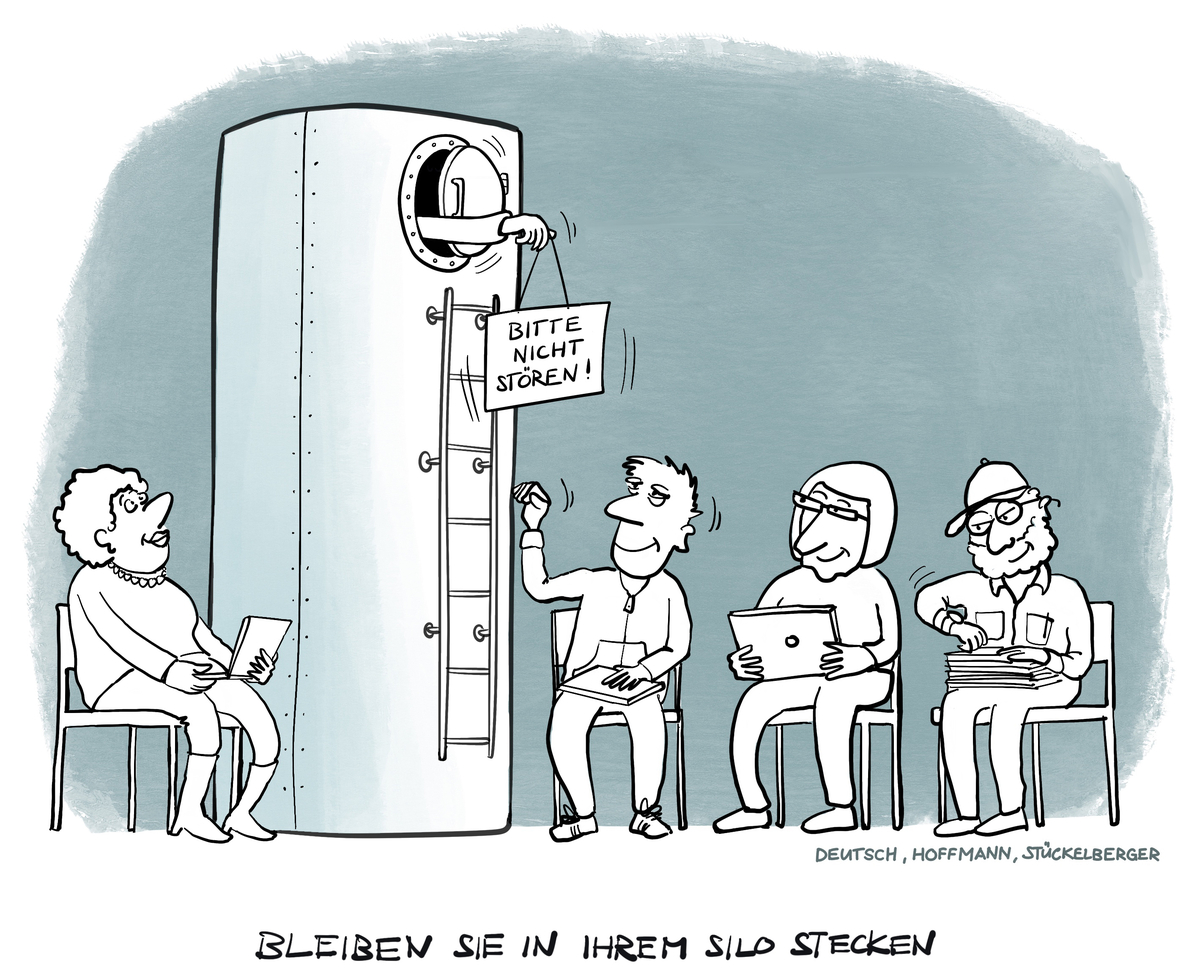
Une collaboration réussie dans des projets de recherche inter et transdisciplinaires (ITD) est un défi. Une série de bandes dessinées illustre avec humour le meilleur moyen de vouer celle-ci à l’échec. Les scènes représentées sont censées fournir des pistes de réflexion transdisciplinaires. Elles invitent à remettre en question le comportement de chaque partie prenante et à discuter avec les membres de l’équipe des mesures à mettre en œuvre pour réussir la recherche ITD.
Scènes de la recherche inter- et transdisciplinaire
Comment la collaboration inter- et transdisciplinaire est garantie d'échouer
Les dessins animés sont également disponibles en anglais.
AlphasD
Interdisziplinär
ArbeitsauftragD
Interdisziplinär
AutopilotD
Interdisziplinär
EisenbahnD
Interdisziplinär
EndloseDiskussionD
Interdisziplinär
HerdingCatsD
Interdisziplinär
KeinAperoD
Interdisziplinär
KompostD
Interdisziplinär
LEtatE
Interdisziplinär
NachwuchsD
Interdisziplinär
PerspektiveD
Interdisziplinär
SchleifenLassenD
Interdisziplinär
SiloD2
Interdisziplinär
SyntheseD
Interdisziplinär
UBootD
Interdisziplinär
Des pistes de réflexion interdisciplinaires
La recherche inter et transdisciplinaire est de tous les débats, et est envisagée dans de plus en plus de demandes de projets. Pourtant, la collaboration entre diverses disciplines ainsi qu’avec les parties prenantes de la pratique et de la politique reste un défi pour l’ensemble des personnes impliquées, des responsables de projet et des équipes. Une série de bandes dessinées illustre avec humour le meilleur moyen de vouer celle-ci à l’échec. En effet, le remède idéal pour surmonter les expériences frustrantes est de les prendre à la légère et d’en rire ensemble. Certaines et certains se reconnaîtront peut-être dans les situations évoquées dans les dessins. Car ces bandes dessinées souhaitent ainsi donner des pistes de réflexion. Elles invitent à remettre en question le comportement de chaque partie prenante, à engager le dialogue avec d’autres chercheuses et chercheurs, et à trouver des pistes pour enjamber les frontières disciplinaires et réussir l’intégration au-delà de celles-ci.
Ces bandes dessinées ont déjà été exposées plusieurs fois, notamment à l’Institut de recherche sur l’eau Eawag et à l’«International Transdisciplinarity (ITD) 2024 Conference» à Utrecht, aux Pays-Bas. Elles peuvent être utilisées gratuitement pour d’autres expositions en mentionnant les ayants droit et leur travail. De plus amples informations à ce sujet sont disponibles ci-dessous (voir «Utilisation des bandes dessinées»).
Histoire de la création des bandes dessinées
La série de bandes dessinées repose sur les résultats d’une «stratégie du poirier», une technique de changement de perspective utilisée lors de certains ateliers dans le cadre de divers programmes de recherche ITD pour discuter d’un point de vue différent et plus léger le défi d’«intégration», chargé émotionnellement. Il a été demandé aux participantes et participants d’élaborer des approches, attitudes et stratégies concrètes afin de garantir que l’intégration à leurs programmes échoue à coup sûr. Les résultats de ces ateliers ont été consignés dans une série de bandes dessinées, qui transmettent aux responsables de projets et de programmes ainsi qu’aux membres des équipes, des connaissances exploitables pour empêcher activement l’intégration dans la pratique.
Mais l’œuvre graphique ne s’arrête pas là: elle invite à réfléchir sur les scènes représentées et à imaginer comment elles pourraient être modifiées ou renversées pour aboutir à une intégration proactive. Deux publications remarquables du projet proposent des leviers concrets pour développer des mesures permettant d’améliorer les conditions générales pour l’intégration ainsi que des stratégies de management pour maîtriser les défis qui y sont liés:
Utilisation pour exposition: la série de bandes dessinées a déjà été exposée à plusieurs reprises, notamment à l’Eawag ainsi que dans le cadre de la conférence international sur l’inter et la transdisciplinarité à Utrecht (Pays-Bas) en 2024. Elle peut être exposée gratuitement dans d’autres contextes. Si vous souhaitez organiser une exposition des bandes dessinées, vous devez citer la source ainsi que les auteurs et autrices (voir ci-dessus), et utilisez deux affiches explicatives (en allemand et en anglais).
N’hésitez pas à nous faire part du contexte ou des finalités pour lesquels vous avez utilisé les bandes dessinées ou organisé une exposition, en envoyant un e-mail à Lisa Deutsch ou Sabine Hoffmann.
array(6 items)0 => Snowflake\Publications\Domain\Model\Publicationprototypepersistent entity (uid=33843, pid=124)originalId => protected33843 (integer)
authors => protected'Deutsch, L.; Pohl, C.; Bresch, D. N.; Hoffmann, S.' (75 chars)
title => protected' ' (125 chars)
journal => protected'Global Environmental Change' (27 chars)
year => protected2025 (integer)
volume => protected91 (integer)
issue => protected'' (0 chars)
startpage => protected'102963 (15 pp.)' (15 chars)
otherpage => protected'' (0 chars)
categories => protected'interdisciplinary; transdisciplinary; integration; environmental change; sus tainability; science to action; critical realism' (124 chars)
description => protected'Complex global social-ecological challenges of our time such as climate chan ge, biodiversity loss or, more recently, the Covid-19 pandemic can neither b e comprehensively understood nor properly addressed by employing a single di sciplinary or sectoral perspective. For this reason, more and more large int er- and transdisciplinary (ITD) initiatives are on the rise, intending to op en up the silo-like production of knowledge and to advance the integration o f different fields of expertise within academia, but also across science, po licy and practice. While the need for ITD initiatives in order to both under stand and address the complexity of such global socio-ecological challenges has increasingly been acknowledged by research institutions, funders and pub lic authorities, a question remains concerning the extent to which prevailin g conditions suffice for conducting ITD research, particularly in terms of w hether the envisioned integration of perspectives and actors really happen i n practice. This paper embraces a holistic view on ITD integration by presen ting both an analytical framework and empirical insights from three ITD init iatives based in Switzerland dealing with sustainable urban water management , (future) extreme events and cross-sectoral climate impacts and climate ser vices in different socio-economic contexts. The framework is based on critic al realist reasoning and employs a structure-agency lens by distinguishing c onditions of integration at different structural levels, while also acknowle dging the power of actors to shape integration and the respective structures . The paper thereby illustrates and helps diagnose the source of challenges experienced in living up to ITD integration endeavors and how these differen t structural levels are interrelated and impact ITD integration. We conclude by discussing entry points for action aimed at transforming currently unfav orable structures into favorable ones. We thereby intend to provide, in part icular, insights for a w...' (2196 chars)
serialnumber => protected'0959-3780' (9 chars)
doi => protected'10.1016/j.gloenvcha.2024.102963' (31 chars)
uid => protected33843 (integer)
_localizedUid => protected33843 (integer)modified_languageUid => protectedNULL
_versionedUid => protected33843 (integer)modifiedpid => protected124 (integer)1 => Snowflake\Publications\Domain\Model\Publicationprototypepersistent entity (uid=33548, pid=124)originalId => protected33548 (integer)
authors => protected'Deutsch, L.; Björnsen, A.; Fischer, A. M.; Hama, A . M.; Zimmermann, N. E.; Zurbrügg, C.; Hoffmann, S .' (153 chars)
title => protected'Herding cats: integrative leadership strategies in inter- and transdisciplin ary research programs' (97 chars)
journal => protected'Sustainability Science' (22 chars)
year => protected2025 (integer)
volume => protected20 (integer)
issue => protected'' (0 chars)
startpage => protected'95' (2 chars)
otherpage => protected'115' (3 chars)
categories => protected'leadership; interdisciplinary; transdisciplinary; integration; research prog rams; actionable knowledge' (102 chars)
description => protected'This paper focuses on the critical role of integrative leadership in inter- and transdisciplinary (ITD) research programs. ITD programs have become one of academia's responses to address contemporary sustainability challenges. F ulfilling the promise of such programs is extraordinarily challenging for al l involved participants, but especially for program leaders who have to ensu re that the perspectives of the involved program participants become truly i ntegrated and that final and useful synthesis outputs are created. We presen t six core leadership challenges and respective strategies to address them t o advance integration within ITD programs. These challenges include (1) mast ering complexity and ambiguity, (2) advancing decision-making with lateral l eadership, (3) ensuring responsibility and accountability, (4) setting progr am boundaries, (5) selecting suitable projects, and (6) dealing with misconc eptions. We derived these challenges and respective strategies from both lea ding and studying in-depth three ITD programs focusing on sustainability iss ues in Switzerland. With this paper, we intend to promote awareness about th e range of leadership challenges in ITD programs and provide actionable know ledge, which can support in particular fellow and future leaders, but also f unders and heads of research institutions in their efforts to realize the in tegrative potential of such programs.' (1405 chars)
serialnumber => protected'1862-4065' (9 chars)
doi => protected'10.1007/s11625-024-01585-4' (26 chars)
uid => protected33548 (integer)
_localizedUid => protected33548 (integer)modified_languageUid => protectedNULL
_versionedUid => protected33548 (integer)modifiedpid => protected124 (integer)2 => Snowflake\Publications\Domain\Model\Publicationprototypepersistent entity (uid=33599, pid=124)originalId => protected33599 (integer)
authors => protected'Deutsch, L.' (16 chars)
title => protected'Practicing integration in inter- and transdisciplinary research: the role of enabling conditions and integrative leadership' (123 chars)
journal => protected'' (0 chars)
year => protected2024 (integer)
volume => protected0 (integer)
issue => protected'' (0 chars)
startpage => protected'145 p' (10 chars)
otherpage => protected'' (0 chars)
categories => protected'' (0 chars)
description => protected'Given the complexity of contemporary societal challenges such as climate cha nge, sustainability transformations and pandemics, the question of how these challenges can be adequately addressed has become increasingly urgent in re cent years. In the highly differentiated societies of the 21st century, ther e is generally no shortage of experts who can make a valuable contribution t o addressing these problems. However, what tends to be lacking is a meaningf ul integration of these individual perspectives across disciplinary boundari es (interdisciplinarity) as well as the integration of knowledge from scienc e, policy and practice (transdisciplinarity) in order to avoid a one-sided u nderstanding of and solution to the aforementioned challenges. For this reas on, more and more inter- and transdisciplinary research programs are being s et up to address societally relevant issues by bundling several projects und er one roof and involving a large number of different disciplines and stakeh olders. However, this integration does not take place automatically, but mus t be proactively encouraged, fostered and led. This dissertation aims to con tribute to the theoretical understanding as well as the practical implementa tion of inter- and transdisciplinary (ITD) integration in research programs and projects by embracing three research foci: (a) the role of conditions un der which ITD integration takes place (<em>structures</em>), (b) the role of integrative leadership to advance ITD integration processes (<em>agency</em >), and (c) the role of integrative methods to facilitate ITD integration (< em>means</em>). [...]' (1617 chars)
serialnumber => protected'' (0 chars)
doi => protected'10.3929/ethz-b-000698963' (24 chars)
uid => protected33599 (integer)
_localizedUid => protected33599 (integer)modified_languageUid => protectedNULL
_versionedUid => protected33599 (integer)modifiedpid => protected124 (integer)3 => Snowflake\Publications\Domain\Model\Publicationprototypepersistent entity (uid=33066, pid=124)originalId => protected33066 (integer)
authors => protected'Hoffmann, S.; Deutsch, L.; O’Rourke, M.' (56 chars)
title => protected'Integration experts and expertise' (33 chars)
journal => protected'In: Darbellay, F. (Eds.), Elgar encyclopedia of interdisciplinarity and transdisciplinarity' (96 chars)
year => protected2024 (integer)
volume => protected0 (integer)
issue => protected'' (0 chars)
startpage => protected'273' (3 chars)
otherpage => protected'276' (3 chars)
categories => protected'integration; expertise; interdisciplinarity; transdisciplinarity; experts; r oles' (80 chars)
description => protected'Integration experts and expertise are crucial for unfolding the full potenti al of inter- and transdisciplinary (ITD) research. Expanding on the concept of ITD integration, this entry focuses on integration experts, who lead, adm inister, manage, monitor, assess, accompany and/or advise others on integrat ion across different scientific disciplines (i.e., interdisciplinary integra tion) as well as across science, policy and practice (i.e., transdisciplinar y integration). The entry identifies the diverse roles integration experts p lay in ITD research projects or programs as integrative leaders, bridge buil ders, boundary crossers, translators, catalysts, facilitators, contributors, mediators, advisors, or evaluators. It also discloses the personal qualitie s (e.g., curiosity, sociability, creativity, reflexivity, humility) and expe rtise (e.g., contributory expertise, interactional expertise, referred exper tise) integration experts bring in to realize—together with all other proj ect or program members—the integrative potential of ITD projects or progra ms.' (1067 chars)
serialnumber => protected'' (0 chars)
doi => protected'10.4337/9781035317967.ch60' (26 chars)
uid => protected33066 (integer)
_localizedUid => protected33066 (integer)modified_languageUid => protectedNULL
_versionedUid => protected33066 (integer)modifiedpid => protected124 (integer)4 => Snowflake\Publications\Domain\Model\Publicationprototypepersistent entity (uid=24829, pid=124)originalId => protected24829 (integer)
authors => protected'Hoffmann, S.; Deutsch, L.; Thompson Klein, J.; O'Rourke,  ;M.' (79 chars)
title => protected'Integrate the integrators! A call for establishing academic careers for inte gration experts' (91 chars)
journal => protected'Humanities and Social Sciences Communications' (45 chars)
year => protected2022 (integer)
volume => protected9 (integer)
issue => protected'' (0 chars)
startpage => protected'147 (10 pp.)' (12 chars)
otherpage => protected'' (0 chars)
categories => protected'' (0 chars)
description => protected'Integration is often considered the core challenge and the defining characte ristic of inter- and trans-disciplinary (ITD) research. Given its importance , it is surprising that the current system of higher education does not prov ide permanent positions for integration experts; i.e., experts who lead, adm inister, manage, monitor, assess, accompany, and/or advise others on integra tion within ITD projects or programs. Based on empirical results of an ITD 2 019 Conference Workshop entitled "Is there a new profession of integration e xperts on the rise?" held in Gothenburg, Sweden, and our own experience in l eading and studying ITD integration, the present article sheds light on the overarching question, "What are integration experts?", thus contributing to the emerging literature on integration and integration expertise. We use dir ect quotes from participants to substantiate workshop results and triangulat e them with recent literature on ITD research as well as Science of Team Sci ence (SciTS) and Science and Technology Studies (STS). We conclude our artic le by discussing possible unintended consequences of establishing academic c areers for integration experts, and suggest four complementary ways to suppo rt them, while mitigating potentially negative consequences: (a) establishin g an international Community of Practice (CoP) to foster peer-to-peer exchan ge among integration experts, create greater visibility, and develop ideas f or transforming academic structures; (b) studying academic careers of integr ation experts to provide empirical evidence of "successful" examples and dis close different ways of establishing related academic positions; (c) funding respective positions and aligning metrics for ITD research to foster integr ation within ITD projects or programs; and (d) engaging in collaborative dia log with academic institutions and funding agencies to present empirical res ults and lessons learnt from (a) and (b) to support them in establishing and legitimating careers fo...' (2174 chars)
serialnumber => protected'' (0 chars)
doi => protected'10.1057/s41599-022-01138-z' (26 chars)
uid => protected24829 (integer)
_localizedUid => protected24829 (integer)modified_languageUid => protectedNULL
_versionedUid => protected24829 (integer)modifiedpid => protected124 (integer)5 => Snowflake\Publications\Domain\Model\Publicationprototypepersistent entity (uid=22292, pid=124)originalId => protected22292 (integer)
authors => protected'Deutsch, L.; Belcher, B.; Claus, R.; Hoffmann, S.' (69 chars)
title => protected'Leading inter- and transdisciplinary research: lessons from applying theorie s of change to a strategic research program' (119 chars)
journal => protected'Environmental Science and Policy' (32 chars)
year => protected2021 (integer)
volume => protected120 (integer)
issue => protected'' (0 chars)
startpage => protected'29' (2 chars)
otherpage => protected'41' (2 chars)
categories => protected'interdisciplinary; transdisciplinary; theory of change; leadership; urban wa ter management; research programs' (109 chars)
description => protected'Theory of Change (ToC) has been promoted as a useful tool in sustainability research for visioning, planning, communication, monitoring, evaluation and learning. It involves a mapping of steps towards a desired long-term goal su pplemented with continuous reflection on how and why change is expected to h appen in a particular context. However, there is limited reported experience with the development and application of ToCs in inter- and transdisciplinar y research contexts. While some previous publications have focused on ex-pos t application, there has been little discussion about the process of develop ing and using ToCs in strategic planning and monitoring in large inter- and transdisciplinary research programs. This article reports challenges and les sons learned from the experience of developing and using ToCs in the inter- and transdisciplinary research program <em>Wings</em> (<em>W</em>ater and sa nitation <strong>i</strong>nnovations for <em>n</em>on-<em>g</em>rid <em>s</ em>olutions). Challenges include (1) managing time constraints, (2) balancin g between concrete and abstract discussions, (3) ensuring diversity in group composition, (4) fluctuating between reservations and appreciation, and (5) fulfilling both service and science roles while leading the ToC process. Th e experience highlights the importance of alternating formal and informal in teraction formats throughout the process, ensuring heterogenous group format ion, involving early career scientists, being responsive to emergent needs a nd making the added value of developing and using ToCs explicit and tangible for all participants. Although these lessons are mainly derived from develo ping ToCs within the interdisciplinary program team, they can support other programs in both their inter- and transdisciplinary research endeavors.' (1819 chars)
serialnumber => protected'1462-9011' (9 chars)
doi => protected'10.1016/j.envsci.2021.02.009' (28 chars)
uid => protected22292 (integer)
_localizedUid => protected22292 (integer)modified_languageUid => protectedNULL
_versionedUid => protected22292 (integer)modifiedpid => protected124 (integer)
Creating favorable conditions for inter- and transdisciplinary integration – an analytical framework and empirical insights
Complex global social-ecological challenges of our time such as climate change, biodiversity loss or, more recently, the Covid-19 pandemic can neither be comprehensively understood nor properly addressed by employing a single disciplinary or sectoral perspective. For this reason, more and more large inter- and transdisciplinary (ITD) initiatives are on the rise, intending to open up the silo-like production of knowledge and to advance the integration of different fields of expertise within academia, but also across science, policy and practice. While the need for ITD initiatives in order to both understand and address the complexity of such global socio-ecological challenges has increasingly been acknowledged by research institutions, funders and public authorities, a question remains concerning the extent to which prevailing conditions suffice for conducting ITD research, particularly in terms of whether the envisioned integration of perspectives and actors really happen in practice. This paper embraces a holistic view on ITD integration by presenting both an analytical framework and empirical insights from three ITD initiatives based in Switzerland dealing with sustainable urban water management, (future) extreme events and cross-sectoral climate impacts and climate services in different socio-economic contexts. The framework is based on critical realist reasoning and employs a structure-agency lens by distinguishing conditions of integration at different structural levels, while also acknowledging the power of actors to shape integration and the respective structures. The paper thereby illustrates and helps diagnose the source of challenges experienced in living up to ITD integration endeavors and how these different structural levels are interrelated and impact ITD integration. We conclude by discussing entry points for action aimed at transforming currently unfavorable structures into favorable ones. We thereby intend to provide, in particular, insights for a wide range of actors interested in making sure that ITD initiatives intended to address the global social-ecological challenges of our time can realize their full integration potential in practice.
Deutsch, L.; Pohl, C.; Bresch, D. N.; Hoffmann, S. (2025) Creating favorable conditions for inter- and transdisciplinary integration – an analytical framework and empirical insights, Global Environmental Change, 91, 102963 (15 pp.), doi:10.1016/j.gloenvcha.2024.102963, Institutional Repository
Herding cats: integrative leadership strategies in inter- and transdisciplinary research programs
This paper focuses on the critical role of integrative leadership in inter- and transdisciplinary (ITD) research programs. ITD programs have become one of academia's responses to address contemporary sustainability challenges. Fulfilling the promise of such programs is extraordinarily challenging for all involved participants, but especially for program leaders who have to ensure that the perspectives of the involved program participants become truly integrated and that final and useful synthesis outputs are created. We present six core leadership challenges and respective strategies to address them to advance integration within ITD programs. These challenges include (1) mastering complexity and ambiguity, (2) advancing decision-making with lateral leadership, (3) ensuring responsibility and accountability, (4) setting program boundaries, (5) selecting suitable projects, and (6) dealing with misconceptions. We derived these challenges and respective strategies from both leading and studying in-depth three ITD programs focusing on sustainability issues in Switzerland. With this paper, we intend to promote awareness about the range of leadership challenges in ITD programs and provide actionable knowledge, which can support in particular fellow and future leaders, but also funders and heads of research institutions in their efforts to realize the integrative potential of such programs.
Deutsch, L.; Björnsen, A.; Fischer, A. M.; Hama, A. M.; Zimmermann, N. E.; Zurbrügg, C.; Hoffmann, S. (2025) Herding cats: integrative leadership strategies in inter- and transdisciplinary research programs, Sustainability Science, 20, 95-115, doi:10.1007/s11625-024-01585-4, Institutional Repository
Practicing integration in inter- and transdisciplinary research: the role of enabling conditions and integrative leadership
Given the complexity of contemporary societal challenges such as climate change, sustainability transformations and pandemics, the question of how these challenges can be adequately addressed has become increasingly urgent in recent years. In the highly differentiated societies of the 21st century, there is generally no shortage of experts who can make a valuable contribution to addressing these problems. However, what tends to be lacking is a meaningful integration of these individual perspectives across disciplinary boundaries (interdisciplinarity) as well as the integration of knowledge from science, policy and practice (transdisciplinarity) in order to avoid a one-sided understanding of and solution to the aforementioned challenges. For this reason, more and more inter- and transdisciplinary research programs are being set up to address societally relevant issues by bundling several projects under one roof and involving a large number of different disciplines and stakeholders. However, this integration does not take place automatically, but must be proactively encouraged, fostered and led. This dissertation aims to contribute to the theoretical understanding as well as the practical implementation of inter- and transdisciplinary (ITD) integration in research programs and projects by embracing three research foci: (a) the role of conditions under which ITD integration takes place (structures), (b) the role of integrative leadership to advance ITD integration processes (agency), and (c) the role of integrative methods to facilitate ITD integration (means). [...]
Integration experts and expertise are crucial for unfolding the full potential of inter- and transdisciplinary (ITD) research. Expanding on the concept of ITD integration, this entry focuses on integration experts, who lead, administer, manage, monitor, assess, accompany and/or advise others on integration across different scientific disciplines (i.e., interdisciplinary integration) as well as across science, policy and practice (i.e., transdisciplinary integration). The entry identifies the diverse roles integration experts play in ITD research projects or programs as integrative leaders, bridge builders, boundary crossers, translators, catalysts, facilitators, contributors, mediators, advisors, or evaluators. It also discloses the personal qualities (e.g., curiosity, sociability, creativity, reflexivity, humility) and expertise (e.g., contributory expertise, interactional expertise, referred expertise) integration experts bring in to realize—together with all other project or program members—the integrative potential of ITD projects or programs.
Hoffmann, S.; Deutsch, L.; O’Rourke, M. (2024) Integration experts and expertise, In: Darbellay, F. (Eds.), Elgar encyclopedia of interdisciplinarity and transdisciplinarity, 273-276, doi:10.4337/9781035317967.ch60, Institutional Repository
Integrate the integrators! A call for establishing academic careers for integration experts
Integration is often considered the core challenge and the defining characteristic of inter- and trans-disciplinary (ITD) research. Given its importance, it is surprising that the current system of higher education does not provide permanent positions for integration experts; i.e., experts who lead, administer, manage, monitor, assess, accompany, and/or advise others on integration within ITD projects or programs. Based on empirical results of an ITD 2019 Conference Workshop entitled "Is there a new profession of integration experts on the rise?" held in Gothenburg, Sweden, and our own experience in leading and studying ITD integration, the present article sheds light on the overarching question, "What are integration experts?", thus contributing to the emerging literature on integration and integration expertise. We use direct quotes from participants to substantiate workshop results and triangulate them with recent literature on ITD research as well as Science of Team Science (SciTS) and Science and Technology Studies (STS). We conclude our article by discussing possible unintended consequences of establishing academic careers for integration experts, and suggest four complementary ways to support them, while mitigating potentially negative consequences: (a) establishing an international Community of Practice (CoP) to foster peer-to-peer exchange among integration experts, create greater visibility, and develop ideas for transforming academic structures; (b) studying academic careers of integration experts to provide empirical evidence of "successful" examples and disclose different ways of establishing related academic positions; (c) funding respective positions and aligning metrics for ITD research to foster integration within ITD projects or programs; and (d) engaging in collaborative dialog with academic institutions and funding agencies to present empirical results and lessons learnt from (a) and (b) to support them in establishing and legitimating careers for integration experts. If academia is to be serious about addressing the most pressing environmental and societal problems of our time, it needs to integrate its integrators.
Hoffmann, S.; Deutsch, L.; Thompson Klein, J.; O'Rourke, M. (2022) Integrate the integrators! A call for establishing academic careers for integration experts, Humanities and Social Sciences Communications, 9, 147 (10 pp.), doi:10.1057/s41599-022-01138-z, Institutional Repository
Leading inter- and transdisciplinary research: lessons from applying theories of change to a strategic research program
Theory of Change (ToC) has been promoted as a useful tool in sustainability research for visioning, planning, communication, monitoring, evaluation and learning. It involves a mapping of steps towards a desired long-term goal supplemented with continuous reflection on how and why change is expected to happen in a particular context. However, there is limited reported experience with the development and application of ToCs in inter- and transdisciplinary research contexts. While some previous publications have focused on ex-post application, there has been little discussion about the process of developing and using ToCs in strategic planning and monitoring in large inter- and transdisciplinary research programs. This article reports challenges and lessons learned from the experience of developing and using ToCs in the inter- and transdisciplinary research program Wings (Water and sanitation innovations for non-grid solutions). Challenges include (1) managing time constraints, (2) balancing between concrete and abstract discussions, (3) ensuring diversity in group composition, (4) fluctuating between reservations and appreciation, and (5) fulfilling both service and science roles while leading the ToC process. The experience highlights the importance of alternating formal and informal interaction formats throughout the process, ensuring heterogenous group formation, involving early career scientists, being responsive to emergent needs and making the added value of developing and using ToCs explicit and tangible for all participants. Although these lessons are mainly derived from developing ToCs within the interdisciplinary program team, they can support other programs in both their inter- and transdisciplinary research endeavors.
Deutsch, L.; Belcher, B.; Claus, R.; Hoffmann, S. (2021) Leading inter- and transdisciplinary research: lessons from applying theories of change to a strategic research program, Environmental Science and Policy, 120, 29-41, doi:10.1016/j.envsci.2021.02.009, Institutional Repository