Détail de l'archive

Des détoxifiants de la décharge

18 juin 2021 | Annette Ryser

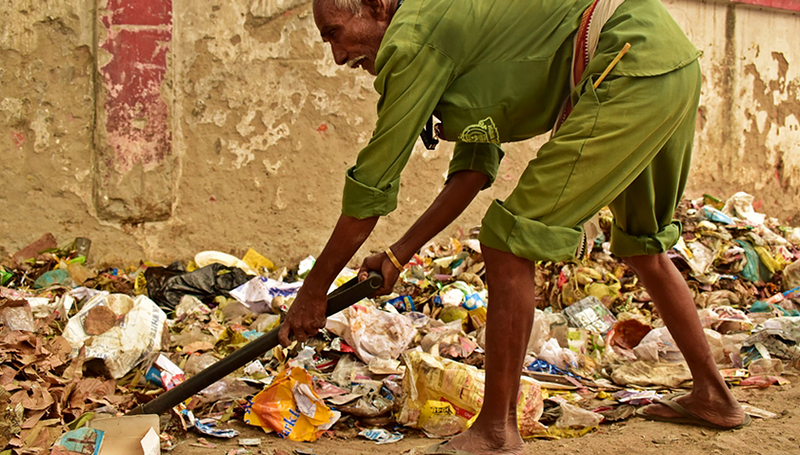
Des bactéries provenant d'une décharge indienne pourraient contribuer à éliminer la contamination chimique. L'accent est mis sur les pesticides tels que le lindane ou les agents ignifuges bromés, qui s'accumulent dans la nature et dans les chaînes alimentaires. Les chercheurs de l'Eawag et de l'Empa ont utilisé des bactéries pour produire des enzymes capables de décomposer ces produits chimiques.

Pouvons-nous récupérer ou rendre inoffensifs les déchets chimiques des générations passées? Le microbiologiste Hans Peter Kohler de l’institut de recherche de l’eau Eawag et le chimiste de l'Empa Norbert Heeb, ainsi que des chercheurs de l'Université des sciences appliquées de Zurich (ZHAW) et de deux instituts indiens, ont mis la question à l'épreuve.

Retrouvez l'article exhaustif sur ce sujet sur le site de l'Empa: Des détoxifiants de la décharge

Photo de couverture: Avinash Kumar für Unsplash

Coopérations

  • Empa
  • Université des sciences appliquées de Zurich (ZHAW)

Publication originale

Extbase Variable Dump
array(2 items)
   publications => '22027' (5 chars)
   libraryUrl => '' (0 chars)
Extbase Variable Dump
array(1 item)
   0 => Snowflake\Publications\Domain\Model\Publicationprototypepersistent entity (uid=22027, pid=124)
      originalId => protected22027 (integer)
      authors => protected'Heeb, N. V.; Hubeli, J.; Fleischmann, T.; Lienemann,&nbs
         p;P.; Nayyar, N.; Lal, R.; Kohler, H. P. E.
' (144 chars) title => protected'Transformation of ε-HBCD with the <em>Sphingobium Indicum</em> enzymes LinA
         1, LinA2 and LinATM, a triple mutant of LinA2
' (121 chars) journal => protected'Chemosphere' (11 chars) year => protected2021 (integer) volume => protected267 (integer) issue => protected'' (0 chars) startpage => protected'129217 (12 pp.)' (15 chars) otherpage => protected'' (0 chars) categories => protected'' (0 chars) description => protected'Hexabromocyclododecanes (HBCDs) were used as flame-retardants until their ba
         n in 2013. Among the 16 stereoisomers known, ε-HBCD has the highest symmetr
         y. This makes ε-HBCD an interesting substrate to study the selectivity of b
         iotransformations. We expressed three LinA dehydrohalogenase enzymes in <em>
         E. coli</em> bacteria, two wild-type, originating from <em>Sphingobium indic
         um</em> B90A bacteria and LinATM, a triple mutant of LinA2, with mutations o
         f L96C, F113Y and T133 M. These enzymes are involved in the hexachlorocycloh
         exane (HCH) metabolism, specifically of the insecticide γ-HCH (Lindane). We
          studied the reactivity of those eight HBCD stereoisomers found in technical
          HBCD. Furthermore, we compared kinetics and selectivity of these LinA varia
         nts with respect to ε-HBCD. LC-MS data indicate that all enzymes converted
         ε-HBCD to pentabromocyclododecenes (PBCDens). Transformations followed Mich
         aelis-Menten kinetics. Rate constants k<sub>cat</sub> and enzyme specificiti
         es k<sub>cat</sub>/K<sub>M</sub> indicate that ε-HBCD conversion was fastes
         t and most specific with LinA2. Only one PBCDen stereoisomer was formed by L
         inA2, while LinA1 and LinATM produced mixtures of two PBCDE enantiomers at t
         
         
          assume that 1E,5S,6R,9S,10R-PBCDen is the ε-HBCD transformation product fr
         om LinA2. Implementing three amino acids of the LinA1 substrate-binding site
          into LinA2 resulted in a triple mutant with similar kinetics and product sp
         ecificity like LinA1. Thus, point-directed mutagenesis is an interesting too
         l to modify the substrate- and product-specificity of LinA enzymes and enlar
         ge their scope to metabolize other halogenated persistent organic pollutants
          regulated under the Stockholm Convention.
' (1866 chars) serialnumber => protected'0045-6535' (9 chars) doi => protected'10.1016/j.chemosphere.2020.129217' (33 chars) uid => protected22027 (integer) _localizedUid => protected22027 (integer)modified _languageUid => protectedNULL _versionedUid => protected22027 (integer)modified pid => protected124 (integer)
Heeb, N. V.; Hubeli, J.; Fleischmann, T.; Lienemann, P.; Nayyar, N.; Lal, R.; Kohler, H. P. E. (2021) Transformation of ε-HBCD with the Sphingobium Indicum enzymes LinA1, LinA2 and LinATM, a triple mutant of LinA2, Chemosphere, 267, 129217 (12 pp.), doi:10.1016/j.chemosphere.2020.129217, Institutional Repository