Détail de l'archive

Les influences humaines sur la qualité des eaux souterraines

9 septembre 2019 | Stephanie Schnydrig

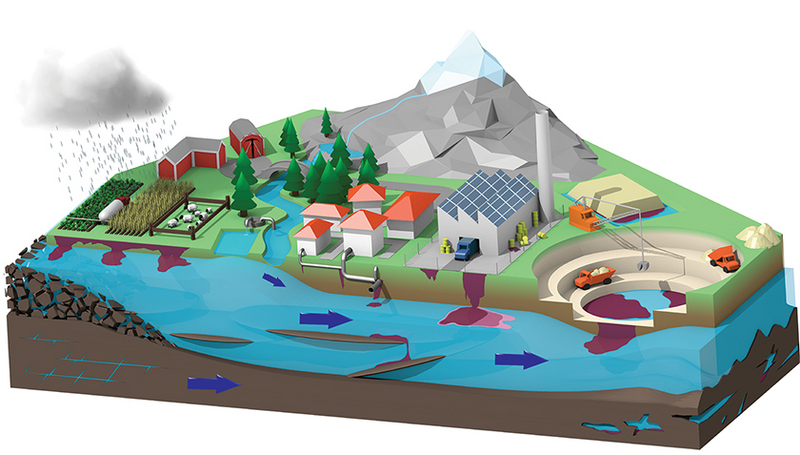
La prise de conscience d'une consommation durable des eaux souterraines ne cesse de croître en raison du changement de l'utilisation des terres et du changement climatique. En conséquence, on s'intéresse de plus en plus à mieux comprendre les processus naturels et anthropiques qui influencent la qualité des eaux souterraines.

Dans un article de synthèse, des chercheurs de l'Eawag ont identifié les principaux polluants anthropiques qui se répandent dans les eaux souterraines ainsi que leurs principales sources. Selon cet article, l'agriculture intensive, le mitage, l'industrie pharmaceutique, les infrastructures d'assainissement insuffisantes, le manque de données concernant la qualité de l'eau ainsi que l’absence de prise de conscience de l’importance des eaux souterraines en tant que ressource renouvelable comptent parmi les problèmes les plus urgents. Mais du fait que les aquifères présentent des caractéristiques très différentes, il reste encore difficile d'assurer un suivi fiable du transport des polluants et d'identifier leur provenance exacte, écrivent les chercheurs.

Dans cet article, des études de cas concrètes sont présentées afin d'illustrer les menaces qui pèsent sur les ressources mondiales en eaux souterraines, comme par exemple les conséquences des activités minières en Afrique du Sud ou les accumulations de nitrates résultant de l'agriculture intensive aux États-Unis.

Les chercheurs soulignent l'importance d'une recherche transdisciplinaire et d'une communication transfrontalière afin de garantir une qualité des eaux souterraines durable dans le monde.

Publication originale

Extbase Variable Dump
array(2 items)
   publications => '18918' (5 chars)
   libraryUrl => '' (0 chars)
Extbase Variable Dump
array(1 item)
   0 => Snowflake\Publications\Domain\Model\Publicationprototypepersistent entity (uid=18918, pid=124)
      originalId => protected18918 (integer)
      authors => protected'Burri, N. M.; Weatherl, R.; Moeck, C.; Schirmer, M.' (76 chars)
      title => protected'A review of threats to groundwater quality in the anthropocene' (62 chars)
      journal => protected'Science of the Total Environment' (32 chars)
      year => protected2019 (integer)
      volume => protected684 (integer)
      issue => protected'' (0 chars)
      startpage => protected'136' (3 chars)
      otherpage => protected'154' (3 chars)
      categories => protected'water resources; groundwater quality; anthropogenic activity; contamination;
          sustainable; transdisciplinary
' (107 chars) description => protected'Awareness concerning sustainable groundwater consumption under the context o
         f land use and climate change is gaining traction, raising the bar for adequ
         ate understanding of the complexities of natural and anthropogenic processes
          and how they affect groundwater quality. The heterogeneous characteristics
         of aquifers have hampered comprehensive source, transport and contaminant id
         entification. As questions remain about the behavior and prediction of well-
         known groundwater contaminants, new concerns around emerging contaminants ar
         e on the increase. This review highlights some of the key contaminants that
         originate from anthropogenic activities, organized based on land use categor
         ies namely agricultural, urban and industrial. It further highlights the ext
         ensive overlap, in terms of both provenance as well as contaminant type, bet
         ween the different land use sectors. A selection of case studies from litera
         ture that describe the continued concern of established contaminants, as wel
         l as new and emerging compounds, are presented to illustrate the many qualit
         ative threats to global groundwater resources. In some cases, the risk of gr
         oundwater contamination lacks adequate gravity, while in others the underlyi
         ng physical and societal processes are not fully understood and activities m
         ay commence without adequately considering potential impacts. In the agricul
         tural context, the historic and current application of fertilizers and plant
          protectants, use of veterinary pharmaceuticals and hormones, strives to saf
         eguard the growing food demands. In the context of a sprawling urban environ
         ment, waste, human pharmaceuticals, and urban pesticide outputs are increasi
         ng, with adequate runoff and sanitation infrastructure often lagging. Finall
         y, industrial activities are associated with accidental leaks and spills, wh
         ile the large-scale storage of industrial byproducts has led to legacy conta
         minants such as those stemming from raw mineral extraction. With this review
          paper, we aim to unders...
' (2202 chars) serialnumber => protected'0048-9697' (9 chars) doi => protected'10.1016/j.scitotenv.2019.05.236' (31 chars) uid => protected18918 (integer) _localizedUid => protected18918 (integer)modified _languageUid => protectedNULL _versionedUid => protected18918 (integer)modified pid => protected124 (integer)
Burri, N. M.; Weatherl, R.; Moeck, C.; Schirmer, M. (2019) A review of threats to groundwater quality in the anthropocene, Science of the Total Environment, 684, 136-154, doi:10.1016/j.scitotenv.2019.05.236, Institutional Repository