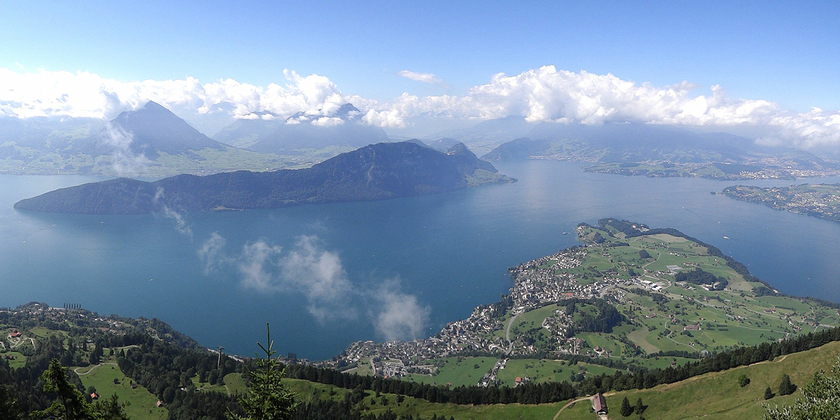
Tiefe Seen können als Wärmequelle oder -senke zum Heizen oder Kühlen genutzt werden. Diese saubere, lokale und erneuerbare Energiequelle wurde früher meist übersehen. In den letzten Jahren wurden nun mehrere Projekte realisiert oder geplant, die Seewärme und -kälte ausnutzen. Entsprechend hat sich das Interesse der Behörden und der Öffentlichkeit erhöht.
In einem vom Bundesamt für Umwelt (BAFU) finanzierten Projekt wurde das Potenzial für die Wärme- und Kältenutzung aller grösseren Seen und Flüsse in der Schweiz abgeschätzt. Detaillierte Informationen dazu sind auf der Thermdis Projektwebseite veröffentlicht. Diese Abschätzungen zeigen das grosse vorhandene Potenzial dieser Energiequelle in der Schweiz auf. Für die Nutzung einzelner Gewässer muss allerdings jeweils das Potenzial unter Berücksichtigung der speziellen Eigenschaften des Gewässers abgeschätzt werden. Im Rahmen von Beratungs- und Forschungsprojekten wurden solche Abschätzungen für einzelne Seen (z.B. Bodensee oder Zugersee) bereits durchgeführt.
array(4 items)0 => Snowflake\Publications\Domain\Model\Publicationprototypepersistent entity (uid=17829, pid=124)originalId => protected17829 (integer)
authors => protected'Gaudard, A.; Wüest, A.; Schmid, M.' (50 chars)
title => protected'Using lakes and rivers for extraction and disposal of heat: estimate of regi onal potentials' (91 chars)
journal => protected'Renewable Energy' (16 chars)
year => protected2019 (integer)
volume => protected134 (integer)
issue => protected'' (0 chars)
startpage => protected'330' (3 chars)
otherpage => protected'342' (3 chars)
categories => protected'surface waters heat management; heat pump systems; free cooling; carbon-free heat production; district cooling and heating; surface waters temperature' (150 chars)
description => protected'There is increasing interest in using waterbodies as renewable energy source s to heat and cool buildings and infrastructure. Here, we estimate the poten tials for heat extraction and disposal for the main lakes and rivers of Swit zerland based on acceptable temperature changes in the waterbodies, and comp are them to regional demands. In most cases, the potentials considerably exc eed the demand, and minor impacts on the thermal regime of the waterbodies a re expected. There are, however, critical situations: rivers crossing densel y-populated areas, where demand often exceeds the potential, and heat dispos al in summer into lowland rivers and shallow lakes, where temperatures may e xceed ecological criteria. To assess the impacts of a realistic thermal use, we model the temperature effects in two lakes: Upper Lake Constance, a larg e lake with relatively low population density, and Lower Lake Zurich, a smal ler lake with high regional demand. The estimated mean temperature alteratio ns are −0.05 to +0.02 °C for Lake Constance, and −0.60 to +0.22 °C for Lake Zurich. Based on the model results, we discuss the effects of operatin g parameters on the efficiency and impacts of thermal use. Our analysis demo nstrates that waterbodies provide real alternatives for heat/cold production in many regions of the world.' (1322 chars)
serialnumber => protected'0960-1481' (9 chars)
doi => protected'10.1016/j.renene.2018.10.095' (28 chars)
uid => protected17829 (integer)
_localizedUid => protected17829 (integer)modified_languageUid => protectedNULL
_versionedUid => protected17829 (integer)modifiedpid => protected124 (integer)1 => Snowflake\Publications\Domain\Model\Publicationprototypepersistent entity (uid=17001, pid=124)originalId => protected17001 (integer)
authors => protected'Gaudard, A.; Weber, C.; Alexander, T. J.; Hunziker,  ;S.; Schmid, M.' (96 chars)
title => protected'Impacts of using lakes and rivers for extraction and disposal of heat' (69 chars)
journal => protected'Wiley Interdisciplinary Reviews: Water' (38 chars)
year => protected2018 (integer)
volume => protected5 (integer)
issue => protected'5' (1 chars)
startpage => protected'e1295 (18 pp.)' (14 chars)
otherpage => protected'' (0 chars)
categories => protected'freshwater ecosystems; renewable heat; thermal discharge' (56 chars)
description => protected'The extraction and disposal of heat from lakes and rivers is a large yet sca rcely exploited source of renewable energy, which can partly replace fossil fuel heating and electrical cooling systems. Its use is expected to increase in the near future, which brings attention to the impacts of discharging th ermally altered water into aquatic systems. Our review indicates that therma l discharge affects physical and ecological processes, with impacts recorded at all levels of biological organization. Many in situ studies found local effects of thermal discharge (such as attraction or avoidance of mobile orga nisms), while impacts at the scale of the whole water body were rarely detec ted. In complex systems, diffuse impacts of thermal discharge are difficult to disentangle from natural variability or other anthropogenic influences. D ischarge of warm water in summer is likely to be most critical, especially i n the context of climate change. Under this scenario, water temperatures may reach maxima that negatively affect some species. Given the diversity and c omplexity of the impacts of thermal pollution on aquatic systems, careful pl anning and judicious management is required when using lakes and rivers for extraction and disposal of heat. We discuss the drivers that influence the s everity of potential impacts of such thermal use, and the options available to avoid or mitigate these impacts (such as adapting the operating condition s).' (1447 chars)
serialnumber => protected'' (0 chars)
doi => protected'10.1002/wat2.1295' (17 chars)
uid => protected17001 (integer)
_localizedUid => protected17001 (integer)modified_languageUid => protectedNULL
_versionedUid => protected17001 (integer)modifiedpid => protected124 (integer)2 => Snowflake\Publications\Domain\Model\Publicationprototypepersistent entity (uid=16440, pid=124)originalId => protected16440 (integer)
authors => protected'Gaudard, A.; Schmid, M.; Wüest, A.' (50 chars)
title => protected'Thermische Nutzung von Seen und Flüssen. Potenzial der Schweizer Oberfläch engewässer' (87 chars)
journal => protected'Aqua & Gas' (10 chars)
year => protected2018 (integer)
volume => protected98 (integer)
issue => protected'2' (1 chars)
startpage => protected'26' (2 chars)
otherpage => protected'33' (2 chars)
categories => protected'' (0 chars)
description => protected'Die Schweizer Oberflächengewässer enthalten sehr grosse Mengen erneuerbare r thermischer Energie, wovon ein Teil zum Heizen und Kühlen nahe gelegener
, vergleicht dieses Potenzial mit der regionalen Nachfrage und fasst die mit der Nutzung dieser thermischen Energie verbundenen Überlegungen und techni schen Schwierigkeiten zusammen.' (487 chars)
serialnumber => protected'2235-5197' (9 chars)
doi => protected'' (0 chars)
uid => protected16440 (integer)
_localizedUid => protected16440 (integer)modified_languageUid => protectedNULL
_versionedUid => protected16440 (integer)modifiedpid => protected124 (integer)3 => Snowflake\Publications\Domain\Model\Publicationprototypepersistent entity (uid=7763, pid=124)originalId => protected7763 (integer)
authors => protected'Fink, G.; Schmid, M.; Wüest, A.' (47 chars)
title => protected'Large lakes as sources and sinks of anthropogenic heat: capacities and limit s' (77 chars)
journal => protected'Water Resources Research' (24 chars)
year => protected2014 (integer)
volume => protected50 (integer)
issue => protected'9' (1 chars)
startpage => protected'7285' (4 chars)
otherpage => protected'7301' (4 chars)
categories => protected'' (0 chars)
description => protected'The goal of reducing carbon fuel and thereby saving energy will increase the use of lake water for heating and cooling of riparian infrastructures. This raises the question of which heat use designs meet the ecological and techn ical requirements for lakes, particularly in regard to climate warming. Thus , this study explores heat use effects on the temperature and stratification of a large, deep, temperate lake by applying the one-dimensional k-epsilon model SIMSTRAT to various forcing scenarios. Several design parameters, such as extraction and discharge depth, and their effects were assessed. Additio nally, 21st century climate projections were used to evaluate the effects of climate change relative to those of heat use. Generally, the study showed o nly minor effects for a realistic heat demand of ±2 W m<SUP>−2</SUP> quit e independent of the heat extraction/discharge modes. Mean water temperature changed less than ±0.2°C as long as there was no discharge into the deepe st layers. Water extraction and discharge at the surface had the least therm al influence. To relate to climate change, heat use was scaled up to +85 W m <SUP>−2</SUP>. Resultant simulations showed that such (unrealistic) anthro pogenic, lake-based “<I>thermal pollution</I>” would have a comparable i nfluence to that of climate change. Conversely, heat extraction could damp o r even compensate climate-induced warming. The present study concludes that (i) there are minor effects on water temperatures, stratification, and seaso nal mixing due to heat use of up to ±2 W m<SUP>−2</SUP> and (ii) those in fluences are insignificant relative to the expected climate change.' (1663 chars)
serialnumber => protected'0043-1397' (9 chars)
doi => protected'10.1002/2014WR015509' (20 chars)
uid => protected7763 (integer)
_localizedUid => protected7763 (integer)modified_languageUid => protectedNULL
_versionedUid => protected7763 (integer)modifiedpid => protected124 (integer)
Using lakes and rivers for extraction and disposal of heat: estimate of regional potentials
There is increasing interest in using waterbodies as renewable energy sources to heat and cool buildings and infrastructure. Here, we estimate the potentials for heat extraction and disposal for the main lakes and rivers of Switzerland based on acceptable temperature changes in the waterbodies, and compare them to regional demands. In most cases, the potentials considerably exceed the demand, and minor impacts on the thermal regime of the waterbodies are expected. There are, however, critical situations: rivers crossing densely-populated areas, where demand often exceeds the potential, and heat disposal in summer into lowland rivers and shallow lakes, where temperatures may exceed ecological criteria. To assess the impacts of a realistic thermal use, we model the temperature effects in two lakes: Upper Lake Constance, a large lake with relatively low population density, and Lower Lake Zurich, a smaller lake with high regional demand. The estimated mean temperature alterations are −0.05 to +0.02 °C for Lake Constance, and −0.60 to +0.22 °C for Lake Zurich. Based on the model results, we discuss the effects of operating parameters on the efficiency and impacts of thermal use. Our analysis demonstrates that waterbodies provide real alternatives for heat/cold production in many regions of the world.
Gaudard, A.; Wüest, A.; Schmid, M. (2019) Using lakes and rivers for extraction and disposal of heat: estimate of regional potentials, Renewable Energy, 134, 330-342, doi:10.1016/j.renene.2018.10.095, Institutional Repository
Impacts of using lakes and rivers for extraction and disposal of heat
The extraction and disposal of heat from lakes and rivers is a large yet scarcely exploited source of renewable energy, which can partly replace fossil fuel heating and electrical cooling systems. Its use is expected to increase in the near future, which brings attention to the impacts of discharging thermally altered water into aquatic systems. Our review indicates that thermal discharge affects physical and ecological processes, with impacts recorded at all levels of biological organization. Many in situ studies found local effects of thermal discharge (such as attraction or avoidance of mobile organisms), while impacts at the scale of the whole water body were rarely detected. In complex systems, diffuse impacts of thermal discharge are difficult to disentangle from natural variability or other anthropogenic influences. Discharge of warm water in summer is likely to be most critical, especially in the context of climate change. Under this scenario, water temperatures may reach maxima that negatively affect some species. Given the diversity and complexity of the impacts of thermal pollution on aquatic systems, careful planning and judicious management is required when using lakes and rivers for extraction and disposal of heat. We discuss the drivers that influence the severity of potential impacts of such thermal use, and the options available to avoid or mitigate these impacts (such as adapting the operating conditions).
Gaudard, A.; Weber, C.; Alexander, T. J.; Hunziker, S.; Schmid, M. (2018) Impacts of using lakes and rivers for extraction and disposal of heat, Wiley Interdisciplinary Reviews: Water, 5(5), e1295 (18 pp.), doi:10.1002/wat2.1295, Institutional Repository
Thermische Nutzung von Seen und Flüssen. Potenzial der Schweizer Oberflächengewässer
Die Schweizer Oberflächengewässer enthalten sehr grosse Mengen erneuerbarer thermischer Energie, wovon ein Teil zum Heizen und Kühlen nahe gelegener Infrastrukturen genutzt werden kann. Dieser Artikel präsentiert eine Abschätzung des thermischen Potenzials der wichtigsten Schweizer Seen und Flüsse, vergleicht dieses Potenzial mit der regionalen Nachfrage und fasst die mit der Nutzung dieser thermischen Energie verbundenen Überlegungen und technischen Schwierigkeiten zusammen.
Gaudard, A.; Schmid, M.; Wüest, A. (2018) Thermische Nutzung von Seen und Flüssen. Potenzial der Schweizer Oberflächengewässer, Aqua & Gas, 98(2), 26-33, Institutional Repository
Large lakes as sources and sinks of anthropogenic heat: capacities and limits
The goal of reducing carbon fuel and thereby saving energy will increase the use of lake water for heating and cooling of riparian infrastructures. This raises the question of which heat use designs meet the ecological and technical requirements for lakes, particularly in regard to climate warming. Thus, this study explores heat use effects on the temperature and stratification of a large, deep, temperate lake by applying the one-dimensional k-epsilon model SIMSTRAT to various forcing scenarios. Several design parameters, such as extraction and discharge depth, and their effects were assessed. Additionally, 21st century climate projections were used to evaluate the effects of climate change relative to those of heat use. Generally, the study showed only minor effects for a realistic heat demand of ±2 W m−2 quite independent of the heat extraction/discharge modes. Mean water temperature changed less than ±0.2°C as long as there was no discharge into the deepest layers. Water extraction and discharge at the surface had the least thermal influence. To relate to climate change, heat use was scaled up to +85 W m−2. Resultant simulations showed that such (unrealistic) anthropogenic, lake-based “thermal pollution” would have a comparable influence to that of climate change. Conversely, heat extraction could damp or even compensate climate-induced warming. The present study concludes that (i) there are minor effects on water temperatures, stratification, and seasonal mixing due to heat use of up to ±2 W m−2 and (ii) those influences are insignificant relative to the expected climate change.
Fink, G.; Schmid, M.; Wüest, A. (2014) Large lakes as sources and sinks of anthropogenic heat: capacities and limits, Water Resources Research, 50(9), 7285-7301, doi:10.1002/2014WR015509, Institutional Repository