Abteilung Siedlungshygiene und Wasser für Entwicklung

Strategien zur Verringerung der Rekontamination von behandeltem Wasser während Transport und Aufbewahrung
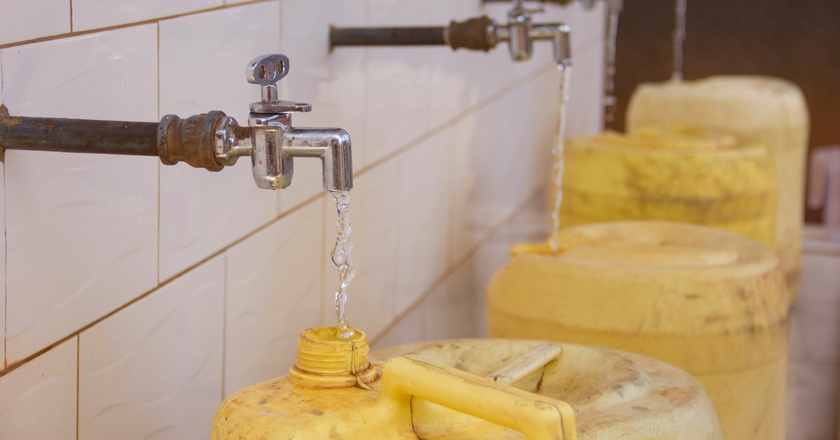
Unter hygische schwierigen Bedingungen kann Wasser, das an der Quelle oder am Brunnen sauber zur Verfügung gestellt wird während dem Transport oder der Aufbewahrung wieder verkeimt werden. Die Verfügbarkeit von Produkten und Ansätzen zur Verringerung dieser Rekontaminationsrisiken ist von großer Bedeutung, um sicheres Wasser am Ort des Verbrauchs zu gewährleisten. Sauberes Trinkwasser ist ein entscheidender Indikator für die Erreichung des SDG 6.1. Um einen Beitrag zur Erreichung dieses Ziels zu leisten, experimentieren wir mit verschiedenen Ansätzen zur Verbesserung der sicheren Aufbewahrung des Trinkwasser. Methoden, die wir evaluieren, um das Wiederverkeimungsrisiko zu reduzieren sind z. B. die Sekundärdesinfektion mit UV-C-LEDs, die in die Lagerbehälter integriert wurden oder die Installation von kostengünstigen passiven Chlorierungssystemen in die Trinkwasserversorgung. Ausserdem testen wir verbesserte, reinigungsfreundlichere Designs für Behälter, die verwendet werden für den Transport und die Aufbewahrung von Trinkwasser, und angepasste Reinigungstrategien.

Einfluss von Behälterdesign und Reinigung auf die Verringerung des Rekontaminationsrisikos
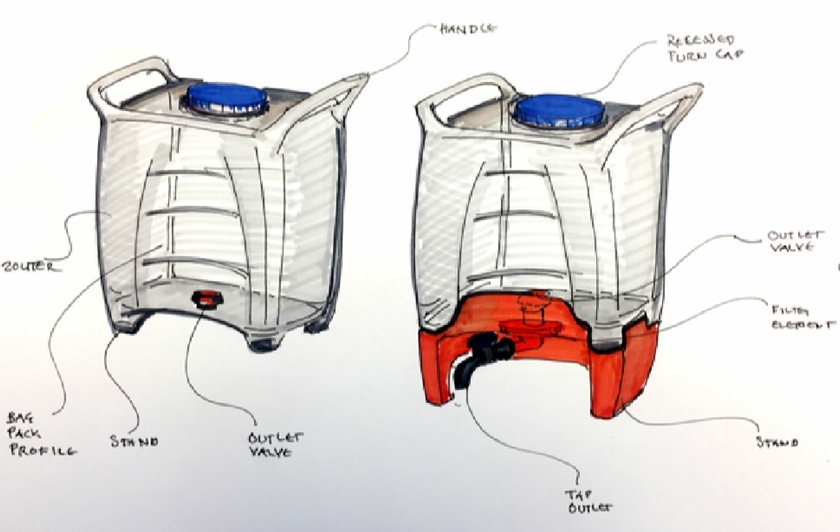
Trinkwasser wird während des Transports und der Lagerung häufig rekontaminiert, wenn Wasser in verschmutzte Wasserbehälter gefüllt wird. Die Konstruktion des Behälters wirkt sich auf die Wasserqualität aus. Die Behälter werden oft ebenerdig aufbewahrt, so dass sie für Kinder und Tiere leicht zugänglich sind, was den Eintrag von Krankheitserregern in die Gefässe begünstig und ein Grund für die Verschlechterung der Wasserqualität sein kann. Daher ist es wichtig, die Behälter mit Deckeln zu versehen und sie erhöht zu lagern. Während der Entnahme wird das Wasser oft durch den Kontakt mit verschmutzten Händen, Tassen und Schöpflöffeln verdorben. Der Kontakt zwischen den Händen und dem Wasser im Container kann durch den Einbau eines Ausgusses zur Wasserentnahme aus den Behältern verhindert werden.

Behälter mit engen Öffnungen verhindern den Kontakt mit möglichen Kontaminationsquellen und verringern damit das Rekontaminationsrisiko, erschweren aber auch die systematische Reinigung der Behälterinnenwände. Die regelmäßige Verwendung von Trinkwasserbehältern ohne ordnungsgemäße Reinigung führt zur Bildung eines Biofilms im Behälter. Dieser Biofilm beherbergt Bakterienkolonien, bietet ihnen Nahrung für ihr Wachstum, schützt sie vor der Desinfektion und verbraucht freies Restchlor, wodurch das Risiko einer Verunreinigung des Wassers, das in die Behälter gefüllt wird, steigt.

In diesem Projekt arbeiten wir mit der lokalen Bevölkerung, lokalen Nichtregierungsorganisationen in Uganda und Kenia sowie mit der Zürcher Hochschule der Künste zusammen. Das Ziel der Zusammenarbeit ist, die Wirkung der Sekundärdesinfektion in Kombination mit optimal designten Wasserbehältern auf die Wasserqualität zu bewerten.

Passive Chlorierung im Trinkwasserversorgungssystem
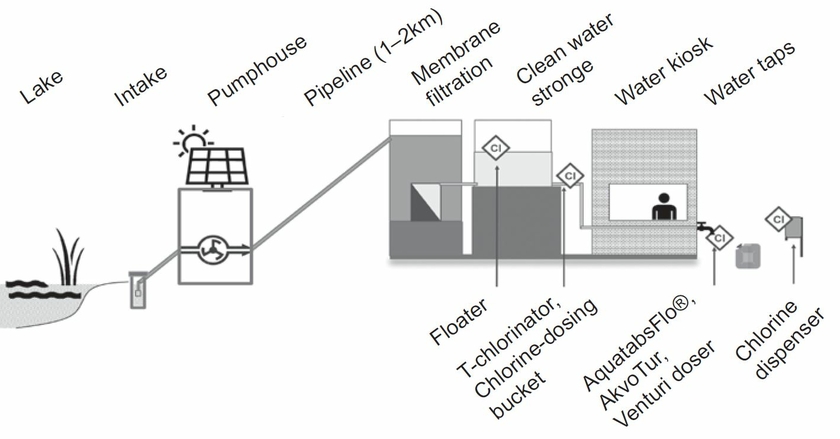
In diesem Projekt arbeiten wir mit der lokalen Bevölkerung und den Nichtregierungsorganisationen Get Water Uganda, Helvetas Swiss Intercooperation in Nepal und Sandec's Water Supply and Treatment Goup zusammen, um folgende Themen zu evaluieren:

a) die technische Leistung verschiedener kostengünstiger Designs von nichtelektrisch betriebenen Chlorierungsanlagen für Trinkwasserversorgungssysteme auf Systemebene (Konsistenz der Dosierung, Haltbarkeit des Produkts, Betriebs- und Wartungsanforderungen, Wasserqualität),

b) Geschäftsmodell für den Betrieb solcher Anlagen (anfängliche und wiederkehrende Kosten, Modelle zur Erzielung von Einnahmen im Hinblick auf verschiedene Interessengruppen, Managementkonzepte, Verfügbarkeit von Produkten und Ersatzteilen)

c) Nutzerperspektiven (Akzeptanz, Geschmackswahrnehmung und Bereitschaft, für zusätzliche Kosten zu zahlen)

d) Evaluation von passiver Chlorierung in Trinkwasserversorgungssystemen im Vergleich zu Trinkwasserbehandlung im Haushalt und Auswirkung auf die konsumierte  Trinkwasserqualität und auf die Gesundheit von Kindern

Publikationen

Rekontamination und Aufbewahrung

Extbase Variable Dump
array(2 items)
   publications => '21855,18600,18787,17859' (23 chars)
   libraryUrl => '' (0 chars)
Extbase Variable Dump
array(4 items)
   0 => Snowflake\Publications\Domain\Model\Publicationprototypepersistent entity (uid=21855, pid=124)
      originalId => protected21855 (integer)
      authors => protected'Gärtner, N.; Germann, L.; Wanyama, K.; Ouma, H.; Meierh
         ofer, R.
' (89 chars) title => protected'Keeping water from kiosks clean: strategies for reducing recontamination dur
         ing transport and storage in Eastern Uganda
' (119 chars) journal => protected'Water Research X' (16 chars) year => protected2021 (integer) volume => protected10 (integer) issue => protected'' (0 chars) startpage => protected'100079 (8 pp.)' (14 chars) otherpage => protected'' (0 chars) categories => protected'chlorination; drinking water treatment; water kiosks; safe storage; drinking
          water recontamination; hygiene
' (107 chars) description => protected'Drinking water is frequently recontaminated during transport and storage whe
         n water is poured into jerrycans. To address this issue, three strategies ai
         ming at reducing these recontamination risks were implemented at water kiosk
         s in Eastern Uganda. In all three strategies, water at the kiosks was chlori
         nated to a free residual chlorine (FRC) concentration of 2 mg/L at the tap
          of the kiosk. In addition, water was collected in different containers for
         drinking water transport: a) uncleaned jerrycans, b) cleaned jerrycans, and
         c) cleaned improved containers with a wide mouth and a spigot. Water quality
          in the containers was compared to that of a control group collecting unchlo
         rinated water in uncleaned jerrycans. Water samples were collected at the ta
         p of the kiosk, from the containers of 135 households after they were filled
          at the tap, and from the same containers in the households after 24 h of
         water storage. The samples were analysed for counts of <em>E. coli</em>, tot
         al coliforms, and FRC. Household interviews and structured observations were
          conducted to identify confounding variables and to assess the influence of
         water, sanitation, and hygiene infrastructure and practices on recontaminati
         on.<br /> All three intervention strategies contributed to significantly low
         er <em>E. coli</em> recontamination levels after 24 h than in the control
         group (Median (Mdn) = 9 CFU/100 mL, Interquartile Range (IQR) = 
         25). Median <em>E. coli</em> counts and mean FRC consumption were higher in
         
         
         = 2, ΔFRC = 1.6 mg/L) and the lowest in cleaned improved containers
          (Median = 0 CFU/100 mL, IQR = 0, ΔFRC = 1.2 mg/L). The F
         RC concentration at the tap of 2 mg/L was too low to protect water from <e
         m>E. coli</em> recontamination in uncleaned jerrycans over 24 h. Cleaning
         the jerrycans was inconv...
' (2599 chars) serialnumber => protected'2589-9147' (9 chars) doi => protected'10.1016/j.wroa.2020.100079' (26 chars) uid => protected21855 (integer) _localizedUid => protected21855 (integer)modified _languageUid => protectedNULL _versionedUid => protected21855 (integer)modified pid => protected124 (integer)
1 => Snowflake\Publications\Domain\Model\Publicationprototypepersistent entity (uid=18600, pid=124) originalId => protected18600 (integer) authors => protected'Meierhofer,&nbsp;R.; Wietlisbach,&nbsp;B.; Matiko,&nbsp;C.' (58 chars) title => protected'Influence of container cleanliness, container disinfection with chlorine, an
         d container handling on recontamination of water collected from a water kios
         k in a Kenyan slum
' (170 chars) journal => protected'Journal of Water and Health' (27 chars) year => protected2019 (integer) volume => protected17 (integer) issue => protected'2' (1 chars) startpage => protected'308' (3 chars) otherpage => protected'317' (3 chars) categories => protected'chlorination; drinking water quality; drinking water treatment; low-income c
         ountry; recontamination; safe storage
' (113 chars) description => protected'The study assessed whether using clean containers that had been disinfected
         with chlorine at a water kiosk in the Kangemi slum in Nairobi reduced recont
         amination of treated water during drinking transport and storage. At the sam
         e time, the impacts of container handling and hygiene conditions at the hous
         ehold level on water quality changes during storage were evaluated. Data wer
         e collected during interviews with 135 households using either new, clean Ma
         ji Safi containers (MSCs) that had been disinfected with chlorine or normal
         uncleaned jerrycans (NJCs). Bacteriological water quality and free chlorine
         levels in both types of containers were measured after container filling at
         the kiosk and in the same containers after 24 h storage in households. The u
         se of MSCs significantly reduced the risk of recontaminating the treated wat
         er. After water filling at the kiosk, none of the MSCs contained <i>Escheric
         hia coli</i> bacteria, and 2.8% were contaminated after 24 h storage. In con
         trast, 6.2% of NJCs were contaminated after filling, and 15.2% after 24 h st
         orage. Multivariate logistic regression indicated that the use of a clean wa
         ter container and sufficient chlorine and the frequency of cleaning the cont
         ainer in the household mitigated recontamination. We suggest further investi
         gation of water container designs that facilitate cleaning.
' (1351 chars) serialnumber => protected'1477-8920' (9 chars) doi => protected'10.2166/wh.2019.282' (19 chars) uid => protected18600 (integer) _localizedUid => protected18600 (integer)modified _languageUid => protectedNULL _versionedUid => protected18600 (integer)modified pid => protected124 (integer)
2 => Snowflake\Publications\Domain\Model\Publicationprototypepersistent entity (uid=18787, pid=124) originalId => protected18787 (integer) authors => protected'Meierhofer,&nbsp;R.; Rubli,&nbsp;P.; Oremo,&nbsp;J.; Odhiambo,&nbsp;A.' (70 chars) title => protected'Does activated silver reduce recontamination risks in the reservoirs of cera
         mic water filters?
' (94 chars) journal => protected'Water' (5 chars) year => protected2019 (integer) volume => protected11 (integer) issue => protected'5' (1 chars) startpage => protected'1108 (11 pp.)' (13 chars) otherpage => protected'' (0 chars) categories => protected'household water treatment; water quality; recontamination; low income countr
         y; safe storage; silver disinfection; ceramic water filter
' (134 chars) description => protected'Efforts to provide safe water are challenged by recontamination and regrowth
          of pathogens in treated water during storage. This study evaluated the pote
         ntial of metallic silver with a chemically etched surface to reduce recontam
         ination risks during water storage in ceramic water filters. Batch experimen
         ts were conducted in the laboratory with water storage buckets containing th
         ree configurations of varying amounts of silver. Field trials in a rural are
         a in Kenya assessed the effect of the same configurations in the storage buc
         kets of locally produced ceramic pot filters without colloidal silver coatin
         g. The tests revealed that the etched silver slightly reduced microbiologica
         l recontamination risks during water storage despite the low diffusion of si
         lver ions (&lt;5 µg Ag/L). The effect was strongly influenced by water chem
         istry parameters. A statistically significant difference in the removal of <
         em>E. coli</em> (Δ Log Removal Value (LRV) = 0.6) and total coliforms (Δ L
         RV = 1.7) was found between households using a filter with silver in the wat
         er reservoir and those using a filter without silver. Multivariate regressio
         n of water handling factors and hygiene practices on filter performance reve
         aled that the presence of silver in the reservoir and cleaning the filter el
         ement with a brush were associated with a better filter performance.
' (1360 chars) serialnumber => protected'2073-4441' (9 chars) doi => protected'10.3390/w11051108' (17 chars) uid => protected18787 (integer) _localizedUid => protected18787 (integer)modified _languageUid => protectedNULL _versionedUid => protected18787 (integer)modified pid => protected124 (integer)
3 => Snowflake\Publications\Domain\Model\Publicationprototypepersistent entity (uid=17859, pid=124) originalId => protected17859 (integer) authors => protected'Meierhofer,&nbsp;R.; Bänziger,&nbsp;C.; Deppeler,&nbsp;S.; Kunwar,&nbsp;B.&
         nbsp;M.; Bhatta,&nbsp;M.
' (100 chars) title => protected'From water source to tap of ceramic filters - factors that influence water q
         uality between collection and consumption in rural households in Nepal
' (146 chars) journal => protected'International Journal of Environmental Research and Public Health' (65 chars) year => protected2018 (integer) volume => protected15 (integer) issue => protected'11' (2 chars) startpage => protected'2439 (14 pp.)' (13 chars) otherpage => protected'' (0 chars) categories => protected'drinking water quality; ceramic water filtration; household water treatment;
          recontamination; hygiene
' (101 chars) description => protected'The study assessed changes in water quality between the water source and the
          tap of locally produced low cost ceramic water filters used by a community
         living in hygienically critical conditions in a remote mountainous area in W
         estern Nepal. Data was collected from 42 rural households during two visits.
          The effectiveness of filter handling on its performance was assessed throug
         h microbiological analysis, structured household interviews and structured o
         bservations. Water quality decreased significantly when source water was fil
         led into transport containers, while the use of the filters improved drinkin
         g water quality for about 40% of the households. Highly inadequate filter cl
         eaning practices involving the use of contaminated raw water, hands (geo mea
         n = 110 <i>E. coli</i> CFU/100 mL) and cleaning tools (geo mean = 80 <i>E. c
         oli</i> CFU/100 mL) stained hygienic parts of the filter. The use of boiling
          water to disinfect the filters was significantly correlated with improved f
         ilter performance and should be further promoted. However, even disinfected
         filters achieved a very low average LRV for <i>E. coli</i> of 0.4 in the fie
         ld and performed worse than during laboratory tests (LRV for <i>E. coli</i>
         of 1.5-2). Comprehensive training on adequate filter handling, as well as be
         tter filter products, are required to improve the impact of filter use.
' (1363 chars) serialnumber => protected'1661-7827' (9 chars) doi => protected'10.3390/ijerph15112439' (22 chars) uid => protected17859 (integer) _localizedUid => protected17859 (integer)modified _languageUid => protectedNULL _versionedUid => protected17859 (integer)modified pid => protected124 (integer)
Gärtner, N.; Germann, L.; Wanyama, K.; Ouma, H.; Meierhofer, R. (2021) Keeping water from kiosks clean: strategies for reducing recontamination during transport and storage in Eastern Uganda, Water Research X, 10, 100079 (8 pp.), doi:10.1016/j.wroa.2020.100079, Institutional Repository
Meierhofer, R.; Wietlisbach, B.; Matiko, C. (2019) Influence of container cleanliness, container disinfection with chlorine, and container handling on recontamination of water collected from a water kiosk in a Kenyan slum, Journal of Water and Health, 17(2), 308-317, doi:10.2166/wh.2019.282, Institutional Repository
Meierhofer, R.; Rubli, P.; Oremo, J.; Odhiambo, A. (2019) Does activated silver reduce recontamination risks in the reservoirs of ceramic water filters?, Water, 11(5), 1108 (11 pp.), doi:10.3390/w11051108, Institutional Repository
Meierhofer, R.; Bänziger, C.; Deppeler, S.; Kunwar, B. M.; Bhatta, M. (2018) From water source to tap of ceramic filters - factors that influence water quality between collection and consumption in rural households in Nepal, International Journal of Environmental Research and Public Health, 15(11), 2439 (14 pp.), doi:10.3390/ijerph15112439, Institutional Repository

Passive Chlorierung

Extbase Variable Dump
array(2 items)
   publications => '22544' (5 chars)
   libraryUrl => '' (0 chars)
Extbase Variable Dump
array(1 item)
   0 => Snowflake\Publications\Domain\Model\Publicationprototypepersistent entity (uid=22544, pid=124)
      originalId => protected22544 (integer)
      authors => protected'Dössegger,&nbsp;L.; Tournefier,&nbsp;A.; Germann,&nbsp;L.; Gärtner,&nbsp;N
         .; Huonder,&nbsp;T.; Etenu,&nbsp;C.; Wanyama,&nbsp;K.; Ouma,&nbsp;H.; Meierh
         ofer,&nbsp;R.
' (165 chars) title => protected'Assessment of low-cost, non-electrically powered chlorination devices for gr
         avity-driven membrane water kiosks in eastern Uganda
' (128 chars) journal => protected'Waterlines' (10 chars) year => protected2021 (integer) volume => protected40 (integer) issue => protected'2' (1 chars) startpage => protected'92' (2 chars) otherpage => protected'106' (3 chars) categories => protected'point-of-collection chlorination; water treatment; recontamination; GDM wate
         r kiosk; low-income country
' (103 chars) description => protected'Recontamination during transport and storage is a common challenge of water
         supply in low-income settings, especially if water is collected manually. Ch
         lorination is a strategy to reduce recontamination. We assessed seven low-co
         st, non-electrically powered chlorination devices in gravity-driven membrane
          filtration (GDM) kiosks in eastern Uganda: one floater, two in-line dosers,
          three end-line dosers (tap-attached), and one manual dispenser. The evaluat
         ion criteria were dosing consistency, user-friendliness, ease of maintenance
         , local supply chain, and cost. Achieving an adequate chlorine dosage (∼2
         mg/L at the tap and ≥ 0.2 mg/L after 24 h of storage in a container) was c
         hallenging. The T-chlorinator was the most promising option for GDM kiosks:
         it achieved correct dosage (CD, 1.5-2.5 mg/L) with a probability of 90 per c
         ent, was easy to use and maintain, economical, and can be made from locally
         available materials. The other in-line option, the chlorine-dosing bucket (4
         0 per cent CD) still needs design improvements. The end-line options AkvoTur
          (67 per cent CD) and AquatabsFlo® (57 per cent CD) are easy to install and
          operate at the tap, but can be easily damaged in the GDM set-up. The Ventur
         i doser (52 per cent CD) did not perform satisfactorily with flow rates &gt;
          6 L/min. The chlorine dispenser (52 per cent CD) was robust and user-friend
         ly, but can only be recommended if users comply with chlorinating the water
         themselves. Establishing a sustainable supply chain for chlorine products wa
         s challenging. Where solid chlorine tablets were locally rarely available, t
         he costs of liquid chlorine options were high (27-162 per cent of the water
         price).
' (1679 chars) serialnumber => protected'0262-8104' (9 chars) doi => protected'10.3362/1756-3488.20-00014' (26 chars) uid => protected22544 (integer) _localizedUid => protected22544 (integer)modified _languageUid => protectedNULL _versionedUid => protected22544 (integer)modified pid => protected124 (integer)
Dössegger, L.; Tournefier, A.; Germann, L.; Gärtner, N.; Huonder, T.; Etenu, C.; Wanyama, K.; Ouma, H.; Meierhofer, R. (2021) Assessment of low-cost, non-electrically powered chlorination devices for gravity-driven membrane water kiosks in eastern Uganda, Waterlines, 40(2), 92-106, doi:10.3362/1756-3488.20-00014, Institutional Repository