Abteilung Oberflächengewässer

Biogeochemischer Kreislauf an oxisch-anoxischen Grenzen
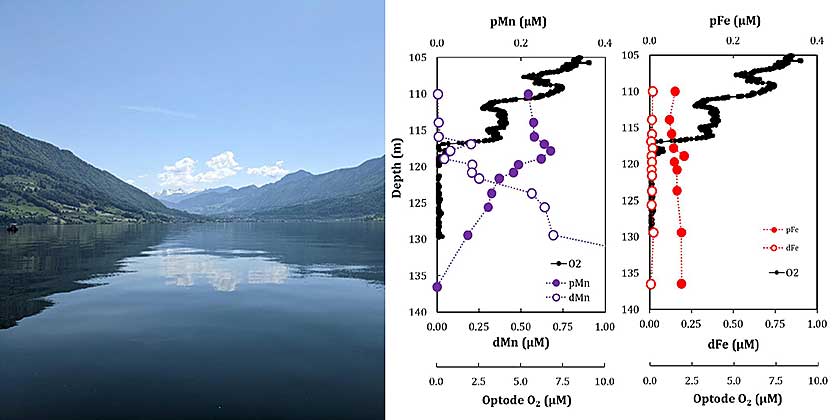

In Abwesenheit von Sauerstoff werden andere Elemente wie Eisen und Mangan für die mikrobielle Atmung verwendet. Damit ist der Kreislauf dieser Metalle grundlegend mit den Hauptelementen der Erde (Kohlenstoff, Sauerstoff, Schwefel, Stickstoff) verknüpft.
In diesem Projekt wird der biogeochemische Kreislauf von Eisen, Mangan und anderen Spurenelementen an der oxisch-anoxischen Grenzfläche des Zugersees mit chemischen, physikalischen und mikrobiellen Methoden untersucht. Im Vergleich zu anderen anoxischen Seen ist der Zugersee einzigartig, da er hohe Mangan- aber niedrige Eisen- und Schwefelkonzentrationen aufweist, was ihn zu einem besonders interessanten Untersuchungsgebiet macht.

Anoxische Zustände sind überall auf der modernen Erde zu finden und waren während des größten Teils der Erdgeschichte der Hauptzustand der Gewässer der Erde. Daher bieten diese anoxischen Gebiete nicht nur einzigartige Bedingungen für die Untersuchung moderner Prozesse, sondern dienen auch als Analogie für die Untersuchung biogeochemischer Kreisläufe in der Erdgeschichte.
Ein weiteres Ziel dieses Projekts ist es, zu untersuchen, wie die chemischen Indikatoren, die wir zur Rekonstruktion der wichtigsten Zustände der Erde verwenden (Metallhäufigkeit, stabile Isotope und Speziation), von den anoxischen Bedingungen im Zugersee und anderen anoxischen Seen beeinflusst werden.

Publikationen

Extbase Variable Dump
array(2 items)
   publications => '34753,33341' (11 chars)
   libraryUrl => '' (0 chars)
Extbase Variable Dump
array(2 items)
   0 => Snowflake\Publications\Domain\Model\Publicationprototypepersistent entity (uid=34753, pid=124)
      originalId => protected34753 (integer)
      authors => protected'Janssen, D. J.; Bauer, K. W.; Bruggmann, S.; Crowe,
          S. A.
' (92 chars) title => protected'The global biogeochemical cycle of chromium at the Earth's surface' (66 chars) journal => protected'Global Biogeochemical Cycles' (28 chars) year => protected2025 (integer) volume => protected39 (integer) issue => protected'6' (1 chars) startpage => protected'e2025GB008525 (43 pp.)' (22 chars) otherpage => protected'' (0 chars) categories => protected'' (0 chars) description => protected'The biogeochemistry of Cr and its cycling in Earth's surface environments is
          reviewed. A synthesis and critical evaluation of the major processes contro
         lling Cr mobility and isotope composition (δ<sup>53</sup>Cr) is presented,
         taking a source to sink view beginning with Cr mobilization from Earth's cru
         st. Transport and cycling in inland waters and input to the oceans are discu
         ssed. Anthropogenic mobilization of Cr results in contributions to the atmos
         phere and inland waters that are of similar orders of magnitude as natural p
         rocesses. The principal sources of Cr to the oceans are rivers and diffusive
          fluxes from marine sediments. Internal cycling of Cr in the ocean is largel
         y controlled by reductive removal onto particles, particularly in O<sub>2</s
         ub>-depleted waters, and redistribution through ocean circulation. Chromium
         removal from the oceans occurs primarily in organic carbon-rich, O<sub>2</su
         b>-poor shelf sediments. Despite theoretically poor mobility of Cr(III), red
         uctive removal in anoxic waters is non-quantitative. As a result, isotope fr
         actionation drives δ<sup>53</sup>Cr offsets in removed Cr as well as residu
         al dissolved Cr(III), which accumulates in anoxic water, compared to the cor
         responding source. The implications for δ<sup>53</sup>Cr-based reconstructi
         ons are discussed, along with an outlook for future proxy applications based
          on the processes controlling Cr incorporation into sediments. The roles of
         different source and sink processes are quantified in an updated mass balanc
         e for the global ocean. Finally, priority topics for future research are sug
         gested, which at present are the primary uncertainties of the modern Cr biog
         eochemical cycle and aspects of the Cr isotope mass balance.
' (1732 chars) serialnumber => protected'0886-6236' (9 chars) doi => protected'10.1029/2025GB008525' (20 chars) uid => protected34753 (integer) _localizedUid => protected34753 (integer)modified _languageUid => protectedNULL _versionedUid => protected34753 (integer)modified pid => protected124 (integer)
1 => Snowflake\Publications\Domain\Model\Publicationprototypepersistent entity (uid=33341, pid=124) originalId => protected33341 (integer) authors => protected'Janssen,&nbsp;D.&nbsp;J.; Damanik,&nbsp;A.; Tournier,&nbsp;N.; Tolu,&nbsp;J.
         ; Winkel,&nbsp;L.; Cahyarini,&nbsp;S.&nbsp;Y.; Vogel,&nbsp;H.
' (137 chars) title => protected'Biogeochemical cycling of trace elements and nutrients in ferruginous waters
         : constraints from a deep oligotrophic ancient lake
' (127 chars) journal => protected'Limnology and Oceanography' (26 chars) year => protected2024 (integer) volume => protected69 (integer) issue => protected'11' (2 chars) startpage => protected'2775' (4 chars) otherpage => protected'2790' (4 chars) categories => protected'' (0 chars) description => protected'Iron-rich, ferruginous waters were the dominant geochemical regime for most
         of Earth's history. Modern ferruginous waters are found in stratified, sulfu
         r-poor lakes, and serve as crucial analogs for biogeochemical cycling throug
         hout Earth's past. Here we present the first depth-resolved data of physical
          structure, nutrients and trace elements from Lake Poso (Indonesia), a deep
         oligotrophic ancient lake. Lake Poso is ferruginous, with anoxia below ~ 9
         0 m depth, placing it among the world's largest ferruginous lakes. Physica
         l stratification is weaker than other tropical anoxic lakes, indicating sens
         itivity for paleoclimate reconstructions. Trace elements and nutrients are p
         redominantly shaped by the oxic–anoxic transition. Manganese– and Fe oxy
         hydroxide–driven biogeochemical cycling occurs at distinct depth horizons,
          with Co and Ni controlled by Mn and showing shallow release in anoxic water
         s, while V, Cr, P, and As are controlled by Fe, with release in surface sedi
         ments and diffusive transport. Chromium is nonquantitatively removed in anox
         ic waters, in contrast to widespread assumptions in Cr-based paleoreconstruc
         tions. Oxycline U and Se removal corresponds to a local N minimum, suggestin
         g biological reduction and/or uptake. These first ferruginous water Se data
         also show removal in sediments, indicating sediment signals reflect multiple
          removal processes and informing Se-based paleoreconstructions, while the ab
         sence of sediment U removal contrasts other anoxic basins. A comparison with
          other ferruginous lakes demonstrates how local influences drive deviations
         from expectations in other systems, and highlight common, generalizable ferr
         uginous basin features. Therefore, these data will guide research in ferrugi
         nous settings across space and time, and improve paleoreconstructions from f
         erruginous sediment records.
' (1852 chars) serialnumber => protected'0024-3590' (9 chars) doi => protected'10.1002/lno.12687' (17 chars) uid => protected33341 (integer) _localizedUid => protected33341 (integer)modified _languageUid => protectedNULL _versionedUid => protected33341 (integer)modified pid => protected124 (integer)
Janssen, D. J.; Bauer, K. W.; Bruggmann, S.; Crowe, S. A. (2025) The global biogeochemical cycle of chromium at the Earth's surface, Global Biogeochemical Cycles, 39(6), e2025GB008525 (43 pp.), doi:10.1029/2025GB008525, Institutional Repository
Janssen, D. J.; Damanik, A.; Tournier, N.; Tolu, J.; Winkel, L.; Cahyarini, S. Y.; Vogel, H. (2024) Biogeochemical cycling of trace elements and nutrients in ferruginous waters: constraints from a deep oligotrophic ancient lake, Limnology and Oceanography, 69(11), 2775-2790, doi:10.1002/lno.12687, Institutional Repository