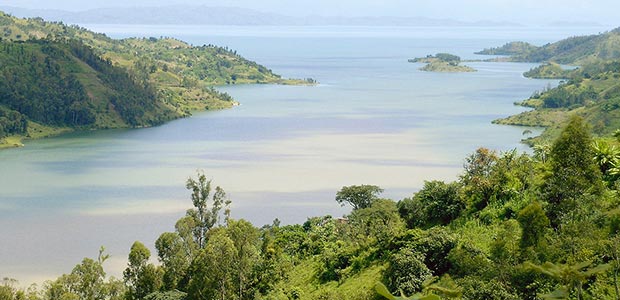
Der Kivu-See liegt in Ostafrika an der Grenze zwischen Ruanda und der Demokratischen Republik Kongo. Er hat eine Oberfläche von 2385 km2, ein Volumen von 550 km3 und eine maximale Tiefe von 485 m. Etwa 2 Millionen Menschen leben in der näheren Umgebung des Sees.
Der Kivu-See ist in vielerlei Hinsicht einmalig. Er weist eine ausserordentlich starke permanente Dichteschichtung auf, und in seinem Tiefenwasser sind ungefähr 62 km3 Methan und 300 km3 Kohlendioxid gespeichert. Diese ausserordentlich grossen im See gespeicherten Gasmengen könnten eine enorme Naturkatastrophe verursachen, sollten sie plötzlich aus dem See ausbrechen. Dieses Schreckensszenario ist zwar sehr unwahrscheinlich, aber beispielswiese im Falle eines Vulkanausbruchs auf dem Seegrund nicht ganz auszuschliessen. Das im See gelöste Methan ist aber nicht nur eine Gefahr sondern auch eine wertvolle Ressource.
Die Eawag hat seit dem Ausbruch des Vulkans Nyiragongo im Jahr 2002 gemeinsam mit lokalen Partnern zahlreiche Forschungs- und Beratungsprojekte am Kivu-See durchgeführt, einerseits um die komplexen und ungewöhnlichen Prozesse im See besser zu verstehen, und andererseits, um eine möglichst umweltverträgliche und sicher Nutzung des Methans aus dem See zu ermöglichen.
Die ungewöhnliche Schichtung des Kivu-Sees, welche die Anreicherung der Gase im Tiefenwasser ermöglicht hat, wird durch das Zusammenspiel von mehreren Grundwasserquellen mit unterschiedlichen Eigenschaften verursacht.
Die Gaskonzentrationen im See sind in etwa in einem Gleichgewichtszustand, der sich über viele Jahrhunderte entwickelt hat. Ihre Konzentrationen blieben innerhalb der letzten Jahrzehnte innerhalb der Messgenauigkeit unverändert.
Das Tiefenwasser des Sees enthält auch sehr grosse Mengen der Nährstoffe Phosphor und Stickstoff. Die Oberflächenschicht des Sees wird hauptsächlich durch internes Recycling aus dem Tiefenwasser mit diesen Nährstoffen versorgt. Um eine Überdüngung des Sees zu verhindern ist es wichtig, dass dieses Nährstoffrecycling durch die Anlagen zur Methangewinnung nicht deutlich erhöht wird.
Um eine sichere und nachhaltige Nutzung des Methans zu gewährleisten, ist es von zentraler Bedeutung, dass die Veränderungen, welche die Nutzung im See auslöst, genau beobachtet werden. Zu diesem Zweck wurde in Ruanda unter anderem mit wissenschaftlicher Unterstützung durch die Eawag ein Monitoring durch das «Lake Kivu Monitoring Programme» (LKMP) aufgebaut.
array(9 items)0 => Snowflake\Publications\Domain\Model\Publicationprototypepersistent entity (uid=23901, pid=124)originalId => protected23901 (integer)
authors => protected'Bärenbold, F.; Kipfer, R.; Schmid, M.' (53 chars)
title => protected'Dynamic modelling provides new insights into development and maintenance of Lake Kivu's density stratification' (110 chars)
journal => protected'Environmental Modelling and Software' (36 chars)
year => protected2022 (integer)
volume => protected147 (integer)
issue => protected'' (0 chars)
startpage => protected'105251 (15 pp.)' (15 chars)
otherpage => protected'' (0 chars)
categories => protected'Lake Kivu; Simstrat-AED2; 1d modelling; gas accumulation; hydrothermal groun dwater' (82 chars)
description => protected'Lake Kivu is a 485 m deep, Central-East African rift lake with huge amounts of carbon dioxide and methane dissolved in its stably stratified deep waters . In view of future large-scale methane extraction, one-dimensional numerica l modelling is an important and computationally inexpensive tool to analyze the evolution of stratification and the content of gases in Lake Kivu. For t his purpose, we coupled the physical lake model Simstrat to the biogeochemic al library AED2. Compared to an earlier modelling approach, this coupled app roach offers several key improvements, most importantly the dynamic evaluati on of mixing processes over the whole water column, including a parameteriza tion for double-diffusive transport, and the density-dependent stratificatio n of groundwater inflows. The coupled model successfully reproduces today's near steady-state of Lake Kivu, and we demonstrate that a complete mixing ev ent ∼2000 years ago is compatible with today's physical and biogeochemical state.' (995 chars)
serialnumber => protected'1364-8152' (9 chars)
doi => protected'10.1016/j.envsoft.2021.105251' (29 chars)
uid => protected23901 (integer)
_localizedUid => protected23901 (integer)modified_languageUid => protectedNULL
_versionedUid => protected23901 (integer)modifiedpid => protected124 (integer)1 => Snowflake\Publications\Domain\Model\Publicationprototypepersistent entity (uid=9181, pid=124)originalId => protected9181 (integer)
authors => protected'Ross, K. A.; Gashugi, E.; Gafasi, A.; Wüest, A.; S chmid, M.' (90 chars)
title => protected'Characterisation of the subaquatic groundwater discharge that maintains the permanent stratification within Lake Kivu; East Africa' (130 chars)
journal => protected'PLoS One' (8 chars)
year => protected2015 (integer)
volume => protected10 (integer)
issue => protected'3' (1 chars)
startpage => protected'e0121217 (21 pp.)' (17 chars)
otherpage => protected'' (0 chars)
categories => protected'' (0 chars)
description => protected'Warm and cold subaquatic groundwater discharge into Lake Kivu forms the larg e-scale density gradients presently observed in the lake. This structure is pertinent to maintaining the stratification that locks the high volume of ga ses in the deepwater. Our research presents the first characterisation of th ese inflows. Temperature and conductivity profiling was conducted from Janua ry 2010 to March 2013 to map the locations of groundwater discharge. Water s amples were obtained within the lake at the locations of the greatest temper ature anomalies observed from the background lake-profile. The isotopic and chemical signatures of the groundwater were applied to assess how these infl
ince its turnover that is speculated to have occurred within the last ~1000 yrs. Given a recent salinity increase in the lake constrained to within mont hs of seismic activity measured beneath the basin, it is plausible that incr eased hydrothermal-groundwater inflows into the deep basin are correlated wi th episodic geologic events. These results invalidate the simple two-compone nt end-member mixing regime that has been postulated up to now, and indicate the importance of monitoring this potentially explosive lake.' (1354 chars)
serialnumber => protected'' (0 chars)
doi => protected'10.1371/journal.pone.0121217' (28 chars)
uid => protected9181 (integer)
_localizedUid => protected9181 (integer)modified_languageUid => protectedNULL
_versionedUid => protected9181 (integer)modifiedpid => protected124 (integer)2 => Snowflake\Publications\Domain\Model\Publicationprototypepersistent entity (uid=8156, pid=124)originalId => protected8156 (integer)
authors => protected'Ross, K. A.; Schmid, M.; Ogorka, S.; Muvundja, F.&n bsp;A.; Anselmetti, F. S.' (111 chars)
title => protected'The history of subaquatic volcanism recorded in the sediments of Lake Kivu; East Africa' (87 chars)
journal => protected'Journal of Paleolimnology' (25 chars)
year => protected2015 (integer)
volume => protected54 (integer)
issue => protected'1' (1 chars)
startpage => protected'137' (3 chars)
otherpage => protected'152' (3 chars)
categories => protected'XRF; N-15; lake sediment; subaquatic volcanism; limnic erruption; high-resol ution seismic' (89 chars)
description => protected'Subaquatic volcanic activity has been ongoing in Lake Kivu since the early H olocene and has a dynamic effect on the biological productivity in the surfa ce water, and the preservation of carbonate in the deep anoxic water. Ground water discharge into the lake's deepwater propels the upward advection of th e water column that ultimately supplies nutrients to the surface water for b iological production. The amount of nutrients supplied from the deepwater ca n be increased suddenly by (1) a cold meteorological event that drives deep seasonal mixing resulting in increased nutrients from below and oxygen from above, or (2) subaquatic volcanic activity that induces a buoyant hydrotherm al plume, which entrains nutrients from the deepwater and results in anoxia or suboxic conditions in the surface water. Previous sedimentological studie s in Lake Kivu have hypothesized that regional climatic changes are responsi ble for sudden changes in the preservation of carbonates in the Main Basin. Here we reveal that sublacustrine volcanic events most likely induce the abr upt changes to the geochemistry in the sediment in Lake Kivu. An unprecedent ed look into the sediment stratigraphy and geochemistry from high-resolution seismic-reflection, and <sup>15</sup>N-isotope analyses was conducted in th e Main Basin. The results reveal that buoyant hydrothermal plumes caused by subaquatic volcanic activity are a possible trigger for increased biological productivity and organic matter preservation, and that ongoing hydrothermal activity increases the alkalinity in the deepwater, leading to carbonate pr eservation. The onset of carbonate preservation since the 1970s that is curr ently observed in the sediment could indicate that hydrothermal discharge ha s recently increased in the lake.' (1781 chars)
serialnumber => protected'0921-2728' (9 chars)
doi => protected'10.1007/s10933-015-9842-6' (25 chars)
uid => protected8156 (integer)
_localizedUid => protected8156 (integer)modified_languageUid => protectedNULL
_versionedUid => protected8156 (integer)modifiedpid => protected124 (integer)3 => Snowflake\Publications\Domain\Model\Publicationprototypepersistent entity (uid=9054, pid=124)originalId => protected9054 (integer)
authors => protected'Muvundja, F. A.; Wüest, A.; Isumbisho, M.; Kaningini,&n bsp;M. B.; Pasche, N.; Rinta, P.; Schmid, M.' (140 chars)
title => protected'Modelling Lake Kivu water level variations over the last seven decades' (70 chars)
journal => protected'Limnologica' (11 chars)
year => protected2014 (integer)
volume => protected47 (integer)
issue => protected'' (0 chars)
startpage => protected'21' (2 chars)
otherpage => protected'33' (2 chars)
categories => protected'East-African lakes; Lake Kivu; hydrological variability; modelling; Ruzizi I Hydropower Dam' (91 chars)
description => protected'This study aimed at analysing the hydrological changes in the Lake Kivu Basi n over the last seven decades with focus on the response of the lake water l evel to meteorological factors and hydropower dam construction. Historical p recipitation and lake water levels were acquired from literature, local agen cies and from global databases in order to compile a coherent dataset. The n et lake inflow was modelled using a soil water balance model and the water l evels were reconstructed using a parsimonious lake water balance model. The soil water balance shows that 370 mm yr<SUP>−1</SUP> (25%) of the precip itation in the catchment contributes to the runoff and baseflow whereas 1100 mm yr<SUP>−1</SUP> (75%) contributes to the evapotranspiration. A revie w of the lake water balance resulted in the following estimates of hydrologi cal contributions: 55%, 25%, and 20% of the overall inputs from precipitatio n, surface inflows, and subaquatic groundwater discharge, respectively. The overall losses were 58% and 42% for lake surface evaporation and outflow dis charge, respectively. The hydrological model used indicated a remarkable sen sitivity of the lake water levels to hydrometeorological variability up to 1 977, when the outflow bed was artificially widened.' (1267 chars)
serialnumber => protected'0075-9511' (9 chars)
doi => protected'10.1016/j.limno.2014.02.003' (27 chars)
uid => protected9054 (integer)
_localizedUid => protected9054 (integer)modified_languageUid => protectedNULL
_versionedUid => protected9054 (integer)modifiedpid => protected124 (integer)4 => Snowflake\Publications\Domain\Model\Publicationprototypepersistent entity (uid=10890, pid=124)originalId => protected10890 (integer)
authors => protected'Descy, J.-P.; Darchambeau, F.; Schmid, M.' (56 chars)
title => protected'Lake Kivu. Limnology and biogeochemistry of a tropical great lake' (65 chars)
journal => protected'' (0 chars)
year => protected2012 (integer)
volume => protected0 (integer)
issue => protected'' (0 chars)
startpage => protected'190 p' (10 chars)
otherpage => protected'' (0 chars)
categories => protected'' (0 chars)
description => protected'' (0 chars)
serialnumber => protected'' (0 chars)
doi => protected'10.1007/978-94-007-4243-7' (25 chars)
uid => protected10890 (integer)
_localizedUid => protected10890 (integer)modified_languageUid => protectedNULL
_versionedUid => protected10890 (integer)modifiedpid => protected124 (integer)5 => Snowflake\Publications\Domain\Model\Publicationprototypepersistent entity (uid=6670, pid=124)originalId => protected6670 (integer)
authors => protected'Pasche, N.; Schmid, M.; Vazquez, F.; Schubert, C. J .; Wüest, A.; Kessler, J. D.; Pack, M. A.; Reeburg h, W. S.; Bürgmann, H.' (190 chars)
title => protected'Methane sources and sinks in Lake Kivu' (38 chars)
journal => protected'Journal of Geophysical Research: Biogeosciences' (47 chars)
year => protected2011 (integer)
volume => protected116 (integer)
issue => protected'G3' (2 chars)
startpage => protected'G03006 (16 pp.)' (15 chars)
otherpage => protected'' (0 chars)
categories => protected'' (0 chars)
description => protected'Unique worldwide, Lake Kivu stores enormous amounts of CH<sub>4</sub> and CO <sub>2</sub>. A recent study reported that CH<sub>4</sub> concentrations in the lake have increased by up to 15% in the last 30 years and that accumulat ion at this rate could lead to catastrophic outgassing by ∼2100. This stud y investigates the present-day CH<sub>4</sub> formation and oxidation in Lak e Kivu. Analyses of <sup>14</sup>C and <sup>13</sup>C in CH<sub>4</sub> and potential carbon sources revealed that below 260 m, an unusually high ∼65% of the CH<sub>4</sub> originates either from reduction of geogenic CO<sub>2 </sub> with mostly geogenic H<sub>2</sub> or from direct inflows of geogenic CH<sub>4</sub>. Aerobic CH<sub>4</sub> oxidation, performed by close relati ves of type X CH<sub>4</sub>-oxidizing bacteria, is the main process prevent ing CH<sub>4</sub> from escaping to the atmosphere. Anaerobic CH<sub>4</sub> oxidation, carried out by CH<sub>4</sub>-oxidizing archaea in the SO<sub>4< /sub><sup>2−</sup>-reducing zone, was also detected but is limited by the availability of sulfate. Changes in <sup>14</sup>C<sub>CH4</sub> and <sup>13 </sup>C<sub>CH4</sub> since the 1970s suggest that the amount of CH<sub>4</s ub> produced from degrading organic material has increased due to higher acc umulation of organic matter. This, as well as the sudden onset of carbonates in the 1960s, has previously been explained by three environmental changes: (1) introduction of nonnative fish, (2) amplified subaquatic inflows follow ing hydrological changes, and (3) increased external inputs due to the fast growing population. The resulting enhancement of primary production and orga nic matter sedimentation likely caused CH<sub>4</sub> to increase. However, given the large proportion of old CH<sub>4</sub> carbon, we cannot exclude a n increased inflow of geogenic H<sub>2</sub> or CH<sub>4</sub>.' (1887 chars)
serialnumber => protected'2169-8953' (9 chars)
doi => protected'10.1029/2011JG001690' (20 chars)
uid => protected6670 (integer)
_localizedUid => protected6670 (integer)modified_languageUid => protectedNULL
_versionedUid => protected6670 (integer)modifiedpid => protected124 (integer)6 => Snowflake\Publications\Domain\Model\Publicationprototypepersistent entity (uid=6113, pid=124)originalId => protected6113 (integer)
authors => protected'Muvundja, F. A.; Pasche, N.; Bugenyi, F. W. B. ; Isumbisho, M.; Müller, B.; Namugize, J.-N.; Rinta, P. ; Schmid, M.; Stierli, R.; Wüest, A.' (204 chars)
title => protected'Balancing nutrient inputs to Lake Kivu' (38 chars)
journal => protected'Journal of Great Lakes Research' (31 chars)
year => protected2009 (integer)
volume => protected35 (integer)
issue => protected'3' (1 chars)
startpage => protected'406' (3 chars)
otherpage => protected'418' (3 chars)
categories => protected'internal loading; methane; nitrogen; phosphorus; primary production; river i nflows' (82 chars)
description => protected'The primary production in meromictic Lake Kivu is sustained by external nutr ient inputs and by internal loading due to upwelling caused by sub-aquatic s ources. We present here the results of external loading of phosphorus (P), n itrogen (N) and silica (Si) by rivers and atmospheric deposition measured fr om 2006 to 2008. These external inputs are compared to internal loading. The input of soluble-reactive P (SRP), supplied in equal parts from rivers and atmospheric deposition, adds up to 230 t P yr<SUP>–1</SUP>, 20 times less than total P load. Ammonium (mainly via rainwater) and nitrate (mainly via r ivers) are primary sources of the dissolved N load (5400 t N yr<SUP>–1</SU P>), with both species contributing ∼50%. Dissolved Si input (40,000 t Si yr<SUP>–1</SUP>) is unique in that only ∼60% enters by rivers, while the remaining ∼40% comes from sub-aquatic sources and atmospheric deposition is negligible. Based on the molar nutrient ratios, we identify P as the limi ting factor for algae production. Despite the strong anthropogenic impact on the catchment and the high particle erosion (74 t km<SUP>–2</SUP> yr<SUP> –1</SUP>), the area-specific nutrient mobilization is rather low. The exte rnal nutrient input is therefore not the cause for the reported increase of methane production in the last decades. External loading to the epilimnion p lays a lesser role for all three nutrients (∼10% for SRP, ∼25% for disso lved N and ∼45% for dissolved Si), as compared to the lake-internal loadin g by upwelling (90%, 75% and 55%, respectively). Lake Kivu, therefore, is si milar to other East African large lakes in that the internal loading exceeds the external loading. Despite the substantial uncertainty of the load estim ates of up to 50%, we can conclude that the observed nutrient input is consi stent with the primary production of 260 g C m<SUP>–2</SUP> yr<SUP>–1</S UP> recently measured by Sarmento et al. (2006) and also consistent with the lake-internal fluxes es...' (2038 chars)
serialnumber => protected'0380-1330' (9 chars)
doi => protected'10.1016/j.jglr.2009.06.002' (26 chars)
uid => protected6113 (integer)
_localizedUid => protected6113 (integer)modified_languageUid => protectedNULL
_versionedUid => protected6113 (integer)modifiedpid => protected124 (integer)7 => Snowflake\Publications\Domain\Model\Publicationprototypepersistent entity (uid=6097, pid=124)originalId => protected6097 (integer)
authors => protected'Pasche, N.; Dinkel, C.; Müller, B.; Schmid, M.; Wüest, A.; Wehrli, B.' (101 chars)
title => protected'Physical and biogeochemical limits to internal nutrient loading of meromicti c Lake Kivu' (87 chars)
journal => protected'Limnology and Oceanography' (26 chars)
year => protected2009 (integer)
volume => protected54 (integer)
issue => protected'6' (1 chars)
startpage => protected'1863' (4 chars)
otherpage => protected'1873' (4 chars)
categories => protected'' (0 chars)
description => protected'Lake Kivu is one of the large African Rift lakes situated between the Democr atic Republic of the Congo and Rwanda. In its permanently stratified hypolim nion, unusually high methane concentrations have increased further in recent decades. Because methanogenesis is, in part, dependent on supply of organic material from the photic zone, it is necessary to quantify upward nutrient fluxes from the saline, nutrient-rich deep waters. These upward fluxes are m ainly driven by advection caused by subaquatic springs. Biogenic calcite pre cipitation drives surface-water depletion and deep-water enrichment of Ca<su p>2+</sup>, Sr<sup>2+</sup>, and Ba<sup>2+</sup>. Methane is mainly oxidized aerobically at the redox interface at 60 m, with a small contribution of an aerobic methane oxidation. A subaquatic spring that sustains the major chemo cline at 250 m depth was depleted of N, P, and CH<sub>4</sub>, and concentra tions of major ions were slightly lower than in the lake water of the same d epth. Enrichment of the deep waters with nutrients and CH<sub>4</sub> are dr iven by mineralization of settling organic material, whereas SiO<sub>2</sub> is influenced by uptake and mineralization of diatoms and inputs through su baquatic springs. Dissolved inorganic phosphorus and Si fluxes supplied by i nternal loading through upwelling were found to be lower than the estimation s for Lakes Malawi and Tanganyika. In contrast, N flux was within the lower range for Lake Malawi, whereas it was assumed to be totally lost by denitrif ication in Lake Tanganyika. In Lake Kivu, nutrient uptake by primary product ion is three times higher than nutrient upward fluxes.' (1650 chars)
serialnumber => protected'0024-3590' (9 chars)
doi => protected'10.4319/lo.2009.54.6.1863' (25 chars)
uid => protected6097 (integer)
_localizedUid => protected6097 (integer)modified_languageUid => protectedNULL
_versionedUid => protected6097 (integer)modifiedpid => protected124 (integer)8 => Snowflake\Publications\Domain\Model\Publicationprototypepersistent entity (uid=5020, pid=124)originalId => protected5020 (integer)
authors => protected'Schmid, M.; Halbwachs, M.; Wehrli, B.; Wüest, A.' (69 chars)
title => protected'Weak mixing in Lake Kivu: new insights indicate increasing risk of uncontrol led gas eruption' (92 chars)
journal => protected'Geochemistry, Geophysics, Geosystems' (36 chars)
year => protected2005 (integer)
volume => protected6 (integer)
issue => protected'7' (1 chars)
startpage => protected'Q07009 (11 pp.)' (15 chars)
otherpage => protected'' (0 chars)
categories => protected'carbon dioxide; double diffusion; gas release; Lake Kivu; methane; mixing pr ocesses' (83 chars)
description => protected'The deep waters of the East African Rift Lake Kivu contain large amounts of dissolved carbon dioxide and methane. The release of a fraction of these gas es, which could be triggered by a magma eruption within the lake, would have catastrophic consequences for the two million people living on its shore. U p to now the safety assessment of the lake was based on the assumption that the gas concentrations in the deep waters are in a steady state with a resid ence time of 400 years. Turbulent transport was regarded as the main pathway of vertical exchange. Recent measurements and the analysis of the vertical transport processes in the lake radically change this evaluation. The vertic al turbulent exchange is negligible, as documented by a spectacular set of s everal hundred double-diffusive layers. Gases are mainly transported out of the deep zones by a slow upwelling with a residence time of 800-1000 years. Our results indicate that the methane production within the sediment has rec ently increased, leading to a gas accumulation in the deep waters and conseq uently decreasing the heat input needed to trigger a devastating gas release . With the estimated current CH<sub>4</sub> production, the gas concentratio ns could approach saturation within this century.' (1265 chars)
serialnumber => protected'1525-2027' (9 chars)
doi => protected'10.1029/2004GC000892' (20 chars)
uid => protected5020 (integer)
_localizedUid => protected5020 (integer)modified_languageUid => protectedNULL
_versionedUid => protected5020 (integer)modifiedpid => protected124 (integer)
Dynamic modelling provides new insights into development and maintenance of Lake Kivu's density stratification
Lake Kivu is a 485 m deep, Central-East African rift lake with huge amounts of carbon dioxide and methane dissolved in its stably stratified deep waters. In view of future large-scale methane extraction, one-dimensional numerical modelling is an important and computationally inexpensive tool to analyze the evolution of stratification and the content of gases in Lake Kivu. For this purpose, we coupled the physical lake model Simstrat to the biogeochemical library AED2. Compared to an earlier modelling approach, this coupled approach offers several key improvements, most importantly the dynamic evaluation of mixing processes over the whole water column, including a parameterization for double-diffusive transport, and the density-dependent stratification of groundwater inflows. The coupled model successfully reproduces today's near steady-state of Lake Kivu, and we demonstrate that a complete mixing event ∼2000 years ago is compatible with today's physical and biogeochemical state.
Bärenbold, F.; Kipfer, R.; Schmid, M. (2022) Dynamic modelling provides new insights into development and maintenance of Lake Kivu's density stratification, Environmental Modelling and Software, 147, 105251 (15 pp.), doi:10.1016/j.envsoft.2021.105251, Institutional Repository
Characterisation of the subaquatic groundwater discharge that maintains the permanent stratification within Lake Kivu; East Africa
Warm and cold subaquatic groundwater discharge into Lake Kivu forms the large-scale density gradients presently observed in the lake. This structure is pertinent to maintaining the stratification that locks the high volume of gases in the deepwater. Our research presents the first characterisation of these inflows. Temperature and conductivity profiling was conducted from January 2010 to March 2013 to map the locations of groundwater discharge. Water samples were obtained within the lake at the locations of the greatest temperature anomalies observed from the background lake-profile. The isotopic and chemical signatures of the groundwater were applied to assess how these inflows contribute to the overall stratification. It is inferred that Lake Kivu’s deepwater has not been completely recharged by the groundwater inflows since its turnover that is speculated to have occurred within the last ~1000 yrs. Given a recent salinity increase in the lake constrained to within months of seismic activity measured beneath the basin, it is plausible that increased hydrothermal-groundwater inflows into the deep basin are correlated with episodic geologic events. These results invalidate the simple two-component end-member mixing regime that has been postulated up to now, and indicate the importance of monitoring this potentially explosive lake.
Ross, K. A.; Gashugi, E.; Gafasi, A.; Wüest, A.; Schmid, M. (2015) Characterisation of the subaquatic groundwater discharge that maintains the permanent stratification within Lake Kivu; East Africa, PLoS One, 10(3), e0121217 (21 pp.), doi:10.1371/journal.pone.0121217, Institutional Repository
The history of subaquatic volcanism recorded in the sediments of Lake Kivu; East Africa
Subaquatic volcanic activity has been ongoing in Lake Kivu since the early Holocene and has a dynamic effect on the biological productivity in the surface water, and the preservation of carbonate in the deep anoxic water. Groundwater discharge into the lake's deepwater propels the upward advection of the water column that ultimately supplies nutrients to the surface water for biological production. The amount of nutrients supplied from the deepwater can be increased suddenly by (1) a cold meteorological event that drives deep seasonal mixing resulting in increased nutrients from below and oxygen from above, or (2) subaquatic volcanic activity that induces a buoyant hydrothermal plume, which entrains nutrients from the deepwater and results in anoxia or suboxic conditions in the surface water. Previous sedimentological studies in Lake Kivu have hypothesized that regional climatic changes are responsible for sudden changes in the preservation of carbonates in the Main Basin. Here we reveal that sublacustrine volcanic events most likely induce the abrupt changes to the geochemistry in the sediment in Lake Kivu. An unprecedented look into the sediment stratigraphy and geochemistry from high-resolution seismic-reflection, and 15N-isotope analyses was conducted in the Main Basin. The results reveal that buoyant hydrothermal plumes caused by subaquatic volcanic activity are a possible trigger for increased biological productivity and organic matter preservation, and that ongoing hydrothermal activity increases the alkalinity in the deepwater, leading to carbonate preservation. The onset of carbonate preservation since the 1970s that is currently observed in the sediment could indicate that hydrothermal discharge has recently increased in the lake.
Ross, K. A.; Schmid, M.; Ogorka, S.; Muvundja, F. A.; Anselmetti, F. S. (2015) The history of subaquatic volcanism recorded in the sediments of Lake Kivu; East Africa, Journal of Paleolimnology, 54(1), 137-152, doi:10.1007/s10933-015-9842-6, Institutional Repository
Modelling Lake Kivu water level variations over the last seven decades
This study aimed at analysing the hydrological changes in the Lake Kivu Basin over the last seven decades with focus on the response of the lake water level to meteorological factors and hydropower dam construction. Historical precipitation and lake water levels were acquired from literature, local agencies and from global databases in order to compile a coherent dataset. The net lake inflow was modelled using a soil water balance model and the water levels were reconstructed using a parsimonious lake water balance model. The soil water balance shows that 370 mm yr−1 (25%) of the precipitation in the catchment contributes to the runoff and baseflow whereas 1100 mm yr−1 (75%) contributes to the evapotranspiration. A review of the lake water balance resulted in the following estimates of hydrological contributions: 55%, 25%, and 20% of the overall inputs from precipitation, surface inflows, and subaquatic groundwater discharge, respectively. The overall losses were 58% and 42% for lake surface evaporation and outflow discharge, respectively. The hydrological model used indicated a remarkable sensitivity of the lake water levels to hydrometeorological variability up to 1977, when the outflow bed was artificially widened.
Muvundja, F. A.; Wüest, A.; Isumbisho, M.; Kaningini, M. B.; Pasche, N.; Rinta, P.; Schmid, M. (2014) Modelling Lake Kivu water level variations over the last seven decades, Limnologica, 47, 21-33, doi:10.1016/j.limno.2014.02.003, Institutional Repository
Unique worldwide, Lake Kivu stores enormous amounts of CH4 and CO2. A recent study reported that CH4 concentrations in the lake have increased by up to 15% in the last 30 years and that accumulation at this rate could lead to catastrophic outgassing by ∼2100. This study investigates the present-day CH4 formation and oxidation in Lake Kivu. Analyses of 14C and 13C in CH4 and potential carbon sources revealed that below 260 m, an unusually high ∼65% of the CH4 originates either from reduction of geogenic CO2 with mostly geogenic H2 or from direct inflows of geogenic CH4. Aerobic CH4 oxidation, performed by close relatives of type X CH4-oxidizing bacteria, is the main process preventing CH4 from escaping to the atmosphere. Anaerobic CH4 oxidation, carried out by CH4-oxidizing archaea in the SO42−-reducing zone, was also detected but is limited by the availability of sulfate. Changes in 14CCH4 and 13CCH4 since the 1970s suggest that the amount of CH4 produced from degrading organic material has increased due to higher accumulation of organic matter. This, as well as the sudden onset of carbonates in the 1960s, has previously been explained by three environmental changes: (1) introduction of nonnative fish, (2) amplified subaquatic inflows following hydrological changes, and (3) increased external inputs due to the fast growing population. The resulting enhancement of primary production and organic matter sedimentation likely caused CH4 to increase. However, given the large proportion of old CH4 carbon, we cannot exclude an increased inflow of geogenic H2 or CH4.
Pasche, N.; Schmid, M.; Vazquez, F.; Schubert, C. J.; Wüest, A.; Kessler, J. D.; Pack, M. A.; Reeburgh, W. S.; Bürgmann, H. (2011) Methane sources and sinks in Lake Kivu, Journal of Geophysical Research: Biogeosciences, 116(G3), G03006 (16 pp.), doi:10.1029/2011JG001690, Institutional Repository
Balancing nutrient inputs to Lake Kivu
The primary production in meromictic Lake Kivu is sustained by external nutrient inputs and by internal loading due to upwelling caused by sub-aquatic sources. We present here the results of external loading of phosphorus (P), nitrogen (N) and silica (Si) by rivers and atmospheric deposition measured from 2006 to 2008. These external inputs are compared to internal loading. The input of soluble-reactive P (SRP), supplied in equal parts from rivers and atmospheric deposition, adds up to 230 t P yr–1, 20 times less than total P load. Ammonium (mainly via rainwater) and nitrate (mainly via rivers) are primary sources of the dissolved N load (5400 t N yr–1), with both species contributing ∼50%. Dissolved Si input (40,000 t Si yr–1) is unique in that only ∼60% enters by rivers, while the remaining ∼40% comes from sub-aquatic sources and atmospheric deposition is negligible. Based on the molar nutrient ratios, we identify P as the limiting factor for algae production. Despite the strong anthropogenic impact on the catchment and the high particle erosion (74 t km–2 yr–1), the area-specific nutrient mobilization is rather low. The external nutrient input is therefore not the cause for the reported increase of methane production in the last decades. External loading to the epilimnion plays a lesser role for all three nutrients (∼10% for SRP, ∼25% for dissolved N and ∼45% for dissolved Si), as compared to the lake-internal loading by upwelling (90%, 75% and 55%, respectively). Lake Kivu, therefore, is similar to other East African large lakes in that the internal loading exceeds the external loading. Despite the substantial uncertainty of the load estimates of up to 50%, we can conclude that the observed nutrient input is consistent with the primary production of 260 g C m–2 yr–1 recently measured by Sarmento et al. (2006) and also consistent with the lake-internal fluxes established by Pasche et al. (in press).
Muvundja, F. A.; Pasche, N.; Bugenyi, F. W. B.; Isumbisho, M.; Müller, B.; Namugize, J.-N.; Rinta, P.; Schmid, M.; Stierli, R.; Wüest, A. (2009) Balancing nutrient inputs to Lake Kivu, Journal of Great Lakes Research, 35(3), 406-418, doi:10.1016/j.jglr.2009.06.002, Institutional Repository
Physical and biogeochemical limits to internal nutrient loading of meromictic Lake Kivu
Lake Kivu is one of the large African Rift lakes situated between the Democratic Republic of the Congo and Rwanda. In its permanently stratified hypolimnion, unusually high methane concentrations have increased further in recent decades. Because methanogenesis is, in part, dependent on supply of organic material from the photic zone, it is necessary to quantify upward nutrient fluxes from the saline, nutrient-rich deep waters. These upward fluxes are mainly driven by advection caused by subaquatic springs. Biogenic calcite precipitation drives surface-water depletion and deep-water enrichment of Ca2+, Sr2+, and Ba2+. Methane is mainly oxidized aerobically at the redox interface at 60 m, with a small contribution of anaerobic methane oxidation. A subaquatic spring that sustains the major chemocline at 250 m depth was depleted of N, P, and CH4, and concentrations of major ions were slightly lower than in the lake water of the same depth. Enrichment of the deep waters with nutrients and CH4 are driven by mineralization of settling organic material, whereas SiO2 is influenced by uptake and mineralization of diatoms and inputs through subaquatic springs. Dissolved inorganic phosphorus and Si fluxes supplied by internal loading through upwelling were found to be lower than the estimations for Lakes Malawi and Tanganyika. In contrast, N flux was within the lower range for Lake Malawi, whereas it was assumed to be totally lost by denitrification in Lake Tanganyika. In Lake Kivu, nutrient uptake by primary production is three times higher than nutrient upward fluxes.
Pasche, N.; Dinkel, C.; Müller, B.; Schmid, M.; Wüest, A.; Wehrli, B. (2009) Physical and biogeochemical limits to internal nutrient loading of meromictic Lake Kivu, Limnology and Oceanography, 54(6), 1863-1873, doi:10.4319/lo.2009.54.6.1863, Institutional Repository
Weak mixing in Lake Kivu: new insights indicate increasing risk of uncontrolled gas eruption
The deep waters of the East African Rift Lake Kivu contain large amounts of dissolved carbon dioxide and methane. The release of a fraction of these gases, which could be triggered by a magma eruption within the lake, would have catastrophic consequences for the two million people living on its shore. Up to now the safety assessment of the lake was based on the assumption that the gas concentrations in the deep waters are in a steady state with a residence time of 400 years. Turbulent transport was regarded as the main pathway of vertical exchange. Recent measurements and the analysis of the vertical transport processes in the lake radically change this evaluation. The vertical turbulent exchange is negligible, as documented by a spectacular set of several hundred double-diffusive layers. Gases are mainly transported out of the deep zones by a slow upwelling with a residence time of 800-1000 years. Our results indicate that the methane production within the sediment has recently increased, leading to a gas accumulation in the deep waters and consequently decreasing the heat input needed to trigger a devastating gas release. With the estimated current CH4 production, the gas concentrations could approach saturation within this century.
Schmid, M.; Halbwachs, M.; Wehrli, B.; Wüest, A. (2005) Weak mixing in Lake Kivu: new insights indicate increasing risk of uncontrolled gas eruption, Geochemistry, Geophysics, Geosystems, 6(7), Q07009 (11 pp.), doi:10.1029/2004GC000892, Institutional Repository