Abteilung Oberflächengewässer

Nährstoffe & toxische Metalle in arktischen Flüssen
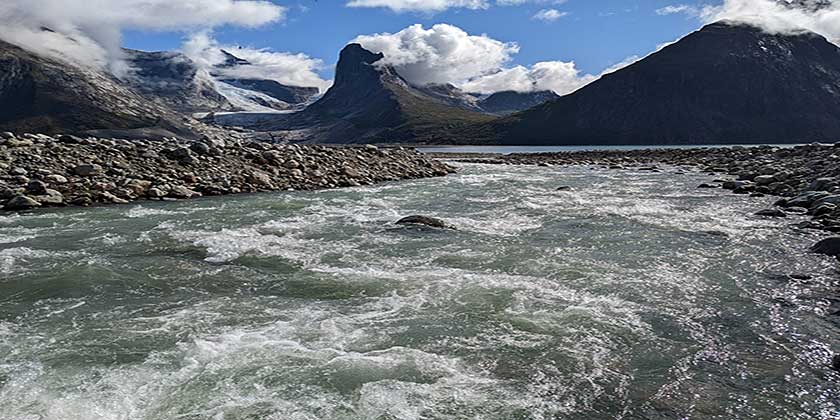

Arktische Flüsse sind wichtige Überträger von Nährstoffen und biogeochemischen Indikatoren und verbinden das Einzugsgebiet mit dem Küstenmeer. Diese Flüsse können jedoch auch toxische Metalle transportieren - überall in Grönland und der kanadischen Arktis finden sich hohe natürliche Anreicherungen potenziell toxischer Metalle (z. B. Kupfer, Zink, Blei). Dies kann lokale ökologische Risiken mit sich bringen, die durch anthropogene Aktivitäten noch verschärft werden können.

In diesem Projekt werden die Konzentrationen von Nährstoffen und Toxinen in den Flüssen Grönlands untersucht, wobei der Schwerpunkt auf der Kontrolle ihrer Verteilung, ihrer Formen und ihrer Flüsse liegt. Die Arktis ist eine sich rasch verändernde Umwelt mit zunehmender Eisschmelze, zurückweichenden Gletschern und veränderten Niederschlagsmustern. Schmelzender Permafrost und veränderte Landnutzung verändern die Flussbedingungen zusätzlich.
Daher wird dieses Projekt nicht nur moderne Erkenntnisse über diese wenig untersuchten Systeme liefern, sondern auch dazu beitragen, Ausgangswerte für die Bewertung künftiger Veränderungen festzulegen.

Publikationen

Extbase Variable Dump
array(2 items)
   publications => '33871' (5 chars)
   libraryUrl => '' (0 chars)
Extbase Variable Dump
array(1 item)
   0 => Snowflake\Publications\Domain\Model\Publicationprototypepersistent entity (uid=33871, pid=124)
      originalId => protected33871 (integer)
      authors => protected'Saboret, G.; Moccetti, C.; Wassenaar, L. I.; Matthews,&n
         bsp;B.; Aquino, N. J.; Janssen, D. J.; Brodersen, J
         .; Schubert, C. J.
' (180 chars) title => protected'Impact of glaciers on trophic dynamics and polyunsaturated fat accumulation
         in Southern Greenland Fjord ecosystems
' (114 chars) journal => protected'Global Change Biology' (21 chars) year => protected2025 (integer) volume => protected31 (integer) issue => protected'1' (1 chars) startpage => protected'e70044 (19 pp.)' (15 chars) otherpage => protected'' (0 chars) categories => protected'amino acid isotope; arctic char; fjord; food web; glacier; Greenland; polyun
         saturated fatty acid; trophic position
' (114 chars) description => protected'The primary production of fjords across the Arctic and Subarctic is undergoi
         ng significant transformations due to the climatically driven retreat of gla
         ciers and ice sheets. However, the implications of these changes for upper t
         rophic levels remain largely unknown. In this study, we employ both bulk and
          compound-specific stable isotope analyses to investigate how shifts at the
         base of fjord food webs impact the carbon and energy sources of consumers. F
         ocusing on two rapidly changing fjords in Southern Greenland, we used the mi
         gratory Arctic char as an indicator species, sampling populations along envi
         ronmental gradients within the fjords, building upon the assumption that cha
         r populations feed primarily close to their natal stream, thereby integratin
         g a dietary gradient. Our analysis of bulk stable isotopes in Arctic char ti
         ssue confirmed this premise, revealing a consistent change in resource use f
         rom the outer to the inner fjord, which nonetheless served as preferred feed
         ing grounds. Essential amino acid analysis further indicated shifts in carbo
         n and nitrogen sources, consistent with changes in nutrient use near glacier
          inputs characterized by low turbidity and high iron levels. Notably, these
         changes in the source of primary production were associated with shifts in t
         rophic positions and the transfer of polyunsaturated fatty acids, with Arcti
         c char in glacier-influenced inner fjords feeding at lower trophic level (si
         ze-corrected) and accumulating higher levels of high-quality docosahexaenoic
          acid (DHA). These findings highlight the usefulness of new analytical tools
          in revealing that glacial retreat can substantially alter food web dynamics
         , enhancing both carbon flow and the nutritional quality of fish in fjord ec
         osystems. The two Southern Greenland fjords studied could represent the futu
         re of other fjords, where retreating glaciers become land-terminating and gl
         acial inputs decrease. Our study underscores the critical role of glacier dy
         namics in affecting high...
' (2075 chars) serialnumber => protected'1354-1013' (9 chars) doi => protected'10.1111/gcb.70044' (17 chars) uid => protected33871 (integer) _localizedUid => protected33871 (integer)modified _languageUid => protectedNULL _versionedUid => protected33871 (integer)modified pid => protected124 (integer)
Saboret, G.; Moccetti, C.; Wassenaar, L. I.; Matthews, B.; Aquino, N. J.; Janssen, D. J.; Brodersen, J.; Schubert, C. J. (2025) Impact of glaciers on trophic dynamics and polyunsaturated fat accumulation in Southern Greenland Fjord ecosystems, Global Change Biology, 31(1), e70044 (19 pp.), doi:10.1111/gcb.70044, Institutional Repository

Kontakt

Zusammenarbeit

Finanzierung