Abteilung Oberflächengewässer

Fernerkundung der Phytoplanktondiversität
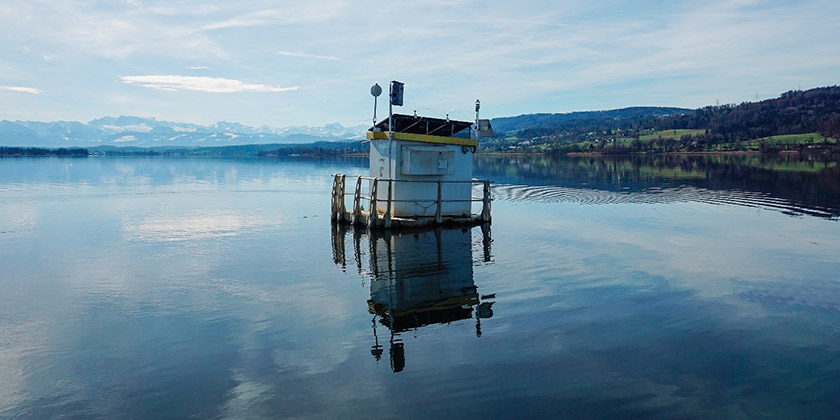

Phytoplankton spielt in Seen eine zentrale Rolle. Es bildet die Grundlage der Nahrungskette für Organismen höherer Ordnung. Seine Artenzusammensetzung und sein Zustand sind wichtige Indikatoren für die Widerstandsfähigkeit des Ökosystems. Phytoplanktongemeinschaften haben charakteristische Pigmentierungen. Diesen können mit Hilfe spektrometrischer Messungen im Labor, im Feld, von Flugzeugen oder Satelliten aus untersucht werden.

Im Labor werden Phytoplanktonkulturen meist unter künstlichem Weißlicht gezüchtet. Sie bilden dabei Pigmente aus, die sich erheblich von jenen in natürlich gewachsenem Phytoplankton unterscheiden können. Wir verwenden ein experimentelles Gerät, mit dem wir Licht, Temperatur und Nährstoffe während der Algenzucht regulieren können. Dies ermöglicht, die Auswirkungen wechselnder Umweltbedingungen auf die Pigmentierung ausgewählter Phytoplanktontaxa besser zu verstehen.

Die spektrale Reflektanz, das heisst die Farbe von Seen, wird u. a. durch Phytoplanktonpigmente beeinflusst. Sie kann bequem mit optischen Sensoren. Diese Messungen lassen sich mit der repräsentativen Pigmentabsorption von geeigneten Laborkulturen interpretieren. So können wir das Vorkommen und den Zustand verschiedener Planktonarten grossflächig untersuchen. Nach erfolgreichen Tests mit bodengestützten Messungen setzen wir dieses Verfahren nun auch auf hyperspektrale Flugzeug- und Satellitendaten.

Publikation

Extbase Variable Dump
array(2 items)
   publications => '35701' (5 chars)
   libraryUrl => '' (0 chars)
Extbase Variable Dump
array(1 item)
   0 => Snowflake\Publications\Domain\Model\Publicationprototypepersistent entity (uid=35701, pid=124)
      originalId => protected35701 (integer)
      authors => protected'Maire, L.; Gege, P.; Damm, A.; Odermatt, D.' (63 chars)
      title => protected'Differentiating phytoplankton taxa in lakes using hyperspectral in situ refl
         ectance and imaging microscopy
' (106 chars) journal => protected'Science of the Total Environment' (32 chars) year => protected2025 (integer) volume => protected1003 (integer) issue => protected'' (0 chars) startpage => protected'180718 (19 pp.)' (15 chars) otherpage => protected'' (0 chars) categories => protected'phytoplankton taxonomic groups; hyperspectral data; remote sensing reflectan
         ce; inland waters; radiative transfer modeling; bio-optical modeling
' (144 chars) description => protected'Phytoplankton play a central role in aquatic ecosystems, influencing biogeoc
         hemical cycles, food web dynamics, and overall water quality. Monitoring the
         ir composition is essential for assessing water ecosystem health and detecti
         ng environmental changes. Chlorophyll-a concentration is widely used as a pr
         oxy for phytoplankton abundance in inland waters. Together with colored diss
         olved organic matter and total suspended matter, these parameters can be ret
         rieved from remote sensing reflectance data. However, identifying the detail
         ed taxonomic composition of phytoplankton in lakes remains a major challenge
         . Spectral matching algorithms offer promising solutions to overcome this li
         mitation. In this study, we investigated the potential of retrieving phytopl
         ankton taxa composition from high-resolution in situ spectroscopy measuremen
         ts by applying radiative transfer inversion and validating the results again
         st phytoplankton abundance data obtained from an imaging microscope. First,
         we assessed the performance of our approach in retrieving four phytoplankton
          taxa under cloud-free conditions. Then, we extended the analysis to two sea
         sons, covering multiple consecutive blooms using data acquired independently
          of cloudiness. The high agreement between the imaging microscopy results an
         d those obtained from in situ spectroscopy indicates that remote sensing wit
         h radiative transfer inversions can track the evolution of phytoplankton blo
         oms. The results suggest that low phytoplankton concentrations and the lack
         of unique spectral features for some taxa may prevent the accurate identific
         ation of phytoplankton composition through spectroscopy. In addition, the na
         tural variability in cell size, along with physiological changes such as flu
         ctuations in intracellular chlorophyll-a content, impacts the empirical conv
         ersion from cell cross section to intracellular chlorophyll-a content.
' (1894 chars) serialnumber => protected'0048-9697' (9 chars) doi => protected'10.1016/j.scitotenv.2025.180718' (31 chars) uid => protected35701 (integer) _localizedUid => protected35701 (integer)modified _languageUid => protectedNULL _versionedUid => protected35701 (integer)modified pid => protected124 (integer)
Maire, L.; Gege, P.; Damm, A.; Odermatt, D. (2025) Differentiating phytoplankton taxa in lakes using hyperspectral in situ reflectance and imaging microscopy, Science of the Total Environment, 1003, 180718 (19 pp.), doi:10.1016/j.scitotenv.2025.180718, Institutional Repository

Kontakt

Finanzierung

Eawag