Department Surface Waters - Research and Management

Remote sensing of phytoplankton diversity
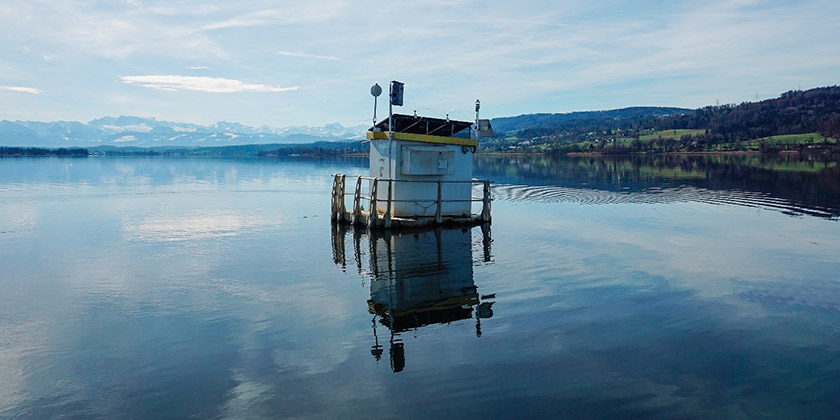

Phytoplankton plays a central role in lakes. It forms the basis of the food chain for higher-order organisms. Its species composition and status are important indicators of the resilience of the ecosystem. Phytoplankton communities have characteristic pigmentation. These can be analysed using spectrometric measurements in the laboratory, in the field, from aircraft or satellites.

In the laboratory, phytoplankton cultures are often grown under artificial white light. In doing so, they form pigments that can differ considerably from those in naturally grown phytoplankton. We use an experimental device with which we can regulate light, temperature and nutrients during algae cultivation. This allows us to better understand the effects of changing environmental conditions on the pigmentation of selected phytoplankton taxa.

The spectral reflectance, i.e. the colour of lakes, is influenced by phytoplankton pigments, among other things. It can be easily measured with optical sensors. These measurements can be interpreted with the representative pigment absorption of suitable laboratory cultures. This allows us to analyse the occurrence and condition of different plankton species on a large scale. Following successful tests with ground-based measurements, we are now also applying this method to hyperspectral aircraft and satellite data.

Publication

Extbase Variable Dump
array(2 items)
   publications => '35701' (5 chars)
   libraryUrl => '' (0 chars)
Extbase Variable Dump
array(1 item)
   0 => Snowflake\Publications\Domain\Model\Publicationprototypepersistent entity (uid=35701, pid=124)
      originalId => protected35701 (integer)
      authors => protected'Maire, L.; Gege, P.; Damm, A.; Odermatt, D.' (63 chars)
      title => protected'Differentiating phytoplankton taxa in lakes using hyperspectral in situ refl
         ectance and imaging microscopy
' (106 chars) journal => protected'Science of the Total Environment' (32 chars) year => protected2025 (integer) volume => protected1003 (integer) issue => protected'' (0 chars) startpage => protected'180718 (19 pp.)' (15 chars) otherpage => protected'' (0 chars) categories => protected'phytoplankton taxonomic groups; hyperspectral data; remote sensing reflectan
         ce; inland waters; radiative transfer modeling; bio-optical modeling
' (144 chars) description => protected'Phytoplankton play a central role in aquatic ecosystems, influencing biogeoc
         hemical cycles, food web dynamics, and overall water quality. Monitoring the
         ir composition is essential for assessing water ecosystem health and detecti
         ng environmental changes. Chlorophyll-a concentration is widely used as a pr
         oxy for phytoplankton abundance in inland waters. Together with colored diss
         olved organic matter and total suspended matter, these parameters can be ret
         rieved from remote sensing reflectance data. However, identifying the detail
         ed taxonomic composition of phytoplankton in lakes remains a major challenge
         . Spectral matching algorithms offer promising solutions to overcome this li
         mitation. In this study, we investigated the potential of retrieving phytopl
         ankton taxa composition from high-resolution in situ spectroscopy measuremen
         ts by applying radiative transfer inversion and validating the results again
         st phytoplankton abundance data obtained from an imaging microscope. First,
         we assessed the performance of our approach in retrieving four phytoplankton
          taxa under cloud-free conditions. Then, we extended the analysis to two sea
         sons, covering multiple consecutive blooms using data acquired independently
          of cloudiness. The high agreement between the imaging microscopy results an
         d those obtained from in situ spectroscopy indicates that remote sensing wit
         h radiative transfer inversions can track the evolution of phytoplankton blo
         oms. The results suggest that low phytoplankton concentrations and the lack
         of unique spectral features for some taxa may prevent the accurate identific
         ation of phytoplankton composition through spectroscopy. In addition, the na
         tural variability in cell size, along with physiological changes such as flu
         ctuations in intracellular chlorophyll-a content, impacts the empirical conv
         ersion from cell cross section to intracellular chlorophyll-a content.
' (1894 chars) serialnumber => protected'0048-9697' (9 chars) doi => protected'10.1016/j.scitotenv.2025.180718' (31 chars) uid => protected35701 (integer) _localizedUid => protected35701 (integer)modified _languageUid => protectedNULL _versionedUid => protected35701 (integer)modified pid => protected124 (integer)
Maire, L.; Gege, P.; Damm, A.; Odermatt, D. (2025) Differentiating phytoplankton taxa in lakes using hyperspectral in situ reflectance and imaging microscopy, Science of the Total Environment, 1003, 180718 (19 pp.), doi:10.1016/j.scitotenv.2025.180718, Institutional Repository

Contact

Loé Maire PhD student Tel. +41 58 765 6656 Send Mail
Prof. Dr. Alexander Damm Remote Sensing of Water Systems Tel. +41 58 765 6755 Send Mail

Funding

Eawag