Der Klimawandel führt global zu Veränderungen der Temperatur und der Schichtung von Seen mit Folgen auch für die Ökosysteme. Es wird erwartet, dass sich diese Auswirkungen in Zukunft noch verstärken werden. Wir erforschen diese Veränderungen und ihre Ursachen durch:
Studien zum Wärmehaushalt von Seen und wie dieser auf Änderungen im Klima reagiert;
Beobachtung und Beurteilung von Trends in der Temperatur und der thermischen Struktur von Seen und Untersuchung der Ursachen dieser Trends mit Hilfe von Datenanalysen und numerischen Modellen;
Berechnung der erwarteten Veränderungen der thermischen Struktur und der Wasserqualität von Seen für verschiedene Klimaszenarien mit numerischen Modellen.
Die Untersuchungen werden sowohl auf nationaler Ebene durchgeführt, zum Beispiel im Rahmen des Hydro CH2018 Projekts und des Center for Climate Systems Modelling (C2SM), als auch in internationaler Zusammenarbeit im Rahmen des Global Lake Ecological Observatory Network GLEON, des Inter-Sectoral Impact Model Intercomparison Project ISIMIP und des Projektes Seewandel-Klima.
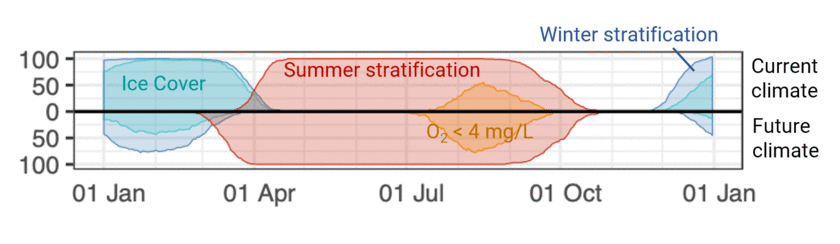
Die folgende Abbildung zeigt zum Beispiel die für das aktuelle Klima und das IPCC A2-Szenario berechneten Wahrscheinlichkeiten, dass der Sihlsee an einem bestimmten Tag im Jahr geschichtet oder eisbedeckt ist und Sauerstoffkonzentrationen unter dem gesetzlichen Grenzwert von 4 mg/L erreicht (nach Kobler et al., 2019).
array(7 items)0 => Snowflake\Publications\Domain\Model\Publicationprototypepersistent entity (uid=22677, pid=124)originalId => protected22677 (integer)
authors => protected'Jane, S. F.; Hansen, G. J. A.; Kraemer, B.&nbs p;M.; Leavitt, P. R.; Mincer, J. L.; North, R.  ;L.; Pilla, R. M.; Stetler, J. T.; Williamson, C.&n bsp;E.; Woolway, R. I.; Arvola, L.; Chandra, S.; DeGaspe ri, C. L.; Diemer, L.; Dunalska, J.; Erina, O.; Fla im, G.; Grossart, H.-P.; Hambright, K. D.; Hein, C. ; Hejzlar, J.; Janus, L. L.; Jenny, J.-P.; Jones, J . R.; Knoll, L. B.; Leoni, B.; Mackay, E.; Matsuzak i, S.-I. S.; McBride, C.; Müller-Navarra, D. C.; P aterson, A. M.; Pierson, D.; Rogora, M.; Rusak, J.& nbsp;A.; Sadro, S.; Saulnier-Talbot, E.; Schmid, M.; Sommarug a, R.; Thiery, W.; Verburg, P.; Weathers, K. C.; We yhenmeyer, G. A.; Yokota, K.; Rose, K. C.' (978 chars)
title => protected'Widespread deoxygenation of temperate lakes' (43 chars)
journal => protected'Nature' (6 chars)
year => protected2021 (integer)
volume => protected594 (integer)
issue => protected'7861' (4 chars)
startpage => protected'66' (2 chars)
otherpage => protected'70' (2 chars)
categories => protected'' (0 chars)
description => protected'The concentration of dissolved oxygen in aquatic systems helps to regulate b iodiversity, nutrient biogeochemistry, greenhouse gas emissions, and the qua lity of drinking water. The long-term declines in dissolved oxygen concentra tions in coastal and ocean waters have been linked to climate warming and hu man activity, but little is known about the changes in dissolved oxygen conc entrations in lakes. Although the solubility of dissolved oxygen decreases w ith increasing water temperatures, long-term lake trajectories are difficult to predict. Oxygen losses in warming lakes may be amplified by enhanced dec omposition and stronger thermal stratification or oxygen may increase as a r esult of enhanced primary production. Here we analyse a combined total of 45 ,148 dissolved oxygen and temperature profiles and calculate trends for 393 temperate lakes that span 1941 to 2017. We find that a decline in dissolved oxygen is widespread in surface and deep-water habitats. The decline in surf ace waters is primarily associated with reduced solubility under warmer wate r temperatures, although dissolved oxygen in surface waters increased in a s ubset of highly productive warming lakes, probably owing to increasing produ ction of phytoplankton. By contrast, the decline in deep waters is associate d with stronger thermal stratification and loss of water clarity, but not wi th changes in gas solubility. Our results suggest that climate change and de clining water clarity have altered the physical and chemical environment of lakes. Declines in dissolved oxygen in freshwater are 2.75 to 9.3 times grea ter than observed in the world’s oceans and could threaten essential lake ecosystem services.' (1691 chars)
serialnumber => protected'0028-0836' (9 chars)
doi => protected'10.1038/s41586-021-03550-y' (26 chars)
uid => protected22677 (integer)
_localizedUid => protected22677 (integer)modified_languageUid => protectedNULL
_versionedUid => protected22677 (integer)modifiedpid => protected124 (integer)1 => Snowflake\Publications\Domain\Model\Publicationprototypepersistent entity (uid=22687, pid=124)originalId => protected22687 (integer)
authors => protected'Kraemer, B. M.; Pilla, R. M.; Woolway, R. I.; Anneville, O.; Ban, S.; Colom-Montero, W.; Devlin, S.&nb sp;P.; Dokulil, M. T.; Gaiser, E. E.; Hambright, K. D.; Hessen, D. O.; Higgins, S. N.; Jöhnk, K. D.; Keller, W.; Knoll, L. B.; Leavitt, P. R.; Lepori, F.; Luger, M. S.; Maberly, S. C.; Müller- Navarra, D. C.; Paterson, A. M.; Pierson, D. C .; Richardson, D. C.; Rogora, M.; Rusak, J. A.; Sad ro, S.; Salmaso, N.; Schmid, M.; Silow, E. A.; Somm aruga, R.; Stelzer, J. A. A.; Straile, D.; Thiery,& nbsp;W.; Timofeyev, M. A.; Verburg, P.; Weyhenmeyer, G.& nbsp;A.; Adrian, R.' (860 chars)
title => protected'Climate change drives widespread shifts in lake thermal habitat' (63 chars)
journal => protected'Nature Climate Change' (21 chars)
year => protected2021 (integer)
volume => protected11 (integer)
issue => protected'' (0 chars)
startpage => protected'521' (3 chars)
otherpage => protected'529' (3 chars)
categories => protected'' (0 chars)
description => protected'Lake surfaces are warming worldwide, raising concerns about lake organism re sponses to thermal habitat changes. Species may cope with temperature increa ses by shifting their seasonality or their depth to track suitable thermal h abitats, but these responses may be constrained by ecological interactions, life histories or limiting resources. Here we use 32 million temperature mea surements from 139 lakes to quantify thermal habitat change (percentage of n on-overlap) and assess how this change is exacerbated by potential habitat c onstraints. Long-term temperature change resulted in an average 6.2% non-ove rlap between thermal habitats in baseline (1978-1995) and recent (1996-2013) time periods, with non-overlap increasing to 19.4% on average when habitats were restricted by season and depth. Tropical lakes exhibited substantially higher thermal non-overlap compared with lakes at other latitudes. Lakes wi th high thermal habitat change coincided with those having numerous endemic species, suggesting that conservation actions should consider thermal habita t change to preserve lake biodiversity.' (1103 chars)
serialnumber => protected'1758-678X' (9 chars)
doi => protected'10.1038/s41558-021-01060-3' (26 chars)
uid => protected22687 (integer)
_localizedUid => protected22687 (integer)modified_languageUid => protectedNULL
_versionedUid => protected22687 (integer)modifiedpid => protected124 (integer)2 => Snowflake\Publications\Domain\Model\Publicationprototypepersistent entity (uid=22089, pid=124)originalId => protected22089 (integer)
authors => protected'Råman Vinnå, L.; Medhaug, I.; Schmid, M.; Bouffard, D.' (76 chars)
title => protected'The vulnerability of lakes to climate change along an altitudinal gradient' (74 chars)
journal => protected'Communications Earth & Environment' (34 chars)
year => protected2021 (integer)
volume => protected2 (integer)
issue => protected'' (0 chars)
startpage => protected'35 (10 pp.)' (11 chars)
otherpage => protected'' (0 chars)
categories => protected'' (0 chars)
description => protected'Studies of future 21<sup>st</sup> century climate warming in lakes along alt itudinal gradients have been partially obscured by local atmospheric phenome na unresolved in climate models. Here we forced the physical lake model Sims trat with locally downscaled climate models under three future scenarios to investigate the impact on 29 Swiss lakes, varying in size along an altitudin al gradient. Results from the worst-case scenario project substantial change at the end of the century in duration of ice-cover at mid to high altitude (−2 to −107 days), stratification duration (winter −17 to −84 days, summer −2 to 73 days), while lower and especially mid altitude (present da y mean annual air temperature from 9 °C to 3 °C) dimictic lakes risk s hift to monomictic regimes (seven out of the eight lakes). Analysis further indicates that for many lakes shifts in mixing regime can be avoided by adhe ring to the most stringent scenario.' (948 chars)
serialnumber => protected'' (0 chars)
doi => protected'10.1038/s43247-021-00106-w' (26 chars)
uid => protected22089 (integer)
_localizedUid => protected22089 (integer)modified_languageUid => protectedNULL
_versionedUid => protected22089 (integer)modifiedpid => protected124 (integer)3 => Snowflake\Publications\Domain\Model\Publicationprototypepersistent entity (uid=18195, pid=124)originalId => protected18195 (integer)
authors => protected'Kobler, U. G.; Wüest, A.; Schmid, M.' (57 chars)
title => protected'Combined effects of pumped-storage operation and climate change on thermal s tructure and water quality' (102 chars)
journal => protected'Climatic Change' (15 chars)
year => protected2019 (integer)
volume => protected152 (integer)
issue => protected'' (0 chars)
startpage => protected'427' (3 chars)
otherpage => protected'443' (3 chars)
categories => protected'' (0 chars)
description => protected'The assessment of ecological impacts of pumped-storage (PS) hydropower plant s on the two connected water bodies is usually based on present climatic con ditions. However, significant changes in climate must be expected during the ir long concession periods. We, therefore, investigate the combined effects of climate change and PS operations on water temperature and quality, as wel l as extent and duration of stratification and ice cover, using a site in Sw itzerland. For this purpose, a coupled two-dimensional hydrodynamic and wate r quality model for the two connected water bodies is run with 150 years lon g synthetic stochastic meteorological forcing for both current and future cl imate conditions under two PS and two reference scenarios. The results show relevant synergistic and antagonistic effects of PS operations and climate c hange. For example, hypolimnion temperatures in September are projected to i ncrease by < 0.6 °C in a near-natural reference scenario and by ~ 2. 5 °C in an extended PS scenario. Ice cover, which occurs every year under n ear-natural conditions in the current climate, would almost completely vanis h with extended PS operation in the future climate. Conversely, the expected negative impacts of climate change on hypolimnetic dissolved oxygen concent rations are partially counteracted by extended PS operations. We, therefore, recommend considering future climate conditions for the environmental impac t assessment in the planning of new or the recommissioning of existing PS hy dropower plants.' (1536 chars)
serialnumber => protected'0165-0009' (9 chars)
doi => protected'10.1007/s10584-018-2340-x' (25 chars)
uid => protected18195 (integer)
_localizedUid => protected18195 (integer)modified_languageUid => protectedNULL
_versionedUid => protected18195 (integer)modifiedpid => protected124 (integer)4 => Snowflake\Publications\Domain\Model\Publicationprototypepersistent entity (uid=14062, pid=124)originalId => protected14062 (integer)
authors => protected'Schmid, M.; Köster, O.' (33 chars)
title => protected'Excess warming of a Central European lake driven by solar brightening' (69 chars)
journal => protected'Water Resources Research' (24 chars)
year => protected2016 (integer)
volume => protected52 (integer)
issue => protected'10' (2 chars)
startpage => protected'8103' (4 chars)
otherpage => protected'8116' (4 chars)
categories => protected'' (0 chars)
description => protected'Recent trends in summer surface temperatures of many lakes exceed the corres ponding air temperature trends. This disagrees with expectations from lake s urface heat budgets, which predict that lake surface temperatures should inc rease by 75–90% of the increase in air temperatures. Here we investigate t he causes for this excess warming for Lower Lake Zurich, a representative de ep and stratified Central European lake, by a combined data analysis and mod eling approach. Lake temperatures are simulated using a one-dimensional vert ical model driven by 33 years of homogenized meteorological data. The model is calibrated and validated using an equally long time series of monthly wat er temperature profiles. The effects of individual forcing parameters are in vestigated by scenarios where the trends of single variables are retained wh ile those of all other forcing variables are removed. The results show that ∼60% of the observed warming of spring and summer lake surface temperature s were caused by increased air temperature and ∼40% by increased solar rad iation. The effects of the trends of all other forcing variables were small. Following projections of climate models, the increasing trends in solar rad iation, and consequently the excess warming of lake surface temperatures, ar e not likely to continue in the future.' (1331 chars)
serialnumber => protected'0043-1397' (9 chars)
doi => protected'10.1002/2016WR018651' (20 chars)
uid => protected14062 (integer)
_localizedUid => protected14062 (integer)modified_languageUid => protectedNULL
_versionedUid => protected14062 (integer)modifiedpid => protected124 (integer)5 => Snowflake\Publications\Domain\Model\Publicationprototypepersistent entity (uid=7602, pid=124)originalId => protected7602 (integer)
authors => protected'Schmid, M.; Hunziker, S.; Wüest, A.' (51 chars)
title => protected'Lake surface temperatures in a changing climate: a global sensitivity analys is' (78 chars)
journal => protected'Climatic Change' (15 chars)
year => protected2014 (integer)
volume => protected124 (integer)
issue => protected'1-2' (3 chars)
startpage => protected'301' (3 chars)
otherpage => protected'315' (3 chars)
categories => protected'' (0 chars)
description => protected'We estimate the effects of climatic changes, as predicted by six climate mod els, on lake surface temperatures on a global scale, using the lake surface equilibrium temperature as a proxy. We evaluate interactions between differe nt forcing variables, the sensitivity of lake surface temperatures to these variables, as well as differences between climate zones. Lake surface equili brium temperatures are predicted to increase by 70 to 85 % of the increase in air temperatures. On average, air temperature is the main driver for chan ges in lake surface temperatures, and its effect is reduced by ~10 % by cha nges in other meteorological variables. However, the contribution of these o ther variables to the variance is ~40 % of that of air temperature, and the ir effects can be important at specific locations. The warming increases the importance of longwave radiation and evaporation for the lake surface heat balance compared to shortwave radiation and convective heat fluxes. We discu ss the consequences of our findings for the design and evaluation of differe nt types of studies on climate change effects on lakes.' (1119 chars)
serialnumber => protected'0165-0009' (9 chars)
doi => protected'10.1007/s10584-014-1087-2' (25 chars)
uid => protected7602 (integer)
_localizedUid => protected7602 (integer)modified_languageUid => protectedNULL
_versionedUid => protected7602 (integer)modifiedpid => protected124 (integer)6 => Snowflake\Publications\Domain\Model\Publicationprototypepersistent entity (uid=7610, pid=124)originalId => protected7610 (integer)
authors => protected'Fink, G.; Schmid, M.; Wahl, B.; Wolf, T.; Wüest, A .' (77 chars)
title => protected'Heat flux modifications related to climate-induced warming of large European lakes' (82 chars)
journal => protected'Water Resources Research' (24 chars)
year => protected2014 (integer)
volume => protected50 (integer)
issue => protected'3' (1 chars)
startpage => protected'2072' (4 chars)
otherpage => protected'2085' (4 chars)
categories => protected'' (0 chars)
description => protected'Within the last decades, the water temperature of several European lakes has risen. It is assumed that these temperature increases are due to a reconfig uration of the heat-balance components. This study explores the dominant mod ifications of heat exchange with the atmosphere and their temporal evolution s. The objective is to identify the primary changes in heat fluxes and the s equence of events of the reconfiguration for the period 1984–2011. For thi s purpose, a model was applied to Lake Constance to estimate the contributio ns of the individual heat fluxes to the total heat balance. The results show that increasing absorption of solar radiation (+0.21 ± 0.13 W m<SUP>−2</ SUP> yr<SUP>−1</SUP>) and of longwave radiation (+0.25 ± 0.11 W m<SUP>− 2</SUP> yr<SUP>−1</SUP>) was responsible for the lake surface warming of 0 .046 ± 0.011°C yr<SUP>−1</SUP>. Heat losses to the atmosphere by longwav e emission (−0.24 ± 0.06 W m<SUP>−2</SUP> yr<SUP>−1</SUP>) and by lat ent heat flux (−0.27 ± 0.12 W m<SUP>−2</SUP> yr<SUP>−1</SUP>) have in tensified in parallel due to higher lake surface temperatures. The heat budg et is in a quasi-steady state, whereas incoming solar radiation and the warm er atmosphere increased the lake surface temperature; the warmer surface emi ts more longwave radiation and more water is evaporated. At each level of th e slowly increasing water temperature, the heat fluxes are balanced. The ove rall change of the total heat content, however, is relatively little. Althou gh the cooling effect of inflowing rivers decreased, this contribution is al so small.' (1605 chars)
serialnumber => protected'0043-1397' (9 chars)
doi => protected'10.1002/2013WR014448' (20 chars)
uid => protected7610 (integer)
_localizedUid => protected7610 (integer)modified_languageUid => protectedNULL
_versionedUid => protected7610 (integer)modifiedpid => protected124 (integer)
Widespread deoxygenation of temperate lakes
The concentration of dissolved oxygen in aquatic systems helps to regulate biodiversity, nutrient biogeochemistry, greenhouse gas emissions, and the quality of drinking water. The long-term declines in dissolved oxygen concentrations in coastal and ocean waters have been linked to climate warming and human activity, but little is known about the changes in dissolved oxygen concentrations in lakes. Although the solubility of dissolved oxygen decreases with increasing water temperatures, long-term lake trajectories are difficult to predict. Oxygen losses in warming lakes may be amplified by enhanced decomposition and stronger thermal stratification or oxygen may increase as a result of enhanced primary production. Here we analyse a combined total of 45,148 dissolved oxygen and temperature profiles and calculate trends for 393 temperate lakes that span 1941 to 2017. We find that a decline in dissolved oxygen is widespread in surface and deep-water habitats. The decline in surface waters is primarily associated with reduced solubility under warmer water temperatures, although dissolved oxygen in surface waters increased in a subset of highly productive warming lakes, probably owing to increasing production of phytoplankton. By contrast, the decline in deep waters is associated with stronger thermal stratification and loss of water clarity, but not with changes in gas solubility. Our results suggest that climate change and declining water clarity have altered the physical and chemical environment of lakes. Declines in dissolved oxygen in freshwater are 2.75 to 9.3 times greater than observed in the world’s oceans and could threaten essential lake ecosystem services.
Jane, S. F.; Hansen, G. J. A.; Kraemer, B. M.; Leavitt, P. R.; Mincer, J. L.; North, R. L.; Pilla, R. M.; Stetler, J. T.; Williamson, C. E.; Woolway, R. I.; Arvola, L.; Chandra, S.; DeGasperi, C. L.; Diemer, L.; Dunalska, J.; Erina, O.; Flaim, G.; Grossart, H.-P.; Hambright, K. D.; Hein, C.; Hejzlar, J.; Janus, L. L.; Jenny, J.-P.; Jones, J. R.; Knoll, L. B.; Leoni, B.; Mackay, E.; Matsuzaki, S.-I. S.; McBride, C.; Müller-Navarra, D. C.; Paterson, A. M.; Pierson, D.; Rogora, M.; Rusak, J. A.; Sadro, S.; Saulnier-Talbot, E.; Schmid, M.; Sommaruga, R.; Thiery, W.; Verburg, P.; Weathers, K. C.; Weyhenmeyer, G. A.; Yokota, K.; Rose, K. C. (2021) Widespread deoxygenation of temperate lakes, Nature, 594(7861), 66-70, doi:10.1038/s41586-021-03550-y, Institutional Repository
Climate change drives widespread shifts in lake thermal habitat
Lake surfaces are warming worldwide, raising concerns about lake organism responses to thermal habitat changes. Species may cope with temperature increases by shifting their seasonality or their depth to track suitable thermal habitats, but these responses may be constrained by ecological interactions, life histories or limiting resources. Here we use 32 million temperature measurements from 139 lakes to quantify thermal habitat change (percentage of non-overlap) and assess how this change is exacerbated by potential habitat constraints. Long-term temperature change resulted in an average 6.2% non-overlap between thermal habitats in baseline (1978-1995) and recent (1996-2013) time periods, with non-overlap increasing to 19.4% on average when habitats were restricted by season and depth. Tropical lakes exhibited substantially higher thermal non-overlap compared with lakes at other latitudes. Lakes with high thermal habitat change coincided with those having numerous endemic species, suggesting that conservation actions should consider thermal habitat change to preserve lake biodiversity.
Kraemer, B. M.; Pilla, R. M.; Woolway, R. I.; Anneville, O.; Ban, S.; Colom-Montero, W.; Devlin, S. P.; Dokulil, M. T.; Gaiser, E. E.; Hambright, K. D.; Hessen, D. O.; Higgins, S. N.; Jöhnk, K. D.; Keller, W.; Knoll, L. B.; Leavitt, P. R.; Lepori, F.; Luger, M. S.; Maberly, S. C.; Müller-Navarra, D. C.; Paterson, A. M.; Pierson, D. C.; Richardson, D. C.; Rogora, M.; Rusak, J. A.; Sadro, S.; Salmaso, N.; Schmid, M.; Silow, E. A.; Sommaruga, R.; Stelzer, J. A. A.; Straile, D.; Thiery, W.; Timofeyev, M. A.; Verburg, P.; Weyhenmeyer, G. A.; Adrian, R. (2021) Climate change drives widespread shifts in lake thermal habitat, Nature Climate Change, 11, 521-529, doi:10.1038/s41558-021-01060-3, Institutional Repository
The vulnerability of lakes to climate change along an altitudinal gradient
Studies of future 21st century climate warming in lakes along altitudinal gradients have been partially obscured by local atmospheric phenomena unresolved in climate models. Here we forced the physical lake model Simstrat with locally downscaled climate models under three future scenarios to investigate the impact on 29 Swiss lakes, varying in size along an altitudinal gradient. Results from the worst-case scenario project substantial change at the end of the century in duration of ice-cover at mid to high altitude (−2 to −107 days), stratification duration (winter −17 to −84 days, summer −2 to 73 days), while lower and especially mid altitude (present day mean annual air temperature from 9 °C to 3 °C) dimictic lakes risk shift to monomictic regimes (seven out of the eight lakes). Analysis further indicates that for many lakes shifts in mixing regime can be avoided by adhering to the most stringent scenario.
Råman Vinnå, L.; Medhaug, I.; Schmid, M.; Bouffard, D. (2021) The vulnerability of lakes to climate change along an altitudinal gradient, Communications Earth & Environment, 2, 35 (10 pp.), doi:10.1038/s43247-021-00106-w, Institutional Repository
Combined effects of pumped-storage operation and climate change on thermal structure and water quality
The assessment of ecological impacts of pumped-storage (PS) hydropower plants on the two connected water bodies is usually based on present climatic conditions. However, significant changes in climate must be expected during their long concession periods. We, therefore, investigate the combined effects of climate change and PS operations on water temperature and quality, as well as extent and duration of stratification and ice cover, using a site in Switzerland. For this purpose, a coupled two-dimensional hydrodynamic and water quality model for the two connected water bodies is run with 150 years long synthetic stochastic meteorological forcing for both current and future climate conditions under two PS and two reference scenarios. The results show relevant synergistic and antagonistic effects of PS operations and climate change. For example, hypolimnion temperatures in September are projected to increase by < 0.6 °C in a near-natural reference scenario and by ~ 2.5 °C in an extended PS scenario. Ice cover, which occurs every year under near-natural conditions in the current climate, would almost completely vanish with extended PS operation in the future climate. Conversely, the expected negative impacts of climate change on hypolimnetic dissolved oxygen concentrations are partially counteracted by extended PS operations. We, therefore, recommend considering future climate conditions for the environmental impact assessment in the planning of new or the recommissioning of existing PS hydropower plants.
Kobler, U. G.; Wüest, A.; Schmid, M. (2019) Combined effects of pumped-storage operation and climate change on thermal structure and water quality, Climatic Change, 152, 427-443, doi:10.1007/s10584-018-2340-x, Institutional Repository
Excess warming of a Central European lake driven by solar brightening
Recent trends in summer surface temperatures of many lakes exceed the corresponding air temperature trends. This disagrees with expectations from lake surface heat budgets, which predict that lake surface temperatures should increase by 75–90% of the increase in air temperatures. Here we investigate the causes for this excess warming for Lower Lake Zurich, a representative deep and stratified Central European lake, by a combined data analysis and modeling approach. Lake temperatures are simulated using a one-dimensional vertical model driven by 33 years of homogenized meteorological data. The model is calibrated and validated using an equally long time series of monthly water temperature profiles. The effects of individual forcing parameters are investigated by scenarios where the trends of single variables are retained while those of all other forcing variables are removed. The results show that ∼60% of the observed warming of spring and summer lake surface temperatures were caused by increased air temperature and ∼40% by increased solar radiation. The effects of the trends of all other forcing variables were small. Following projections of climate models, the increasing trends in solar radiation, and consequently the excess warming of lake surface temperatures, are not likely to continue in the future.
Schmid, M.; Köster, O. (2016) Excess warming of a Central European lake driven by solar brightening, Water Resources Research, 52(10), 8103-8116, doi:10.1002/2016WR018651, Institutional Repository
Lake surface temperatures in a changing climate: a global sensitivity analysis
We estimate the effects of climatic changes, as predicted by six climate models, on lake surface temperatures on a global scale, using the lake surface equilibrium temperature as a proxy. We evaluate interactions between different forcing variables, the sensitivity of lake surface temperatures to these variables, as well as differences between climate zones. Lake surface equilibrium temperatures are predicted to increase by 70 to 85 % of the increase in air temperatures. On average, air temperature is the main driver for changes in lake surface temperatures, and its effect is reduced by ~10 % by changes in other meteorological variables. However, the contribution of these other variables to the variance is ~40 % of that of air temperature, and their effects can be important at specific locations. The warming increases the importance of longwave radiation and evaporation for the lake surface heat balance compared to shortwave radiation and convective heat fluxes. We discuss the consequences of our findings for the design and evaluation of different types of studies on climate change effects on lakes.
Schmid, M.; Hunziker, S.; Wüest, A. (2014) Lake surface temperatures in a changing climate: a global sensitivity analysis, Climatic Change, 124(1-2), 301-315, doi:10.1007/s10584-014-1087-2, Institutional Repository
Heat flux modifications related to climate-induced warming of large European lakes
Within the last decades, the water temperature of several European lakes has risen. It is assumed that these temperature increases are due to a reconfiguration of the heat-balance components. This study explores the dominant modifications of heat exchange with the atmosphere and their temporal evolutions. The objective is to identify the primary changes in heat fluxes and the sequence of events of the reconfiguration for the period 1984–2011. For this purpose, a model was applied to Lake Constance to estimate the contributions of the individual heat fluxes to the total heat balance. The results show that increasing absorption of solar radiation (+0.21 ± 0.13 W m−2 yr−1) and of longwave radiation (+0.25 ± 0.11 W m−2 yr−1) was responsible for the lake surface warming of 0.046 ± 0.011°C yr−1. Heat losses to the atmosphere by longwave emission (−0.24 ± 0.06 W m−2 yr−1) and by latent heat flux (−0.27 ± 0.12 W m−2 yr−1) have intensified in parallel due to higher lake surface temperatures. The heat budget is in a quasi-steady state, whereas incoming solar radiation and the warmer atmosphere increased the lake surface temperature; the warmer surface emits more longwave radiation and more water is evaporated. At each level of the slowly increasing water temperature, the heat fluxes are balanced. The overall change of the total heat content, however, is relatively little. Although the cooling effect of inflowing rivers decreased, this contribution is also small.
Fink, G.; Schmid, M.; Wahl, B.; Wolf, T.; Wüest, A. (2014) Heat flux modifications related to climate-induced warming of large European lakes, Water Resources Research, 50(3), 2072-2085, doi:10.1002/2013WR014448, Institutional Repository