Abteilung Umwelttoxikologie

Metabolomik in Grünalgen

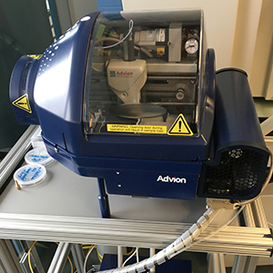
Aquatische Organismen sind einer stetig zunehmenden Anzahl Chemikalien ausgesetzt. In der Risikobeurteilung und molekularen Ökotoxikologie ist daher wichtig die zugrunde liegenden molekularen Mechanismen der Stressantwort zu identifizieren und zu verstehen. Das Metabolom widerspiegelt den aktuellen biochemischen Status eines Organismus’ und damit auch die Dynamik der metabolischen Netzwerke. Änderungen im Metabolom treten auf bevor sie sich physiologisch manifestieren. Um diese metabolischen Anpassungen zu verstehen benutzen wir für die Analyse von anionischen und kationischen Primärmetaboliten eine Methode mit hohem Durchsatz, d.h chip-basierte Direktinfusion gekoppelt mit hochauflösender Massenspektrometrie. Dies erlaubt hohe zeitliche Auflösung und eine Vielzahl von experimentellen Konditionen.

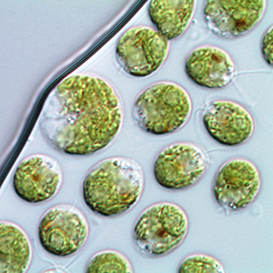
Zur Zeit untersuchen wir die metabolische Antwort von Grünalgen und Zebrafisch auf Exposition an Silber, Zink, Kupfer und Aluminium. Zusammen mit Anita Narwani (Eco) werden wir den Effekt von Temperatur und Nährstofflimitierung auf den Metabolismus von Phytoplankton untersuchen.

Publikationen

Extbase Variable Dump
array(2 items)
   publications => '10615' (5 chars)
   libraryUrl => '' (0 chars)
Extbase Variable Dump
array(1 item)
   0 => Snowflake\Publications\Domain\Model\Publicationprototypepersistent entity (uid=10615, pid=124)
      originalId => protected10615 (integer)
      authors => protected'Ammann, A. A.; Suter, M. J. -F.' (56 chars)
      title => protected'Multimode gradient high performance liquid chromatography mass spectrometry 
         method applicable to metabolomics and environmental monitoring
' (138 chars) journal => protected'Journal of Chromatography A' (27 chars) year => protected2016 (integer) volume => protected1456 (integer) issue => protected'' (0 chars) startpage => protected'145' (3 chars) otherpage => protected'151' (3 chars) categories => protected'gradient multimode separation; HILIC; anion exchange (AEX); cation exchange
         (CEX); reversed-phase; metabolomics; complex environmental mixtures
' (143 chars) description => protected'Metabolomics or environmental investigations generate samples containing ver
         y large numbers of small molecular weight analytes. A single mode chromatogr
         aphic separation excludes a substantial part of such complex analyte mixture
         s. For instance, a reversed-phase separation would not retain ionic species,
          resulting in a correspondingly huge front peak. To address this problem, we
          used two commercially available mixed-mode ion-exchange reversed-phase colu
         mns (WAX-1 and WCX-1) in sequence in a novel multimode separation method.<BR
         /> After trapping hydrophobics on a C<SUB>18</SUB>-trap in loop position, hy
         drophilics passing the trap are separated by a simultaneous gradient for HIL
         IC, anion and cation exchange chromatography. This gradient ends in a washou
         t phase with a high percentage of water, the correct starting conditions for
          a reversed-phase gradient eluting hydrophobics from the trap in a second st
         ep of the run. Amino acids (9), organic acids (2), sugars (8), fatty acid de
         rived compounds (11), antioxidants (4), miscellanea (6) and xenobiotics (4)
         were analyzed. Compounds were separated after a single sample injection duri
         ng a 50 min run. Lipids derived small fatty acids up to a chain length of 1
         2 carbons were also accessible within this run time.
' (1268 chars) serialnumber => protected'0021-9673' (9 chars) doi => protected'10.1016/j.chroma.2016.06.001' (28 chars) uid => protected10615 (integer) _localizedUid => protected10615 (integer)modified _languageUid => protectedNULL _versionedUid => protected10615 (integer)modified pid => protected124 (integer)
Ammann, A. A.; Suter, M. J. -F. (2016) Multimode gradient high performance liquid chromatography mass spectrometry method applicable to metabolomics and environmental monitoring, Journal of Chromatography A, 1456, 145-151, doi:10.1016/j.chroma.2016.06.001, Institutional Repository