News

Neue Form der Symbiose entdeckt

3. März 2021 | Max-Planck-Institut für Marine Mikrobiologie, Bremen

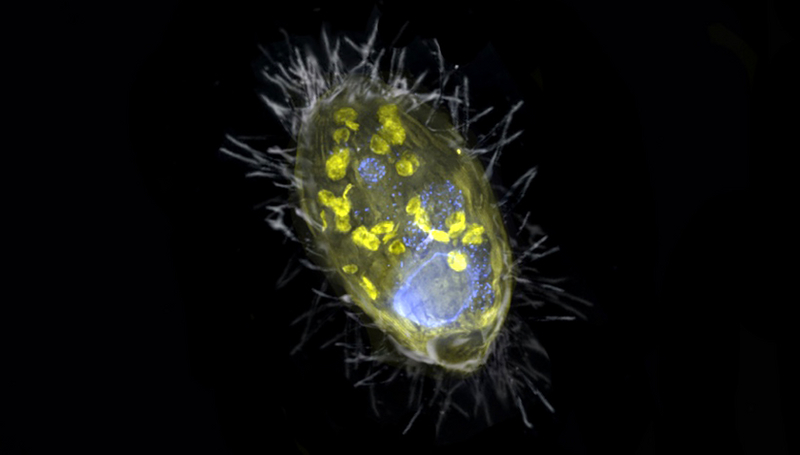
In einem einzelligen Wimpertierchen aus dem Zugersee wurde ein Bakterium gefunden, dessen Aufgabe es ist, für das Wimpertierchen zu atmen und es mit Energie zu versorgen. Wobei dieser so genannte Endosymbiont nicht Sauerstoff nutzt, sondern Nitrat.

Sie werden auch Kraftwerke der Zellen genannt: Die Mitochondrien. Sie kommen in fast allen Zellen mit einem Zellkern vor und versorgen sie mit Energie. Bisher war man davon ausgegangen, dass nur Mitochondrien die Aufgabe des Energielieferanten übernehmen können. Forschende des Max-Planck-Instituts für Marine Mikrobiologie, des Max-Planck-Genom Zentrums und des Wasserforschungsinstituts Eawag haben nun herausgefunden, dass das so nicht stimmt. Ihre Ergebnisse werfen ein völlig neues Licht auf die Energieversorgung von Zellen in sauerstofffreier Umgebung und wurden jetzt in dem renommierten wissenschaftlichen Fachmagazin Nature veröffentlicht.

Weitere Informationen zur Neuentdeckung auf der Webseite des Max-Planck-Instituts für Marine Mikrobiologie: Neue Form der Symbiose entdeckt

Titelbild: ©Max-Planck-Institut für Marine Mikrobiologie, S. Ahmerkamp

Originalpublikation

Extbase Variable Dump
array(2 items)
   publications => '22268' (5 chars)
   libraryUrl => '' (0 chars)
Extbase Variable Dump
array(1 item)
   0 => Snowflake\Publications\Domain\Model\Publicationprototypepersistent entity (uid=22268, pid=124)
      originalId => protected22268 (integer)
      authors => protected'Graf, J. S.; Schorn, S.; Kitzinger, K.; Ahmerkamp, 
         S.; Woehle, C.; Huettel, B.; Schubert, C. J.; Kuypers,&n
         bsp;M. M. M.; Milucka, J.
' (192 chars) title => protected'Anaerobic endosymbiont generates energy for ciliate host by denitrification' (75 chars) journal => protected'Nature' (6 chars) year => protected2021 (integer) volume => protected591 (integer) issue => protected'' (0 chars) startpage => protected'445' (3 chars) otherpage => protected'450' (3 chars) categories => protected'' (0 chars) description => protected'Mitochondria are specialized eukaryotic organelles that have a dedicated fun
         ction in oxygen respiration and energy production. They evolved about 2 bil
         lion years ago from a free-living bacterial ancestor (probably an alphaprote
         obacterium), in a process known as endosymbiosis<sup>1,2</sup>. Many unicell
         ular eukaryotes have since adapted to life in anoxic habitats and their mito
         chondria have undergone further reductive evolution<sup>3</sup>. As a result
         , obligate anaerobic eukaryotes with mitochondrial remnants derive their ene
         rgy mostly from fermentation<sup>4</sup>. Here we describe <em>'Candidatus A
         zoamicus ciliaticola'</em>, which is an obligate endosymbiont of an anaerobi
         c ciliate and has a dedicated role in respiration and providing energy for i
         ts eukaryotic host. <em>'Candidatus A. ciliaticola'</em> contains a highly r
         educed 0.29-Mb genome that encodes core genes for central information proces
         sing, the electron transport chain, a truncated tricarboxylic acid cycle, AT
         P generation and iron–sulfur cluster biosynthesis. The genome encodes a re
         spiratory denitrification pathway instead of aerobic terminal oxidases, whic
         h enables its host to breathe nitrate instead of oxygen. <em>'Candidatus A.
         ciliaticola'</em> and its ciliate host represent an example of a symbiosis t
         hat is based on the transfer of energy in the form of ATP, rather than nutri
         tion. This discovery raises the possibility that eukaryotes with mitochondri
         al remnants may secondarily acquire energy-providing endosymbionts to comple
         ment or replace functions of their mitochondria.
' (1568 chars) serialnumber => protected'0028-0836' (9 chars) doi => protected'10.1038/s41586-021-03297-6' (26 chars) uid => protected22268 (integer) _localizedUid => protected22268 (integer)modified _languageUid => protectedNULL _versionedUid => protected22268 (integer)modified pid => protected124 (integer)
Graf, J. S.; Schorn, S.; Kitzinger, K.; Ahmerkamp, S.; Woehle, C.; Huettel, B.; Schubert, C. J.; Kuypers, M. M. M.; Milucka, J. (2021) Anaerobic endosymbiont generates energy for ciliate host by denitrification, Nature, 591, 445-450, doi:10.1038/s41586-021-03297-6, Institutional Repository

Beteiligte Institutionen

  • Max-Planck-Institut für Marine Mikrobiologie, Bremen, Deutschland
  • Max-Planck-Genom Zentrum Köln, Max-Planck-Institut für Pflanzenzüchtungsforschung, Köln, Deutschland
  • Eawag Wasserforschungsinstitut, Kastanienbaum, Schweiz