News Detail

New form of symbiosis discovered

March 3, 2021 | Max-Planck-Institut für Marine Mikrobiologie, Bremen

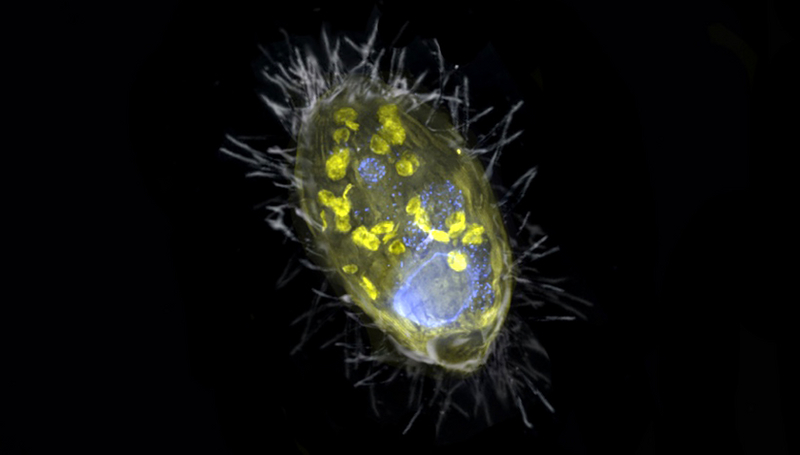
Researchers have discovered a unique bacterium that lives inside a unicellular eukaryote and provides it with energy. Unlike mitochondria, this so-called endosymbiont derives energy from the respiration of nitrate, not oxygen.

They are also called power plants of the cells: the mitochondria. They are present in almost all eukaryotic cells and they supply the cells with energy. Until now, it was assumed that only mitochondria can act as the cells’ energy providers. Scientists at the Max Planck Institute for Marine Microbiology, together with their colleagues from the Max Planck Genome Center in Cologne and the aquatic research institute Eawag, have now discovered that symbiotic bacteria can fulfil this function too. Their findings shed a completely new light on the survival of simple eukaryotes in oxygen-free environments. These results have just been published in the renowned scientific journal Nature.

More information about the new discovery on the website of the Max Planck Institute for Marine Microbiology: New form of symbiosis discovered

Cover picture: ©Max-Planck-Institut für Marine Mikrobiologie, S. Ahmerkamp

Original publication

Extbase Variable Dump
array(2 items)
   publications => '22268' (5 chars)
   libraryUrl => '' (0 chars)
Extbase Variable Dump
array(1 item)
   0 => Snowflake\Publications\Domain\Model\Publicationprototypepersistent entity (uid=22268, pid=124)
      originalId => protected22268 (integer)
      authors => protected'Graf, J. S.; Schorn, S.; Kitzinger, K.; Ahmerkamp, 
         S.; Woehle, C.; Huettel, B.; Schubert, C. J.; Kuypers,&n
         bsp;M. M. M.; Milucka, J.
' (192 chars) title => protected'Anaerobic endosymbiont generates energy for ciliate host by denitrification' (75 chars) journal => protected'Nature' (6 chars) year => protected2021 (integer) volume => protected591 (integer) issue => protected'' (0 chars) startpage => protected'445' (3 chars) otherpage => protected'450' (3 chars) categories => protected'' (0 chars) description => protected'Mitochondria are specialized eukaryotic organelles that have a dedicated fun
         ction in oxygen respiration and energy production. They evolved about 2 bil
         lion years ago from a free-living bacterial ancestor (probably an alphaprote
         obacterium), in a process known as endosymbiosis<sup>1,2</sup>. Many unicell
         ular eukaryotes have since adapted to life in anoxic habitats and their mito
         chondria have undergone further reductive evolution<sup>3</sup>. As a result
         , obligate anaerobic eukaryotes with mitochondrial remnants derive their ene
         rgy mostly from fermentation<sup>4</sup>. Here we describe <em>'Candidatus A
         zoamicus ciliaticola'</em>, which is an obligate endosymbiont of an anaerobi
         c ciliate and has a dedicated role in respiration and providing energy for i
         ts eukaryotic host. <em>'Candidatus A. ciliaticola'</em> contains a highly r
         educed 0.29-Mb genome that encodes core genes for central information proces
         sing, the electron transport chain, a truncated tricarboxylic acid cycle, AT
         P generation and iron–sulfur cluster biosynthesis. The genome encodes a re
         spiratory denitrification pathway instead of aerobic terminal oxidases, whic
         h enables its host to breathe nitrate instead of oxygen. <em>'Candidatus A.
         ciliaticola'</em> and its ciliate host represent an example of a symbiosis t
         hat is based on the transfer of energy in the form of ATP, rather than nutri
         tion. This discovery raises the possibility that eukaryotes with mitochondri
         al remnants may secondarily acquire energy-providing endosymbionts to comple
         ment or replace functions of their mitochondria.
' (1568 chars) serialnumber => protected'0028-0836' (9 chars) doi => protected'10.1038/s41586-021-03297-6' (26 chars) uid => protected22268 (integer) _localizedUid => protected22268 (integer)modified _languageUid => protectedNULL _versionedUid => protected22268 (integer)modified pid => protected124 (integer)
Graf, J. S.; Schorn, S.; Kitzinger, K.; Ahmerkamp, S.; Woehle, C.; Huettel, B.; Schubert, C. J.; Kuypers, M. M. M.; Milucka, J. (2021) Anaerobic endosymbiont generates energy for ciliate host by denitrification, Nature, 591, 445-450, doi:10.1038/s41586-021-03297-6, Institutional Repository

Participating institutions

  • Max-Planck-Institut für Marine Mikrobiologie, Bremen, Deutschland
  • Max-Planck-Genom Zentrum Köln, Max-Planck-Institut für Pflanzenzüchtungsforschung, Köln, Deutschland
  • Eawag Wasserforschungsinstitut, Kastanienbaum, Schweiz