Détail

Découverte d’une nouvelle forme de symbiose

3 mars 2021 | Max-Planck-Institut für Marine Mikrobiologie, Bremen

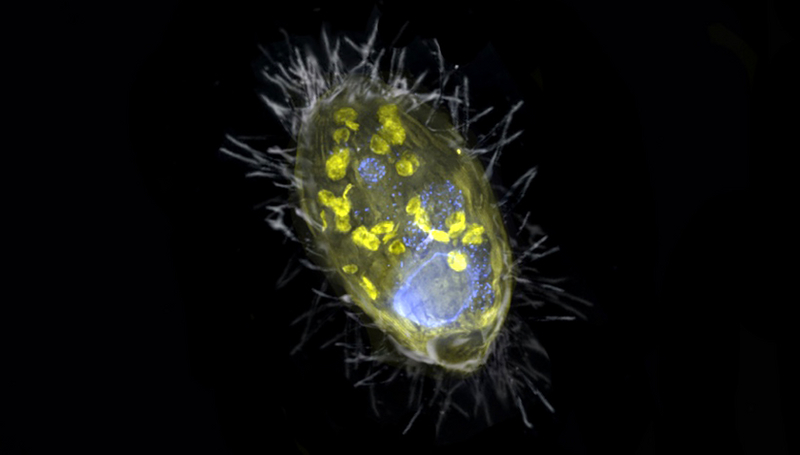
Une bactérie dont le rôle est de respirer pour un cilié et de l’alimenter en énergie a été découverte dans un unicellulaire cilié du lac de Zoug. Cet organisme appelé endosymbiote utilise pour cela non de l’oxygène mais du nitrate.

Elles sont aussi décrites comme les
«centrales énergétiques» des cellules: les mitochondries. Présentes dans la plupart des cellules possédant un noyau cellulaire, elles les fournissent en énergie. On supposait jusqu’à présent que seules les mitochondries pouvaient assumer la tâche de fournisseurs en énergie. Des chercheurs de l’Institut Max Planck de microbiologie marine, le Max-Planck-Genom Center et l’institut de recherche sur l’eau Eawag ont prouvé que cette hypothèse est erronée. Leurs découvertes, publiées dans le prestigieux magazine scientifique Nature, jettent une lumière complètement nouvelle sur l’approvisionnement en énergie des cellules vivant en milieu exempt d’oxygène.

De plus amples informations sur cette nouvelle découverte sont disponibles sur le site internet de l’Institut Max Planck de microbiologie marine en anglais et en allemand.

New form of symbiosis discovered

Neue Form der Symbiose entdeckt

Photo de couverture: ©Max-Planck-Institut für Marine Mikrobiologie, S. Ahmerkamp

Publication originale

Extbase Variable Dump
array(2 items)
   publications => '22268' (5 chars)
   libraryUrl => '' (0 chars)
Extbase Variable Dump
array(1 item)
   0 => Snowflake\Publications\Domain\Model\Publicationprototypepersistent entity (uid=22268, pid=124)
      originalId => protected22268 (integer)
      authors => protected'Graf, J. S.; Schorn, S.; Kitzinger, K.; Ahmerkamp, 
         S.; Woehle, C.; Huettel, B.; Schubert, C. J.; Kuypers,&n
         bsp;M. M. M.; Milucka, J.
' (192 chars) title => protected'Anaerobic endosymbiont generates energy for ciliate host by denitrification' (75 chars) journal => protected'Nature' (6 chars) year => protected2021 (integer) volume => protected591 (integer) issue => protected'' (0 chars) startpage => protected'445' (3 chars) otherpage => protected'450' (3 chars) categories => protected'' (0 chars) description => protected'Mitochondria are specialized eukaryotic organelles that have a dedicated fun
         ction in oxygen respiration and energy production. They evolved about 2 bil
         lion years ago from a free-living bacterial ancestor (probably an alphaprote
         obacterium), in a process known as endosymbiosis<sup>1,2</sup>. Many unicell
         ular eukaryotes have since adapted to life in anoxic habitats and their mito
         chondria have undergone further reductive evolution<sup>3</sup>. As a result
         , obligate anaerobic eukaryotes with mitochondrial remnants derive their ene
         rgy mostly from fermentation<sup>4</sup>. Here we describe <em>'Candidatus A
         zoamicus ciliaticola'</em>, which is an obligate endosymbiont of an anaerobi
         c ciliate and has a dedicated role in respiration and providing energy for i
         ts eukaryotic host. <em>'Candidatus A. ciliaticola'</em> contains a highly r
         educed 0.29-Mb genome that encodes core genes for central information proces
         sing, the electron transport chain, a truncated tricarboxylic acid cycle, AT
         P generation and iron–sulfur cluster biosynthesis. The genome encodes a re
         spiratory denitrification pathway instead of aerobic terminal oxidases, whic
         h enables its host to breathe nitrate instead of oxygen. <em>'Candidatus A.
         ciliaticola'</em> and its ciliate host represent an example of a symbiosis t
         hat is based on the transfer of energy in the form of ATP, rather than nutri
         tion. This discovery raises the possibility that eukaryotes with mitochondri
         al remnants may secondarily acquire energy-providing endosymbionts to comple
         ment or replace functions of their mitochondria.
' (1568 chars) serialnumber => protected'0028-0836' (9 chars) doi => protected'10.1038/s41586-021-03297-6' (26 chars) uid => protected22268 (integer) _localizedUid => protected22268 (integer)modified _languageUid => protectedNULL _versionedUid => protected22268 (integer)modified pid => protected124 (integer)
Graf, J. S.; Schorn, S.; Kitzinger, K.; Ahmerkamp, S.; Woehle, C.; Huettel, B.; Schubert, C. J.; Kuypers, M. M. M.; Milucka, J. (2021) Anaerobic endosymbiont generates energy for ciliate host by denitrification, Nature, 591, 445-450, doi:10.1038/s41586-021-03297-6, Institutional Repository

Institutions concernées

  • Max-Planck-Institut für Marine Mikrobiologie, Bremen, Deutschland
  • Max-Planck-Genom Zentrum Köln, Max-Planck-Institut für Pflanzenzüchtungsforschung, Köln, Deutschland
  • Eawag Wasserforschungsinstitut, Kastanienbaum, Schweiz