Department Fish Ecology and Evolution

Cyprinid partial and differential migration
Of all the great spectacles of nature, animal migration is without doubt one of the most remarkable. It has fascinated mankind for thousands of years, with reports of migratory fishes seasonally moving in and out of the Black Sea being documented over twenty centuries ago. The study of migration continues to be a major focus of contemporary biological research, and we now know that migration is a ubiquitous feature in the life cycle of an extremely diverse range of animals, from microscopic crustaceans to large, sea-dwelling mammals.

When living in an environment where alternative habitats change their relative profitability either during the season, e.g. due to temperature changes or during an animal’s ontogeny, habitat shifts carried out through migration will often be an evolutionary superior strategy over residency. However, although analyses of changes in relative costs and benefits of different habitats may well predict the timing of migration of the average individual, it has rarely been applied to individual organisms, explaining why often only a part of a population migrates (partial migration), why individuals migrate at different times or to different locations (differential migration) or maybe most interestingly, why populations differ in their migration patterns (both partial- and differential migration).

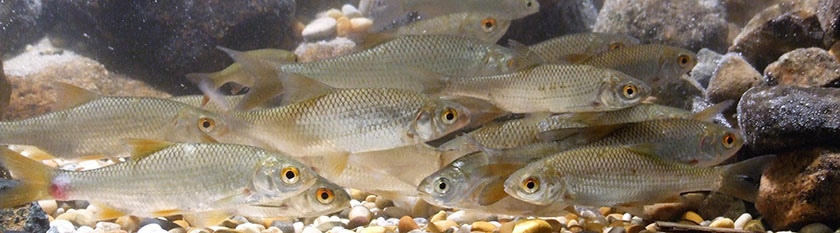
Cyprinid fish often migrates from shallower lakes into streams during winter to escape predation risk during winter, where their growth rates are low due to low temperatures and where they therefore cannot profit from the higher food abundance in the lakes. However, most often only a part of the fish populations are migrating (i.e. partial migration) and among the migrants, timing, duration and destination of migration are different (i.e. differential migration). Since the cyprinid fish are often dominant species in the lake ecosystems with high ecological impact, their temporary absence from the lakes are affecting both lower trophic levels of the lake and resident top-predators. Hence, the study system offers a novel opportunity to study the interactions between differentiation in individual life history and ecosystem structure and dynamics.

Contact

Funding and duration

Funding:         Swedish Research Council (VR), Formas; Danish National Fishing License Funds

Duration:       2003 - ongoing

Collaboration

The studies on partial migration of cyprinid fish are carried out in shallow lakes in Denmark and Southern Sweden in collaboration with the Danish Technical University (DTU-Aqua) and Lund University in Sweden.

Selected publications

Extbase Variable Dump
array(2 items)
   publications => '18271,15186,14414,9218,9221,9051' (32 chars)
   libraryUrl => '' (0 chars)
Extbase Variable Dump
array(6 items)
   0 => Snowflake\Publications\Domain\Model\Publicationprototypepersistent entity (uid=18271, pid=124)
      originalId => protected18271 (integer)
      authors => protected'Skov, C.; Hansen, J. H.; Baktoft, H.; Brodersen, J.
         ; Brönmark, C.; Hansson, L.-A.; Hulthén, K.; Chapman, 
         B. B.; Nilsson, P. A.
' (188 chars) title => protected'Biomanipulating streams: a supplementary tool in lake restoration' (65 chars) journal => protected'Hydrobiologia' (13 chars) year => protected2019 (integer) volume => protected829 (integer) issue => protected'1' (1 chars) startpage => protected'205' (3 chars) otherpage => protected'216' (3 chars) categories => protected'fish removal; cost-effective; cyprinid fishes; migration; evolutionary conse
         quences
' (83 chars) description => protected'Removal of cyprinid fish is a widely used biomanipulation tool to transform
         turbid shallow eutrophic lakes in north temperate regions into a clear water
          state. We here evaluate the removal of cyprinids from streams as a suppleme
         nt to lake fishing. Since cyprinids often aggregate in high densities in lak
         e inlet/outlet streams during winter migration, removal of fish in this spac
         e-confined habitat may be cost-efficient as compared to fish removal in the
         lake habitat. In two consecutive years, we annually removed up to 35% of the
          dominant cyprinids from an inlet stream to a lake and argue that this could
          easily be increased with a more targeted fishing effort. Concurrently, we m
         onitored species- and length-specific variation in migration propensity, to
         explore how this relates to efficient fish removal. Smaller planktivores gen
         erally had a much higher migratory propensity than larger benthivores. Hence
         , stream fishing specifically targets species and size groups that are less
         efficiently controlled with traditional lake fishing methods. As a rule of t
         humb, stream fishing is most efficient when water temperature is 2–6°C. P
         rior to implementing fish removals from streams, the potential evolutionary
         consequences of the targeted removal of migratory phenotypes should be consi
         dered.
' (1298 chars) serialnumber => protected'0018-8158' (9 chars) doi => protected'10.1007/s10750-018-3832-4' (25 chars) uid => protected18271 (integer) _localizedUid => protected18271 (integer)modified _languageUid => protectedNULL _versionedUid => protected18271 (integer)modified pid => protected124 (integer)
1 => Snowflake\Publications\Domain\Model\Publicationprototypepersistent entity (uid=15186, pid=124) originalId => protected15186 (integer) authors => protected'Nilsson, P. A.; Hulthén, K.; Chapman, B. B.; Hanss
         on, L.-A.; Brodersen, J.; Baktoft, H.; Vinterstare, J.;
         Brönmark, C.; Skov, C.
' (185 chars) title => protected'Species integrity enhanced by a predation cost to hybrids in the wild' (69 chars) journal => protected'Biology Letters' (15 chars) year => protected2017 (integer) volume => protected13 (integer) issue => protected'7' (1 chars) startpage => protected'20170208 (4 pp.)' (16 chars) otherpage => protected'' (0 chars) categories => protected'predator-prey; cormorant; fish; diversity; evolution' (52 chars) description => protected'Species integrity can be challenged, and even eroded, if closely related spe
         cies can hybridize and produce fertile offspring of comparable fitness to th
         at of parental species. The maintenance of newly diverged or closely related
          species therefore hinges on the establishment and effectiveness of pre- and
         /or post-zygotic reproductive barriers. Ecological selection, including pred
         ation, is often presumed to contribute to reduced hybrid fitness, but field
         evidence for a predation cost to hybridization remains elusive. Here we prov
         ide proof-of-concept for predation on hybrids being a postzygotic barrier to
          gene flow in the wild. Cyprinid fishes commonly produce fertile, viable hyb
         rid offspring and therefore make excellent study organisms to investigate ec
         ological costs to hybrids. We electronically tagged two freshwater cyprinid
         fish species (roach <I>Rutilus rutilus</I> and bream <I>Abramis brama</I>) a
         nd their hybrids in 2005. Tagged fish were returned to their lake of origin,
          exposing them to natural predation risk from apex avian predators (great co
         rmorant, <I>Phalacrocorax carbo</I>). Scanning for regurgitated tags under c
         ormorant roosts 3–4 years later identified cormorant-killed individual fis
         h and allowed us to directly test for a predation cost to hybrids in the wil
         d. Hybrid individuals were found significantly more susceptible to cormorant
          predation than individuals from either parental species. Such ecological se
         lection against hybrids contributes to species integrity, and can enhance sp
         ecies diversification.
' (1542 chars) serialnumber => protected'1744-9561' (9 chars) doi => protected'10.1098/rsbl.2017.0208' (22 chars) uid => protected15186 (integer) _localizedUid => protected15186 (integer)modified _languageUid => protectedNULL _versionedUid => protected15186 (integer)modified pid => protected124 (integer)
2 => Snowflake\Publications\Domain\Model\Publicationprototypepersistent entity (uid=14414, pid=124) originalId => protected14414 (integer) authors => protected'Hulthén,&nbsp;K.; Chapman,&nbsp;B.&nbsp;B.; Nilsson,&nbsp;P.&nbsp;A.; Hanss
         
         
' (167 chars) title => protected'A predation cost to bold fish in the wild' (41 chars) journal => protected'Scientific Reports' (18 chars) year => protected2017 (integer) volume => protected7 (integer) issue => protected'1' (1 chars) startpage => protected'1239 (5 pp.)' (12 chars) otherpage => protected'' (0 chars) categories => protected'' (0 chars) description => protected'Studies of predator-mediated selection on behaviour are critical for our und
         erstanding of the evolution and maintenance of behavioural diversity in natu
         ral populations. Consistent individual differences in prey behaviour, especi
         ally in the propensity to take risks ("boldness"), are widespread in the ani
         mal kingdom. Theory predicts that individual behavioural types differ in a c
         ost-benefit trade-off where bolder individuals benefit from greater access t
         o resources while paying higher predation-risk costs. However, explicitly li
         nking predation events to individual behaviour under natural conditions is c
         hallenging and there is currently little data from the wild. We assayed indi
         vidual behaviour and electronically tagged hundreds of fish (roach, <em>Ruti
         lus rutilus</em>) before releasing them into their lake of origin, thereby e
         xposing them to predation risk from avian apex predators (cormorants, <em>Ph
         alacrocorax carbo</em>). Scanning for regurgitated tags at the cormorant roo
         sting site provided data on individual predation events. We found that fish
         with higher boldness have a greater susceptibility to cormorant predation co
         mpared to relatively shy, risk-averse individuals. Our findings hereby provi
         de unique and direct evidence of behavioural type-dependent predation vulner
         ability in the wild, i.e. that there is a predation cost to boldness, which
         is critical for our understanding of the evolution and maintenance of behavi
         oural diversity in natural populations.
' (1483 chars) serialnumber => protected'2045-2322' (9 chars) doi => protected'10.1038/s41598-017-01270-w' (26 chars) uid => protected14414 (integer) _localizedUid => protected14414 (integer)modified _languageUid => protectedNULL _versionedUid => protected14414 (integer)modified pid => protected124 (integer)
3 => Snowflake\Publications\Domain\Model\Publicationprototypepersistent entity (uid=9218, pid=124) originalId => protected9218 (integer) authors => protected'Chapman,&nbsp;B.&nbsp;B.; Hulthén,&nbsp;K.; Brönmark,&nbsp;C.; Nilsson,&nb
         sp;P.&nbsp;A.; Skov,&nbsp;C.; Hansson,&nbsp;L.-A.; Brodersen,&nbsp;J.
' (145 chars) title => protected'Shape up or ship out: migratory behaviour predicts morphology across spatial
          scale in a freshwater fish
' (103 chars) journal => protected'Journal of Animal Ecology' (25 chars) year => protected2015 (integer) volume => protected84 (integer) issue => protected'5' (1 chars) startpage => protected'1187' (4 chars) otherpage => protected'1193' (4 chars) categories => protected'animal migration; ecomorphology; fish; geometric morphometrics; partial migr
         ation
' (81 chars) description => protected'1. Migration is a widespread phenomenon, with powerful ecological and evolut
         ionary consequences. Morphological adaptations to reduce the energetic costs
          associated with migratory transport are commonly documented for migratory s
         pecies. However, few studies have investigated whether variation in body mor
         phology can be explained by variation in migratory strategy within a species
         .<BR/>2. We address this question in roach <I>Rutilus rutilus</I>, a partial
         ly migratory freshwater fish that migrates from lakes into streams during wi
         nter. We both compare body shape between populations that differ in migrator
         y opportunity (open vs. closed lakes), and between individuals from a single
          population that vary in migratory propensity (migrants and residents from a
          partially migratory population). Following hydrodynamic theory, we posit th
         at migrants should have a more shallow body depth, to reduce the costs assoc
         iated with migrating into streams with higher flow conditions than the lakes
          the residents occupy all year round.<BR/>3. We find evidence both across an
         d within populations to support our prediction, with individuals from open l
         akes and migrants from the partially migratory population having a more slen
         der, shallow-bodied morphology than fish from closed lakes and all-year resi
         dents.<BR/>4. Our data suggest that a shallow body morphology is beneficial
         to migratory individuals and our study is one of the first to link migratory
          strategy and intraspecific variation in body shape.
' (1496 chars) serialnumber => protected'0021-8790' (9 chars) doi => protected'10.1111/1365-2656.12374' (23 chars) uid => protected9218 (integer) _localizedUid => protected9218 (integer)modified _languageUid => protectedNULL _versionedUid => protected9218 (integer)modified pid => protected124 (integer)
4 => Snowflake\Publications\Domain\Model\Publicationprototypepersistent entity (uid=9221, pid=124) originalId => protected9221 (integer) authors => protected'Hulthén,&nbsp;K.; Chapman,&nbsp;B.&nbsp;B.; Nilsson,&nbsp;P.&nbsp;A.; Vinte
         rstare,&nbsp;J.; Hansson,&nbsp;L.-A.; Skov,&nbsp;C.; Brodersen,&nbsp;J.; Bak
         toft,&nbsp;H.; Brönmark,&nbsp;C.
' (185 chars) title => protected'Escaping peril: perceived predation risk affects migratory propensity' (69 chars) journal => protected'Biology Letters' (15 chars) year => protected2015 (integer) volume => protected11 (integer) issue => protected'8' (1 chars) startpage => protected'20150466 (4 pp.)' (16 chars) otherpage => protected'' (0 chars) categories => protected'predation; animal migration; facultative migration; environmentally induced;
          mortality risk
' (91 chars) description => protected'Although migratory plasticity is increasingly documented, the ecological dri
         vers of plasticity are not well understood. Predation risk can influence mig
         ratory dynamics, but whether seasonal migrants can adjust their migratory be
         haviour according to perceived risk is unknown. We used electronic tags to r
         ecord the migration of individual roach (<I>Rutilus rutilus</I>), a partiall
         y migratory fish, in the wild following exposure to manipulation of direct (
         predator presence/absence) and indirect (high/low roach density) perceived p
         redation risk in experimental mesocosms. Following exposure, we released fis
         h in their lake summer habitat and monitored individual migration to connect
         ed streams over an entire season. Individuals exposed to increased perceived
          direct predation risk (i.e. a live predator) showed a higher migratory prop
         ensity but no change in migratory timing, while indirect risk (i.e. roach de
         nsity) affected timing but not propensity showing that elevated risk carried
          over to alter migratory behaviour in the wild. Our key finding demonstrates
          predator-driven migratory plasticity, highlighting the powerful role of pre
         dation risk for migratory decision-making and dynamics.
' (1195 chars) serialnumber => protected'1744-9561' (9 chars) doi => protected'10.1098/rsbl.2015.0466' (22 chars) uid => protected9221 (integer) _localizedUid => protected9221 (integer)modified _languageUid => protectedNULL _versionedUid => protected9221 (integer)modified pid => protected124 (integer)
5 => Snowflake\Publications\Domain\Model\Publicationprototypepersistent entity (uid=9051, pid=124) originalId => protected9051 (integer) authors => protected'Brodersen,&nbsp;J.; Chapman,&nbsp;B.&nbsp;B.; Nilsson,&nbsp;P.&nbsp;A.; Skov
         ,&nbsp;C.; Hansson,&nbsp;L.-A.; Brönmark,&nbsp;C.
' (126 chars) title => protected'Fixed and flexible: coexistence of obligate and facultative migratory strate
         gies in a freshwater fish
' (101 chars) journal => protected'PLoS One' (8 chars) year => protected2014 (integer) volume => protected9 (integer) issue => protected'3' (1 chars) startpage => protected'e90294 (7 pp.)' (14 chars) otherpage => protected'' (0 chars) categories => protected'' (0 chars) description => protected'Migration is an important event in many animal life histories, but the degre
         e to which individual animals participate in seasonal migrations often varie
         s within populations. The powerful ecological and evolutionary consequences
         of such partial migration are now well documented, but the underlying mechan
         isms are still heavily debated. One potential mechanism of partial migration
          is between-individual variation in body condition, where animals in poor co
         ndition cannot pay the costs of migration and hence adopt a resident strateg
         y. However, underlying intrinsic traits may overrule such environmental infl
         uence, dictating individual consistency in migratory patterns. Unfortunately
         , field tests of individual consistency compared to the importance of indivi
         dual condition on migratory propensity are rare. Here we analyse 6 years of
         field data on roach migration, gathered by tagging almost 3000 individual fi
         sh and monitoring their seasonal migrations over extended periods of time. O
         ur aims were to provide a field test of the role of condition in wild fish f
         or migratory decisions, and also to assess individual consistency in migrato
         ry tendency. Our analyses reveal that (1) migratory strategy, in terms of mi
         gration/residency, is highly consistent within individuals over time and (2)
          there is a positive relationship between condition and the probability of m
         igration, but only in individuals that adopt a migratory strategy at some po
         int during their lives. However, life-long residents do not differ in condit
         ion to migrants, hence body condition is only a good predictor of migratory
         tendency in fish with migratory phenotypes and not a more general determinan
         t of migratory tendency for the population. As resident individuals can achi
         eve very high body condition and still remain resident, we suggest that our
         data provides some of the first field evidence to show that both facultative
          and obligate strategies can co-exist within populations of migratory animal
         s.
' (1978 chars) serialnumber => protected'' (0 chars) doi => protected'10.1371/journal.pone.0090294' (28 chars) uid => protected9051 (integer) _localizedUid => protected9051 (integer)modified _languageUid => protectedNULL _versionedUid => protected9051 (integer)modified pid => protected124 (integer)
Skov, C.; Hansen, J. H.; Baktoft, H.; Brodersen, J.; Brönmark, C.; Hansson, L.-A.; Hulthén, K.; Chapman, B. B.; Nilsson, P. A. (2019) Biomanipulating streams: a supplementary tool in lake restoration, Hydrobiologia, 829(1), 205-216, doi:10.1007/s10750-018-3832-4, Institutional Repository
Nilsson, P. A.; Hulthén, K.; Chapman, B. B.; Hansson, L.-A.; Brodersen, J.; Baktoft, H.; Vinterstare, J.; Brönmark, C.; Skov, C. (2017) Species integrity enhanced by a predation cost to hybrids in the wild, Biology Letters, 13(7), 20170208 (4 pp.), doi:10.1098/rsbl.2017.0208, Institutional Repository
Hulthén, K.; Chapman, B. B.; Nilsson, P. A.; Hansson, L.-A.; Skov, C.; Brodersen, J.; Vinterstare, J.; Brönmark, C. (2017) A predation cost to bold fish in the wild, Scientific Reports, 7(1), 1239 (5 pp.), doi:10.1038/s41598-017-01270-w, Institutional Repository
Chapman, B. B.; Hulthén, K.; Brönmark, C.; Nilsson, P. A.; Skov, C.; Hansson, L.-A.; Brodersen, J. (2015) Shape up or ship out: migratory behaviour predicts morphology across spatial scale in a freshwater fish, Journal of Animal Ecology, 84(5), 1187-1193, doi:10.1111/1365-2656.12374, Institutional Repository
Hulthén, K.; Chapman, B. B.; Nilsson, P. A.; Vinterstare, J.; Hansson, L.-A.; Skov, C.; Brodersen, J.; Baktoft, H.; Brönmark, C. (2015) Escaping peril: perceived predation risk affects migratory propensity, Biology Letters, 11(8), 20150466 (4 pp.), doi:10.1098/rsbl.2015.0466, Institutional Repository
Brodersen, J.; Chapman, B. B.; Nilsson, P. A.; Skov, C.; Hansson, L.-A.; Brönmark, C. (2014) Fixed and flexible: coexistence of obligate and facultative migratory strategies in a freshwater fish, PLoS One, 9(3), e90294 (7 pp.), doi:10.1371/journal.pone.0090294, Institutional Repository