
Department Sanitation, Water and Solid Waste for Development
Educational Innovation
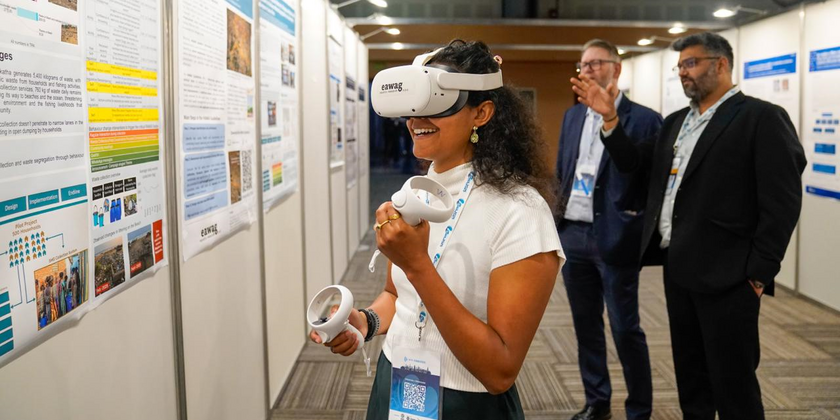
At the WASH Learning Lab, we design, test, and refine innovative educational approaches that strengthen how WASH and solid waste management knowledge is taught and applied in practice. Our work goes beyond content delivery: we experiment with digital, immersive, and adaptive learning formats to improve accessibility, learner engagement, inclusiveness, and the connection between theory and real-world implementation.
Our current innovation portfolio focuses on four complementary areas: augmented reality to bridge classroom learning and field-level understanding of technologies, immersive 360° video for field-based learning, the Beekee Box for offline-first digital learning to expand access in low-connectivity contexts, and AI-supported tools to enhance inclusiveness and teaching and learning processes. By testing and co-creating these approaches in collaboration with partners across different context, we generate evidence on their potential, limitations, and pathways for scale-up.
ARise: Augmented Reality - Innovative Science Education
Goal:
To enhance systems understanding in sanitation and solid waste management by using augmented reality (AR) to visualize complex, interconntected processes.
Approach:
ARise explores how AR can help learners better understand WASH and solid waste management systems & technologies as spatial, dynamic, and interconnected processes rather than isolated components.
Through interactive AR visualisations, learners and practitioners can:
- Explore technology layers and flows
- Visualize treatment processes in 3D
- Connect theoretical concepts with the real-world
Application:
Current ARise models include:
- Vermifilter ARise model
- Second ARise model will be announced soon
These models are piloted in selected educational contexts and integrated into teaching formats to evaluate their pedagogoical added value and scalability.
Immersive 360° Video: Vermicomposting in Practice
Goal:
To strengthen practice-based learning by enabling learners and practitioners to virtually experience vermicomposting.
Approach:
In Colombia, we are producing an immersive 360° video that takes learners directly into operational vermicomposting environments. This format allows participants to:
- Step inside real-world facilities and observe processes as they unfold
- Engage more deeply with practical implementation challenges
- Build contextual understanding even when on-site visits are not feasible
Immersive video is particularly valuable in settings where access to demonstration sites is limited, helping bridge the gap between theory and hands‑on practice.
Application:
The 360° vermicomposting video is currently in production and will be integrated into the Solid Waste Management MOOC.
Offine-First Digital Learning with the BeekeeBox
Goal:
To expand access to high-quality WASH and solid waste management education in contexts with limited or unstable internet connectivity.
Approach:
Access to digital education remains uneven, particularly in settings with limited connectivity. Through the BeekeeBox, we explore how WASH education can reach learners offline:
The BeekeeBox is a portable, offline digital classroom that:
- Provides access to course videos and materials
- Enables local access without internet
- Supports blended and facilitator-led formats
Application:
We collaborate with partners to test how offline-first approaches can sustainably expand access to digital WASH education.
AI in WASH Education – Inclusive and adaptive content creation
Goal:
To explore how AI-supported tools can enhance WASH education while critically assessing their opportunities and potential risks.
We test emerging AI applications that support:
- Content creating and adaptation
- Multilingual course development
- Accessibility enhancements
- Learner engagement
A concrete example is our AI-avatar MOOC video, which demonstrates how AI can support multilingual and more accessible WASH education.
Application:
Watch the AI-avatar MOOC video on Youtube.