Assessing the impact of carrying water on women’s health
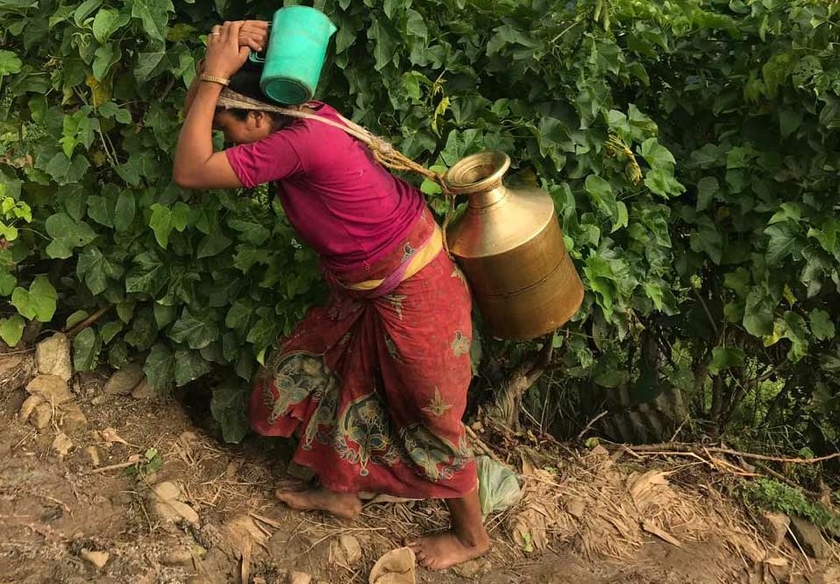
Improved access to safe drinking water and sanitation are important determinants of human health. For decades the benchmark for improving access to drinking water as stated in the Millennium Development Goals has been community level access. Much greater health and economic benefits can be generated if access to safe drinking water is provided at the household level instead of community level. First, household water access will increase the amount of water available for hygienic practices in the household therewith reducing the amount of pathogens in the household environment. Second, drinking water itself will be less prone to recontamination during transport and storage if it can be collected at the tap in the household, and third, the tremendous work and health burden women are facing to transport water from the water supply point in the community to their homes will be reduced. This aspect is accounted for in the Sustainable Development Goal 6.1. where the definition of safely managed drinking water is drinking water from an improved source that is located on premises, available when need and free from faecal and priority chemical contamination.
This project aimed at quantifying the third aspect of health burden i.e. understanding health constraints women in Nepal are facing by carrying water from the community source to their homes to quantity the benefit that can be generated by increasing piped household level access to safe drinking water. The study was conducted in collaboration with public health researchers from Kathmandu University School of Medical Science and social psychologists from the University of Bern.
array(3 items)0 => Snowflake\Publications\Domain\Model\Publicationprototypepersistent entity (uid=25021, pid=124)originalId => protected25021 (integer)
authors => protected'Meierhofer, R.; Tomberge, V. M. J.; Inauen, J.; Shr estha, A.' (90 chars)
title => protected'Water carrying in hills of Nepal-associations with women’s musculoskeletal disorders, uterine prolapse, and spontaneous abortions' (131 chars)
journal => protected'PLoS One' (8 chars)
year => protected2022 (integer)
volume => protected17 (integer)
issue => protected'6' (1 chars)
startpage => protected'e0269926 (23 pp.)' (17 chars)
otherpage => protected'' (0 chars)
categories => protected'' (0 chars)
description => protected'More than a third of women in Nepal have to carry water from source to home to satisfy their families’ daily needs. A cross-sectional study was carrie d out in a hilly area in Nepal to assess water-carrying practices and their association with women’s health. Quantitative interviews were conducted wi th 1001 women of reproductive age and were complemented with health surveys carried out by health professionals and structured observations of water car rying. Multivariate mixed logistic regression models were used to assess the associations between water-carrying-related risk factors and health issues for women. Around 46% of women faced considerably increased to excessive phy sical stress due to water carrying during the dry season. Women suffered fro m a disproportionately high prevalence of back pain (61%), with about 18% of this pain being horrible to excruciating; pain in the knees (34%); uterine prolapse (11.3%); and at least one spontaneous abortion (9%). The risk categ ory of water carrying was significantly associated with uterine prolapse (OR = 1.44, 95%CI = 1.12-1.85, <em>p</em> = 0.031) and pain in the hips (OR = 1 .69, 95%CI = 1.27-2.26, <em>p</em><0.001). Receiving help with water carr ying during pregnancy and during the first three months after delivery was a ssociated with reduced odds ratios for uterine prolapse (OR = 0.10, 95% CI = 0.01-0.87, <em>p</em> = 0.037), and strong back pain (OR = 0.32, 95% CI = 0 .12-0.87, <em>p</em> = 0.026). Improvements to water supply infrastructure a nd the promotion of social support for carrying water during pregnancy and a fter delivery are recommended to reduce water-carrying-related health risks.' (1672 chars)
serialnumber => protected'' (0 chars)
doi => protected'10.1371/journal.pone.0269926' (28 chars)
uid => protected25021 (integer)
_localizedUid => protected25021 (integer)modified_languageUid => protectedNULL
_versionedUid => protected25021 (integer)modifiedpid => protected124 (integer)1 => Snowflake\Publications\Domain\Model\Publicationprototypepersistent entity (uid=24067, pid=124)originalId => protected24067 (integer)
authors => protected'Tomberge, V. M. J.; Shrestha, A.; Meierhofer, R.; I nauen, J.' (90 chars)
title => protected'Understanding safe water-carrying practices during pregnancy and postpartum: a mixed-methods study in Nepal' (107 chars)
journal => protected'Applied Psychology: Health and Well-Being' (41 chars)
year => protected2022 (integer)
volume => protected14 (integer)
issue => protected'2' (1 chars)
startpage => protected'691' (3 chars)
otherpage => protected'711' (3 chars)
categories => protected'access to water; convergent mixed-methods design; health action process appr oach; low-income population; psychosocial determinants of health; women's he alth' (156 chars)
description => protected'Daily carrying of heavy loads of domestic water, especially during pregnancy and postpartum, bears a threat to maternal health in low-income countries. Using an extended health action process approach (HAPA), we examined women's reasons for and psychosocial determinants of safe water-carrying during pre gnancy and postpartum. In a mixed-methods study, trained local interviewers conducted 1001 quantitative interviews with women of reproductive age (<em>n </em> = 921 analyzed) and 21 qualitative interviews with women of reproduct ive age, in-laws, and spouses in rural Nepal. We analyzed the quantitative d ata with generalized estimating equations to model the HAPA-based psychosoci al determinants of avoiding water-carrying during pregnancy and postpartum. Subjective perspectives were investigated with thematic analysis. Outcome ex pectancies (<em>B</em> = 0.24), self-efficacy (<em>B </em>= 0.20), and injun ctive norms (<em>B </em>= 0.23) were significantly associated with the inten tion to avoid water-carrying. Self-efficacy (<em>B</em> = 0.36) and instrume ntal support (<em>B </em>= 0.05) are related to behavior (all <em>p</em> < ; 0.05). Women explained water-carrying during pregnancy by a lack of family support, a shift of health decision-making power to in-laws, and low behavi oral control. Overall, the necessity of water, family decision-making struct ures, and low support make it difficult for women to discontinue water-carry ing. Additionally to infrastructural improvements, behavioral interventions may increase women's self-efficacy for safe water-carrying (e.g. reducing we ight) and social support.' (1621 chars)
serialnumber => protected'1758-0846' (9 chars)
doi => protected'10.1111/aphw.12325' (18 chars)
uid => protected24067 (integer)
_localizedUid => protected24067 (integer)modified_languageUid => protectedNULL
_versionedUid => protected24067 (integer)modifiedpid => protected124 (integer)2 => Snowflake\Publications\Domain\Model\Publicationprototypepersistent entity (uid=23275, pid=124)originalId => protected23275 (integer)
authors => protected'Tomberge, V. M. J.; Bischof, J. S.; Meierhofer,&nbs p;R.; Shrestha, A.; Inauen, J.' (116 chars)
title => protected'The physical burden of water carrying and women's psychosocial well-being: e vidence from rural nepal' (100 chars)
journal => protected'International Journal of Environmental Research and Public Health' (65 chars)
year => protected2021 (integer)
volume => protected18 (integer)
issue => protected'15' (2 chars)
startpage => protected'7908 (11 pp.)' (13 chars)
otherpage => protected'' (0 chars)
categories => protected'gender inequalities in health; water access; psychosocial well-being; unpaid work; low-income population' (104 chars)
description => protected'Many women in low-income countries carry heavy loads of drinking water for t heir families in difficult terrain. This can adversely affect their health a nd well-being. The present study is the first to investigate the physical bu rden of water carrying and women's psychosocial well-being, and how this rel ationship is moderated by environmental and health conditions. Trained local interviewers conducted interviews with 1001 women across five rural communi ties in Nepal. In addition, objective measurement was used to assess the wei ght carried and distance from the water source. The physical burden of water carrying was calculated from weight, distance, and frequency of trips. Its association with psychosocial well-being was modeled using generalized estim ating equations. Two additional models included the terrain and uterine prol apse as moderators. The physical burden of water carrying is directly relate d to higher emotional distress and reduced daily functioning. This correlati on was exacerbated for women carrying in hilly versus flat terrain, and for those who had uterine prolapse. Our results underline the importance of adeq uate water access for women's psychosocial well-being, especially for vulner able populations such as women with impaired health (e.g., uterine prolapse) or those living in hilly terrain. The results further highlight the interco nnectedness of the Sustainable Development Goal (SDG) 6: water access, SDG 3 : health and well-being, and SDG 5: gender equality.' (1496 chars)
serialnumber => protected'1661-7827' (9 chars)
doi => protected'10.3390/ijerph18157908' (22 chars)
uid => protected23275 (integer)
_localizedUid => protected23275 (integer)modified_languageUid => protectedNULL
_versionedUid => protected23275 (integer)modifiedpid => protected124 (integer)
Water carrying in hills of Nepal-associations with women’s musculoskeletal disorders, uterine prolapse, and spontaneous abortions
More than a third of women in Nepal have to carry water from source to home to satisfy their families’ daily needs. A cross-sectional study was carried out in a hilly area in Nepal to assess water-carrying practices and their association with women’s health. Quantitative interviews were conducted with 1001 women of reproductive age and were complemented with health surveys carried out by health professionals and structured observations of water carrying. Multivariate mixed logistic regression models were used to assess the associations between water-carrying-related risk factors and health issues for women. Around 46% of women faced considerably increased to excessive physical stress due to water carrying during the dry season. Women suffered from a disproportionately high prevalence of back pain (61%), with about 18% of this pain being horrible to excruciating; pain in the knees (34%); uterine prolapse (11.3%); and at least one spontaneous abortion (9%). The risk category of water carrying was significantly associated with uterine prolapse (OR = 1.44, 95%CI = 1.12-1.85, p = 0.031) and pain in the hips (OR = 1.69, 95%CI = 1.27-2.26, p<0.001). Receiving help with water carrying during pregnancy and during the first three months after delivery was associated with reduced odds ratios for uterine prolapse (OR = 0.10, 95% CI = 0.01-0.87, p = 0.037), and strong back pain (OR = 0.32, 95% CI = 0.12-0.87, p = 0.026). Improvements to water supply infrastructure and the promotion of social support for carrying water during pregnancy and after delivery are recommended to reduce water-carrying-related health risks.
Meierhofer, R.; Tomberge, V. M. J.; Inauen, J.; Shrestha, A. (2022) Water carrying in hills of Nepal-associations with women’s musculoskeletal disorders, uterine prolapse, and spontaneous abortions, PLoS One, 17(6), e0269926 (23 pp.), doi:10.1371/journal.pone.0269926, Institutional Repository
Understanding safe water-carrying practices during pregnancy and postpartum: a mixed-methods study in Nepal
Daily carrying of heavy loads of domestic water, especially during pregnancy and postpartum, bears a threat to maternal health in low-income countries. Using an extended health action process approach (HAPA), we examined women's reasons for and psychosocial determinants of safe water-carrying during pregnancy and postpartum. In a mixed-methods study, trained local interviewers conducted 1001 quantitative interviews with women of reproductive age (n = 921 analyzed) and 21 qualitative interviews with women of reproductive age, in-laws, and spouses in rural Nepal. We analyzed the quantitative data with generalized estimating equations to model the HAPA-based psychosocial determinants of avoiding water-carrying during pregnancy and postpartum. Subjective perspectives were investigated with thematic analysis. Outcome expectancies (B = 0.24), self-efficacy (B = 0.20), and injunctive norms (B = 0.23) were significantly associated with the intention to avoid water-carrying. Self-efficacy (B = 0.36) and instrumental support (B = 0.05) are related to behavior (all p < 0.05). Women explained water-carrying during pregnancy by a lack of family support, a shift of health decision-making power to in-laws, and low behavioral control. Overall, the necessity of water, family decision-making structures, and low support make it difficult for women to discontinue water-carrying. Additionally to infrastructural improvements, behavioral interventions may increase women's self-efficacy for safe water-carrying (e.g. reducing weight) and social support.
Tomberge, V. M. J.; Shrestha, A.; Meierhofer, R.; Inauen, J. (2022) Understanding safe water-carrying practices during pregnancy and postpartum: a mixed-methods study in Nepal, Applied Psychology: Health and Well-Being, 14(2), 691-711, doi:10.1111/aphw.12325, Institutional Repository
The physical burden of water carrying and women's psychosocial well-being: evidence from rural nepal
Many women in low-income countries carry heavy loads of drinking water for their families in difficult terrain. This can adversely affect their health and well-being. The present study is the first to investigate the physical burden of water carrying and women's psychosocial well-being, and how this relationship is moderated by environmental and health conditions. Trained local interviewers conducted interviews with 1001 women across five rural communities in Nepal. In addition, objective measurement was used to assess the weight carried and distance from the water source. The physical burden of water carrying was calculated from weight, distance, and frequency of trips. Its association with psychosocial well-being was modeled using generalized estimating equations. Two additional models included the terrain and uterine prolapse as moderators. The physical burden of water carrying is directly related to higher emotional distress and reduced daily functioning. This correlation was exacerbated for women carrying in hilly versus flat terrain, and for those who had uterine prolapse. Our results underline the importance of adequate water access for women's psychosocial well-being, especially for vulnerable populations such as women with impaired health (e.g., uterine prolapse) or those living in hilly terrain. The results further highlight the interconnectedness of the Sustainable Development Goal (SDG) 6: water access, SDG 3: health and well-being, and SDG 5: gender equality.
Tomberge, V. M. J.; Bischof, J. S.; Meierhofer, R.; Shrestha, A.; Inauen, J. (2021) The physical burden of water carrying and women's psychosocial well-being: evidence from rural nepal, International Journal of Environmental Research and Public Health, 18(15), 7908 (11 pp.), doi:10.3390/ijerph18157908, Institutional Repository