Department Sanitation, Water and Solid Waste for Development

Water-Energy-Environment (3E) Programme
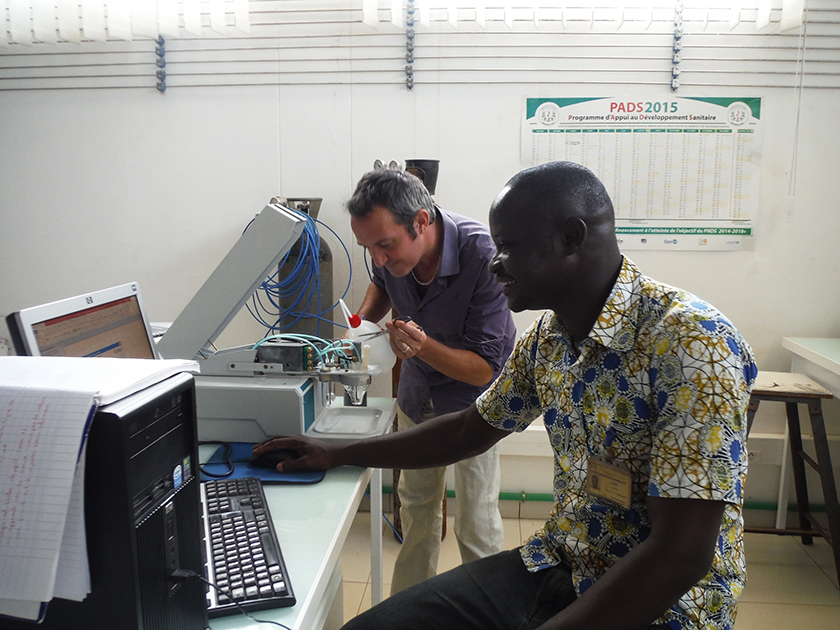
The Water-Energy-Environment (3E) programme was launched in 2012 with funding support from the Swiss Agency for Development Cooperation (SDC), with the aim to support scientific partnerships between the International Institute for Water and Environmental Engineering (2iE) of Ouagadougou, Burkina Faso, and Swiss universities and institutes (EPFL, HEIG VD and EAWAG).

Eawag and 2iE are particularly focusing on the fate and transport of arsenic on the environment. The project's first phase (2012-2016) focused on the development of risk maps and mitigation technologies for the removal of arsenic from drinking water. The technologies studied were:

  • Reverse osmosis and nanofiltration.
  • Community-scale treatment filters based on commercially available iron-hydroxide filter materials (for rural areas with boreholes).
  • Filters containing locally available materials (suitable to the household level).

The project received a one-year extension (2017) to assess the uptake of arsenic in food products (i.e. the impact of irrigating and cooking with arsenic contaminated water), as well as current practices in term of drinking water quality monitoring (chemical and microbial water quality).

Publications

Extbase Variable Dump
array(2 items)
   publications => '23134' (5 chars)
   libraryUrl => '' (0 chars)
Extbase Variable Dump
array(1 item)
   0 => Snowflake\Publications\Domain\Model\Publicationprototypepersistent entity (uid=23134, pid=124)
      originalId => protected23134 (integer)
      authors => protected'Clair-Caliot, G.; Marks, S. J.; Hug, S. J.; Bretzle
         r, A.; N'guessan, N.'goran D.; Tihe, S. F. K.;
          Lalanne, F.
' (169 chars) title => protected'Uptake of arsenic by irrigated vegetables and cooked food products in Burkin
         a Faso
' (82 chars) journal => protected'Frontiers in Water' (18 chars) year => protected2021 (integer) volume => protected3 (integer) issue => protected'' (0 chars) startpage => protected'667308 (17 pp.)' (15 chars) otherpage => protected'' (0 chars) categories => protected'arsenic; irrigation water; accumulation; vegetable; uptake; cooking; risk as
         sessment; Burkina Faso
' (98 chars) description => protected'As compared to the Asian lowlands, environmental exposure to arsenic (As) in
          West Africa has received little attention. Recent studies have found geogen
         ic As contamination of groundwater in many regions in Burkina Faso. As-conta
         minated groundwater is used for drinking and increasingly also for the irrig
         ation of staple foods. This study assesses the extent to which irrigation an
         d cooking of staple foods in Burkina Faso influence plant uptake and dietary
          consumption of As, respectively. Using a greenhouse experimental setup, we
         evaluated the transfer of As from irrigation water spiked with 0, 100, 500,
         and 1,000 μg/L As(V) to the organs and edible parts of seven commonly consu
         med vegetables (amaranth, carrot, green bean, lettuce, okra, spinach, and to
         mato). Next, we cooked the greenhouse-cultivated vegetables and externally p
         urchased foods with As-free and As-spiked waters. The As content in all plan
         t organs increased with increasing As in the irrigation water. With 500 μg/
         L, the concentrations of As in the edible parts (ordered from highest to low
         est) were as follows: spinach (6.6 ± 0.5 μg/g); lettuce (3.9 ± 0.1 μg/g)
         ; carrot (3.5 ± <0.1 μg/g); amaranth (2.2 ± <0.1 μg/g); okra (0.9
         ± <0.1 μg/g); green bean (0.8 ± <0.1 μg/g); and tomato (0.2 ± &lt
         ;0.1 μg/g). The edible parts of leafy vegetables irrigated with As-spiked w
         ater had a higher average As content (4.9 ± 4.5 μg/g) than root (2.9 ± 2.
         0 μg/g) and fruit/pod vegetables (0.8 ± 1.1 μg/g). Cooking with an excess
          volume of As-free water reduced the As content in the cooked vegetables by
         39% on average, while cooking with As-contaminated water transferred As to t
         he cooked food. The As content in steamed foods was 8 to 18 times lower than
          in boiled foods. Based on human health risk estimates, we generally recomme
         nd to avoid planting leafy and root vegetables in areas with As concentratio
         ns above 100 μg/L in irrigation water. In areas with elevated As contaminat
         ion, mitigation strategi...
' (2117 chars) serialnumber => protected'' (0 chars) doi => protected'10.3389/frwa.2021.667308' (24 chars) uid => protected23134 (integer) _localizedUid => protected23134 (integer)modified _languageUid => protectedNULL _versionedUid => protected23134 (integer)modified pid => protected124 (integer)
Clair-Caliot, G.; Marks, S. J.; Hug, S. J.; Bretzler, A.; N'guessan, N.'goran D.; Tihe, S. F. K.; Lalanne, F. (2021) Uptake of arsenic by irrigated vegetables and cooked food products in Burkina Faso, Frontiers in Water, 3, 667308 (17 pp.), doi:10.3389/frwa.2021.667308, Institutional Repository

Arsenic au Burkina Faso Videos