Department Systems Analysis, Integrated Assessment and Modelling

Entropic Activation
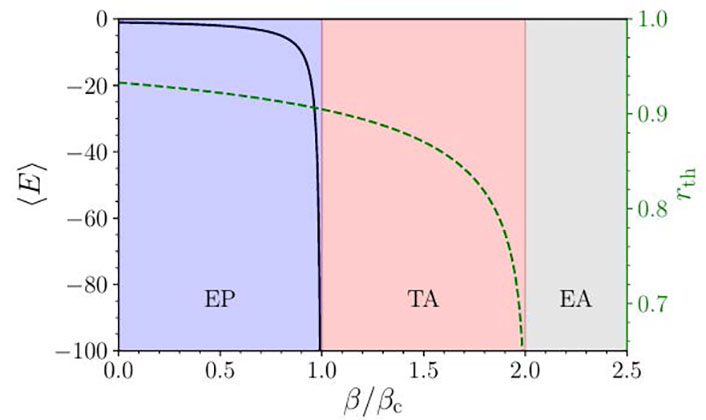
Activated dynamics is a very slow process that takes place on exponentially large time scales. Usually it is associated to barrier hopping. However, activation can also be driven by entropy, which completely changes the way we should think of relaxation in complex systems. We study the emergence of entropically activated dynamics in several systems, from toy to machine learning models.

Contact

Dr. Marco Baity Jesi Group Leader (he/him) Tel. +41 58 765 5793 Send Mail

Publications

Extbase Variable Dump
array(2 items)
   publications => '22893,21099' (11 chars)
   libraryUrl => '' (0 chars)
Extbase Variable Dump
array(2 items)
   0 => Snowflake\Publications\Domain\Model\Publicationprototypepersistent entity (uid=22893, pid=124)
      originalId => protected22893 (integer)
      authors => protected'Baity-Jesi, M.; Biroli, G.; Reichman, D. R.' (63 chars)
      title => protected'Revisiting the concept of activation in supercooled liquids' (59 chars)
      journal => protected'European Physical Journal E: Soft Matter and Biological Physics' (63 chars)
      year => protected2021 (integer)
      volume => protected44 (integer)
      issue => protected'6' (1 chars)
      startpage => protected'77 (10 pp.)' (11 chars)
      otherpage => protected'' (0 chars)
      categories => protected'' (0 chars)
      description => protected'In this work, we revisit the description of dynamics based on the concepts o
         f metabasins and activation in mildly supercooled liquids via the analysis o
         f the dynamics of a paradigmatic glass former between its onset temperature
         <em>T</em><sub>o</sub> and mode-coupling temperature <em>T</em><sub>c</sub>.
          First, we provide measures that demonstrate that the onset of glassiness is
          indeed connected to the landscape, and that metabasin waiting time distribu
         tions are so broad that the system can remain stuck in a metabasin for times
          that exceed <em>τ</em><sub>α</sub> by orders of magnitude. We then reanal
         yze the transitions between metabasins, providing several indications that t
         he standard picture of activated dynamics in terms of traps does not hold in
          this regime. Instead, we propose that here activation is principally driven
          by entropic instead of energetic barriers. In particular, we illustrate tha
         t activation is not controlled by the hopping of high energetic barriers and
          should more properly be interpreted as the entropic selection of nearly bar
         rierless but rare pathways connecting metabasins on the landscape.
' (1130 chars) serialnumber => protected'1292-8941' (9 chars) doi => protected'10.1140/epje/s10189-021-00077-y' (31 chars) uid => protected22893 (integer) _localizedUid => protected22893 (integer)modified _languageUid => protectedNULL _versionedUid => protected22893 (integer)modified pid => protected124 (integer)
1 => Snowflake\Publications\Domain\Model\Publicationprototypepersistent entity (uid=21099, pid=124) originalId => protected21099 (integer) authors => protected'Carbone,&nbsp;M.&nbsp;R.; Astuti,&nbsp;V.; Baity-Jesi,&nbsp;M.' (62 chars) title => protected'Effective traplike activated dynamics in a continuous landscape' (63 chars) journal => protected'Physical Review E' (17 chars) year => protected2020 (integer) volume => protected101 (integer) issue => protected'5' (1 chars) startpage => protected'052304 (11 pp.)' (15 chars) otherpage => protected'' (0 chars) categories => protected'' (0 chars) description => protected'We use a simple model to extend network models for activated dynamics to a c
         ontinuous landscape with a well-defined notion of distance and a direct conn
         ection to many-body systems. The model consists of a tracer in a high-dimens
         ional funnel landscape with no disorder. We find a nonequilibrium low-temper
         ature phase with aging dynamics that is effectively equivalent to that of mo
         dels with built-in disorder, such as the trap model, step model and random e
         nergy model. Finally, we compare entropy with energy-driven activation, and
         we remark that the former is more robust to the choice of the dynamics since
          it does not depend on whether one uses local or global updates.
' (672 chars) serialnumber => protected'2470-0045' (9 chars) doi => protected'10.1103/PhysRevE.101.052304' (27 chars) uid => protected21099 (integer) _localizedUid => protected21099 (integer)modified _languageUid => protectedNULL _versionedUid => protected21099 (integer)modified pid => protected124 (integer)
Baity-Jesi, M.; Biroli, G.; Reichman, D. R. (2021) Revisiting the concept of activation in supercooled liquids, European Physical Journal E: Soft Matter and Biological Physics, 44(6), 77 (10 pp.), doi:10.1140/epje/s10189-021-00077-y, Institutional Repository
Carbone, M. R.; Astuti, V.; Baity-Jesi, M. (2020) Effective traplike activated dynamics in a continuous landscape, Physical Review E, 101(5), 052304 (11 pp.), doi:10.1103/PhysRevE.101.052304, Institutional Repository