Department Systems Analysis, Integrated Assessment and Modelling

Spatial dynamics of blue-green predator-prey interactions

Studying interactions between terrestrial avian predators and aquatic fish prey at different spatial scales and their impact on movement, behavior and population dynamics
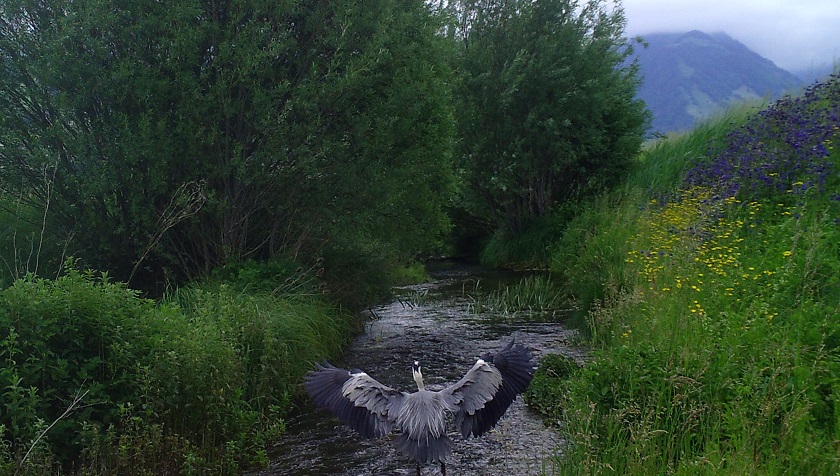
This project studies the interactions of terrestrial avian predators and their aquatic prey, fish. The goal is to learn about the influence of abiotic variables and biotic interactions on the spatial dynamics of piscivorous birds (such as Grey heron, Ardea cinerea) and the fish species they prey upon (e.g., Brown trout). Piscivorous birds move between different aquatic food webs, and some of their prey species are migratory fish (such as Brown trout, Salmo trutta) that move between streams and lakes according to trade-offs between opportunities to grow and predation risk. We are interested in how fish densities influence the movement and foraging behavior of predatory birds, and how, in turn, predation pressure from birds influences the migration behavior and population dynamics of fish. This project thus integrates movement and behavioral ecology with predator-prey interactions across aquatic-terrestrial ecosystem boundaries.

With a focus on modelling, the project will leverage multi-year datasets on the spatial distribution and size of bird colonies and camera trap data on bird foraging behavior, combined with datasets on stream fish abundance, the movement of tagged individual fish and fish tags recovered from bird colonies.

Studying interactions between terrestrial avian predators and aquatic fish prey at different spatial scales and their impact on movement, behavior and population dynamics


Team

Yannick Burkard PhD Candidate Tel. +41 58 765 5722 Send Mail
Dr. Helen Moor Group leader Tel. +41 58 765 6475 Send Mail

Publications

Extbase Variable Dump
array(2 items)
   publications => '31835' (5 chars)
   libraryUrl => '' (0 chars)
Extbase Variable Dump
array(1 item)
   0 => Snowflake\Publications\Domain\Model\Publicationprototypepersistent entity (uid=31835, pid=124)
      originalId => protected31835 (integer)
      authors => protected'Lavender, E.; Hunziker, Y.; McLennan, D.; Dermond, P.; S
         talder, D.; Selz, O.; Brodersen, J.
' (126 chars) title => protected'Sex‐ and length‐dependent variation in migratory propensity in brown tro
         ut
' (78 chars) journal => protected'Ecology of Freshwater Fish' (26 chars) year => protected2023 (integer) volume => protected23 (integer) issue => protected'1' (1 chars) startpage => protected'e12745 (12 pp.)' (15 chars) otherpage => protected'' (0 chars) categories => protected'migration; passive telemetry; potamodromy; predation-growth trade-off; Salmo
          trutta; sdY gene
' (93 chars) description => protected'In partially migratory species, individuals either migrate at some point(s)
         in life or reside within their natal habitat throughout life. For salmonid f
         ish, migration creates opportunities for feeding and growth, but it is also
         associated with increased mortality risk. Such trade-offs likely differ betw
         een the sexes, since reproductive output is more closely tied to body size i
         n females than males. However, testing hypotheses on sex-specific migratory
         behaviour in would-be first-time migratory salmonids is difficult, since sex
         es are generally morphologically indistinguishable prior to maturation. Prev
         ious studies have evaluated the influence of sex on migration based on disse
         ction of migratory juveniles or the sex ratio of returning adults. However,
         both approaches are potentially biased by differential survival during migra
         tion. Here, we utilise advances in minimally invasive genetic sex-determinat
         ion methods for salmonids to investigate sex-specific, spring out-migration
         propensity in potamodromous brown trout (<em>Salmo trutta</em>) in a pre-Alp
         ine, central European lake. We show that there are marked differences in mig
         ratory behaviour between males and females, with small (~10 cm) females be
         ing approximately twice as likely to migrate out of their natal river in spr
         ing compared to similarly sized males, which generally migrate for the first
          time at larger sizes (in similar proportions to larger females). This study
          highlights how novel genetic sex-determination techniques can provide insig
         ht into the sex- and size-specific life-history trade-offs that shape migrat
         ion propensity. Moving forward, these techniques should become useful tools
         for ecologists and fisheries managers.
' (1710 chars) serialnumber => protected'0906-6691' (9 chars) doi => protected'10.1111/eff.12745' (17 chars) uid => protected31835 (integer) _localizedUid => protected31835 (integer)modified _languageUid => protectedNULL _versionedUid => protected31835 (integer)modified pid => protected124 (integer)
Lavender, E.; Hunziker, Y.; McLennan, D.; Dermond, P.; Stalder, D.; Selz, O.; Brodersen, J. (2023) Sex‐ and length‐dependent variation in migratory propensity in brown trout, Ecology of Freshwater Fish, 23(1), e12745 (12 pp.), doi:10.1111/eff.12745, Institutional Repository
   

Contact

Dr. Helen Moor Group leader Tel. +41 58 765 6475 Send Mail