Department Surface Waters - Research and Management

MACRO: Tracking the Polynesian migration
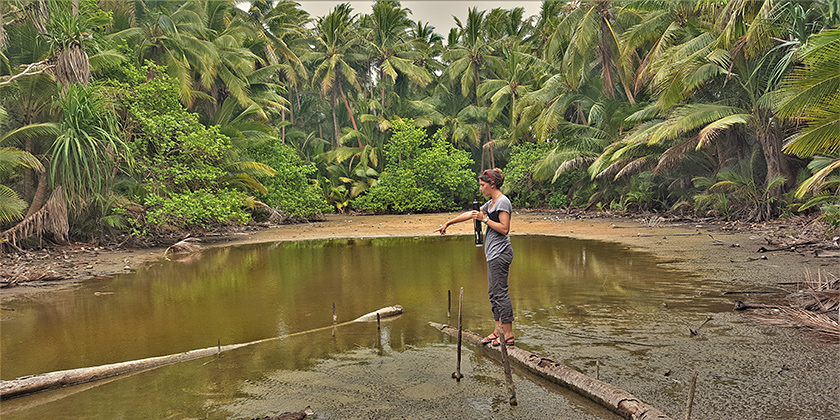

The MACRO project (Molecular traces of Anthropogenic and Climatic impact in Remote Oceania) investigates the timing and extent of human impacts on previously unoccupied islands of Remote Oceania. Lake and swamp sediment cores will be retrieved from several Islands across the Pacific Ocean (Vanuatu, New Zealand, French Polynesia). Multi-proxy analyses of the sediments will then provide combined paleoenvironmental and paleoclimatic reconstructions. The investigation will center on organic molecular fossils (lipid biomarkers).
The arrival of humans and subsequent evolution of population size will be documented by variations in coprostanol (faecal biomarker) and bile acid. New biomarkers will be developed to trace the introduction of cultivated plants. Past variations in rainfall intensity – the most prominent climate variable in this region – will be reconstructed from the hydrogen and carbon isotopic composition of aquatic and terrestrial plant lipids.
We will especially focus on the development of agriculture and the related environmental consequences triggered by land use change (e.g. soil loss, arrival of invasive species, changes in water quality).

Publications

Extbase Variable Dump
array(2 items)
   publications => '18567' (5 chars)
   libraryUrl => '' (0 chars)
Extbase Variable Dump
array(1 item)
   0 => Snowflake\Publications\Domain\Model\Publicationprototypepersistent entity (uid=18567, pid=124)
      originalId => protected18567 (integer)
      authors => protected'Krentscher, C.; Dubois, N.; Camperio, G.; Prebble, M.; L
         add, S. N.
' (96 chars) title => protected'Palmitone as a potential species-specific biomarker for the crop plant taro
         (<em>Colocasia esculenta</em> Schott) on remote Pacific islands
' (139 chars) journal => protected'Organic Geochemistry' (20 chars) year => protected2019 (integer) volume => protected132 (integer) issue => protected'' (0 chars) startpage => protected'1' (1 chars) otherpage => protected'10' (2 chars) categories => protected'Colocasia esculenta; taro; lipid biomarker; palmitone; hentriacontan-16-one;
          Vanuatu; lake sediments
' (100 chars) description => protected'The Pacific Island ecosystems of Remote Oceania were dramatically transforme
         d following the arrival of humans within the last ∼3000 years, as the new
         settlers required technological innovations and environmental modifications
         to maintain their populations. These modifications included the introduction
          of numerous exotic species, including the important crop <em>Colocasia escu
         lenta</em> Schott (taro) and the development of infrastructure suitable for
         its cultivation. Archeological reconstruction of <em>C. esculenta</em> use i
         n the Pacific has been challenging because of the low-specificity of fossil
         starch granules and its limited pollen production during periods of intense
         cultivation. Here, we assess a lipid biomarker approach to trace <em>C. escu
         lenta</em> cultivation in the past. We characterized the neutral lipid compo
         sitions of leaf samples from common cultivars and widespread indigenous spec
         ies from the archipelago of Vanuatu by gas chromatography–mass spectrometr
         y (GC−MS). The compound palmitone (hentriacontan-16-one) was a major leaf
         wax constituent in <em>C. esculenta</em> cultivar samples (mean concentratio
         n of 402 ± 63 µg/g dry wt) and was only detected in one other species, the
          ornamental tree <em>Cananga odorata</em> (175 µg/g dry wt). The structure
         of palmitone is favorable for its long-term stability and we demonstrate its
          preservation potential in a 55 cm sedimentary record from Lake Vesalea on E
         spiritu Santo, Vanuatu, where <em>C. esculenta</em> is grown today. Palmiton
         e concentrations in this core fluctuated up to 4.1 µg/g dry wt. Our results
          indicate that in appropriate environmental contexts, sedimentary palmitone
         concentrations could be used to reconstruct <em>C. esculenta</em> cultivatio
         n and to provide insights about past horticultural innovations in Remote Oce
         ania.
' (1829 chars) serialnumber => protected'0146-6380' (9 chars) doi => protected'10.1016/j.orggeochem.2019.03.006' (32 chars) uid => protected18567 (integer) _localizedUid => protected18567 (integer)modified _languageUid => protectedNULL _versionedUid => protected18567 (integer)modified pid => protected124 (integer)
Krentscher, C.; Dubois, N.; Camperio, G.; Prebble, M.; Ladd, S. N. (2019) Palmitone as a potential species-specific biomarker for the crop plant taro (Colocasia esculenta Schott) on remote Pacific islands, Organic Geochemistry, 132, 1-10, doi:10.1016/j.orggeochem.2019.03.006, Institutional Repository