Department Environmental Chemistry

NAWA Sampling strategy - Optimization of sampling strategies in Swiss Water Quality Monitoring to enhance the detection of industrial emissions
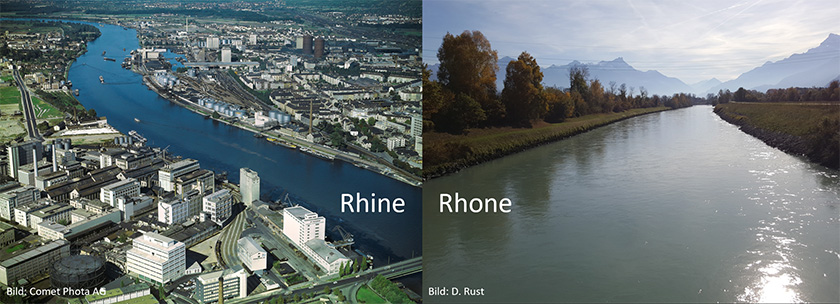

The NAWA Trend program monitors the long-term water quality of Swiss rivers. Traditionally centered on pesticides and pharmaceuticals, the program now integrates LC-HRMS technology to identify a broader range of contaminants, including industrial emissions. To improve their detection, the most effective sampling strategy needs to be determined.

The aim of this project is therefore to evaluate various sampling scenarios and provide recommendations. For this purpose, substances likely originating from industrial emissions are identified via time series analysis. Temporal profiles of substances of interest are used to simulate different sampling scenarios.

The detailed analysis covers the following aspects:

measurement frequency – eight different sampling intervals are tested (2 days to 1 month). Decrease in sampling frequency is expected to result in increasingly smoothed and eventually undetectable industrial emission patterns.

sampling methodology – two sampling methodologies are evaluated: time-proportional and flow-proportional. To simulate flow-proportional sampling, the data is standardized according to river discharge. This helps to understand how each sampling method performs and whether any notable differences arise for detecting industrial contamination.

Further details are available in the following report: https://www.dora.lib4ri.ch/eawag/islandora/object/eawag%3A33812

Publications

Extbase Variable Dump
array(2 items)
   publications => '33812' (5 chars)
   libraryUrl => '' (0 chars)
Extbase Variable Dump
array(1 item)
   0 => Snowflake\Publications\Domain\Model\Publicationprototypepersistent entity (uid=33812, pid=124)
      originalId => protected33812 (integer)
      authors => protected'Chonova, T.; Singer, H.' (33 chars)
      title => protected'Determining an optimal sampling frequency for the identification of industri
         al emissions in the Swiss national water quality monitoring programme NAWA u
         sing high-resolution mass spectrometry
' (190 chars) journal => protected'' (0 chars) year => protected2024 (integer) volume => protected0 (integer) issue => protected'' (0 chars) startpage => protected'13 p' (9 chars) otherpage => protected'' (0 chars) categories => protected'' (0 chars) description => protected'The National Surface Water Quality Monitoring Program (NAWA) plays a crucial
          role in ensuring the continuous collection of data and the ongoing assessme
         nt of water quality in Switzerland. The chemical monitoring in NAWA focuses
         on three primary objectives: early detection of problematic substances, the
         establishment of a digital archive for water quality data, and the comprehen
         sive monitoring of water pollution. To date, monitoring efforts for organic
         micropollutants (OMPs) have primarily targeted pesticides and pharmaceutical
         s using a target screening approach. However, to enhance the detection of a
         broader spectrum of OMPs, in particular substances originating from industri
         al activities, the Water Assessment Steering Group (LGB) and the working gro
         up Lab’Eaux NAWA have initiated the collection of high-resolution mass spe
         ctrometry (HRMS) measurement data at selected NAWA sites. Based on these mea
         surements, a supplementary non-target screening should be implemented. [...]
' (988 chars) serialnumber => protected'' (0 chars) doi => protected'' (0 chars) uid => protected33812 (integer) _localizedUid => protected33812 (integer)modified _languageUid => protectedNULL _versionedUid => protected33812 (integer)modified pid => protected124 (integer)
Chonova, T.; Singer, H. (2024) Determining an optimal sampling frequency for the identification of industrial emissions in the Swiss national water quality monitoring programme NAWA using high-resolution mass spectrometry, 13 p, Institutional Repository