Assessing the environmental behavior of pharmaceutical.
To investigate the fate processes of pharmaceuticals in surface waters we study transformation pathways and kinetics by abiotic and biotic processes. We quantify direct phototransformation kinetics as well as indirect photochemical processes involving reactive intermediates to derive second-order rate constants that are system-independent. We also determine the biological degradability of organic pollutants for examples with freshwater biofilm communities. We are particularly interested in the contribution of extracellular enyzmes on transformation processes of compounds that are note readily taken up by cells. These compounds include antimicrobial peptides and natural toxins.
Recent projects:
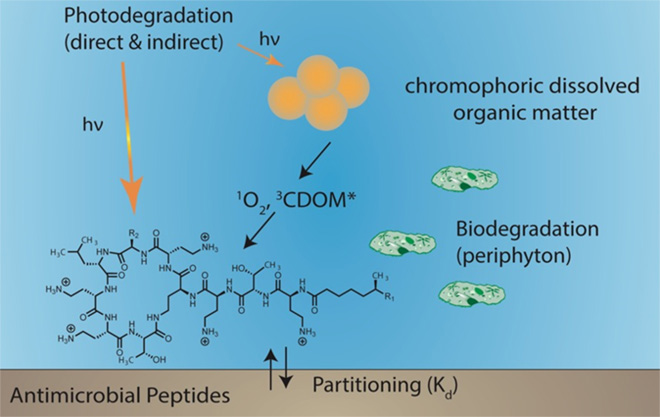
We recently transferred our knowledge gained for small molecule photochemistry to macromolecular pollutants (> 500 Da), which present an added challenge due to their structurally complexity. In a recent study we focused on antimicrobial peptides (AMPs). AMPs are increasingly important as a last resort against multi-drug resistant bacteria due to resistance formation towards conventional antibiotics. While AMPs have been administered as antibiotics and growth promotors in feedstock since the 1960s and were reconsidered for human medicine by the EMA in 2013, details about their mobility and persistence in the environment remain unknown. Our findings of sorption behaviour, photo- and biotransformation suggest that these processes play a critical role in the fate of the AMPs bacitracins, daptomycin, and polymyxins in environmental systems.
For more information take a look at the following publication.
We previously investigated the kinetic solvent isotope effect (KSIE) as it is typically utilized in environmental photochemistry to elucidate whether a compound is susceptible to photooxidation by singlet oxygen (1O2). This KSIE manifests itself in the known difference in 1O2 lifetime in water (H2O) versus heavy water (D2O). We demonstrate an additional enhancement in D2O beyond reaction with 1O2 contributed significantly to the observed KSIE for selected pharmaceuticals. The enhancement was ascribed to slower reduction of transient radical species due to H/D exchange at DOM’s phenolic antioxidant moieties. Other pollutants with quenchable radical intermediates may also be susceptible to such an additional KSIE, which has to be considered when using the KSIE as a diagnostic tool. For more information take a look at the following publicationhttps://www.eawag.ch/typo3/#_msocom_1.
Another project focused on electron transfer properties between compounds of interest and dissolved organic matter (DOM). We demonstrated that the dual roles of DOM, acting as oxidant and antioxidant, significantly influences the photochemical fate of non-steroidal anti-inflammatory drugs and the amino acid tryptophan. We used steady-state as well as laser-flash photolysis and high-resolution mass spectrometry to mechanistically elucidate reaction pathways in these studies. For more information take a look at the following publicationhttps://www.eawag.ch/typo3/#_msocom_1.
array(3 items)0 => Snowflake\Publications\Domain\Model\Publicationprototypepersistent entity (uid=19499, pid=124)originalId => protected19499 (integer)
authors => protected'Davis, C. A.; Janssen, E. M. -L.' (57 chars)
title => protected'Environmental fate processes of antimicrobial peptides daptomycin, bacitraci ns, and polymyxins' (94 chars)
journal => protected'Environment International' (25 chars)
year => protected2020 (integer)
volume => protected134 (integer)
issue => protected'' (0 chars)
startpage => protected'105271 (9 pp.)' (14 chars)
otherpage => protected'' (0 chars)
categories => protected'nonribosomal peptides; colistin; sorption; phototransformation; biotransform ation; antibiotics' (94 chars)
description => protected'Antimicrobial peptides (AMPs) are increasingly important as a last resort ag ainst multi-drug resistant bacteria due to resistance formation towards conv entional antibiotics. However, many AMPs were introduced to the market befor e environmental risk assessment was required, e.g., by the European Medicine s Agency (EMA) since 1998. While AMPs have been administered as antibiotics and growth promotors in feedstock since the 1960s and were reconsidered for human medicine by the EMA in 2013, details about their mobility and persiste nce in the environment remain unknown. This study investigated the environme ntal fate of three commonly used AMPs: bacitracins, daptomycin, and polymyxi ns B and E (Colistin). We observed moderate sorption affinity of daptomycin to standard European soils (K<sub>d</sub> = 20.6–48.6), while polymyxi ns adsorbed irreversibly. Bacitracin variants sorbed slightly to sandy soil (K<sub>d</sub> = 5.8–8) and significantly to clayey soil (K<sub>d</sub > = 169–250). We further investigated photochemical and microbial tran sformation processes relevant in surface waters. We demonstrated that photot ransformation of all AMPs was enhanced in the presence of dissolved organic matter and fast bimolecular reaction rate constant with singlet oxygen contr ibuted largely to indirect phototransformation (15–41%). Phototransformati on product analysis for daptomycin was consistent with expected modification s of the tryptophan and kynurenine moieties. Moreover, riverine biofilm comm unities demonstrated biotransformation potential for all AMPs. Our findings of sorption behaviour, photo- and biotransformation suggest that these proce sses play a critical role in the fate of bacitracins, daptomycin, and polymy xins in environmental systems.' (1778 chars)
serialnumber => protected'0160-4120' (9 chars)
doi => protected'10.1016/j.envint.2019.105271' (28 chars)
uid => protected19499 (integer)
_localizedUid => protected19499 (integer)modified_languageUid => protectedNULL
_versionedUid => protected19499 (integer)modifiedpid => protected124 (integer)1 => Snowflake\Publications\Domain\Model\Publicationprototypepersistent entity (uid=17408, pid=124)originalId => protected17408 (integer)
authors => protected'Davis, C. A.; McNeill, K.; Janssen, E. M. -L.' (75 chars)
title => protected'Non-singlet oxygen kinetic solvent isotope effects in aquatic photochemistry' (76 chars)
journal => protected'Environmental Science and Technology' (36 chars)
year => protected2018 (integer)
volume => protected52 (integer)
issue => protected'17' (2 chars)
startpage => protected'9908' (4 chars)
otherpage => protected'9916' (4 chars)
categories => protected'' (0 chars)
description => protected'The kinetic solvent isotope effect (KSIE) is typically utilized in environme ntal photochemistry to elucidate whether a compound is susceptible to photoo xidation by singlet oxygen (<small><sup>1</sup></small>O<small><sub>2</sub>< /small>), due to its known difference in lifetime in water (H<small><sub>2</ sub></small>O) versus heavy water (D<small><sub>2</sub></small>O). Here, the overall indirect photodegradation rates of diarylamines in the presence of dissolved organic matter (DOM) were enhanced in D<small><sub>2</sub></small> O to a greater extent than expected based on their reactivity with <small><s up>1</sup></small>O<small><sub>2</sub></small>. For each diarylamine, the re lative contribution of reaction with <small><sup>1</sup></small>O<small><sub >2</sub></small> to the observed KSIE was determined from high resolution da ta of <small><sup>1</sup></small>O<small><sub>2</sub></small> lifetimes by t ime-resolved infrared luminescence spectroscopy. The additional enhancement in D<small><sub>2</sub></small>O beyond reaction with <small><sup>1</sup></s mall>O<small><sub>2</sub></small> contributed significantly to the observed KSIE for diarylamines (8–65%) and diclofenac (100%). The enhancement was a scribed to slower reduction of transient radical species of the diarylamines due to H/D exchange at DOM's phenolic antioxidant moieties. A slower second -order reaction rate constant with a model antioxidant was verified for mefe namic acid radicals using transient absorption spectroscopy. Changes in life time and reactivity with triplet sensitizers were not responsible for the ad ditional KSIE. Other pollutants with quenchable radical intermediates may al so be susceptible to such an additional KSIE, which has to be considered whe n using the KSIE as a diagnostic tool.' (1786 chars)
serialnumber => protected'0013-936X' (9 chars)
doi => protected'10.1021/acs.est.8b01512' (23 chars)
uid => protected17408 (integer)
_localizedUid => protected17408 (integer)modified_languageUid => protectedNULL
_versionedUid => protected17408 (integer)modifiedpid => protected124 (integer)2 => Snowflake\Publications\Domain\Model\Publicationprototypepersistent entity (uid=14173, pid=124)originalId => protected14173 (integer)
authors => protected'Davis, C. A.; Erickson, P. R.; McNeill, K.; Janssen , E. M. L.' (101 chars)
title => protected'Environmental photochemistry of fenamate NSAIDs and their radical intermedia tes' (79 chars)
journal => protected'Environmental Science: Processes and Impacts' (44 chars)
year => protected2017 (integer)
volume => protected19 (integer)
issue => protected'5' (1 chars)
startpage => protected'656' (3 chars)
otherpage => protected'665' (3 chars)
categories => protected'' (0 chars)
description => protected'Fenamates are a class of non-steroidal anti-inflammatory drugs (NSAIDs) that are not fully removed during wastewater treatment and can be released to su rface waters. Here, near-surface photochemical half-lives were evaluated to range from minutes to hours of four fenamates and the closely related diclof enac. While quantum yields for direct photochemical reactions at the water s urface vary widely from 0.071 for diclofenac to <0.001 for mefenamic acid, a ll fenamates showed significant reactivity towards singlet oxygen and hydrox yl radical with bimolecular reaction rate constants of 1.3-2.8 x 10<SUP>7</S UP> M<SUP>-1</SUP> s<SUP>-1</SUP> and 1.1-2.7 x 10<SUP>10</SUP> M<SUP>-1</SU P> s<SUP>-1</SUP>, respectively. Photodecay rates increased in the presence of dissolved organic matter (DOM) for diclofenac (+19%), tolfenamic acid (+9 %), and mefenamic acid (+95%), but decreased for flufenamic acid (-2%) and m eclofenamic acid (-14%) after accounting for light screening effects. Fast r eaction rate constants of all NSAIDs with model triplet sensitizers were qua ntified by laser flash photolysis. Here, the direct observation of diphenyla mine radical intermediates by transient absorption spectroscopy demonstrates one-electron oxidation of all fenamates. Quenching rate constants of these radical intermediates by ascorbic acid, a model antioxidant, were also quant ified. These observations suggest that the balance of oxidation by photoexci ted triplet DOM and quenching of the formed radical intermediates by antioxi dant moieties determines whether net sensitization or net quenching by DOM o ccurs in the photochemical degradation of fenamates.' (1648 chars)
serialnumber => protected'2050-7887' (9 chars)
doi => protected'10.1039/C7EM00079K' (18 chars)
uid => protected14173 (integer)
_localizedUid => protected14173 (integer)modified_languageUid => protectedNULL
_versionedUid => protected14173 (integer)modifiedpid => protected124 (integer)
Environmental fate processes of antimicrobial peptides daptomycin, bacitracins, and polymyxins
Antimicrobial peptides (AMPs) are increasingly important as a last resort against multi-drug resistant bacteria due to resistance formation towards conventional antibiotics. However, many AMPs were introduced to the market before environmental risk assessment was required, e.g., by the European Medicines Agency (EMA) since 1998. While AMPs have been administered as antibiotics and growth promotors in feedstock since the 1960s and were reconsidered for human medicine by the EMA in 2013, details about their mobility and persistence in the environment remain unknown. This study investigated the environmental fate of three commonly used AMPs: bacitracins, daptomycin, and polymyxins B and E (Colistin). We observed moderate sorption affinity of daptomycin to standard European soils (Kd = 20.6–48.6), while polymyxins adsorbed irreversibly. Bacitracin variants sorbed slightly to sandy soil (Kd = 5.8–8) and significantly to clayey soil (Kd = 169–250). We further investigated photochemical and microbial transformation processes relevant in surface waters. We demonstrated that phototransformation of all AMPs was enhanced in the presence of dissolved organic matter and fast bimolecular reaction rate constant with singlet oxygen contributed largely to indirect phototransformation (15–41%). Phototransformation product analysis for daptomycin was consistent with expected modifications of the tryptophan and kynurenine moieties. Moreover, riverine biofilm communities demonstrated biotransformation potential for all AMPs. Our findings of sorption behaviour, photo- and biotransformation suggest that these processes play a critical role in the fate of bacitracins, daptomycin, and polymyxins in environmental systems.
Davis, C. A.; Janssen, E. M. -L. (2020) Environmental fate processes of antimicrobial peptides daptomycin, bacitracins, and polymyxins, Environment International, 134, 105271 (9 pp.), doi:10.1016/j.envint.2019.105271, Institutional Repository
Non-singlet oxygen kinetic solvent isotope effects in aquatic photochemistry
The kinetic solvent isotope effect (KSIE) is typically utilized in environmental photochemistry to elucidate whether a compound is susceptible to photooxidation by singlet oxygen (1O2), due to its known difference in lifetime in water (H2O) versus heavy water (D2O). Here, the overall indirect photodegradation rates of diarylamines in the presence of dissolved organic matter (DOM) were enhanced in D2O to a greater extent than expected based on their reactivity with 1O2. For each diarylamine, the relative contribution of reaction with 1O2 to the observed KSIE was determined from high resolution data of 1O2 lifetimes by time-resolved infrared luminescence spectroscopy. The additional enhancement in D2O beyond reaction with 1O2 contributed significantly to the observed KSIE for diarylamines (8–65%) and diclofenac (100%). The enhancement was ascribed to slower reduction of transient radical species of the diarylamines due to H/D exchange at DOM's phenolic antioxidant moieties. A slower second-order reaction rate constant with a model antioxidant was verified for mefenamic acid radicals using transient absorption spectroscopy. Changes in lifetime and reactivity with triplet sensitizers were not responsible for the additional KSIE. Other pollutants with quenchable radical intermediates may also be susceptible to such an additional KSIE, which has to be considered when using the KSIE as a diagnostic tool.
Davis, C. A.; McNeill, K.; Janssen, E. M. -L. (2018) Non-singlet oxygen kinetic solvent isotope effects in aquatic photochemistry, Environmental Science and Technology, 52(17), 9908-9916, doi:10.1021/acs.est.8b01512, Institutional Repository
Environmental photochemistry of fenamate NSAIDs and their radical intermediates
Fenamates are a class of non-steroidal anti-inflammatory drugs (NSAIDs) that are not fully removed during wastewater treatment and can be released to surface waters. Here, near-surface photochemical half-lives were evaluated to range from minutes to hours of four fenamates and the closely related diclofenac. While quantum yields for direct photochemical reactions at the water surface vary widely from 0.071 for diclofenac to <0.001 for mefenamic acid, all fenamates showed significant reactivity towards singlet oxygen and hydroxyl radical with bimolecular reaction rate constants of 1.3-2.8 x 10⁷ M-1 s-1 and 1.1-2.7 x 10¹⁰ M-1 s-1, respectively. Photodecay rates increased in the presence of dissolved organic matter (DOM) for diclofenac (+19%), tolfenamic acid (+9%), and mefenamic acid (+95%), but decreased for flufenamic acid (-2%) and meclofenamic acid (-14%) after accounting for light screening effects. Fast reaction rate constants of all NSAIDs with model triplet sensitizers were quantified by laser flash photolysis. Here, the direct observation of diphenylamine radical intermediates by transient absorption spectroscopy demonstrates one-electron oxidation of all fenamates. Quenching rate constants of these radical intermediates by ascorbic acid, a model antioxidant, were also quantified. These observations suggest that the balance of oxidation by photoexcited triplet DOM and quenching of the formed radical intermediates by antioxidant moieties determines whether net sensitization or net quenching by DOM occurs in the photochemical degradation of fenamates.
Davis, C. A.; Erickson, P. R.; McNeill, K.; Janssen, E. M. L. (2017) Environmental photochemistry of fenamate NSAIDs and their radical intermediates, Environmental Science: Processes and Impacts, 19(5), 656-665, doi:10.1039/C7EM00079K, Institutional Repository
Additional publication
Elisabeth M.-L. Janssen, Emily Marron, Kristopher McNeill (2015) Aquatic photochemical kinetics of benzotriazole and structurally related compounds. Environmental Science: Processes and Impacts, 17, pp. 939-946. DOI: 10.1039/C5EM00045A