Department Environmental Chemistry

PROduCTS - Predicting environment-specific biotransformation of chemical contaminants

Waste chemicals released into the environment are detrimental both to humans and the natural world. Fortunately, microbial communities in the environment can reduce the problem by breaking down the chemicals – a process called biotransformation. We know little about this process, with the result that for many chemicals released we do not know the extent to which they will be transformed.  

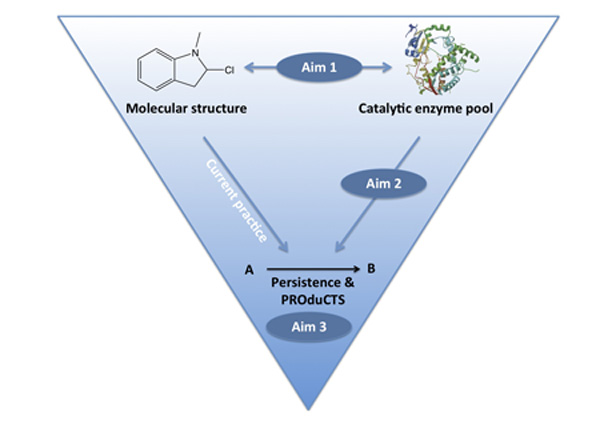
In the ERC-funded project PROduCTS we will therefore study the timescale and products of biotransformation for different chemicals, locations and microbial populations, and derive predictive methods from these observations. These will be implemented in a publically-accessible prediction system.
Our research approach is highly interdisciplinary and profits from the most recent technological and scientific advances in the fields of analytical chemistry, molecular biology and chemo-/bioinformatics. Our results should have a major impact: not only on chemical risk assessments, but also on the recovery of contaminated sites and development of green chemical alternatives.   
Publications

Extbase Variable Dump
array(2 items)
   publications => '17514,17089,16945,16192,14465,12376,10415,9182' (46 chars)
   libraryUrl => '' (0 chars)
Extbase Variable Dump
array(8 items)
   0 => Snowflake\Publications\Domain\Model\Publicationprototypepersistent entity (uid=17514, pid=124)
      originalId => protected17514 (integer)
      authors => protected'Achermann, S.; Falås, P.; Joss, A.; Mansfeldt, C.; Men,
          Y.; Vogler, B.; Fenner, K.
' (118 chars) title => protected'Trends in micropollutant biotransformation along a solids retention time gra
         dient
' (81 chars) journal => protected'Environmental Science and Technology' (36 chars) year => protected2018 (integer) volume => protected52 (integer) issue => protected'20' (2 chars) startpage => protected'11601' (5 chars) otherpage => protected'11611' (5 chars) categories => protected'' (0 chars) description => protected'For many polar organic micropollutants, biotransformation by activated sludg
         e microorganisms is a major removal process during wastewater treatment. How
         ever, our current understanding of how wastewater treatment operations influ
         ence microbial communities and their micropollutant biotransformation potent
         ial is limited, leaving major parts of observed variability in biotransforma
         tion rates across treatment facilities unexplained. Here, we present biotran
         sformation rate constants for 42 micropollutants belonging to different chem
         ical classes along a gradient of solids retention time (SRT). The geometric
         mean of biomass-normalized first-order rate constants shows a clear increase
          between 3 d and 15 d SRT by 160% and 87%, respectively, in two experiments.
          However, individual micropollutants show a variety of trends. Rate constant
         s of oxidative biotransformation reactions mostly increased with SRT. Yet, n
         itrifying activity could be excluded as primary driver. For substances under
         going other than oxidative reactions, i.e. mostly substitution-type reaction
         s, more diverse dependencies on SRT were observed. Most remarkably, characte
         ristic trends were observed for groups of substances undergoing similar type
         s of initial transformation reaction, suggesting that shared enzymes or enzy
         me systems that are conjointly regulated catalyze biotransformation reaction
         s within such groups. These findings open up opportunities for correlating r
         ate constants with measures of enzyme abundance, which in turn should help t
         o identify genes or gene products associated with the respective biotransfor
         mation reactions.
' (1613 chars) serialnumber => protected'0013-936X' (9 chars) doi => protected'10.1021/acs.est.8b02763' (23 chars) uid => protected17514 (integer) _localizedUid => protected17514 (integer)modified _languageUid => protectedNULL _versionedUid => protected17514 (integer)modified pid => protected124 (integer)
1 => Snowflake\Publications\Domain\Model\Publicationprototypepersistent entity (uid=17089, pid=124) originalId => protected17089 (integer) authors => protected'Wang, Y.; Lai, A.; Latino, D.; Fenner, K.; Helbling,&nbs
         p;D. E.
' (88 chars) title => protected'Evaluating the environmental parameters that determine aerobic biodegradatio
         n half-lives of pesticides in soil with a multivariable approach
' (140 chars) journal => protected'Chemosphere' (11 chars) year => protected2018 (integer) volume => protected209 (integer) issue => protected'' (0 chars) startpage => protected'430' (3 chars) otherpage => protected'438' (3 chars) categories => protected'aerobic biodegradation; pesticide; multivariable analysis; partitioning; bio
         availability
' (88 chars) description => protected'Aerobic biodegradation half-lives (half-lives) are key parameters used to ev
         aluate pesticide persistence in soil. However, half-life estimates for indiv
         idual pesticides often span several orders of magnitude, reflecting the impa
         ct that various environmental or experimental parameters have on half-lives
         in soil. In this work, we collected literature-reported half-lives for eleve
         n pesticides along with associated metadata describing the environmental or
         experimental conditions under which they were derived. We then developed a m
         ultivariable framework to discover relationships between the half-lives and
         associated metadata. We first compared data for the herbicide atrazine colle
         cted from 95 laboratory and 65 field studies. We discovered that atrazine ap
         plication history and soil texture were the parameters that have the largest
          influence on the observed half-lives in both types of studies. We then exte
         nded the analysis to include ten additional pesticides with data collected e
         xclusively from laboratory studies. We found that, when data were available,
          pesticide application history and biomass concentrations were always positi
         vely associated with half-lives. The relevance of other parameters varied am
         ong the pesticides, but in some cases the variability could be explained by
         the physicochemical properties of the pesticides. For example, we found that
          the relative significance of the organic carbon content of soil for determi
         ning half-lives depends on the relative solubility of the pesticide. Altoget
         her, our analyses highlight the reciprocal influence of both environmental p
         arameters and intrinsic physicochemical properties for determining half-live
         s in soil.
' (1682 chars) serialnumber => protected'0045-6535' (9 chars) doi => protected'10.1016/j.chemosphere.2018.06.077' (33 chars) uid => protected17089 (integer) _localizedUid => protected17089 (integer)modified _languageUid => protectedNULL _versionedUid => protected17089 (integer)modified pid => protected124 (integer)
2 => Snowflake\Publications\Domain\Model\Publicationprototypepersistent entity (uid=16945, pid=124) originalId => protected16945 (integer) authors => protected'Achermann, S.; Bianco, V.; Mansfeldt, C. B.; Vogler,&nbs
         p;B.; Kolvenbach, B. A.; Corvini, P. F. X.; Fenner,
          K.
' (160 chars) title => protected'Biotransformation of sulfonamide antibiotics in activated sludge: the format
         ion of pterin-conjugates leads to sustained risk
' (124 chars) journal => protected'Environmental Science and Technology' (36 chars) year => protected2018 (integer) volume => protected52 (integer) issue => protected'11' (2 chars) startpage => protected'6265' (4 chars) otherpage => protected'6274' (4 chars) categories => protected'' (0 chars) description => protected'The presence of antibiotics in treated wastewater and consequently in surfac
         e and groundwater resources raises concerns about the formation and spread o
         f antibiotic resistance. Improving the removal of antibiotics during wastewa
         ter treatment therefore is a prime objective of environmental engineering. H
         ere we obtained a detailed picture of the fate of sulfonamide antibiotics du
         ring activated sludge treatment using a combination of analytical methods. W
         e show that pterin-sulfonamide conjugates, which are formed when sulfonamide
         s interact with their target enzyme to inhibit folic acid synthesis, represe
         nt a major biotransformation route for sulfonamides in laboratory batch expe
         riments with activated sludge. The same major conjugates were also present i
         n the effluents of nine Swiss wastewater treatment plants. The demonstration
          of this biotransformation route, which is related to bacterial growth, help
         s explain seemingly contradictory views on optimal conditions for sulfonamid
         e removal. More importantly, since pterinsulfonamide conjugates show retaine
         d antibiotic activity, our findings suggest that risk from exposure to sulfo
         namide antibiotics may be less reduced during wastewater treatment than prev
         iously assumed. Our results thus further emphasize the inadequacy of focusin
         g on parent compound removal and the importance of investigating biotransfor
         mation pathways and removal of bioactivity to properly assess contaminant re
         moval in both engineered and natural systems.
' (1489 chars) serialnumber => protected'0013-936X' (9 chars) doi => protected'10.1021/acs.est.7b06716' (23 chars) uid => protected16945 (integer) _localizedUid => protected16945 (integer)modified _languageUid => protectedNULL _versionedUid => protected16945 (integer)modified pid => protected124 (integer)
3 => Snowflake\Publications\Domain\Model\Publicationprototypepersistent entity (uid=16192, pid=124) originalId => protected16192 (integer) authors => protected'Gulde, R.; Anliker, S.; Kohler, H.-P. E.; Fenner, K
         .
' (77 chars) title => protected'Ion trapping of amines in protozoa: a novel removal mechanism for micropollu
         tants in activated sludge
' (101 chars) journal => protected'Environmental Science and Technology' (36 chars) year => protected2018 (integer) volume => protected52 (integer) issue => protected'1' (1 chars) startpage => protected'52' (2 chars) otherpage => protected'60' (2 chars) categories => protected'' (0 chars) description => protected'To optimize removal of organic micropollutants from the water cycle, underst
         anding the processes during activated sludge treatment is essential. In this
          study, we hypothesize that aliphatic amines, which are highly abundant amon
         g organic micropollutants, are partly removed from the water phase in activa
         ted sludge through ion trapping in protozoa. In ion trapping, which has been
          extensively investigated in medical research, the neutral species of amine-
         containing compounds diffuse through the cell membrane and further into acid
         ic vesicles present in eukaryotic cells such as protozoa. There they become
         trapped because diffusion of the positively charged species formed in the ac
         idic vesicles is strongly hindered. We tested our hypothesis with two experi
         ments. First, we studied the distribution of the fluorescent amine acridine
         orange in activated sludge by confocal fluorescence imaging. We observed int
         ense fluorescence in distinct compartments of the protozoa, but not in the b
         acterial biomass. Second, we investigated the distribution of 12 amine-conta
         ining and eight control micropollutants in both regular activated sludge and
          sludge where the protozoa had been inactivated. In contrast to most control
          compounds, the amine-containing micropollutants displayed a distinctly diff
         erent behavior in the noninhibited sludge compared to the inhibited one: (i)
          more removal from the liquid phase; (ii) deviation from first-order kinetic
         s for the removal from the liquid phase; and (iii) higher amounts in the sol
         id phase. These results provide strong evidence that ion trapping in protozo
         a occurs and that it is an important removal mechanism for amine-containing
         micropollutants in batch experiments with activated sludge that has so far g
         one unnoticed. We expect that our findings will trigger further investigatio
         ns on the importance of this process in full-scale wastewater treatment syst
         ems, including its relevance for accumulation of ammonium.
' (1958 chars) serialnumber => protected'0013-936X' (9 chars) doi => protected'10.1021/acs.est.7b03556' (23 chars) uid => protected16192 (integer) _localizedUid => protected16192 (integer)modified _languageUid => protectedNULL _versionedUid => protected16192 (integer)modified pid => protected124 (integer)
4 => Snowflake\Publications\Domain\Model\Publicationprototypepersistent entity (uid=14465, pid=124) originalId => protected14465 (integer) authors => protected'Latino, D. A. R. S.; Wicker, J.; Gütlein, M.;
          Schmid, E.; Kramer, S.; Fenner, K.
' (126 chars) title => protected'Eawag-Soil in enviPath: a new resource for exploring regulatory pesticide so
         il biodegradation pathways and half-life data
' (121 chars) journal => protected'Environmental Science: Processes and Impacts' (44 chars) year => protected2017 (integer) volume => protected19 (integer) issue => protected'3' (1 chars) startpage => protected'449' (3 chars) otherpage => protected'464' (3 chars) categories => protected'' (0 chars) description => protected'Developing models for the prediction of microbial biotransformation pathways
          and half-lives of trace organic contaminants in different environments requ
         ires as training data easily accessible and sufficiently large collections o
         f respective biotransformation data that are annotated with metadata on stud
         y conditions. Here, we present the Eawag-Soil package, a public database tha
         t has been developed to contain all freely accessible regulatory data on pes
         ticide degradation in laboratory soil simulation studies for pesticides regi
         stered in the EU (282 degradation pathways, 1535 reactions, 1619 compounds a
         nd 4716 biotransformation half-life values with corresponding metadata on st
         udy conditions). We provide a thorough description of this novel data resour
         ce, and discuss important features of the pesticide soil degradation data th
         at are relevant for model development. Most notably, the variability of half
         -life values for individual compounds is large and only about one order of m
         agnitude lower than the entire range of median half-life values spanned by a
         ll compounds, demonstrating the need to consider study conditions in the dev
         elopment of more accurate models for biotransformation prediction. We furthe
         r show how the data can be used to find missing rules relevant for predictin
         g soil biotransformation pathways. From this analysis, eight examples of rea
         ction types were presented that should trigger the formulation of new biotra
         nsformation rules, <i>e.g.</i>, Ar-OH methylation, or the extension of exist
         ing rules, <i>e.g.</i>, hydroxylation in aliphatic rings. The data were also
          used to exemplarily explore the dependence of half-lives of different amide
          pesticides on chemical class and experimental parameters. This analysis hig
         hlighted the value of considering initial transformation reactions for the d
         evelopment of meaningful quantitative-structure biotransformation relationsh
         ips (QSBR), which is a novel opportunity offered by the simultaneous encodin
         g of transformation reac...
' (2230 chars) serialnumber => protected'2050-7887' (9 chars) doi => protected'10.1039/C6EM00697C' (18 chars) uid => protected14465 (integer) _localizedUid => protected14465 (integer)modified _languageUid => protectedNULL _versionedUid => protected14465 (integer)modified pid => protected124 (integer)
5 => Snowflake\Publications\Domain\Model\Publicationprototypepersistent entity (uid=12376, pid=124) originalId => protected12376 (integer) authors => protected'Men,&nbsp;Y.; Achermann,&nbsp;S.; Helbling,&nbsp;D.&nbsp;E.; Johnson,&nbsp;D
         .&nbsp;R.; Fenner,&nbsp;K.
' (102 chars) title => protected'Relative contribution of ammonia oxidizing bacteria and other members of nit
         rifying activated sludge communities to micropollutant biotransformation
' (148 chars) journal => protected'Water Research' (14 chars) year => protected2017 (integer) volume => protected109 (integer) issue => protected'' (0 chars) startpage => protected'217' (3 chars) otherpage => protected'226' (3 chars) categories => protected'micropollutant; allylthiourea; octyne; ammonia-oxidizing bacteria; wastewate
         r treatment plants; biotransformation
' (113 chars) description => protected'Improved micropollutant (MP) biotransformation during biological wastewater
         treatment has been associated with high ammonia oxidation activities, sugges
         ting co-metabolic biotransformation by ammonia oxidizing bacteria as an unde
         rlying mechanism. The goal of this study was to clarify the contribution of
         ammonia oxidizing bacteria to increased MP degradation in nitrifying activat
         ed sludge (NAS) communities using a series of inhibition experiments. To thi
         s end, we treated a NAS community with two different ammonia oxidation inhib
         itors, namely octyne (OCT), a mechanistic inhibitor that covalently binds to
          ammonia monooxygenases, and allylthiourea (ATU), a copper chelator that dep
         letes copper ions from the active center of ammonia monooxygenases. We inves
         tigated the biotransformation of 79 structurally different MPs by the inhibi
         tor-treated and untreated sludge communities. Fifty-five compounds exhibited
          over 20% removal in the untreated control after a 46 h-incubation. Of these
         , 31 compounds were significantly inhibited by either ATU and/or OCT. For 17
          of the 31 MPs, the inhibition by ATU at 46 h was substantially higher than
         by OCT despite the full inhibition of ammonia oxidation by both inhibitors.
         This was particularly the case for almost all thioether and phenylurea compo
         unds tested, suggesting that in nitrifying activated sludge communities, ATU
          does not exclusively act as an inhibitor of bacterial ammonia oxidation. Ra
         ther, ATU also inhibited enzymes contributing to MP biotransformation but no
         t to bulk ammonia oxidation. Thus, inhibition studies with ATU tend to overe
         stimate the contribution of ammonia-oxidizing bacteria to MP biotransformati
         on in nitrifying activated sludge communities. Biolog tests revealed only mi
         nor effects of ATU on the heterotrophic respiration of common organic substr
         ates by the sludge community, suggesting that ATU did not affect enzymes tha
         t were essential in energy conservation and central metabolism of heterotrop
         hs. By comparing ATU- an...
' (2276 chars) serialnumber => protected'0043-1354' (9 chars) doi => protected'10.1016/j.watres.2016.11.048' (28 chars) uid => protected12376 (integer) _localizedUid => protected12376 (integer)modified _languageUid => protectedNULL _versionedUid => protected12376 (integer)modified pid => protected124 (integer)
6 => Snowflake\Publications\Domain\Model\Publicationprototypepersistent entity (uid=10415, pid=124) originalId => protected10415 (integer) authors => protected'Wicker,&nbsp;J.; Lorsbach,&nbsp;T.; Gütlein,&nbsp;M.; Schmid,&nbsp;E.; Lati
         no,&nbsp;D.; Kramer,&nbsp;S.; Fenner,&nbsp;K.
' (121 chars) title => protected'enviPath – the environmental contaminant biotransformation pathway resourc
         e
' (77 chars) journal => protected'Nucleic Acids Research' (22 chars) year => protected2016 (integer) volume => protected44 (integer) issue => protected'D1' (2 chars) startpage => protected'D502' (4 chars) otherpage => protected'D508' (4 chars) categories => protected'' (0 chars) description => protected'The University of Minnesota Biocatalysis/Biodegradation Database and Pathway
          Prediction System (UM-BBD/PPS) has been a unique resource covering microbia
         l biotransformation pathways of primarily xenobiotic chemicals for over 15 y
         ears. This paper introduces the successor system, enviPath (The Environmenta
         l Contaminant Biotransformation Pathway Resource), which is a complete redes
         ign and reimplementation of UM-BBD/PPS. enviPath uses the database from the
         UM-BBD/PPS as a basis, extends the use of this database, and allows users to
          include their own data to support multiple use cases. Relative reasoning is
          supported for the refinement of predictions and to allow its extensions in
         terms of previously published, but not implemented machine learning models.
         User access is simplified by providing a REST API that simplifies the inclus
         ion of enviPath into existing workflows. An RDF database is used to enable s
         imple integration with other databases. enviPath is publicly available at ht
         tps://envipath.org with free and open access to its core data.
' (1050 chars) serialnumber => protected'0305-1048' (9 chars) doi => protected'10.1093/nar/gkv1229' (19 chars) uid => protected10415 (integer) _localizedUid => protected10415 (integer)modified _languageUid => protectedNULL _versionedUid => protected10415 (integer)modified pid => protected124 (integer)
7 => Snowflake\Publications\Domain\Model\Publicationprototypepersistent entity (uid=9182, pid=124) originalId => protected9182 (integer) authors => protected'Johnson,&nbsp;D.&nbsp;R.; Helbling,&nbsp;D.&nbsp;E.; Men,&nbsp;Y.; Fenner,&n
         bsp;K.
' (82 chars) title => protected'Can meta-omics help to establish causality between contaminant biotransforma
         tions and genes or gene products?
' (109 chars) journal => protected'Environmental Science: Water Research and Technology' (52 chars) year => protected2015 (integer) volume => protected1 (integer) issue => protected'3' (1 chars) startpage => protected'272' (3 chars) otherpage => protected'278' (3 chars) categories => protected'' (0 chars) description => protected'There is increasing interest in using meta-omics association studies to inve
         stigate contaminant biotransformations. The general strategy is to character
         ize the complete set of genes, transcripts, or enzymes from <I>in situ</I> e
         nvironmental communities and use the abundances of particular genes, transcr
         ipts, or enzymes to establish associations with the communities' potential t
         o biotransform one or more contaminants. The associations can then be used t
         o generate hypotheses about the underlying biological causes of particular b
         iotransformations. While meta-omics association studies are undoubtedly powe
         rful, they have a tendency to generate large numbers of non-causal associati
         ons, making it potentially difficult to identify the genes, transcripts, or
         enzymes that cause or promote a particular biotransformation. In this perspe
         ctive, we describe general scenarios that could lead to pervasive non-causal
          associations or conceal causal associations. We next explore our own publis
         hed data for evidence of pervasive non-causal associations. Finally, we eval
         uate whether causal associations could be identified despite the discussed l
         imitations. Analysis of our own published data suggests that, despite their
         limitations, meta-omics association studies might still be useful for improv
         ing our understanding and predicting the contaminant biotransformation capac
         ities of microbial communities.
' (1399 chars) serialnumber => protected'2053-1400' (9 chars) doi => protected'10.1039/c5ew00016e' (18 chars) uid => protected9182 (integer) _localizedUid => protected9182 (integer)modified _languageUid => protectedNULL _versionedUid => protected9182 (integer)modified pid => protected124 (integer)
Achermann, S.; Falås, P.; Joss, A.; Mansfeldt, C.; Men, Y.; Vogler, B.; Fenner, K. (2018) Trends in micropollutant biotransformation along a solids retention time gradient, Environmental Science and Technology, 52(20), 11601-11611, doi:10.1021/acs.est.8b02763, Institutional Repository
Wang, Y.; Lai, A.; Latino, D.; Fenner, K.; Helbling, D. E. (2018) Evaluating the environmental parameters that determine aerobic biodegradation half-lives of pesticides in soil with a multivariable approach, Chemosphere, 209, 430-438, doi:10.1016/j.chemosphere.2018.06.077, Institutional Repository
Achermann, S.; Bianco, V.; Mansfeldt, C. B.; Vogler, B.; Kolvenbach, B. A.; Corvini, P. F. X.; Fenner, K. (2018) Biotransformation of sulfonamide antibiotics in activated sludge: the formation of pterin-conjugates leads to sustained risk, Environmental Science and Technology, 52(11), 6265-6274, doi:10.1021/acs.est.7b06716, Institutional Repository
Gulde, R.; Anliker, S.; Kohler, H.-P. E.; Fenner, K. (2018) Ion trapping of amines in protozoa: a novel removal mechanism for micropollutants in activated sludge, Environmental Science and Technology, 52(1), 52-60, doi:10.1021/acs.est.7b03556, Institutional Repository
Latino, D. A. R. S.; Wicker, J.; Gütlein, M.; Schmid, E.; Kramer, S.; Fenner, K. (2017) Eawag-Soil in enviPath: a new resource for exploring regulatory pesticide soil biodegradation pathways and half-life data, Environmental Science: Processes and Impacts, 19(3), 449-464, doi:10.1039/C6EM00697C, Institutional Repository
Men, Y.; Achermann, S.; Helbling, D. E.; Johnson, D. R.; Fenner, K. (2017) Relative contribution of ammonia oxidizing bacteria and other members of nitrifying activated sludge communities to micropollutant biotransformation, Water Research, 109, 217-226, doi:10.1016/j.watres.2016.11.048, Institutional Repository
Wicker, J.; Lorsbach, T.; Gütlein, M.; Schmid, E.; Latino, D.; Kramer, S.; Fenner, K. (2016) enviPath – the environmental contaminant biotransformation pathway resource, Nucleic Acids Research, 44(D1), D502-D508, doi:10.1093/nar/gkv1229, Institutional Repository
Johnson, D. R.; Helbling, D. E.; Men, Y.; Fenner, K. (2015) Can meta-omics help to establish causality between contaminant biotransformations and genes or gene products?, Environmental Science: Water Research and Technology, 1(3), 272-278, doi:10.1039/c5ew00016e, Institutional Repository