Department Environmental Chemistry

RÜS Data 3.0 - AI-guided characterization of non-target substances
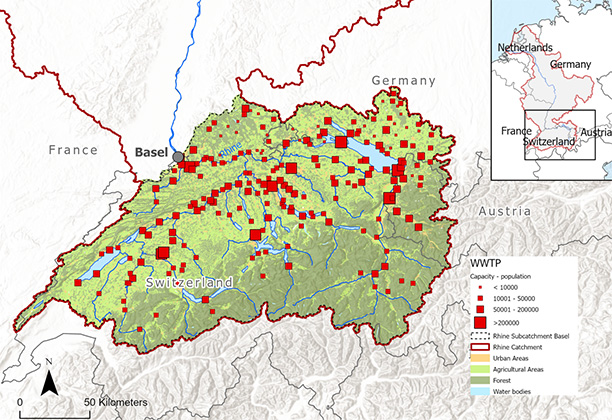

The river Rhine is a crucial water resource for Europe, providing drinking water to millions of people. However, the Rhine is one of the most human-impacted rivers with high industrial activity on the riverbank, which requires close monitoring. To that aim, RÜS (Rheinüberwachungsstation Weil am Rhein) measures daily intensities of hundreds of known and thousands of unknown substances via LC-HRMS/MS. The combined use of target and non-target screening techniques helps to shift the focus from a few legacy chemicals to complex mixtures of unknown substances.

In a previous project (Rues Data 2.0), we showed that 50% of the prioritized substances detected in the Rhine near Basel may originate from industry. We now aim for a deeper understanding of these important contaminants.

The aim of the RUES Data 3.0 project is therefore to perform a multifaceted characterization of pollutants to better comprehend their behavior and potential environmental effects. This workflow is organized into three work packages:

WP1 – Extended characterization of industrial emissions: A detailed descriptor for industrial emissions is developed that uses numerical metrics to characterize the time profile dynamics of the contaminants. This descriptor allows simple prioritization of industrial emission profiles based on the duration, intensity, and course of their occurrence.

WP2 – Data-driven Chemical Characterization: Candidates for chemical characterization of unknown contaminants are identified to enhance our understanding of the type of pollutants present in the chemical space. This is achieved via automatic processing pipelines basing on the information recorded from the MS1 and MS2 spectra.

WP3 – AI-Powered Toxicity Estimation: an in-silico toxicity estimate is calculated using machine learning to evaluate the potential toxicity of unknown compounds.  This approach is implemented through the framework MLinvitroTox.

The results of the three work packages lead to a comprehensive chemical, toxicological and source-based evaluation of the measured contaminants in the Rhine.

Publications

Extbase Variable Dump
array(2 items)
   publications => '33899' (5 chars)
   libraryUrl => '' (0 chars)
Extbase Variable Dump
array(1 item)
   0 => Snowflake\Publications\Domain\Model\Publicationprototypepersistent entity (uid=33899, pid=124)
      originalId => protected33899 (integer)
      authors => protected'Chonova, T.; Ruppe, S.; Langlois, I.; Griesshaber, D.&nb
         sp;S.; Loos, M.; Honti, M.; Fenner, K.; Singer, H.
' (146 chars) title => protected'Unveiling industrial emissions in a large European river: insights from data
          mining of high-frequency measurements
' (114 chars) journal => protected'Water Research' (14 chars) year => protected2025 (integer) volume => protected268 (integer) issue => protected'' (0 chars) startpage => protected'122745 (13 pp.)' (15 chars) otherpage => protected'' (0 chars) categories => protected'non-target screening; prioritization of micropollutants; source elucidation;
          irregular emissions; industrial contamination; time series
' (135 chars) description => protected'Despite the tremendous efforts to improve river water quality, chemical cont
         amination remains a significant issue. Besides well-known contaminants, in r
         ecent years, pollutants of industrial origin received increasing attention b
         ecause of the huge knowledge gap regarding their occurrence, fate and enviro
         nmental risks. Moreover, such pollutants often exhibit high concentration fl
         uctuations over time, which makes them less predictable and measurable with
         classical short-time campaigns.<br />This study provides insights into the d
         ifferent sources of chemical contamination of the Rhine River based on tempo
         ral high-frequency LC-HRMS monitoring data from a single location. A newly d
         eveloped prioritization strategy selected nearly 3000 substances as potentia
         lly major contaminants. A novel classification analysis based on temporal be
         havior identified 53 % of these compounds (accounting for 62 % of the time-i
         ntegrated intensity recorded in the dataset) as originating from irregular e
         mission sources. Irregular emissions can originate from industrial productio
         n cycles. After delimiting other potential irregular sources, we have strong
          evidence indicating that a considerable share of the irregular emissions li
         kely comes from industrial activities. This finding is supported by the stru
         ctural elucidation of sixteen irregularly emitted substances, for which the
         industrial origin was successfully confirmed. Those compounds include 3-chlo
         ro-5-(trifluoromethyl)pyridine-2-carboxylic acid and 4-(dimethylamino)-2,2-d
         iphenylpentanenitrile. In addition, 40 other compounds exhibited temporal em
         ission patterns similar to the sixteen industrial compounds, which strongly
         suggests a common contamination source. Finally, 100 top-ranking compounds w
         ere selected for further structural elucidation and emission reduction measu
         res. The computational approach outlined within this study can be effectivel
         y applied in other large river catchments to identify unknown contaminants s
         temming from industrial ...
' (2008 chars) serialnumber => protected'0043-1354' (9 chars) doi => protected'10.1016/j.watres.2024.122745' (28 chars) uid => protected33899 (integer) _localizedUid => protected33899 (integer)modified _languageUid => protectedNULL _versionedUid => protected33899 (integer)modified pid => protected124 (integer)
Chonova, T.; Ruppe, S.; Langlois, I.; Griesshaber, D. S.; Loos, M.; Honti, M.; Fenner, K.; Singer, H. (2025) Unveiling industrial emissions in a large European river: insights from data mining of high-frequency measurements, Water Research, 268, 122745 (13 pp.), doi:10.1016/j.watres.2024.122745, Institutional Repository