Bacterial tolerance to antibiotics – individual and collective effects
Antibiotics play an essential role for treating bacterial infections in humans and animals, and treatment failure is potentially fatal for infected hosts. A lot of attention is currently given to bacteria that are genetically resistant to antibiotics and can thereby lead to treatment failure. However, bacteria can evade treatment even if they are not genetically resistant. Specific growth conditions, or interactions with other bacterial strains, can render bacterial cells insensitive to the effects of antibiotics. Understanding how bacteria can evade antibiotics, and how antibiotics can be used in a more effective manner, is important both from a scientific as well as from an applied perspective. We are quantifying how antibiotics impact growth and survival of individual bacterial cells, and how these impacts depend on the growth condition and the composition of the bacterial community.
array(2 items)0 => Snowflake\Publications\Domain\Model\Publicationprototypepersistent entity (uid=7746, pid=124)originalId => protected7746 (integer)
authors => protected'Ocampo, P. S.; Lázár, V.; Papp, B.; Arnoldini, M. ; zur Wiesch, P. A.; Busa-Fekete, R.; Fekete, G.; Pál,& nbsp;C.; Ackermann, M.; Bonhoeffer, S.' (200 chars)
title => protected'Antagonism between bacteriostatic and bactericidal antibiotics is prevalent' (75 chars)
journal => protected'Antimicrobial Agents and Chemotherapy' (37 chars)
year => protected2014 (integer)
volume => protected58 (integer)
issue => protected'8' (1 chars)
startpage => protected'4573' (4 chars)
otherpage => protected'4582' (4 chars)
categories => protected'' (0 chars)
description => protected'Combination therapy is rarely used to counter the evolution of resistance in bacterial infections. Expansion of the use of combination therapy requires knowledge of how drugs interact at inhibitory concentrations. More than 50 y ears ago, it was noted that, if bactericidal drugs are most potent with acti vely dividing cells, then the inhibition of growth induced by a bacteriostat ic drug should result in an overall reduction of efficacy when the drug is u sed in combination with a bactericidal drug. Our goal here was to investigat e this hypothesis systematically. We first constructed time-kill curves usin g five different antibiotics at clinically relevant concentrations, and we o bserved antagonism between bactericidal and bacteriostatic drugs. We extende d our investigation by performing a screen of pairwise combinations of 21 di fferent antibiotics at subinhibitory concentrations, and we found that stron g antagonistic interactions were enriched significantly among combinations o f bacteriostatic and bactericidal drugs. Finally, since our hypothesis relie s on phenotypic effects produced by different drug classes, we recreated the se experiments in a microfluidic device and performed time-lapse microscopy to directly observe and quantify the growth and division of individual cells with controlled antibiotic concentrations. While our single-cell observatio ns supported the antagonism between bacteriostatic and bactericidal drugs, t hey revealed an unexpected variety of cellular responses to antagonistic dru g combinations, suggesting that multiple mechanisms underlie the interaction s.' (1598 chars)
serialnumber => protected'0066-4804' (9 chars)
doi => protected'10.1128/AAC.02463-14' (20 chars)
uid => protected7746 (integer)
_localizedUid => protected7746 (integer)modified_languageUid => protectedNULL
_versionedUid => protected7746 (integer)modifiedpid => protected124 (integer)1 => Snowflake\Publications\Domain\Model\Publicationprototypepersistent entity (uid=9122, pid=124)originalId => protected9122 (integer)
authors => protected'Arnoldini, M.; Vizcarra, I. A.; Peña-Miller, R.; Stocke r, N.; Diard, M.; Vogel, V.; Beardmore, R. E.; Hard t, W.-D.; Ackermann, M.' (185 chars)
title => protected'Bistable expression of virulence genes in <I>Salmonella</I> leads to the for mation of an antibiotic-tolerant subpopulation' (122 chars)
journal => protected'PLoS Biology' (12 chars)
year => protected2014 (integer)
volume => protected12 (integer)
issue => protected'8' (1 chars)
startpage => protected'1' (1 chars)
otherpage => protected'8' (1 chars)
categories => protected'' (0 chars)
description => protected'Phenotypic heterogeneity can confer clonal groups of organisms with new func tionality. A paradigmatic example is the bistable expression of virulence ge nes in <I>Salmonella typhimurium</I>, which leads to phenotypically virulent and phenotypically avirulent subpopulations. The two subpopulations have be en shown to divide labor during <I>S. typhimurium</I> infections. Here, we s how that heterogeneous virulence gene expression in this organism also promo tes survival against exposure to antibiotics through a bet-hedging mechanism . Using microfluidic devices in combination with fluorescence time-lapse mic roscopy and quantitative image analysis, we analyzed the expression of virul ence genes at the single cell level and related it to survival when exposed to antibiotics. We found that, across different types of antibiotics and und er concentrations that are clinically relevant, the subpopulation of bacteri al cells that express virulence genes shows increased survival after exposur e to antibiotics. Intriguingly, there is an interplay between the two conseq uences of phenotypic heterogeneity. The bet-hedging effect that arises throu gh heterogeneity in virulence gene expression can protect clonal populations against avirulent mutants that exploit and subvert the division of labor wi thin these populations. We conclude that bet-hedging and the division of lab or can arise through variation in a single trait and interact with each othe r. This reveals a new degree of functional complexity of phenotypic heteroge neity. In addition, our results suggest a general principle of how pathogens can evade antibiotics: Expression of virulence factors often entails metabo lic costs and the resulting growth retardation could generally increase tole rance against antibiotics and thus compromise treatment.' (1804 chars)
serialnumber => protected'1544-9173' (9 chars)
doi => protected'10.1371/journal.pbio.1001928' (28 chars)
uid => protected9122 (integer)
_localizedUid => protected9122 (integer)modified_languageUid => protectedNULL
_versionedUid => protected9122 (integer)modifiedpid => protected124 (integer)
Antagonism between bacteriostatic and bactericidal antibiotics is prevalent
Combination therapy is rarely used to counter the evolution of resistance in bacterial infections. Expansion of the use of combination therapy requires knowledge of how drugs interact at inhibitory concentrations. More than 50 years ago, it was noted that, if bactericidal drugs are most potent with actively dividing cells, then the inhibition of growth induced by a bacteriostatic drug should result in an overall reduction of efficacy when the drug is used in combination with a bactericidal drug. Our goal here was to investigate this hypothesis systematically. We first constructed time-kill curves using five different antibiotics at clinically relevant concentrations, and we observed antagonism between bactericidal and bacteriostatic drugs. We extended our investigation by performing a screen of pairwise combinations of 21 different antibiotics at subinhibitory concentrations, and we found that strong antagonistic interactions were enriched significantly among combinations of bacteriostatic and bactericidal drugs. Finally, since our hypothesis relies on phenotypic effects produced by different drug classes, we recreated these experiments in a microfluidic device and performed time-lapse microscopy to directly observe and quantify the growth and division of individual cells with controlled antibiotic concentrations. While our single-cell observations supported the antagonism between bacteriostatic and bactericidal drugs, they revealed an unexpected variety of cellular responses to antagonistic drug combinations, suggesting that multiple mechanisms underlie the interactions.
Ocampo, P. S.; Lázár, V.; Papp, B.; Arnoldini, M.; zur Wiesch, P. A.; Busa-Fekete, R.; Fekete, G.; Pál, C.; Ackermann, M.; Bonhoeffer, S. (2014) Antagonism between bacteriostatic and bactericidal antibiotics is prevalent, Antimicrobial Agents and Chemotherapy, 58(8), 4573-4582, doi:10.1128/AAC.02463-14, Institutional Repository
Bistable expression of virulence genes in Salmonella leads to the formation of an antibiotic-tolerant subpopulation
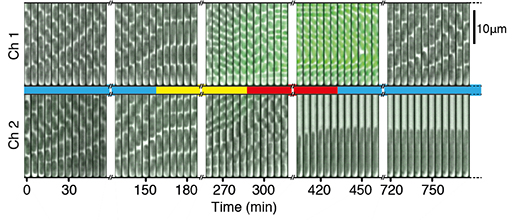
Phenotypic heterogeneity can confer clonal groups of organisms with new functionality. A paradigmatic example is the bistable expression of virulence genes in Salmonella typhimurium, which leads to phenotypically virulent and phenotypically avirulent subpopulations. The two subpopulations have been shown to divide labor during S. typhimurium infections. Here, we show that heterogeneous virulence gene expression in this organism also promotes survival against exposure to antibiotics through a bet-hedging mechanism. Using microfluidic devices in combination with fluorescence time-lapse microscopy and quantitative image analysis, we analyzed the expression of virulence genes at the single cell level and related it to survival when exposed to antibiotics. We found that, across different types of antibiotics and under concentrations that are clinically relevant, the subpopulation of bacterial cells that express virulence genes shows increased survival after exposure to antibiotics. Intriguingly, there is an interplay between the two consequences of phenotypic heterogeneity. The bet-hedging effect that arises through heterogeneity in virulence gene expression can protect clonal populations against avirulent mutants that exploit and subvert the division of labor within these populations. We conclude that bet-hedging and the division of labor can arise through variation in a single trait and interact with each other. This reveals a new degree of functional complexity of phenotypic heterogeneity. In addition, our results suggest a general principle of how pathogens can evade antibiotics: Expression of virulence factors often entails metabolic costs and the resulting growth retardation could generally increase tolerance against antibiotics and thus compromise treatment.
Arnoldini, M.; Vizcarra, I. A.; Peña-Miller, R.; Stocker, N.; Diard, M.; Vogel, V.; Beardmore, R. E.; Hardt, W.-D.; Ackermann, M. (2014) Bistable expression of virulence genes in Salmonella leads to the formation of an antibiotic-tolerant subpopulation, PLoS Biology, 12(8), 1-8, doi:10.1371/journal.pbio.1001928, Institutional Repository