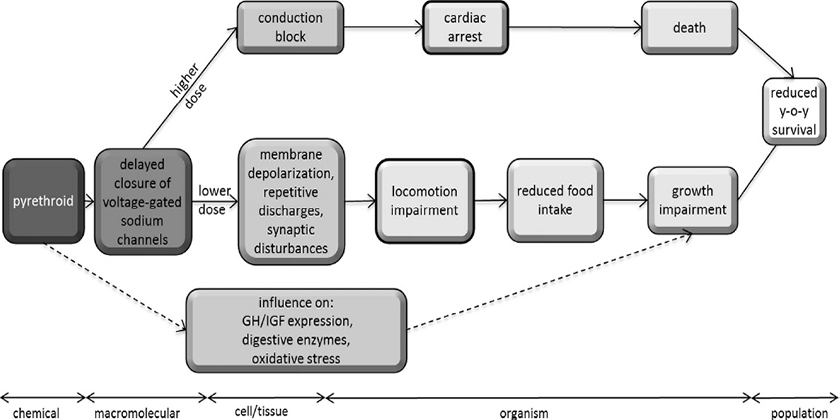
In collaboration with a high level international expert group we are currently developing a framework to advance adverse outcome pathways (AOPs, www.oecd.org/chemicalsafety/testing/adverse-outcome-pathways-molecular-screening-and-toxicogenomics.htm). The AOP is a conceptual knowledge framework that causally links multiple levels of biological organizations, starting from a direct molecular initiating event, continuing through a number of connected key events and finally arriving to an adverse outcome at a biological level of organization relevant to risk assessment. In the future, we envisage AOPs to be used by environmental protection agencies and regulators when developing and implement environmental policies.
At the research level, we want to use the AOP framework to better understand and predict chronic ecotoxicity generally and chronic fish toxicity specifically. We have identified a behavioral parameter (food intake) as a critical anchor point in fish AOPs and, having established behavioral assays in Utox, we can now focus on the impact on behavior by chemicals and mixtures.
array(8 items)0 => Snowflake\Publications\Domain\Model\Publicationprototypepersistent entity (uid=19718, pid=124)originalId => protected19718 (integer)
authors => protected'Burgoon, L. D.; Angrish, M.; Garcia‐Reyero, N.; Polles ch, N.; Zupanic, A.; Perkins, E.' (123 chars)
title => protected'Predicting the probability that a chemical causes steatosis using adverse ou tcome pathway Bayesian networks (AOPBNs)' (116 chars)
journal => protected'Risk Analysis' (13 chars)
year => protected2020 (integer)
volume => protected40 (integer)
issue => protected'3' (1 chars)
startpage => protected'512' (3 chars)
otherpage => protected'523' (3 chars)
categories => protected'adverse outcome pathway; computational toxicology; risk assessment; toxicolo gy' (78 chars)
description => protected'Adverse outcome pathway Bayesian networks (AOPBNs) are a promising avenue fo r developing predictive toxicology and risk assessment tools based on advers e outcome pathways (AOPs). Here, we describe a process for developing AOPBNs . AOPBNs use causal networks and Bayesian statistics to integrate evidence a cross key events. In this article, we use our AOPBN to predict the occurrenc e of steatosis under different chemical exposures. Since it is an expert‐d riven model, we use external data (i.e., data not used for modeling) from th e literature to validate predictions of the AOPBN model. The AOPBN accuratel y predicts steatosis for the chemicals from our external data. In addition, we demonstrate how end users can utilize the model to simulate the confidenc e (based on posterior probability) associated with predicting steatosis. We demonstrate how the network topology impacts predictions across the AOPBN, a nd how the AOPBN helps us identify the most informative key events that shou ld be monitored for predicting steatosis. We close with a discussion of how the model can be used to predict potential effects of mixtures and how to mo del susceptible populations (e.g., where a mutation or stressor may change t he conditional probability tables in the AOPBN). Using this approach for dev eloping expert AOPBNs will facilitate the prediction of chemical toxicity, f acilitate the identification of assay batteries, and greatly improve chemica l hazard screening strategies.' (1474 chars)
serialnumber => protected'0272-4332' (9 chars)
doi => protected'10.1111/risa.13423' (18 chars)
uid => protected19718 (integer)
_localizedUid => protected19718 (integer)modified_languageUid => protectedNULL
_versionedUid => protected19718 (integer)modifiedpid => protected124 (integer)1 => Snowflake\Publications\Domain\Model\Publicationprototypepersistent entity (uid=18858, pid=124)originalId => protected18858 (integer)
authors => protected'Perkins, E. J.; Ashauer, R.; Burgoon, L.; Conolly, R.; Landesmann, B.; Mackay, C.; Murphy, C. A.; Pollesch, N.; Wheeler, J. R.; Zupanic, A.; Scholz, S.' (221 chars)
title => protected'Building and applying quantitative adverse outcome pathway models for chemic al hazard and risk assessment' (105 chars)
journal => protected'Environmental Toxicology and Chemistry' (38 chars)
year => protected2019 (integer)
volume => protected38 (integer)
issue => protected'9' (1 chars)
startpage => protected'1850' (4 chars)
otherpage => protected'1865' (4 chars)
categories => protected'quantitative adverse outcome pathways; TKTD modelling; alternatives to anima l testing; predictive toxicology; species extrapolation; prioritization of c hemicals' (160 chars)
description => protected'An important goal in toxicology is the development of new ways to increase t he speed, accuracy and applicability of chemical hazard and risk assessment approaches. A promising route for this is the integration of <em>in vitro</e m> assays with biological pathway information. Here we examine how the Adver se Outcome Pathway (AOP) framework can be used to develop pathway based quan titative models useful for regulatory chemical safety assessment. By using A OPs as initial conceptual models and the AOP knowledge base as a source of d ata on key event relationships, different methods can be applied to develop computational quantitative AOP models (qAOPs) relevant for decision making. A qAOP model may not necessarily have the same structure as the AOP it is ba sed on. Useful AOP modeling methods range from statistical, Bayesian network s, regression, and ordinary differential equations to individual-based model s and should be chosen according to the questions being asked and the data a vailable. We discuss the need for toxicokinetic models to provide linkages b etween exposure and qAOPs, to extrapolate from <em>in vitro</em> to <em>in v ivo</em>, and to extrapolate across species. Finally, we identified best pra ctices for modeling, model building and the necessity for transparent and co mprehensive documentation to gain confidence in the use of a quantitative AO P models and ultimately their use in regulatory applications.' (1429 chars)
serialnumber => protected'0730-7268' (9 chars)
doi => protected'10.1002/etc.4505' (16 chars)
uid => protected18858 (integer)
_localizedUid => protected18858 (integer)modified_languageUid => protectedNULL
_versionedUid => protected18858 (integer)modifiedpid => protected124 (integer)2 => Snowflake\Publications\Domain\Model\Publicationprototypepersistent entity (uid=16636, pid=124)originalId => protected16636 (integer)
authors => protected'Zupanic, A.; Pillai, S.; Coman Schmid, D.; Schirmer, K.' (75 chars)
title => protected'Green algae and networks for adverse outcome pathways' (53 chars)
journal => protected'In: Garcia-Reyero, N.; Murphy, C. (Eds.), A systems biology approa ch to advancing adverse outcome pathways for risk assessment' (136 chars)
year => protected2018 (integer)
volume => protected0 (integer)
issue => protected'' (0 chars)
startpage => protected'133' (3 chars)
otherpage => protected'148' (3 chars)
categories => protected'' (0 chars)
description => protected'If adverse outcome pathways (AOPs) are to become the new standard predictive tool for chemical risk assessment in ecotoxicology, substantial effort will be required to construct AOPs for exposures to different chemical groups ma king sure that we have enough representation of different test species to ad equately cover the tree of life. This should include plants, which have not yet received sufficient attention from the AOP community. In this chapter, w e present <i>Chlamydomonas reinhardtii</i>, a unicellular green microalga th at serves as a model organism for, among others, photosynthesis and the circ adian rhythm. We review <i>C. reinhardtii</i> as a model organism for ecotox icology and summarize different publicly available genomic and OMICS resourc es for the species. We also present a new putative AOP for <i>C. reinhardtii </i> exposed to silver, constructed based on integration of transcriptomic a nd proteomic datasets. Finally, we present the current state-of-the-art bioi nformatics procedures that can be used for constructing AOPs from OMICS type of datasets and evaluate whether the approaches are suitable for <i>C. rein hardtii</i>.' (1152 chars)
serialnumber => protected'' (0 chars)
doi => protected'10.1007/978-3-319-66084-4_7' (27 chars)
uid => protected16636 (integer)
_localizedUid => protected16636 (integer)modified_languageUid => protectedNULL
_versionedUid => protected16636 (integer)modifiedpid => protected124 (integer)3 => Snowflake\Publications\Domain\Model\Publicationprototypepersistent entity (uid=9131, pid=124)originalId => protected9131 (integer)
authors => protected'Groh, K. J.; Carvalho, R. N.; Chipman, J. K.; Denslow, N. D.; Halder, M.; Murphy, C. A.; Roelofs, D.; Rolaki, A.; Schirmer, K.; Watanabe, K. H.' (223 chars)
title => protected'Development and application of the adverse outcome pathway framework for und erstanding and predicting chronic toxicity: I. challenges and research needs in ecotoxicology' (169 chars)
journal => protected'Chemosphere' (11 chars)
year => protected2015 (integer)
volume => protected120 (integer)
issue => protected'' (0 chars)
startpage => protected'764' (3 chars)
otherpage => protected'777' (3 chars)
categories => protected'adverse outcome pathway (AOP); ecotoxicological risk assessment; chronic tox icity; toxicokinetics; extrapolation from individual to population; cross-sp ecies extrapolation' (171 chars)
description => protected'To elucidate the effects of chemicals on populations of different species in the environment, efficient testing and modeling approaches are needed that consider multiple stressors and allow reliable extrapolation of responses ac ross species. An adverse outcome pathway (AOP) is a concept that provides a framework for organizing knowledge about the progression of toxicity events across scales of biological organization that lead to adverse outcomes relev ant for risk assessment. In this paper, we focus on exploring how the AOP co ncept can be used to guide research aimed at improving both our understandin g of chronic toxicity, including delayed toxicity as well as epigenetic and transgenerational effects of chemicals, and our ability to predict adverse o utcomes. A better understanding of the influence of subtle toxicity on indiv idual and population fitness would support a broader integration of subletha l endpoints into risk assessment frameworks. Detailed mechanistic knowledge would facilitate the development of alternative testing methods as well as h elp prioritize higher tier toxicity testing. We argue that targeted developm ent of AOPs supports both of these aspects by promoting the elucidation of m olecular mechanisms and their contribution to relevant toxicity outcomes acr oss biological scales. We further discuss information requirements and chall enges in application of AOPs for chemical- and site-specific risk assessment and for extrapolation across species. We provide recommendations for potent ial extension of the AOP framework to incorporate information on exposure, t oxicokinetics and situation-specific ecological contexts, and discuss common interfaces that can be employed to couple AOPs with computational modeling approaches and with evolutionary life history theory. The extended AOP frame work can serve as a venue for integration of knowledge derived from various sources, including empirical data as well as molecular, quantitative and evo lutionary-based models d...' (2223 chars)
serialnumber => protected'0045-6535' (9 chars)
doi => protected'10.1016/j.chemosphere.2014.09.068' (33 chars)
uid => protected9131 (integer)
_localizedUid => protected9131 (integer)modified_languageUid => protectedNULL
_versionedUid => protected9131 (integer)modifiedpid => protected124 (integer)4 => Snowflake\Publications\Domain\Model\Publicationprototypepersistent entity (uid=9132, pid=124)originalId => protected9132 (integer)
authors => protected'Groh, K. J.; Carvalho, R. N.; Chipman, J. K.; Denslow, N. D.; Halder, M.; Murphy, C. A.; Roelofs, D.; Rolaki, A.; Schirmer, K.; Watanabe, K. H.' (223 chars)
title => protected'Development and application of the adverse outcome pathway framework for und erstanding and predicting chronic toxicity: II. a focus on growth impairment in fish' (160 chars)
journal => protected'Chemosphere' (11 chars)
year => protected2015 (integer)
volume => protected120 (integer)
issue => protected'' (0 chars)
startpage => protected'778' (3 chars)
otherpage => protected'792' (3 chars)
categories => protected'adverse outcome pathway; 3R (replacement, reduction, refinement); behavior; pyrethroid; selective serotonin reuptake inhibitor; cadmium' (135 chars)
description => protected'Adverse outcome pathways (AOPs) organize knowledge on the progression of tox icity through levels of biological organization. By determining the linkages between toxicity events at different levels, AOPs lay the foundation for me chanism-based alternative testing approaches to hazard assessment. Here, we focus on growth impairment in fish to illustrate the initial stages in the p rocess of AOP development for chronic toxicity outcomes. Growth is an apical endpoint commonly assessed in chronic toxicity tests for which a replacemen t is desirable. Based on several criteria, we identified reduction in food i ntake to be a suitable key event for initiation of middle-out AOP developmen t. To start exploring the upstream and downstream links of this key event, w e developed three AOP case studies, for pyrethroids, selective serotonin reu ptake inhibitors (SSRIs) and cadmium. Our analysis showed that the effect of pyrethroids and SSRIs on food intake is strongly linked to growth impairmen t, while cadmium causes a reduction in growth due to increased metabolic dem ands rather than changes in food intake. Locomotion impairment by pyrethroid s is strongly linked to their effects on food intake and growth, while for S SRIs their direct influence on appetite may play a more important role. We f urther discuss which alternative tests could be used to inform on the predic tive key events identified in the case studies. In conclusion, our work demo nstrates how the AOP concept can be used in practice to assess critically th e knowledge available for specific chronic toxicity cases and to identify ex isting knowledge gaps and potential alternative tests.' (1650 chars)
serialnumber => protected'0045-6535' (9 chars)
doi => protected'10.1016/j.chemosphere.2014.10.006' (33 chars)
uid => protected9132 (integer)
_localizedUid => protected9132 (integer)modified_languageUid => protectedNULL
_versionedUid => protected9132 (integer)modifiedpid => protected124 (integer)5 => Snowflake\Publications\Domain\Model\Publicationprototypepersistent entity (uid=9011, pid=124)originalId => protected9011 (integer)
authors => protected'Villeneuve, D.; Volz, D. C.; Embry, M. R.; Ankley,& nbsp;G. T.; Belanger, S. E.; Léonard, M.; Schirmer,&nbs p;K.; Tanguay, R.; Truong, L.; Wehmas, L.' (208 chars)
title => protected'Investigating alternatives to the fish early-life stage test: a strategy for discovering and annotating adverse outcome pathways for early fish developm ent' (155 chars)
journal => protected'Environmental Toxicology and Chemistry' (38 chars)
year => protected2014 (integer)
volume => protected33 (integer)
issue => protected'1' (1 chars)
startpage => protected'158' (3 chars)
otherpage => protected'169' (3 chars)
categories => protected'adverse outcome pathways; aquatic toxicology; risk assessment; mode of actio n; swim bladder; fish early-life stage toxicity; animal alternative' (143 chars)
description => protected'The fish early-life stage (FELS) test (Organisation for Economic Co-operatio n and Development [OECD] test guideline 210) is the primary test used intern ationally to estimate chronic fish toxicity in support of ecological risk as sessments and chemical management programs. As part of an ongoing effort to develop efficient and cost-effective alternatives to the FELS test, there is a need to identify and describe potential adverse outcome pathways (AOPs) r elevant to FELS toxicity. To support this endeavor, the authors outline and illustrate an overall strategy for the discovery and annotation of FELS AOPs . Key events represented by major developmental landmarks were organized int o a preliminary conceptual model of fish development. Using swim bladder inf lation as an example, a weight-of-evidence-based approach was used to suppor t linkage of key molecular initiating events to adverse phenotypic outcomes and reduced young-of-year survival. Based on an iterative approach, the feas ibility of using key events as the foundation for expanding a network of pla usible linkages and AOP knowledge was explored and, in the process, importan t knowledge gaps were identified. Given the scope and scale of the task, pri oritization of AOP development was recommended and key research objectives w ere defined relative to factors such as current animal-use restrictions in t he European Union and increased demands for fish toxicity data in chemical m anagement programs globally. The example and strategy described are intended to guide collective efforts to define FELS-related AOPs and develop resourc e-efficient predictive assays that address the toxicological domain of the O ECD 210 test.' (1685 chars)
serialnumber => protected'0730-7268' (9 chars)
doi => protected'10.1002/etc.2403' (16 chars)
uid => protected9011 (integer)
_localizedUid => protected9011 (integer)modified_languageUid => protectedNULL
_versionedUid => protected9011 (integer)modifiedpid => protected124 (integer)6 => Snowflake\Publications\Domain\Model\Publicationprototypepersistent entity (uid=7560, pid=124)originalId => protected7560 (integer)
authors => protected'Sturla, S. J.; Boobis, A. R.; FitzGerald, R. E .; Hoeng, J.; Kavlock, R. J.; Schirmer, K.; Whelan,  ;M.; Wilks, M. F.; Peitsch, M. C.' (205 chars)
title => protected'Systems toxicology: from basic research to risk assessment' (58 chars)
journal => protected'Chemical Research in Toxicology' (31 chars)
year => protected2014 (integer)
volume => protected27 (integer)
issue => protected'3' (1 chars)
startpage => protected'314' (3 chars)
otherpage => protected'329' (3 chars)
categories => protected'' (0 chars)
description => protected'Systems Toxicology is the integration of classical toxicology with quantitat ive analysis of large networks of molecular and functional changes occurring across multiple levels of biological organization. Society demands increasi ngly close scrutiny of the potential health risks associated with exposure t o chemicals present in our everyday life, leading to an increasing need for more predictive and accurate risk-assessment approaches. Developing such app roaches requires a detailed mechanistic understanding of the ways in which x enobiotic substances perturb biological systems and lead to adverse outcomes . Thus, Systems Toxicology approaches offer modern strategies for gaining su ch mechanistic knowledge by combining advanced analytical and computational tools. Furthermore, Systems Toxicology is a means for the identification and application of biomarkers for improved safety assessments. In Systems Toxic ology, quantitative systems-wide molecular changes in the context of an expo sure are measured, and a causal chain of molecular events linking exposures with adverse outcomes (i.e., functional and apical end points) is deciphered . Mathematical models are then built to describe these processes in a quanti tative manner. The integrated data analysis leads to the identification of h ow biological networks are perturbed by the exposure and enables the develop ment of predictive mathematical models of toxicological processes. This pers pective integrates current knowledge regarding bioanalytical approaches, com putational analysis, and the potential for improved risk assessment.' (1588 chars)
serialnumber => protected'0893-228X' (9 chars)
doi => protected'10.1021/tx400410s' (17 chars)
uid => protected7560 (integer)
_localizedUid => protected7560 (integer)modified_languageUid => protectedNULL
_versionedUid => protected7560 (integer)modifiedpid => protected124 (integer)7 => Snowflake\Publications\Domain\Model\Publicationprototypepersistent entity (uid=6774, pid=124)originalId => protected6774 (integer)
authors => protected'Volz, D. C.; Belanger, S.; Embry, M.; Padilla, S.; Sanderson, H.; Schirmer, K.; Scholz, S.; Villeneuve, D.' (151 chars)
title => protected'Adverse outcome pathways during early fish development: a conceptual framewo rk for identification of chemical screening and prioritization strategies' (149 chars)
journal => protected'Toxicological Sciences' (22 chars)
year => protected2011 (integer)
volume => protected123 (integer)
issue => protected'2' (1 chars)
startpage => protected'349' (3 chars)
otherpage => protected'358' (3 chars)
categories => protected'adverse outcome pathway; high-throughput screening; zebrafish embryo; fish e arly life-stage test' (96 chars)
description => protected'The fish early life-stage (FELS) test guideline (OECD 210 or OCSPP 850.1400) is the most frequently used bioassay for predicting chronic fish toxicity a nd supporting aquatic ecological risk assessments around the world. For each chemical, the FELS test requires a minimum of 360 fish and 1 to 3 months fr om test initiation to termination. Although valuable for predicting fish ful l life-cycle toxicity, FELS tests are labor and resource intensive and, due to an emphasis on apical endpoints, provide little to no information about c hemical mode of action. Therefore, the development and implementation of alt ernative testing strategies for screening and prioritizing chemicals has the potential to reduce the cost and number of animals required for estimating FELS toxicity and, at the same time, provides insights into mechanisms of to xicity. Using three reference chemicals with wellestablished yet distinct ad verse outcome pathways (AOPs) in early life stages of fish, we proposed FELS -specific AOPs as conceptual frameworks for identifying useful chemical scre ening and prioritization strategies. The reference chemicals selected as cas e studies were a cardiotoxic aryl hydrocarbon receptor agonist (2,3,7,8-tetr achlorodibenzo-p-dioxin), neurotoxic acetylcholinesterase inhibitor (chlorpy rifos), and narcotic surfactant (linear alkylbenzene sulfonate). Using quali tative descriptions for each chemical during early fish development, we deve loped generalized AOPs and, based on these examples, proposed a three-tiered testing strategy for screening and prioritizing chemicals for FELS testing. Linked with biologically based concentration-response models, a tiered test ing strategy may help reduce the reliance on long-term and costly FELS tests required for assessing the hazard of thousands of chemicals currently in co mmerce.' (1831 chars)
serialnumber => protected'1096-6080' (9 chars)
doi => protected'10.1093/toxsci/kfr185' (21 chars)
uid => protected6774 (integer)
_localizedUid => protected6774 (integer)modified_languageUid => protectedNULL
_versionedUid => protected6774 (integer)modifiedpid => protected124 (integer)
Predicting the probability that a chemical causes steatosis using adverse outcome pathway Bayesian networks (AOPBNs)
Adverse outcome pathway Bayesian networks (AOPBNs) are a promising avenue for developing predictive toxicology and risk assessment tools based on adverse outcome pathways (AOPs). Here, we describe a process for developing AOPBNs. AOPBNs use causal networks and Bayesian statistics to integrate evidence across key events. In this article, we use our AOPBN to predict the occurrence of steatosis under different chemical exposures. Since it is an expert‐driven model, we use external data (i.e., data not used for modeling) from the literature to validate predictions of the AOPBN model. The AOPBN accurately predicts steatosis for the chemicals from our external data. In addition, we demonstrate how end users can utilize the model to simulate the confidence (based on posterior probability) associated with predicting steatosis. We demonstrate how the network topology impacts predictions across the AOPBN, and how the AOPBN helps us identify the most informative key events that should be monitored for predicting steatosis. We close with a discussion of how the model can be used to predict potential effects of mixtures and how to model susceptible populations (e.g., where a mutation or stressor may change the conditional probability tables in the AOPBN). Using this approach for developing expert AOPBNs will facilitate the prediction of chemical toxicity, facilitate the identification of assay batteries, and greatly improve chemical hazard screening strategies.
Burgoon, L. D.; Angrish, M.; Garcia‐Reyero, N.; Pollesch, N.; Zupanic, A.; Perkins, E. (2020) Predicting the probability that a chemical causes steatosis using adverse outcome pathway Bayesian networks (AOPBNs), Risk Analysis, 40(3), 512-523, doi:10.1111/risa.13423, Institutional Repository
Building and applying quantitative adverse outcome pathway models for chemical hazard and risk assessment
An important goal in toxicology is the development of new ways to increase the speed, accuracy and applicability of chemical hazard and risk assessment approaches. A promising route for this is the integration of in vitro assays with biological pathway information. Here we examine how the Adverse Outcome Pathway (AOP) framework can be used to develop pathway based quantitative models useful for regulatory chemical safety assessment. By using AOPs as initial conceptual models and the AOP knowledge base as a source of data on key event relationships, different methods can be applied to develop computational quantitative AOP models (qAOPs) relevant for decision making. A qAOP model may not necessarily have the same structure as the AOP it is based on. Useful AOP modeling methods range from statistical, Bayesian networks, regression, and ordinary differential equations to individual-based models and should be chosen according to the questions being asked and the data available. We discuss the need for toxicokinetic models to provide linkages between exposure and qAOPs, to extrapolate from in vitro to in vivo, and to extrapolate across species. Finally, we identified best practices for modeling, model building and the necessity for transparent and comprehensive documentation to gain confidence in the use of a quantitative AOP models and ultimately their use in regulatory applications.
Perkins, E. J.; Ashauer, R.; Burgoon, L.; Conolly, R.; Landesmann, B.; Mackay, C.; Murphy, C. A.; Pollesch, N.; Wheeler, J. R.; Zupanic, A.; Scholz, S. (2019) Building and applying quantitative adverse outcome pathway models for chemical hazard and risk assessment, Environmental Toxicology and Chemistry, 38(9), 1850-1865, doi:10.1002/etc.4505, Institutional Repository
Green algae and networks for adverse outcome pathways
If adverse outcome pathways (AOPs) are to become the new standard predictive tool for chemical risk assessment in ecotoxicology, substantial effort will be required to construct AOPs for exposures to different chemical groups making sure that we have enough representation of different test species to adequately cover the tree of life. This should include plants, which have not yet received sufficient attention from the AOP community. In this chapter, we present Chlamydomonas reinhardtii, a unicellular green microalga that serves as a model organism for, among others, photosynthesis and the circadian rhythm. We review C. reinhardtii as a model organism for ecotoxicology and summarize different publicly available genomic and OMICS resources for the species. We also present a new putative AOP for C. reinhardtii exposed to silver, constructed based on integration of transcriptomic and proteomic datasets. Finally, we present the current state-of-the-art bioinformatics procedures that can be used for constructing AOPs from OMICS type of datasets and evaluate whether the approaches are suitable for C. reinhardtii.
Zupanic, A.; Pillai, S.; Coman Schmid, D.; Schirmer, K. (2018) Green algae and networks for adverse outcome pathways, In: Garcia-Reyero, N.; Murphy, C. (Eds.), A systems biology approach to advancing adverse outcome pathways for risk assessment, 133-148, doi:10.1007/978-3-319-66084-4_7, Institutional Repository
Development and application of the adverse outcome pathway framework for understanding and predicting chronic toxicity: I. challenges and research needs in ecotoxicology
To elucidate the effects of chemicals on populations of different species in the environment, efficient testing and modeling approaches are needed that consider multiple stressors and allow reliable extrapolation of responses across species. An adverse outcome pathway (AOP) is a concept that provides a framework for organizing knowledge about the progression of toxicity events across scales of biological organization that lead to adverse outcomes relevant for risk assessment. In this paper, we focus on exploring how the AOP concept can be used to guide research aimed at improving both our understanding of chronic toxicity, including delayed toxicity as well as epigenetic and transgenerational effects of chemicals, and our ability to predict adverse outcomes. A better understanding of the influence of subtle toxicity on individual and population fitness would support a broader integration of sublethal endpoints into risk assessment frameworks. Detailed mechanistic knowledge would facilitate the development of alternative testing methods as well as help prioritize higher tier toxicity testing. We argue that targeted development of AOPs supports both of these aspects by promoting the elucidation of molecular mechanisms and their contribution to relevant toxicity outcomes across biological scales. We further discuss information requirements and challenges in application of AOPs for chemical- and site-specific risk assessment and for extrapolation across species. We provide recommendations for potential extension of the AOP framework to incorporate information on exposure, toxicokinetics and situation-specific ecological contexts, and discuss common interfaces that can be employed to couple AOPs with computational modeling approaches and with evolutionary life history theory. The extended AOP framework can serve as a venue for integration of knowledge derived from various sources, including empirical data as well as molecular, quantitative and evolutionary-based models describing species responses to toxicants. This will allow a more efficient application of AOP knowledge for quantitative chemical- and site-specific risk assessment as well as for extrapolation across species in the future.
Groh, K. J.; Carvalho, R. N.; Chipman, J. K.; Denslow, N. D.; Halder, M.; Murphy, C. A.; Roelofs, D.; Rolaki, A.; Schirmer, K.; Watanabe, K. H. (2015) Development and application of the adverse outcome pathway framework for understanding and predicting chronic toxicity: I. challenges and research needs in ecotoxicology, Chemosphere, 120, 764-777, doi:10.1016/j.chemosphere.2014.09.068, Institutional Repository
Development and application of the adverse outcome pathway framework for understanding and predicting chronic toxicity: II. a focus on growth impairment in fish
Adverse outcome pathways (AOPs) organize knowledge on the progression of toxicity through levels of biological organization. By determining the linkages between toxicity events at different levels, AOPs lay the foundation for mechanism-based alternative testing approaches to hazard assessment. Here, we focus on growth impairment in fish to illustrate the initial stages in the process of AOP development for chronic toxicity outcomes. Growth is an apical endpoint commonly assessed in chronic toxicity tests for which a replacement is desirable. Based on several criteria, we identified reduction in food intake to be a suitable key event for initiation of middle-out AOP development. To start exploring the upstream and downstream links of this key event, we developed three AOP case studies, for pyrethroids, selective serotonin reuptake inhibitors (SSRIs) and cadmium. Our analysis showed that the effect of pyrethroids and SSRIs on food intake is strongly linked to growth impairment, while cadmium causes a reduction in growth due to increased metabolic demands rather than changes in food intake. Locomotion impairment by pyrethroids is strongly linked to their effects on food intake and growth, while for SSRIs their direct influence on appetite may play a more important role. We further discuss which alternative tests could be used to inform on the predictive key events identified in the case studies. In conclusion, our work demonstrates how the AOP concept can be used in practice to assess critically the knowledge available for specific chronic toxicity cases and to identify existing knowledge gaps and potential alternative tests.
Groh, K. J.; Carvalho, R. N.; Chipman, J. K.; Denslow, N. D.; Halder, M.; Murphy, C. A.; Roelofs, D.; Rolaki, A.; Schirmer, K.; Watanabe, K. H. (2015) Development and application of the adverse outcome pathway framework for understanding and predicting chronic toxicity: II. a focus on growth impairment in fish, Chemosphere, 120, 778-792, doi:10.1016/j.chemosphere.2014.10.006, Institutional Repository
Investigating alternatives to the fish early-life stage test: a strategy for discovering and annotating adverse outcome pathways for early fish development
The fish early-life stage (FELS) test (Organisation for Economic Co-operation and Development [OECD] test guideline 210) is the primary test used internationally to estimate chronic fish toxicity in support of ecological risk assessments and chemical management programs. As part of an ongoing effort to develop efficient and cost-effective alternatives to the FELS test, there is a need to identify and describe potential adverse outcome pathways (AOPs) relevant to FELS toxicity. To support this endeavor, the authors outline and illustrate an overall strategy for the discovery and annotation of FELS AOPs. Key events represented by major developmental landmarks were organized into a preliminary conceptual model of fish development. Using swim bladder inflation as an example, a weight-of-evidence-based approach was used to support linkage of key molecular initiating events to adverse phenotypic outcomes and reduced young-of-year survival. Based on an iterative approach, the feasibility of using key events as the foundation for expanding a network of plausible linkages and AOP knowledge was explored and, in the process, important knowledge gaps were identified. Given the scope and scale of the task, prioritization of AOP development was recommended and key research objectives were defined relative to factors such as current animal-use restrictions in the European Union and increased demands for fish toxicity data in chemical management programs globally. The example and strategy described are intended to guide collective efforts to define FELS-related AOPs and develop resource-efficient predictive assays that address the toxicological domain of the OECD 210 test.
Villeneuve, D.; Volz, D. C.; Embry, M. R.; Ankley, G. T.; Belanger, S. E.; Léonard, M.; Schirmer, K.; Tanguay, R.; Truong, L.; Wehmas, L. (2014) Investigating alternatives to the fish early-life stage test: a strategy for discovering and annotating adverse outcome pathways for early fish development, Environmental Toxicology and Chemistry, 33(1), 158-169, doi:10.1002/etc.2403, Institutional Repository
Systems toxicology: from basic research to risk assessment
Systems Toxicology is the integration of classical toxicology with quantitative analysis of large networks of molecular and functional changes occurring across multiple levels of biological organization. Society demands increasingly close scrutiny of the potential health risks associated with exposure to chemicals present in our everyday life, leading to an increasing need for more predictive and accurate risk-assessment approaches. Developing such approaches requires a detailed mechanistic understanding of the ways in which xenobiotic substances perturb biological systems and lead to adverse outcomes. Thus, Systems Toxicology approaches offer modern strategies for gaining such mechanistic knowledge by combining advanced analytical and computational tools. Furthermore, Systems Toxicology is a means for the identification and application of biomarkers for improved safety assessments. In Systems Toxicology, quantitative systems-wide molecular changes in the context of an exposure are measured, and a causal chain of molecular events linking exposures with adverse outcomes (i.e., functional and apical end points) is deciphered. Mathematical models are then built to describe these processes in a quantitative manner. The integrated data analysis leads to the identification of how biological networks are perturbed by the exposure and enables the development of predictive mathematical models of toxicological processes. This perspective integrates current knowledge regarding bioanalytical approaches, computational analysis, and the potential for improved risk assessment.
Sturla, S. J.; Boobis, A. R.; FitzGerald, R. E.; Hoeng, J.; Kavlock, R. J.; Schirmer, K.; Whelan, M.; Wilks, M. F.; Peitsch, M. C. (2014) Systems toxicology: from basic research to risk assessment, Chemical Research in Toxicology, 27(3), 314-329, doi:10.1021/tx400410s, Institutional Repository
Adverse outcome pathways during early fish development: a conceptual framework for identification of chemical screening and prioritization strategies
The fish early life-stage (FELS) test guideline (OECD 210 or OCSPP 850.1400) is the most frequently used bioassay for predicting chronic fish toxicity and supporting aquatic ecological risk assessments around the world. For each chemical, the FELS test requires a minimum of 360 fish and 1 to 3 months from test initiation to termination. Although valuable for predicting fish full life-cycle toxicity, FELS tests are labor and resource intensive and, due to an emphasis on apical endpoints, provide little to no information about chemical mode of action. Therefore, the development and implementation of alternative testing strategies for screening and prioritizing chemicals has the potential to reduce the cost and number of animals required for estimating FELS toxicity and, at the same time, provides insights into mechanisms of toxicity. Using three reference chemicals with wellestablished yet distinct adverse outcome pathways (AOPs) in early life stages of fish, we proposed FELS-specific AOPs as conceptual frameworks for identifying useful chemical screening and prioritization strategies. The reference chemicals selected as case studies were a cardiotoxic aryl hydrocarbon receptor agonist (2,3,7,8-tetrachlorodibenzo-p-dioxin), neurotoxic acetylcholinesterase inhibitor (chlorpyrifos), and narcotic surfactant (linear alkylbenzene sulfonate). Using qualitative descriptions for each chemical during early fish development, we developed generalized AOPs and, based on these examples, proposed a three-tiered testing strategy for screening and prioritizing chemicals for FELS testing. Linked with biologically based concentration-response models, a tiered testing strategy may help reduce the reliance on long-term and costly FELS tests required for assessing the hazard of thousands of chemicals currently in commerce.
Volz, D. C.; Belanger, S.; Embry, M.; Padilla, S.; Sanderson, H.; Schirmer, K.; Scholz, S.; Villeneuve, D. (2011) Adverse outcome pathways during early fish development: a conceptual framework for identification of chemical screening and prioritization strategies, Toxicological Sciences, 123(2), 349-358, doi:10.1093/toxsci/kfr185, Institutional Repository