Department Environmental Toxicology

Expanding the fish invitrome for animal-free prediction of chemical toxicity to fish
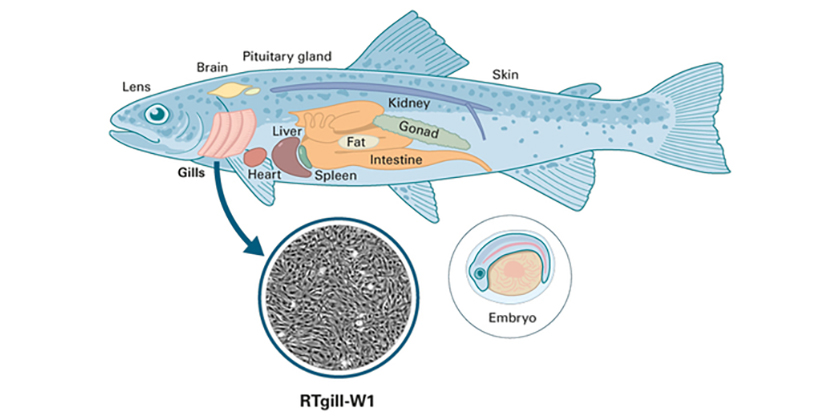

To date, thousands of fish are being used annually to perform toxicity tests needed to inform environmental risk assessment of chemicals. To reduce the use of animals, alternative (non-animal) toxicity testing methods need to be developed. In the project “Expanding the fish invitrome towards a modular, socio-technical framework for animal-free prediction of chemical toxicity to fish”, we work with permanent cell lines of fish origin, used as proxies to gauge fish organism’s responses to chemical exposure in vivo.

This project is part of the Swiss National Research Program (NRP) 79 “Advancing 3Rs – Animals, research and society”. It is led by Kristin Schirmer (Eawag, ETHZ, EPFL), an expert in fish cell toxicology, and a consortium of further experimental researchers (Ksenia Groh (Eawag) – environmental bioanalytics and proteomics; Colette vom Berg (Eawag) – molecular neurotoxicology) and social scientists (Bernhard Truffer (Eawag, Utrecht University) – technological innovation systems and transitions in urban infrastructures; Jarno Hoekman (Utrecht University) – science and innovation studies).

Earlier, Kristin Schirmer’s group developed an assay based on a cell line derived from rainbow trout gills, RTgill-W1, which was demonstrated to provide reliable predictions of acute toxicity for a large number of chemicals. In 2021, this assay was adopted by the OECD as the first-ever fish cell line-based alternative test for aquatic acute toxicity in fish (OECD Test Guideline 249). Based on this pioneering work, development of a multitude of further assays based on the same principle has been initiated, aiming to cover additional aspects relevant to environmental risk assessment. These include, for example, bioaccumulation, biotransformation, and organ-specific toxicity as well as neurotoxicity and molecular mechanism-based prediction of chronic toxicity outcomes. The latter two aspects are now being addressed in the “fish invitrome” project as well. In particular, the PhD project of Jessica Bertoli, supervised by Colette vom Berg, seeks to establish fish brain cell-based models for neurotoxicity assessment, while the PhD project of Mihai-Ovidiu Degeratu, supervised by Ksenia Groh, seeks to develop a protein marker panel for monitoring the mechanisms of action and progression of toxicity in fish cells.

In addition, since the process from method development to OECD adoption of the initial RTgill-W1 assay has taken more than a decade, this project also seeks to facilitate a faster regulatory uptake of similar fish cell-based assays. Specifically, we collaborate with social scientists and other stakeholders in order to implement a co-design process to develop a modular, computationally-linked framework that integrates several fish cell line-based modules which can be selected and combined in different ways depending on the chemical assessment purpose.

Further information on the individual projects comprising the NRP79-funded project consortium “expanding the fish invitrome for toxicity prediction” can be found at the respective links provided above.


Publications

Extbase Variable Dump
array(2 items)
   publications => '35005' (5 chars)
   libraryUrl => '' (0 chars)
Extbase Variable Dump
array(1 item)
   0 => Snowflake\Publications\Domain\Model\Publicationprototypepersistent entity (uid=35005, pid=124)
      originalId => protected35005 (integer)
      authors => protected'Revel, M.; Groh, K.; Bertoli, J.; Degeratu, M.-O.; Fisch
         er, M.; Fischer, S.; Hoekman, J.; Jozef, B.; Li, R.
         ; Mosimann, S. L.; vom Berg, C.; Županič, A.; Truffer,
          B.; Schirmer, K.
' (255 chars) title => protected'Development of the fish invitrome for animal-free environmental risk assessm
         ent of chemicals
' (92 chars) journal => protected'Environmental Toxicology and Chemistry' (38 chars) year => protected2025 (integer) volume => protected44 (integer) issue => protected'9' (1 chars) startpage => protected'2648' (4 chars) otherpage => protected'2658' (4 chars) categories => protected'new approach methodologies; rainbow trout cell lines; toxicity testing; soci
         o-technical approach; co-design with stakeholders
' (125 chars) description => protected'Given the need to reduce animal testing for environmental risk assessment, w
         e aim to develop a fish invitrome, an alternative fish modular framework cap
         able of predicting chemical toxicity in fish without the use of animals. The
          central module of the framework is the validated RTgill-W1 cell line assay
         that predicts fish acute toxicity of chemicals (Organisation for Economic Co
         -operation and Development test guideline 249). Expanding towards prediction
          of chronic toxicity, the fish invitrome includes two other well-advanced mo
         dules for chemical bioaccumulation/biotransformation and inhibition of fish
         growth. This framework is expected to continuously evolve with the developme
         nt of modules that predict, for instance, neurotoxicity and reproductive tox
         icity. We envisage the fish invitrome framework becoming part of the broader
          academic field of new approach methodologies (NAMs), where it will remain f
         lexible and open to integration of new developments from research groups aro
         und the world. To accelerate the development and uptake of this framework, w
         e strive for transdisciplinarity, integrating both natural and social scienc
         es, along with broader stakeholder interactions. A stepwise socio-technical
         approach was chosen, where mainstreaming the fish invitrome involves progres
         sive adoption across various ecotoxicological contexts. The framework will b
         e codesigned with stakeholders from academia, industry, and regulatory bodie
         s. Rather than aiming for immediate regulatory acceptance, this approach aim
         s to build trust and familiarity with fish cell line–based testing among s
         takeholders. By doing so, it encourages broader use of the framework in prac
         tical applications while gradually overcoming institutional, cultural, and t
         echnical barriers. Additionally, establishing a clear roadmap for mainstream
         ing the fish invitrome will help identify and address challenges to its upta
         ke, ensuring a smoother transition<br />to nonorganismal testing methodologi
         es.
' (1979 chars) serialnumber => protected'0730-7268' (9 chars) doi => protected'10.1093/etojnl/vgaf028' (22 chars) uid => protected35005 (integer) _localizedUid => protected35005 (integer)modified _languageUid => protectedNULL _versionedUid => protected35005 (integer)modified pid => protected124 (integer)
Revel, M.; Groh, K.; Bertoli, J.; Degeratu, M.-O.; Fischer, M.; Fischer, S.; Hoekman, J.; Jozef, B.; Li, R.; Mosimann, S. L.; vom Berg, C.; Županič, A.; Truffer, B.; Schirmer, K. (2025) Development of the fish invitrome for animal-free environmental risk assessment of chemicals, Environmental Toxicology and Chemistry, 44(9), 2648-2658, doi:10.1093/etojnl/vgaf028, Institutional Repository

Contact

Prof. Dr. Kristin Schirmer Group leader and deputy head of department Tel. +41 58 765 5266 Send Mail

Team members

Jessica Bertoli PhD Student Tel. +41 58 765 5364 Send Mail
Mihai-Ovidiu Degeratu PhD Student Tel. +41 58 765 5697 Send Mail
Dr. Ksenia Groh Group Leader Tel. +41 58 765 5182 Send Mail
Dr. Marion Revel Postdoctoral Scientist Tel. +41 58 765 6671 Send Mail
René Schönenberger Lab Technician Tel. +41 58 765 5105 Send Mail
Dr. Colette vom Berg Head of department Tel. +41 58 765 5535 Send Mail

In collaboration with

Prof. Dr. Bernhard Truffer Group leader, Group Cirus Tel. +41 58 765 5670 Send Mail
Panel will be used to monitor chemical-induced molecular responses and damage progression in fish cells to inform animal-free prediction of chemical toxicity.