PlastChem: State of the science on plastic chemicals
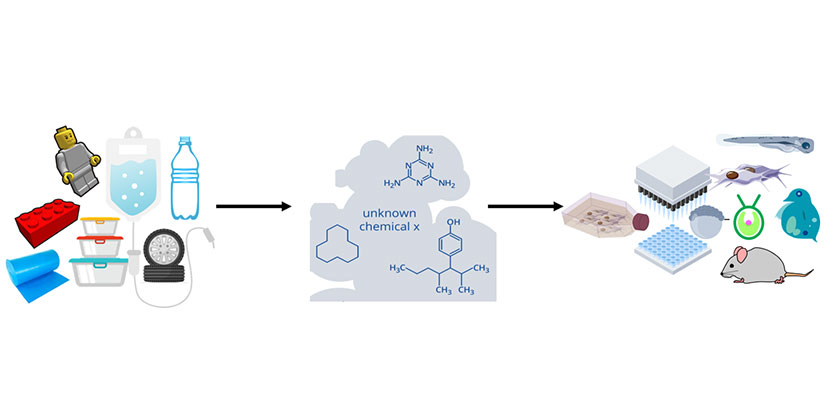
Workflow scheme for bioassay-based testing of plastic leachates (Photo: Ksenia Groh)
Throughout their life cycle, plastic materials and products can release diverse chemicals, many of which are known to be hazardous for human health and/or the environment, while others remain to be characterized for their hazards or even identity, as both can often be unknown. Within the PlastChem project, we produced a report, accompanied by a publicly accessible database, which synthesized the state of science on over 16’000 known plastic chemicals (see plastchem-project.org), covering their identities, hazard properties, and presence in different polymers. Published in 2024, these resources are now used to inform policy development, e.g., to support the UNEP’s work on international plastics treaty.
Despite our growing knowledge on plastic chemicals’ identity and hazards, chemical analytics-based individual assessment of all substances released from plastics remains unfeasible. Instead, assessment by means of bioassays, also referred to as effect-based testing, could provide an alternative approach for initial hazard assessment of chemicals in plastic leachates. Currently, we are working to compile a systematic evidence map aiming to understand, which types of toxicities or bioactivities have been measured for chemical mixtures released from different plastic materials and products.
array(4 items)0 => Snowflake\Publications\Domain\Model\Publicationprototypepersistent entity (uid=35131, pid=124)originalId => protected35131 (integer)
authors => protected'Hader, J. D.; Wagner, M.; Arp, H. P. H.; Groh, K. J.; Løseth, M. E.; Monclús, L.; Muncke, J.; Zimmermann, L.; Wang, Z.' (190 chars)
title => protected'A hazard-based approach enables the efficient identification of chemicals of concern in plastics' (96 chars)
journal => protected'Environmental Science and Technology' (36 chars)
year => protected2025 (integer)
volume => protected59 (integer)
issue => protected'31' (2 chars)
startpage => protected'16144' (5 chars)
otherpage => protected'16155' (5 chars)
categories => protected'Global Plastics Treaty; hazard-based approach; regrettable substitutions; ch emicals management; alternatives; hazardous chemicals' (129 chars)
description => protected'Plastics are composed of complex chemical mixtures, resulting in many chemic als being released during plastic’s life cycle, alongside a range of actua l or potential impacts on human health and the environment. Many plastic che micals also hinder technological solutions toward a safe and sustainable cir cular economy. Hence, there is broad agreement to address so-called plastic chemicals of concern, including under the Global Plastics Treaty. However, d ebate on how to identify such chemicals of concern is ongoing, particularly around whether their risk (and by extension, exposure) should be considered. In this perspective, we provide a review of the difficulties associated wit h understanding human and ecosystem exposure to and risks from plastic chemi cals. Based on this, we highlight benefits of applying a hazard-based approa ch for identifying plastic chemicals of concern in a timely manner, and argu e that additional consideration of exposure/risk would result in unjustified and costly delays, complications, and uncertainties, and therefore should n ot be required. A hazard-based approach to identifying plastic chemicals of concern would enable efficient action toward mitigating the impacts of plast ics on human health and the environment, and facilitate a transition to a sa fe and sustainable plastics economy.' (1328 chars)
serialnumber => protected'0013-936X' (9 chars)
doi => protected'10.1021/acs.est.5c02912' (23 chars)
uid => protected35131 (integer)
_localizedUid => protected35131 (integer)modified_languageUid => protectedNULL
_versionedUid => protected35131 (integer)modifiedpid => protected124 (integer)1 => Snowflake\Publications\Domain\Model\Publicationprototypepersistent entity (uid=34990, pid=124)originalId => protected34990 (integer)
authors => protected'Monclús, L.; Arp, H. P. H.; Groh, K. J.; Falt ynkova, A.; Løseth, M. E.; Muncke, J.; Wang, Z.; W olf, R.; Zimmermann, L.; Wagner, M.' (202 chars)
title => protected'Mapping the chemical complexity of plastics' (43 chars)
journal => protected'Nature' (6 chars)
year => protected2025 (integer)
volume => protected643 (integer)
issue => protected'8071' (4 chars)
startpage => protected'349' (3 chars)
otherpage => protected'355' (3 chars)
categories => protected'' (0 chars)
description => protected'Plastic pollution is a pervasive and growing global problem. Chemicals in pl astics are often not sufficiently considered in the overall strategy to prev ent and mitigate the impacts of plastics on human health, the environment an d circular economy. Here we present an inventory of 16,325 known plastic che micals with a focus on their properties, presence in plastic and hazards. We find that diverse chemical structures serve a small set of functions, inclu ding 5,776 additives, 3,498 processing aids, 1,975 starting substances and 1 ,788 non-intentionally added substances. Using a hazard-based approach, we i dentify more than 4,200 chemicals of concern, which are persistent, bioaccum ulative, mobile or toxic. We also determine 15 priority groups of chemicals, for which more than 40% of their members are of concern. Finally, we examin e data gaps regarding the basic properties, hazards, uses and exposure poten tial of plastic chemicals. Our work maps the chemical landscape of plastics and contributes to setting the baseline for a transition towards safer and m ore sustainable materials and products. We propose that removing known chemi cals of concern, disclosing the chemical composition and simplifying the for mulation of plastics can provide pathways towards this goal.' (1276 chars)
serialnumber => protected'0028-0836' (9 chars)
doi => protected'10.1038/s41586-025-09184-8' (26 chars)
uid => protected34990 (integer)
_localizedUid => protected34990 (integer)modified_languageUid => protectedNULL
_versionedUid => protected34990 (integer)modifiedpid => protected124 (integer)2 => Snowflake\Publications\Domain\Model\Publicationprototypepersistent entity (uid=33093, pid=124)originalId => protected33093 (integer)
authors => protected'Wagner, M.; Monclús, L.; Arp, H. P. H.; Groh,  ;K. J.; Løseth, M. E.; Muncke, J.; Wang, Z.; Wolf, R.; Zimmermann, L.' (181 chars)
title => protected'State of the science on plastic chemicals. Identifying and addressing chemic als and polymers of concern' (103 chars)
journal => protected'' (0 chars)
year => protected2024 (integer)
volume => protected0 (integer)
issue => protected'' (0 chars)
startpage => protected'' (0 chars)
otherpage => protected'' (0 chars)
categories => protected'' (0 chars)
description => protected'' (0 chars)
serialnumber => protected'' (0 chars)
doi => protected'10.5281/zenodo.10701706' (23 chars)
uid => protected33093 (integer)
_localizedUid => protected33093 (integer)modified_languageUid => protectedNULL
_versionedUid => protected33093 (integer)modifiedpid => protected124 (integer)3 => Snowflake\Publications\Domain\Model\Publicationprototypepersistent entity (uid=33196, pid=124)originalId => protected33196 (integer)
authors => protected'Brander, S. M.; Senathirajah, K.; Fernandez, M. O.; Weis, J. S.; Kumar, E.; Jahnke, A.; Hartmann, N.&n bsp;B.; Alava, J. J.; Farrelly, T.; Almroth, B. C.; Groh, K. J.; Syberg, K.; Buerkert, J. S.; Abeynaya ka, A.; Booth, A. M.; Cousin, X.; Herzke, D.; Moncl ús, L.; Morales-Caselles, C.; Bonisoli-Alquati, A.; Al-jaiba chi, R.; Wagner, M.' (485 chars)
title => protected'The time for ambitious action is now: Science-based recommendations for plas tic chemicals to inform an effective global plastic treaty' (134 chars)
journal => protected'Science of the Total Environment' (32 chars)
year => protected2024 (integer)
volume => protected949 (integer)
issue => protected'' (0 chars)
startpage => protected'174881 (11 pp.)' (15 chars)
otherpage => protected'' (0 chars)
categories => protected'global plastic treaty; microplastics; nanoplastics; transparency; human righ ts; source reduction' (96 chars)
description => protected'The ubiquitous and global ecological footprint arising from the rapidly incr easing rates of plastic production, use, and release into the environment is an important modern environmental issue. Of increasing concern are the risk s associated with at least 16,000 chemicals present in plastics, some of whi ch are known to be toxic, and which may leach out both during use and once e xposed to environmental conditions, leading to environmental and human expos ure. In response, the United Nations member states agreed to establish an in ternational legally binding instrument on plastic pollution, the global plas tics treaty. The resolution acknowledges that the treaty should prevent plas tic pollution and its related impacts, that effective prevention requires co nsideration of the transboundary nature of plastic production, use and pollu tion, and that the full life cycle of plastics must be addressed. As a group of scientific experts and members of the Scientists' Coalition for an Effec tive Plastics Treaty, we concur that there are six essential “pillars” n ecessary to truly reduce plastic pollution and allow for chemical detoxifica tion across the full life cycle of plastics. These include a plastic chemica l reduction and simplification, safe and sustainable design of plastic chemi cals, incentives for change, holistic approaches for alternatives, just tran sition and equitable interventions, and centering human rights. There is a c ritical need for scientifically informed and globally harmonized information , transparency, and traceability criteria to protect the environment and pub lic health. The right to a clean, healthy, and sustainable environment must be upheld, and thus it is crucial that scientists, industry, and policy make rs work in concert to create a future free from hazardous plastic contaminat ion.' (1828 chars)
serialnumber => protected'0048-9697' (9 chars)
doi => protected'10.1016/j.scitotenv.2024.174881' (31 chars)
uid => protected33196 (integer)
_localizedUid => protected33196 (integer)modified_languageUid => protectedNULL
_versionedUid => protected33196 (integer)modifiedpid => protected124 (integer)
A hazard-based approach enables the efficient identification of chemicals of concern in plastics
Plastics are composed of complex chemical mixtures, resulting in many chemicals being released during plastic’s life cycle, alongside a range of actual or potential impacts on human health and the environment. Many plastic chemicals also hinder technological solutions toward a safe and sustainable circular economy. Hence, there is broad agreement to address so-called plastic chemicals of concern, including under the Global Plastics Treaty. However, debate on how to identify such chemicals of concern is ongoing, particularly around whether their risk (and by extension, exposure) should be considered. In this perspective, we provide a review of the difficulties associated with understanding human and ecosystem exposure to and risks from plastic chemicals. Based on this, we highlight benefits of applying a hazard-based approach for identifying plastic chemicals of concern in a timely manner, and argue that additional consideration of exposure/risk would result in unjustified and costly delays, complications, and uncertainties, and therefore should not be required. A hazard-based approach to identifying plastic chemicals of concern would enable efficient action toward mitigating the impacts of plastics on human health and the environment, and facilitate a transition to a safe and sustainable plastics economy.
Hader, J. D.; Wagner, M.; Arp, H. P. H.; Groh, K. J.; Løseth, M. E.; Monclús, L.; Muncke, J.; Zimmermann, L.; Wang, Z. (2025) A hazard-based approach enables the efficient identification of chemicals of concern in plastics, Environmental Science and Technology, 59(31), 16144-16155, doi:10.1021/acs.est.5c02912, Institutional Repository
Mapping the chemical complexity of plastics
Plastic pollution is a pervasive and growing global problem. Chemicals in plastics are often not sufficiently considered in the overall strategy to prevent and mitigate the impacts of plastics on human health, the environment and circular economy. Here we present an inventory of 16,325 known plastic chemicals with a focus on their properties, presence in plastic and hazards. We find that diverse chemical structures serve a small set of functions, including 5,776 additives, 3,498 processing aids, 1,975 starting substances and 1,788 non-intentionally added substances. Using a hazard-based approach, we identify more than 4,200 chemicals of concern, which are persistent, bioaccumulative, mobile or toxic. We also determine 15 priority groups of chemicals, for which more than 40% of their members are of concern. Finally, we examine data gaps regarding the basic properties, hazards, uses and exposure potential of plastic chemicals. Our work maps the chemical landscape of plastics and contributes to setting the baseline for a transition towards safer and more sustainable materials and products. We propose that removing known chemicals of concern, disclosing the chemical composition and simplifying the formulation of plastics can provide pathways towards this goal.
Monclús, L.; Arp, H. P. H.; Groh, K. J.; Faltynkova, A.; Løseth, M. E.; Muncke, J.; Wang, Z.; Wolf, R.; Zimmermann, L.; Wagner, M. (2025) Mapping the chemical complexity of plastics, Nature, 643(8071), 349-355, doi:10.1038/s41586-025-09184-8, Institutional Repository
Wagner, M.; Monclús, L.; Arp, H. P. H.; Groh, K. J.; Løseth, M. E.; Muncke, J.; Wang, Z.; Wolf, R.; Zimmermann, L. (2024) State of the science on plastic chemicals. Identifying and addressing chemicals and polymers of concern, doi:10.5281/zenodo.10701706, Institutional Repository
The time for ambitious action is now: Science-based recommendations for plastic chemicals to inform an effective global plastic treaty
The ubiquitous and global ecological footprint arising from the rapidly increasing rates of plastic production, use, and release into the environment is an important modern environmental issue. Of increasing concern are the risks associated with at least 16,000 chemicals present in plastics, some of which are known to be toxic, and which may leach out both during use and once exposed to environmental conditions, leading to environmental and human exposure. In response, the United Nations member states agreed to establish an international legally binding instrument on plastic pollution, the global plastics treaty. The resolution acknowledges that the treaty should prevent plastic pollution and its related impacts, that effective prevention requires consideration of the transboundary nature of plastic production, use and pollution, and that the full life cycle of plastics must be addressed. As a group of scientific experts and members of the Scientists' Coalition for an Effective Plastics Treaty, we concur that there are six essential “pillars” necessary to truly reduce plastic pollution and allow for chemical detoxification across the full life cycle of plastics. These include a plastic chemical reduction and simplification, safe and sustainable design of plastic chemicals, incentives for change, holistic approaches for alternatives, just transition and equitable interventions, and centering human rights. There is a critical need for scientifically informed and globally harmonized information, transparency, and traceability criteria to protect the environment and public health. The right to a clean, healthy, and sustainable environment must be upheld, and thus it is crucial that scientists, industry, and policy makers work in concert to create a future free from hazardous plastic contamination.
Brander, S. M.; Senathirajah, K.; Fernandez, M. O.; Weis, J. S.; Kumar, E.; Jahnke, A.; Hartmann, N. B.; Alava, J. J.; Farrelly, T.; Almroth, B. C.; Groh, K. J.; Syberg, K.; Buerkert, J. S.; Abeynayaka, A.; Booth, A. M.; Cousin, X.; Herzke, D.; Monclús, L.; Morales-Caselles, C.; Bonisoli-Alquati, A.; Al-jaibachi, R.; Wagner, M. (2024) The time for ambitious action is now: Science-based recommendations for plastic chemicals to inform an effective global plastic treaty, Science of the Total Environment, 949, 174881 (11 pp.), doi:10.1016/j.scitotenv.2024.174881, Institutional Repository