
Department Water Resources and Drinking Water
Prediction of global recharge
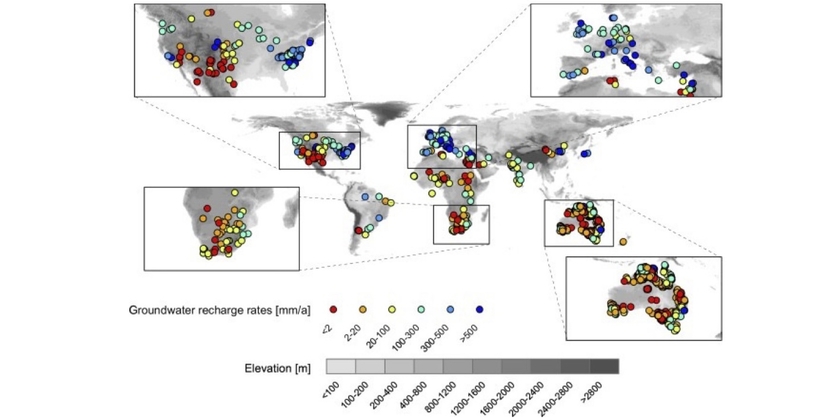
Groundwater recharge is a critical but highly variable component of the global freshwater cycle and a key determinant of groundwater resilience to climate change. Recent advances show that recharge responds nonlinearly to infiltration variability, long-term aridity shifts, and surface–subsurface flux interactions across monthly to decadal timescales. This project builds on global recharge datasets and modeling approaches to systematically quantify how groundwater recharge responds to climate variability and change worldwide. By integrating large-scale observational datasets with parsimonious modeling frameworks, the project will assess groundwater sensitivity to short-term extremes (e.g. droughts and wet periods) and long-term climatic trends. A central focus is to identify regions where recharge is most vulnerable to increasing aridity and where groundwater systems are tightly coupled to surface hydrological fluxes. The outcomes improve global understanding of groundwater–climate interactions, enable comparative analyses across hydroclimatic regimes, and provide a scientific basis for forecasting groundwater availability under future climate conditions. Ultimately, the project supports evidence-based groundwater management and climate adaptation strategies at regional to global scales.

Team
The project was carried out by an interdisciplinary and highly international research team, involving scientists from multiple departments and research institutions with expertise in groundwater hydrology, climate science, and hydrogeology. Details on the project team and international collaborators can be found in the associated peer-reviewed publications resulting from this project.
Partners
The project was developed through extensive international collaboration. This global network enabled the integration of diverse data sources, methods, and perspectives, and ensured broad scientific relevance and applicability of the results.
Publications
- Moeck, C., Collenteur, R. A., Berghuijs, W. R., Luijendijk, E., & Gurdak, J. J. (2024). A global assessment of groundwater recharge response to infiltration variability at monthly to decadal timescales. Water Resources Research, 60(6), e2023WR035828.
- Berghuijs, W. R., Collenteur, R. A., Jasechko, S., Jaramillo, F., Luijendijk, E., Moeck, C., ... & Allen, S. T. (2024). Groundwater recharge is sensitive to changing long-term aridity. Nature Climate Change, 14(4), 357-363.
- Berghuijs, W. R., Luijendijk, E., Moeck, C., van der Velde, Y., & Allen, S. T. (2022). Global recharge data set indicates strengthened groundwater connection to surface fluxes. Geophysical Research Letters, 49(23), e2022GL099010.
- Moeck, C., Grech-Cumbo, N., Podgorski, J., Bretzler, A., Gurdak, J. J., Berg, M., & Schirmer, M. (2020). A global-scale dataset of direct natural groundwater recharge rates: A review of variables, processes and relationships. Science of the total environment, 717, 137042.