Department Water Resources and Drinking Water
Risk mapping of arsenic and trace elements
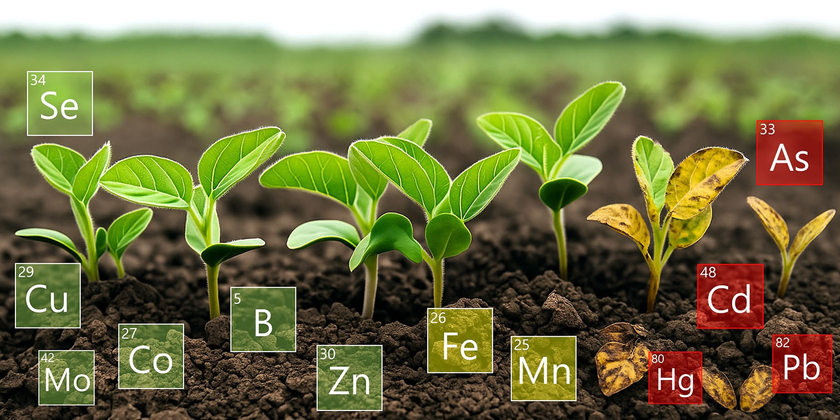
Soils constitute a reactive interface between lithosphere and living systems, mediating the cycling of diverse trace elements. Micronutrients such as Fe, Zn, B, Cu, Se, Mo, Co, Mn, etc., facilitate key metabolic pathways and contribute to biological productivity and nutritional quality. In contrast, naturally occurring toxic elements such as As, Pb, Cd, Cr, etc., may be retained or mobilized through mineral–fluid interactions, creating pathways of exposure that can degrade ecosystem function and human well-being.
Arsenic originating from parent lithologies may accumulate in surface soils and enter trophic pathways, generating food-safety concerns. Other harmful elements can persist in the soil matrix due to low solubility and strong sorption to mineral surfaces, resulting in prolonged environmental exposure. In contrast, the progressive depletion of essential micronutrients reduces soil fertility and biological productivity. Marginal deficiencies in Fe, Zn, or Mo, even without visible symptoms, can suppress growth, yield, and nutrient density.
Collectively, these dynamics illustrate two interdependent pressures on soil systems: geogenic enrichment of toxic constituents threatens public and ecological health, whereas micronutrient decline constrains agricultural sustainability. Clarifying their spatial patterns and lithological controls is fundamental for maintaining soil functionality and food-system resilience.
Geogenic Arsenic in European Topsoil
Arsenic naturally occurs in trace amounts in most soils, but under certain geological conditions, it can accumulate to concentrations of concern. Across Europe, elevated levels are typically driven by mineral-rich parent material, limited erosion, and long-term weathering processes. Such enrichment is not uniform but develops in distinct geochemical zones shaped by landscape evolution.
A continental-scale probability map identified areas where topsoil arsenic exceeds a commonly used threshold of 20 mg/kg. Approximately 11.7% of grassland and 3.9% of cropland fall into this category. These enriched zones are most extensive in regions such as France, Spain, and the Western Balkans. Rather than being widespread, they are spatially limited and concentrated in areas with particular mineralogical and topographic characteristics.
Soil properties such as texture, drainage capacity, and organic-matter content influence arsenic retention and mobility. Although the presence of arsenic in topsoil does not directly indicate food-system risk, it may warrant attention where certain crops or soil conditions could enhance uptake. Identifying and delineating these geogenic hazard zones supports informed land management and risk-based soil assessment.
Trace Elements in Soil
Trace elements constitute a critical component of soil geochemistry, influencing biogeochemical cycles, plant metabolism, and the nutritional composition of agricultural outputs. While some trace elements present toxicological risks at elevated concentrations, many function as essential micronutrients required for enzymatic activity, physiological development, and reproductive success in crops. Their absence or insufficiency, often undetected by conventional soil diagnostics, can impair productivity and compromise food quality without producing clear symptoms.
Micronutrient limitations are not randomly distributed; they are shaped by the interaction of mineralogical composition, pedogenic processes, and climatic regimes. Soils derived from nutrient-poor parent materials, or subjected to intense leaching or elevated alkalinity, commonly exhibit constrained micronutrient bioavailability despite adequate macronutrient levels. These geochemical conditions silently constrain crop yield potential and nutrient density, particularly in intensively cultivated regions.
Current work focuses on spatially explicit identification of single and co-occurring micronutrient deficiencies using integrated geochemical and environmental datasets. Emerging patterns support a more nuanced understanding of soil fertility that extends beyond traditional nutrient frameworks. Addressing trace-element scarcity at landscape scale offers an opportunity to strengthen soil health management, food-system resilience, and the nutritional quality of agricultural products.