Archive detail

Better understanding of innovation dynamics

August 4, 2022 | Ori Schipper

25 years ago, urine-diverting toilets were no more than an idea, challenging the central paradigm of wastewater treatment plants. Since then, however, modular water technologies have become increasingly important. Using a new method, scientists at Eawag have mapped the dynamics of this transition.

“For a long time, the collection of wastewater at treatment plants was the central paradigm for urban water management in Switzerland, even though the sewer system accounts for 80 per cent of the total costs, with only a fifth of the money actually being spent on treating wastewater,” says Bernhard Truffer, Head of Eawag’s Environmental Social Sciences department and Professor at the University of Utrecht. “The assumption that this is the best solution is increasingly being called into question.”

Visualising links among concepts

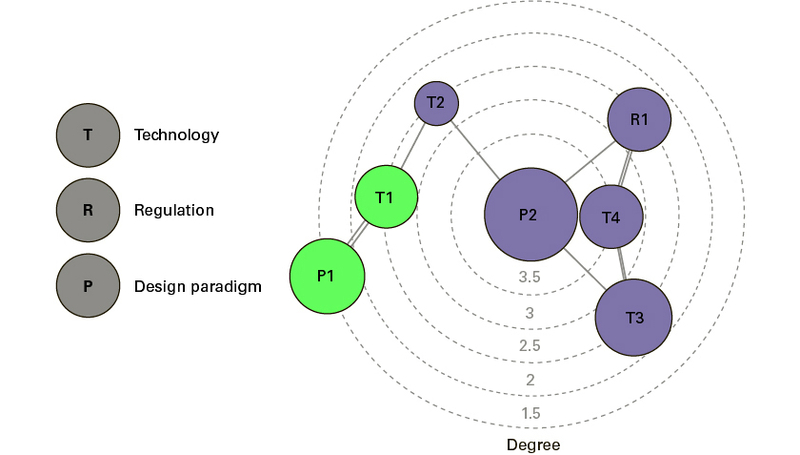
Of growing importance as a possible alternative are what are known as modular water technologies. In Switzerland, 25 years ago, an initial publication by Eawag researchers on urine-diverting toilets helped to launch a sector in which, today, important roles are played not only by a number of start-ups but also by international actors such as the Bill & Melinda Gates Foundation (BMGF). This shift has now been mapped by Jonas Heiberg, Christian Binz and Professor Bernhard Truffer on the basis of interviews with experts, using a new methodological framework developed by the research team: while “socio-technical configuration analysis” may sound as complicated as the graphs of interconnected circles at first glance appear, these networks essentially visualise which actors support similar concepts – and the ties that link them.

Mediating between opposing camps

“Environment-oriented actors find urine source separation attractive, as it is compatible with low-tech processes such as the composting of faecal sludge,” Truffer’s team reports. “But the BMGF – due to a corporate culture based on software development – has always favoured high-tech solutions.” It was only when water experts collaborated with a design team – and proposed a significantly improved toilet design which is also compatible with high-tech treatment – that the BMGF recognised the commercial potential of urine source separation. “This dual orientation made it possible for the experts to mediate increasingly between the opposing camps.”
 

Cover picture: Represented in this network are the concepts of technology (T), regulation (R) and design paradigm (P) associated with wastewater treatment plants (violet) and with urine source separation (green). Located at the centre are established technologies, while new technologies are more peripheral. The larger a node is, the more actors support the concept concerned. (Graphic: Jonas Heiberg et al., Elsevier B.V.)

Original publication

Extbase Variable Dump
array(2 items)
   publications => '23625' (5 chars)
   libraryUrl => '' (0 chars)
Extbase Variable Dump
array(1 item)
   0 => Snowflake\Publications\Domain\Model\Publicationprototypepersistent entity (uid=23625, pid=124)
      originalId => protected23625 (integer)
      authors => protected'Heiberg, J.; Truffer, B.; Binz, C.' (49 chars)
      title => protected'Assessing transitions through socio-technical configuration analysis – a m
         ethodological framework and a case study in the water sector
' (136 chars) journal => protected'Research Policy' (15 chars) year => protected2022 (integer) volume => protected51 (integer) issue => protected'1' (1 chars) startpage => protected'104363 (19 pp.)' (15 chars) otherpage => protected'' (0 chars) categories => protected'socio-technical configuration analysis; geography of transitions; socio-tech
         nical alignments; discourse; modular water technologies
' (131 chars) description => protected'Classic accounts of transitions research have predominantly built on reconst
         ructions of historical transition processes and in-depth case studies to ide
         ntify and conceptualize socio-technical change. While such approaches have s
         ubstantively improved our understanding of transitions, they often suffer fr
         om methodological nationalism and a lack of generalizability beyond spatial
         and sectoral boundaries. To address this gap, we propose a novel methodology
          – socio-technical configuration analysis (STCA) – to map and measure so
         cio-technical alignment processes across time and space. STCA provides a con
         figurational and dynamic perspective on how social and technical elements ge
         t aligned into "configurations that work", allowing for the identification o
         f differentiated transition trajectories at and across spatial and sectoral
         contexts. The methodology's value is illustrated with the empirical case of
         an ongoing shift from centralized to more modular infrastructure configurati
         ons in the global water sector. Building on this illustration, we outline po
         tential contributions of STCA to configurational theorizing in transition st
         udies, sketching the contours of what we believe could become a generative e
         pistemological approach for this field.
' (1255 chars) serialnumber => protected'0048-7333' (9 chars) doi => protected'10.1016/j.respol.2021.104363' (28 chars) uid => protected23625 (integer) _localizedUid => protected23625 (integer)modified _languageUid => protectedNULL _versionedUid => protected23625 (integer)modified pid => protected124 (integer)
Heiberg, J.; Truffer, B.; Binz, C. (2022) Assessing transitions through socio-technical configuration analysis – a methodological framework and a case study in the water sector, Research Policy, 51(1), 104363 (19 pp.), doi:10.1016/j.respol.2021.104363, Institutional Repository

Funding / Cooperations

  • Eawag
  • Universität Utrecht, Niederlande
  • Universität Lund, Schweden