Archive detail

High-speed evolution observed in daphnia

October 8, 2019 | Irene Bättig

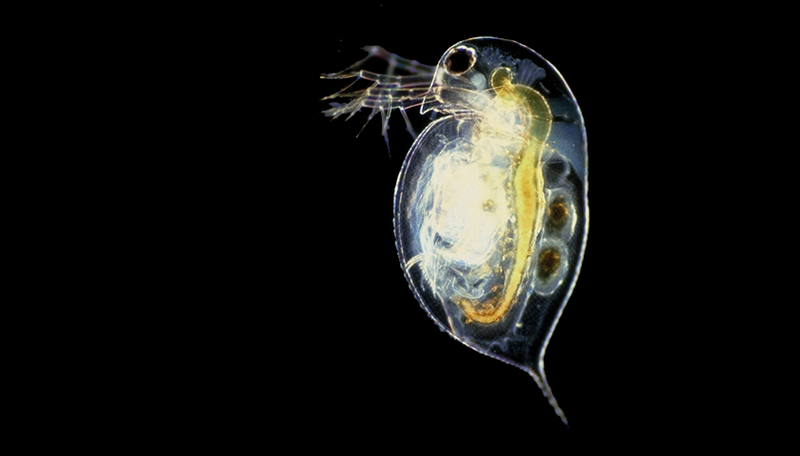
Daphnia can adapt rapidly to changing environmental conditions. This was shown by a study carried out by scientists from Eawag and Cornell University in Oneida Lake (NY, US). This adaptation influences daphnia population density, thus affecting the entire lake food web.

Daphnia, also known as water fleas, play an important role in the food web of lakes: they feed on phytoplankton and are eaten by predators such as fish. Their food resources show marked seasonal variation: in eutrophic waters, the summer is particularly challenging for daphnia, as the phytoplankton community is dominated by cyanobacteria (blue-green algae), which are of poor nutritional quality and often contain toxins.

Adaptation on a short time scale

Certain daphnia genotypes are known to be resistant to dietary cyanobacteria. These would therefore be expected to reproduce more effectively in eutrophic lakes, and in an earlier study in Lake Constance natural selection of this kind was indeed observed over a period of several years. Researchers from Eawag and Cornell University now wished to investigate how rapidly this adaptation occurs. Their study, which began with the collection of samples from Oneida Lake in 2015, was recently completed while Cornell-based project leader Nelson Hairston Jr. was on sabbatical at Eawag.

According to Lynn Govaert, a researcher at Eawag’s Aquatic Ecology department and Zurich University, “We showed that daphnia respond within a single season to changes in the food available, with the resistant genotypes becoming more abundant; in other words, evolution can proceed very rapidly.”

Increased frequency due to adaptation

Although, on a diet containing cyanobacteria, the resistant daphnia were also found to have a somewhat lower growth rate than on a typical spring diet, it was higher than that seen in the more sensitive genotypes, whose growth rate declined sharply in the summer. Consequently, the resistant genotypes dominated the daphnia population in the late summer. “Using models,” Govaert adds, “we also demonstrated that, without this evolutionary adaptation, the daphnia population in Oneida Lake would have been much smaller in the late summer.” Food resources for fish would also have been reduced as a result.

Repeated annual pattern

Over the longer term, there will probably be no change in the composition of the daphnia community, at least as long as the cycle begins again each spring and seasonal variation in food availability follows the same annual pattern.

While the aim of the study, as Govaert stresses, was to explore consumer-resource dynamics in Oneida Lake, she is still prepared to venture a hypothesis: “Climate change can also influence lake ecology, and our findings suggest that daphnia could adapt to those changes, too.”

Original publication

Extbase Variable Dump
array(2 items)
   publications => '19079' (5 chars)
   libraryUrl => '' (0 chars)
Extbase Variable Dump
array(1 item)
   0 => Snowflake\Publications\Domain\Model\Publicationprototypepersistent entity (uid=19079, pid=124)
      originalId => protected19079 (integer)
      authors => protected'Schaffner, L. R.; Govaert, L.; De Meester, L.; Ellner,&n
         bsp;S. P.; Fairchild, E.; Miner, B. E.; Rudstam, L.
          G.; Spaak, P.; Hairston, N. G. J.
' (211 chars) title => protected'Consumer-resource dynamics is an eco-evolutionary process in a natural plank
         ton community
' (89 chars) journal => protected'Nature Ecology & Evolution' (26 chars) year => protected2019 (integer) volume => protected3 (integer) issue => protected'9' (1 chars) startpage => protected'1351' (4 chars) otherpage => protected'1358' (4 chars) categories => protected'' (0 chars) description => protected'When traits affecting species interactions evolve rapidly, ecological dynami
         cs can be altered while they occur. These eco-evolutionary dynamics have bee
         n documented repeatedly in laboratory and mesocosm experiments. We show here
          that they are also important for understanding community functioning in a n
         atural ecosystem. <em>Daphnia</em> is a major planktonic consumer influencin
         g seasonal plankton dynamics in many lakes. It is also sensitive to successi
         on in its phytoplankton food, from edible algae in spring to relatively ined
         ible cyanobacteria in summer. We show for <em>Daphnia mendotae</em> in Oneid
         a Lake, New York, United States, that within-year ecological change in phyto
         plankton (from spring diatoms, cryptophytes and greens to summer cyanobacter
         ia) resulted in consumers evolving increasing tolerance to cyanobacteria ove
         r time. This evolution fed back on ecological seasonal changes in population
          abundance of this major phytoplankton consumer. Oneida Lake is typical of m
         esotrophic lakes broadly, suggesting that eco-evolutionary consumer-resource
          dynamics is probably common.
' (1093 chars) serialnumber => protected'' (0 chars) doi => protected'10.1038/s41559-019-0960-9' (25 chars) uid => protected19079 (integer) _localizedUid => protected19079 (integer)modified _languageUid => protectedNULL _versionedUid => protected19079 (integer)modified pid => protected124 (integer)
Schaffner, L. R.; Govaert, L.; De Meester, L.; Ellner, S. P.; Fairchild, E.; Miner, B. E.; Rudstam, L. G.; Spaak, P.; Hairston, N. G. J. (2019) Consumer-resource dynamics is an eco-evolutionary process in a natural plankton community, Nature Ecology & Evolution, 3(9), 1351-1358, doi:10.1038/s41559-019-0960-9, Institutional Repository