Archive detail

Keeping track of fragrances

March 14, 2019 | Stephanie Schnydrig

A new device developed at Eawag now allows Scientists to determine whether, and to what extent, fragrances in the environment are absorbed in fish without using animals. This is possible thanks to the use of a mirror-polished stainless steel chamber and a permeable membrane with a layer of intestinal fish cells.

Fragrances are added in a wide variety of consumer products – cosmetics, detergents, cleaning agents, and air fresheners. If incompletely eliminated in wastewater treatment plants, they can end up in rivers and lakes. Companies are therefore required to perform an environmental risk assessment before fragrance compounds are used in final products. One important test parameter is the accumulation of substances in fish. However, the properties of fragrances make them difficult to test: some may readily stick to surfaces and they are by design volatile so that we can smell them. “This means,” says biologist Hannah Schug, PhD student in the Environmental Toxicology department led by Kristin Schirmer, “that, during the experiments, fragrances virtually dissipate.”

An intestinal epithelial cell line serving as a barrier

For this reason, Hannah Schug designed a novel test system in collaboration with a leading fragrance company. The device – the size of a small Rubik’s cube – has an inner surface made of polished-mirror stainless steel to reduce losses due to the compounds’ stickiness, and an air-tight lid to minimize evaporation. The system, called TransFEr chamber, consists of an upper and a lower compartment separated by a cellular barrier. This barrier is comprised of fish intestinal epithelial cells representing the intestinal epithelium as a “gatekeeper” in fish. The exposure solution is added to the upper compartment, and measurements are made in the lower compartment to determine the rate of transfer across the intestinal cells. The results indicate to what extent compounds – in this case fragrances – can be absorbed by the intestine to be accumulated or to be transformed in fish.
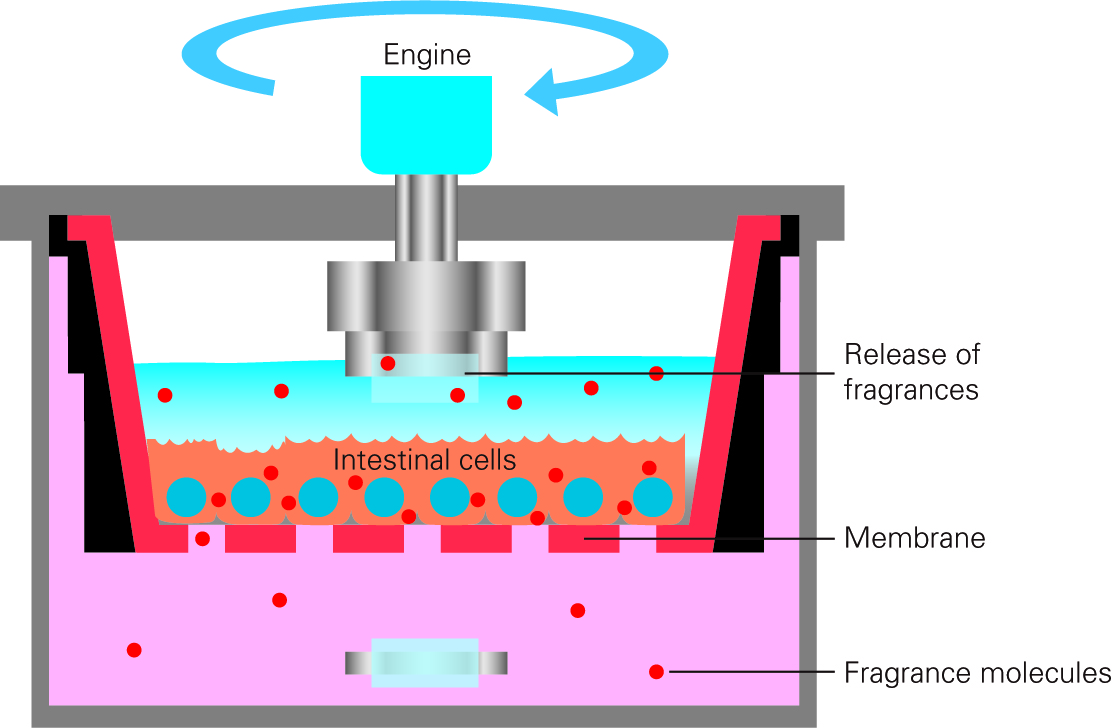
The TransFEr chamber has the size of a small Rubik’s cube.
(Source. Schug et al., 2018)

Potential benefits for pharmaceutical research

As well as being useful for environmental toxicologists, the device developed by Hannah Schug is likely to prove valuable in the future in other fields of research – for example, in human toxicology and pharmacology. Pharmaceutical companies already use human cell lines to determine the intestinal absorption of active medical substances. However, when such substances have challenging properties similar to those of fragrances, they are difficult to test. Schug explains: “With our device, this would now be possible. Whenever it would be demonstrated that a certain substance is unable to cross the human intestinal barrier in the cell-based TransFEr system, one could recommend that animal tests may not even be needed anymore.” Cell-based assays thus have the potential to reduce and perhaps even replace animal experiments in environmental and medical research.

Research efforts to avoid animal experiments

Science and regulation relies on animal experiments to determine the toxicity and accumulation potential of chemical substances. The team led by Kristin Schirmer is working on alternatives to animal testing by developing experimental and theoretical tools designed to reduce or even replace animal experiments for environmental risk assessment in the future.

Original publication

Extbase Variable Dump
array(2 items)
   publications => '17228' (5 chars)
   libraryUrl => '' (0 chars)
Extbase Variable Dump
array(1 item)
   0 => Snowflake\Publications\Domain\Model\Publicationprototypepersistent entity (uid=17228, pid=124)
      originalId => protected17228 (integer)
      authors => protected'Schug, H.; Begnaud, F.; Debonneville, C.; Berthaud, F.; 
         Gimeno, S.; Schirmer, K.
' (110 chars) title => protected'TransFEr: a new device to measure the transfer of volatile and hydrophobic o
         rganic chemicals across an <i>in vitro</i> intestinal fish cell barrier
' (147 chars) journal => protected'Analytical Methods' (18 chars) year => protected2018 (integer) volume => protected10 (integer) issue => protected'36' (2 chars) startpage => protected'4394' (4 chars) otherpage => protected'4403' (4 chars) categories => protected'' (0 chars) description => protected'Transfer of compounds across cellular barriers is a critical step of compoun
         d uptake into organisms. Using <i>in vitro</i> barrier systems to evaluate s
         uch transfer is attractive because of the higher throughput and reduced reso
         urce needs compared to animal studies. Thus far, however, studying the trans
         fer of hydrophobic and volatile compounds was hampered by the unavailability
          of <i>in vitro</i> exposure systems that allow for stable and predictable c
         hemical exposure concentrations. To overcome this limitation, we constructed
          a novel exposure chamber, TransFEr, and tested it with an <i>in vitro</i> e
         pithelial barrier model using the rainbow trout (<i>Oncorhynchus mykiss</i>)
          intestinal cell line, RTgutGC. Key features of the chamber are its closed d
         esign and rotatable silicon segments, which can serve for chemical dosing an
         d sampling. Using the fragrance damascone beta (log <i>K</i><sub>OW</sub>:
          3.7, log HLC: −3.9) as a pilot chemical, we were able to demonstrate th
         at our exposure chamber provides for stable chemical exposure concentrations
          and full mass balance. The RTgutGC epithelium served as barrier for damasco
         ne beta transfer, which we attribute to chemical retention and biotransforma
         tion in the intestinal cells. Nevertheless, substantial transfer of the chem
         ical across the epithelium occurred. When a chemical sink, i.e. a silicon se
         gment, was included in the basolateral chamber to mimic blood constituents b
         inding <i>in vitro</i>, transfer was about three-fold enhanced. We suggest t
         hat the presented methodology can help to obtain insights into chemical upta
         ke mechanisms via the intestinal or other epithelia of fish and other animal
         s for hydrophobic and volatile chemicals.
' (1713 chars) serialnumber => protected'1759-9660' (9 chars) doi => protected'10.1039/C8AY01253A' (18 chars) uid => protected17228 (integer) _localizedUid => protected17228 (integer)modified _languageUid => protectedNULL _versionedUid => protected17228 (integer)modified pid => protected124 (integer)
Schug, H.; Begnaud, F.; Debonneville, C.; Berthaud, F.; Gimeno, S.; Schirmer, K. (2018) TransFEr: a new device to measure the transfer of volatile and hydrophobic organic chemicals across an in vitro intestinal fish cell barrier, Analytical Methods, 10(36), 4394-4403, doi:10.1039/C8AY01253A, Institutional Repository