Archive detail

Otto Jaag Prize for Wenzel Gruber and Urs Schönenberger

Eawag researchers Wenzel Gruber and Urs Schönenberger have won this year's Otto Jaag Water Protection Prize for their dissertations. Reducing emissions of the climate-damaging nitrous oxide from wastewater treatment plants and reducing the leaching of pesticides from drainage systems are the topics.

Nitrous oxide (N2O) is released in the biological treatment stage of wastewater treatment plants (WWTPs), specifically during nitrogen elimination. Depending on the season, type of operation and quality of management, the amount of climate-damaging gas escaping can vary greatly. Moreover, elevated nitrous oxide levels often indicate indirectly that the treated wastewater contains too much nitrite, a fish toxin.
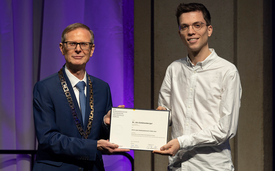
 

Award of the Otto Jaag Water Protection Prize 2022 to Urs Schönenberger by ETH Rector Günther Dissertori
(Photo: ETH, Nicola Pitaro)
 

N2O: Monitoring and process understanding important

Good monitoring of nitrous oxide - which is not technically trivial - and reliable knowledge of the processes involved are thus very important for optimal operation of WWTPs. At Eawag, environmental engineer Wenzel Gruber has been working intensively on these issues in several long-term measurement campaigns, for which he has now been awarded the Otto Jaag Water Protection Prize. The dissertation was supervised, among others, by Prof. Eberhard Morgenroth, Head of the Engineering Department at Eawag. Gruber's work is of great importance for both research and practice, says Morgenroth. This extends, he says, to new methods for taking more precise account of nitrous oxide emissions in greenhouse gas balances in Switzerland or other countries. In addition, says Morgenroth, the work forms a basis for efficiently achieving the legally required increase in nitrogen elimination at wastewater treatment plants.

Prize winner Gruber is pleased about the recognition of his work, even if the prize money of 750 Swiss francs is very modest. In future, initially in parallel with his research work at Eawag, he intends to set up a new company to advise WWTPs and cantons on nitrous oxide issues and to carry out measurement campaigns.
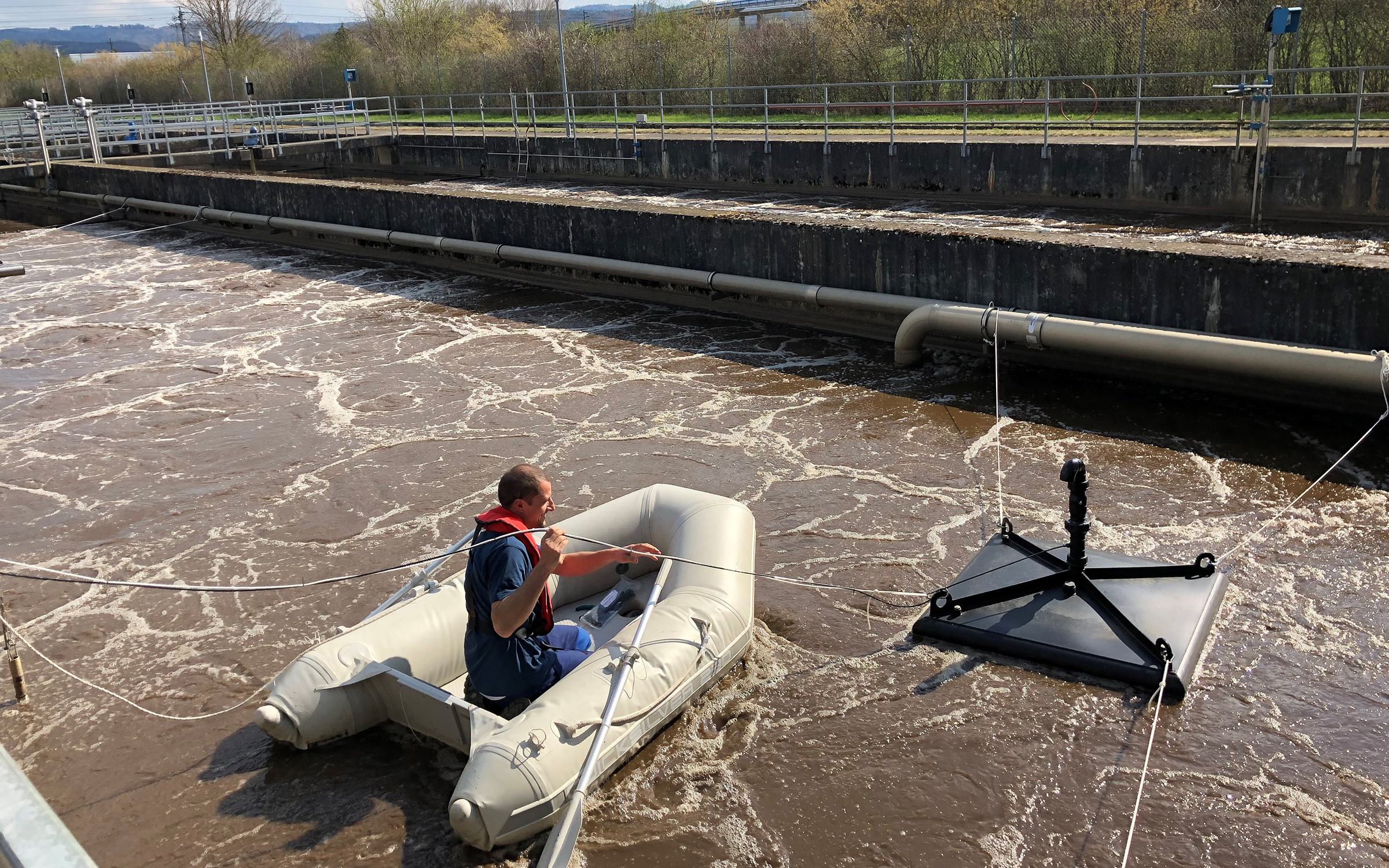
 

Eawag researcher Wenzel Gruber during maintenance work on the measuring installation at the Moossee Urtenenbach WWTP.
(Photo: Andrin Moosmann, Eawag)

Overlooked pathway for pesticides

The second award-winning doctoral thesis can also claim to be of great practical significance. In it, its author, environmental engineer Urs Schönenberger, shows how "short-circuits", for example inlet manholes, in agricultural drainage systems lead to the unintentional release of pesticides into waterbodies. It's a pathway that has received little attention in previous discussions of pesticides. "The issue is highly relevant both politically and scientifically, since pesticides are among the most important eco- and human-toxicological problem substances," says Prof. Max Maurer (ETH and Eawag), who co-supervised Schönenberger's dissertation. In his work, Schönenberger combined field, modeling and laboratory work with partly original approaches and finally presented quantitative results that are of importance for the whole of Switzerland, says Maurer. And the work not only shows "grievances": Schönenberger has systematically compiled possible countermeasures - these are valuable foundations for practice and for policy measures.

We congratulate both winners on the award, which was presented on Saturday, November 19, 2022 on the occasion of ETH Day.
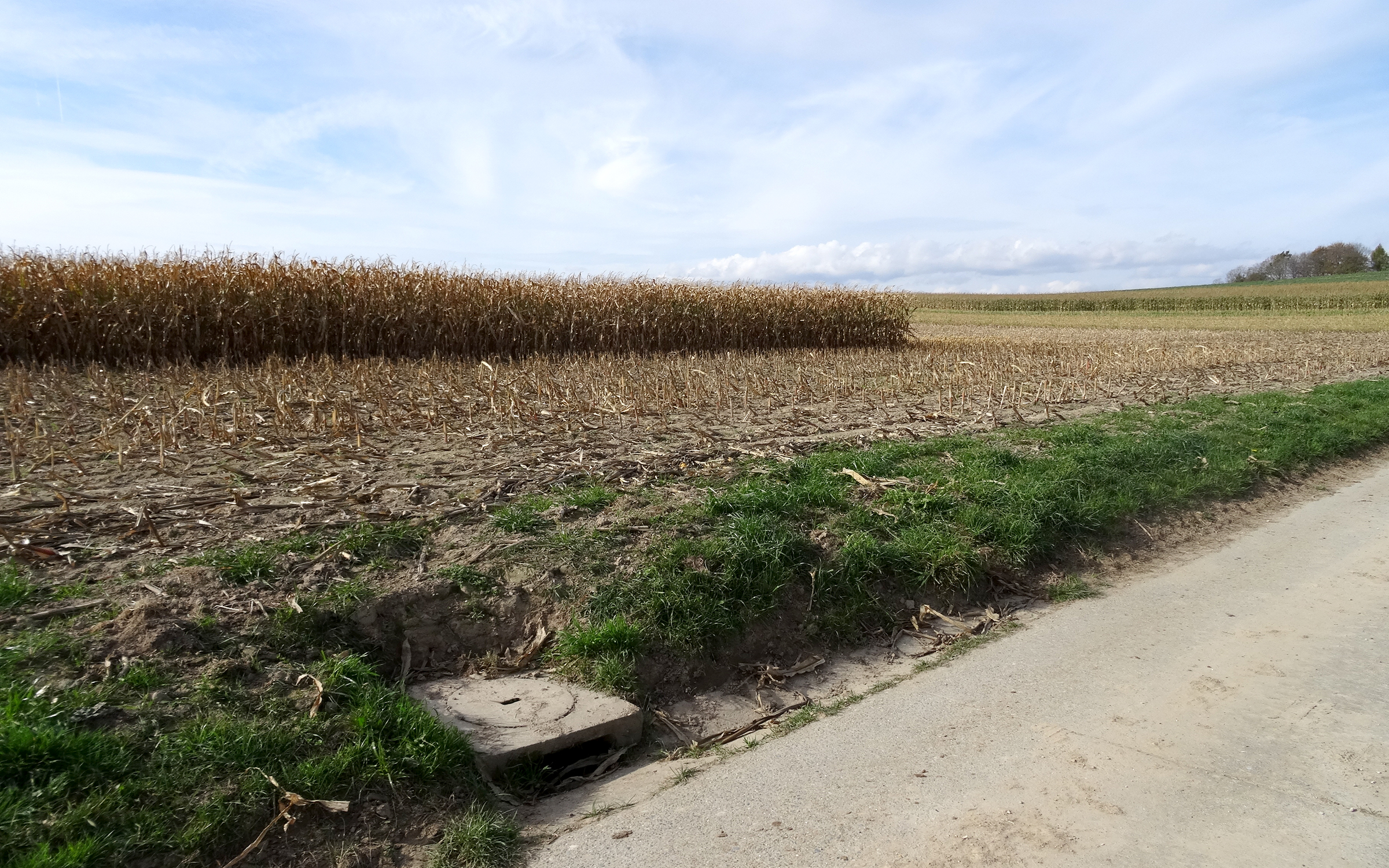
 

Inlets of this type allow water from fields and field paths to flow directly into the nearest watercourse - a hydraulic short-circuit.
(Photo: Eawag, Urs Schönenberger)


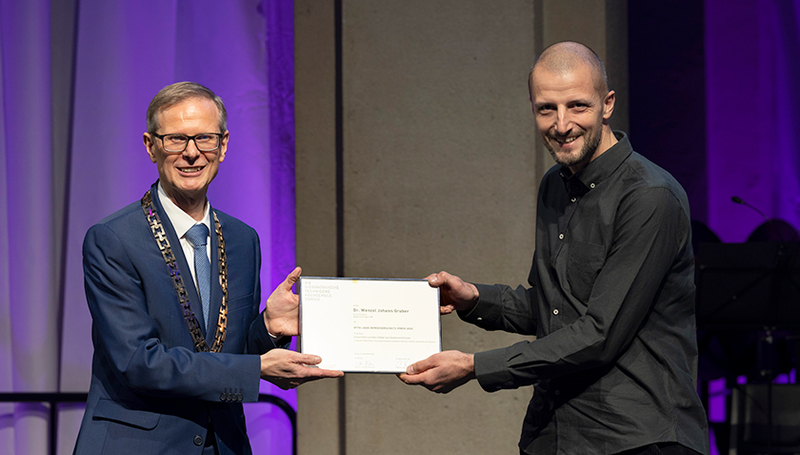
Cover picture: Award of the Otto Jaag Water Protection Prize 2022 to Wenzel Gruber by ETH Rector Günther Dissertori. (Photo: ETH, Nicola Pitaro)
 

Original publications

Extbase Variable Dump
array(2 items)
   publications => '24570,24685' (11 chars)
   libraryUrl => '' (0 chars)
Extbase Variable Dump
array(2 items)
   0 => Snowflake\Publications\Domain\Model\Publicationprototypepersistent entity (uid=24570, pid=124)
      originalId => protected24570 (integer)
      authors => protected'Gruber, W. J.' (23 chars)
      title => protected'Long-term N<sub>2</sub>O emission monitoring in biological wastewater treatm
         ent: methods, applications and relevance
' (116 chars) journal => protected'' (0 chars) year => protected2021 (integer) volume => protected0 (integer) issue => protected'' (0 chars) startpage => protected'305&nbsp;p' (10 chars) otherpage => protected'' (0 chars) categories => protected'' (0 chars) description => protected'Nitrous oxide (N<sub>2</sub>O) emissions substantially contribute to global,
          environmental issues: climate change and stratospheric ozone depletion. Was
         tewater treatment plants (WWTPs) are potent point sources and significant co
         ntributors to anthropogenic N<sub>2</sub>O emissions. However, emissions are
          currently underestimated in most greenhouse gas inventories due to overly s
         implified emission processes of WWTPs in the IPCC guidelines. Key limitation
         s towards more realistic estimations are the low availability of representat
         ive monitoring campaigns and a limited understanding of N<sub>2</sub>O forma
         tion mechanism during biological nitrogen removal in WWTPs. In particular, N
         <sub>2</sub>O emission patterns assessed in long-term full-scale monitoring
         campaigns have shown strong seasonal variations, highlighting the requiremen
         t for long-term monitoring campaigns as basis for representative emission fa
         ctor estimation. But underlying causes for the seasonal dynamics are unclear
         . Therefore, this thesis investigated (i) methods for long-term emission mon
         itoring and the assessment of representative emission factors (EFs), (ii) me
         thodologies for a more realistic estimation of countrywide N<sub>2</sub>O em
         issions and (iii) causes of the seasonal emission pattern to ultimately prop
         ose mitigation measures. [...]<br /><br />Lachgasemissionen (N<sub>2</sub>O)
          tragen substantiell zu bedeutenden, globalen Umweltproblemen bei: dem Klima
         wandel und der stratosphärischen Zerstörung von Ozon. Kläranlagen (ARAs)
         sind relevante N<sub>2</sub>O Punktquellen und verursachen einen relevanten
         Teil der anthropogenen Emissionen. Gegenwärtig werden die N<sub>2</sub>O Em
         issionen aus ARAs in den meisten Treibhausgasinventaren jedoch unterschätzt
         , da die Emissionsprozesse in den üblicherweise verwendeten IPCC Richtlinie
         n unzureichend abgebildet werden. Die Hauptgründe dafür sind eine limitier
         
         
' (2819 chars) serialnumber => protected'' (0 chars) doi => protected'10.3929/ethz-b-000537321' (24 chars) uid => protected24570 (integer) _localizedUid => protected24570 (integer)modified _languageUid => protectedNULL _versionedUid => protected24570 (integer)modified pid => protected124 (integer)
1 => Snowflake\Publications\Domain\Model\Publicationprototypepersistent entity (uid=24685, pid=124) originalId => protected24685 (integer) authors => protected'Schönenberger,&nbsp;U.&nbsp;T.' (31 chars) title => protected'The overlooked pathway: hydraulic shortcuts and their influence on pesticide
          transport in agricultural areas
' (108 chars) journal => protected'' (0 chars) year => protected2022 (integer) volume => protected0 (integer) issue => protected'' (0 chars) startpage => protected'207&nbsp;p' (10 chars) otherpage => protected'' (0 chars) categories => protected'' (0 chars) description => protected'<em>Introduction.</em> Pesticides used in agriculture are transported to sur
         face waters through various pathways and pose a major threat to aquatic ecos
         ystems. Farmers and authorities take various measures to reduce pesticide tr
         ansport to surface waters and to protect them from harmful effects. However,
          such actions can only be effective if the underlying processes driving the
         pesticide risk are understood well enough. Previous research suggests that s
         o-called <em>hydraulic shortcuts</em> may be an important pesticide transpor
         t pathway that has been overlooked in the past. The term hydraulic shortcuts
          refers to inlet or maintenance shafts of agricultural storm drainage system
         s, but also to roads, farm tracks, channel drains, and ditches. Even though
         the relevance of hydraulic shortcuts for pesticide transport has been shown
         in single cases, it is unclear how often these structures occur and how rele
         vant they are in general for pesticide transport compared to other pathways.
         <br /><em>Objectives.</em> This thesis aimed on quantifying the relevance of
          pesticide losses via hydraulic shortcuts to Swiss surface waters. For this,
          the following four research questions were investigated: 1) How often do hy
         draulic shortcuts occur in Swiss agricultural areas? 2) What is their releva
         nce for surface runoffrelated pesticide transport? 3) What is their relevanc
         e for spray drift-related pesticide transport? 4) What pesticide concentrati
         ons and loads are found in hydraulic shortcuts? [...]
' (1497 chars) serialnumber => protected'' (0 chars) doi => protected'10.3929/ethz-b-000539927' (24 chars) uid => protected24685 (integer) _localizedUid => protected24685 (integer)modified _languageUid => protectedNULL _versionedUid => protected24685 (integer)modified pid => protected124 (integer)
Gruber, W. J. (2021) Long-term N2O emission monitoring in biological wastewater treatment: methods, applications and relevance, 305 p, doi:10.3929/ethz-b-000537321, Institutional Repository
Schönenberger, U. T. (2022) The overlooked pathway: hydraulic shortcuts and their influence on pesticide transport in agricultural areas, 207 p, doi:10.3929/ethz-b-000539927, Institutional Repository