Archive detail

Sediment bypass tunnels and biodiversity

October 11, 2018 | Irene Bättig

Mountain rivers swollen by heavy rainfall deposit large amounts of sediment in reservoirs. To prevent the loss of storage capacity, some reservoirs are equipped with bypass tunnels which convey sediment-laden waters to downstream reaches. The fact that such tunnels offer ecological benefits as well as economic advantages was shown, for example, by a study carried out on the Solis reservoir in Graubünden.

Eawag scientists, in collaboration with Japanese colleagues, have now investigated the effects of sediment bypass tunnels (SBTs) on macroinvertebrates (e.g. insect larvae or amphipods). In the study, analysis of DNA metabarcoding data was used for species identification. This method is less time‑consuming and more precise than morphology-based assessments of macroinvertebrates.

Positive influence on biodiversity

The scientists assessed macroinvertebrate communities in three dam-fragmented rivers with SBTs (Reuss/Pfaffensprung, Rabiusa/Egschi and Albula/Solis) in comparison with two free-flowing rivers and two dam-fragmented rivers without SBTs. Overall, they collected almost 7000 larvae from 16 sampling sites and analysed 2.3 million gene sequences, which were assigned to 131 species.

Comparison of upstream and downstream communities showed that SBTs have a positive influence on macroinvertebrate diversity: species composition at downstream sites becomes increasingly similar to upstream sites the longer a tunnel has been in operation and the more frequently it is operated. In contrast, if no sediment is transported to residual reaches, marked dissimilarities are observed between upstream and downstream communities.

Suitable method

The results of the genetic analysis correlated well with the morphological assessments carried out in parallel. The scientists thus demonstrated that DNA metabarcoding is a suitable method for obtaining quantitative estimates of diversity.

Publication (open access)
Extbase Variable Dump
array(2 items)
   publications => '17237' (5 chars)
   libraryUrl => '' (0 chars)
Extbase Variable Dump
array(1 item)
   0 => Snowflake\Publications\Domain\Model\Publicationprototypepersistent entity (uid=17237, pid=124)
      originalId => protected17237 (integer)
      authors => protected'Serrana, J. M.; Yaegashi, S.; Kondoh, S.; Li, B.; R
         obinson, C. T.; Watanabe, K.
' (119 chars) title => protected'Ecological influence of sediment bypass tunnels on macroinvertebrates in dam
         -fragmented rivers by DNA metabarcoding
' (115 chars) journal => protected'Scientific Reports' (18 chars) year => protected2018 (integer) volume => protected8 (integer) issue => protected'' (0 chars) startpage => protected'10185 (10 pp.)' (14 chars) otherpage => protected'' (0 chars) categories => protected'' (0 chars) description => protected'Sediment bypass tunnels (SBTs) are guiding structures used to reduce sedimen
         t accumulation in reservoirs during high flows by transporting sediments to
         downstream reaches during operation. Previous studies monitoring the ecologi
         cal effects of SBT operations on downstream reaches suggest a positive influ
         ence of SBTs on riverbed sediment conditions and macroinvertebrate communiti
         es based on traditional morphology-based surveys. Morphology-based macroinve
         rtebrate assessments are costly and time-consuming, and the large number of
         morphologically cryptic, small-sized and undescribed species usually results
          in coarse taxonomic identification. Here, we used DNA metabarcoding analysi
         s to assess the influence of SBT operations on macroinvertebrates downstream
          of SBT outlets by estimating species diversity and pairwise community dissi
         milarity between upstream and downstream locations in dam-fragmented rivers
         with operational SBTs in comparison to dam-fragmented (i.e., no SBTs) and fr
         ee-flowing rivers (i.e., no dam). We found that macroinvertebrate community
         dissimilarity decreases with increasing operation time and frequency of SBTs
         . These factors of SBT operation influence changes in riverbed features, e.g
         . sediment relations, that subsequently effect the recovery of downstream ma
         croinvertebrate communities to their respective upstream communities. Macroi
         nvertebrate abundance using morphologically-identified specimens was positiv
         ely correlated to read abundance using metabarcoding. This supports and rein
         forces the use of quantitative estimates for diversity analysis with metabar
         coding data.
' (1608 chars) serialnumber => protected'2045-2322' (9 chars) doi => protected'10.1038/s41598-018-28624-2' (26 chars) uid => protected17237 (integer) _localizedUid => protected17237 (integer)modified _languageUid => protectedNULL _versionedUid => protected17237 (integer)modified pid => protected124 (integer)
Serrana, J. M.; Yaegashi, S.; Kondoh, S.; Li, B.; Robinson, C. T.; Watanabe, K. (2018) Ecological influence of sediment bypass tunnels on macroinvertebrates in dam-fragmented rivers by DNA metabarcoding, Scientific Reports, 8, 10185 (10 pp.), doi:10.1038/s41598-018-28624-2, Institutional Repository

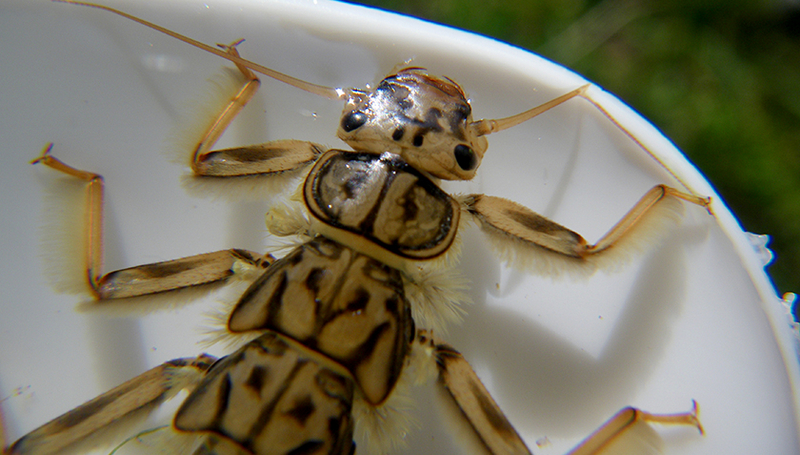
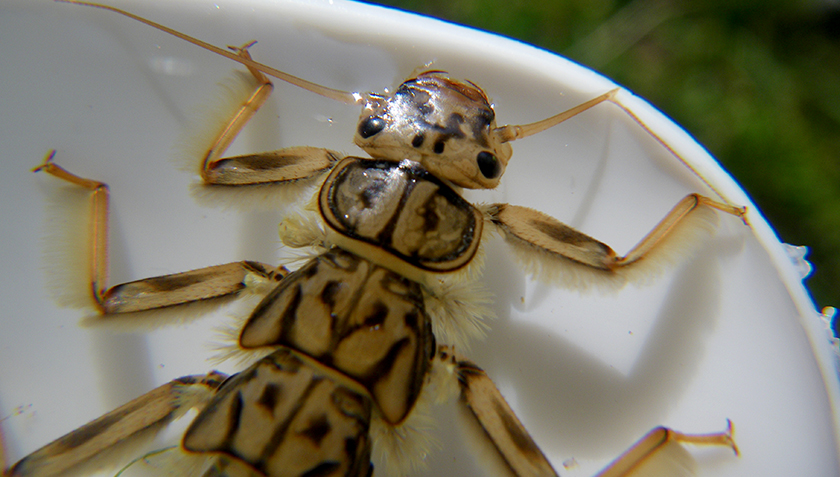
Stonefly larva, family Perlidae. Typical for this family are the gills on the underside of the thorax.
(Photo: Silvana Käser, Eawag)