Archive detail

Water quality: new insights thanks to a more efficient integrated approach

August 9, 2018 | Mirella Wepf

The development of novel, less costly analytical methods is of crucial importance in addressing the issue of micropollutants in surface waters. This was one of the main goals of EDA-EMERGE, an EU-funded programme in which Eawag also participated.

While increasing numbers of chemicals are entering surface waters, routine monitoring in Switzerland and the EU focuses on a relatively small number of compounds. These priority substances were originally defined as being of particular environmental concern. However, recent studies have shown that non-priority or even unidentified substances can also pose significant risks to aquatic life and human health. This was confirmed by a European research programme in which Eawag scientists also participated. The aim of EDA-EMERGE was to develop new effect-directed analysis (EDA) techniques, which were applied in a Europe-wide demonstration programme.

Combining biotesting and chemical analysis

In EDA, biotesting is combined with chemical analysis: while bioassays (e.g. involving human cells or zebrafish embryos) can detect toxicity in water samples, it often remains unclear what substances are causing the effects – hence the need for chemical analysis.

In the EDA-EMERGE programme, this approach was further optimised and simplified. Key components are selected bioassays and a newly developed device for the enrichment of micropollutants from large-volume water samples.

Unexplained adverse effects on organisms

Using the new methods, 37 scientists from 15 institutions investigated water quality near wastewater treatment plants (WWTPs) on four European rivers. One of the sites studied was the Urtene river (in the Bernese Midland) near the Moossee-Urtenenbach WWTP.

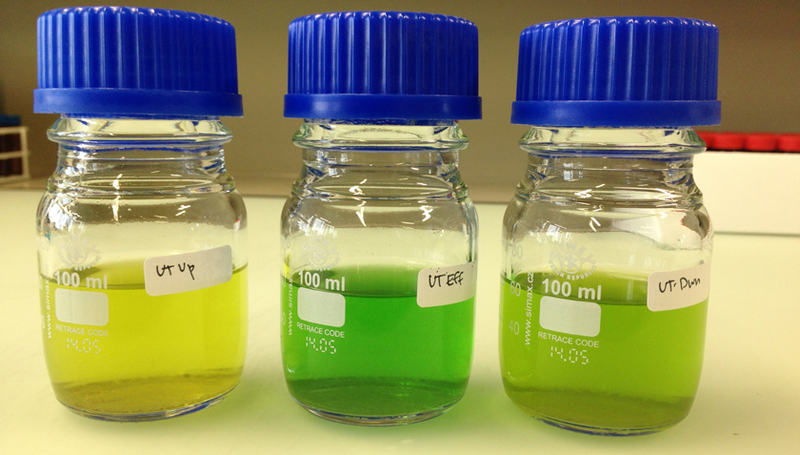
In samples from all four rivers, bioassays detected toxic effects on algae and fish embryos and endocrine effects which could not be explained solely in terms of the standard list of target compounds. The effects were observed, in particular, downstream of WWTP outlets.

Chemical analysis revealed that the samples also contained numerous substances not included on the target list. Frequently occurring compounds included, for example, gabapentin (an anticonvulsant), TMDD (a surfactant) and phthalimide (a fungicide transformation product). (For more information see: Tousova et al. 2017 / https://doi.org/10.1016/j.scitotenv.2017.06.032)
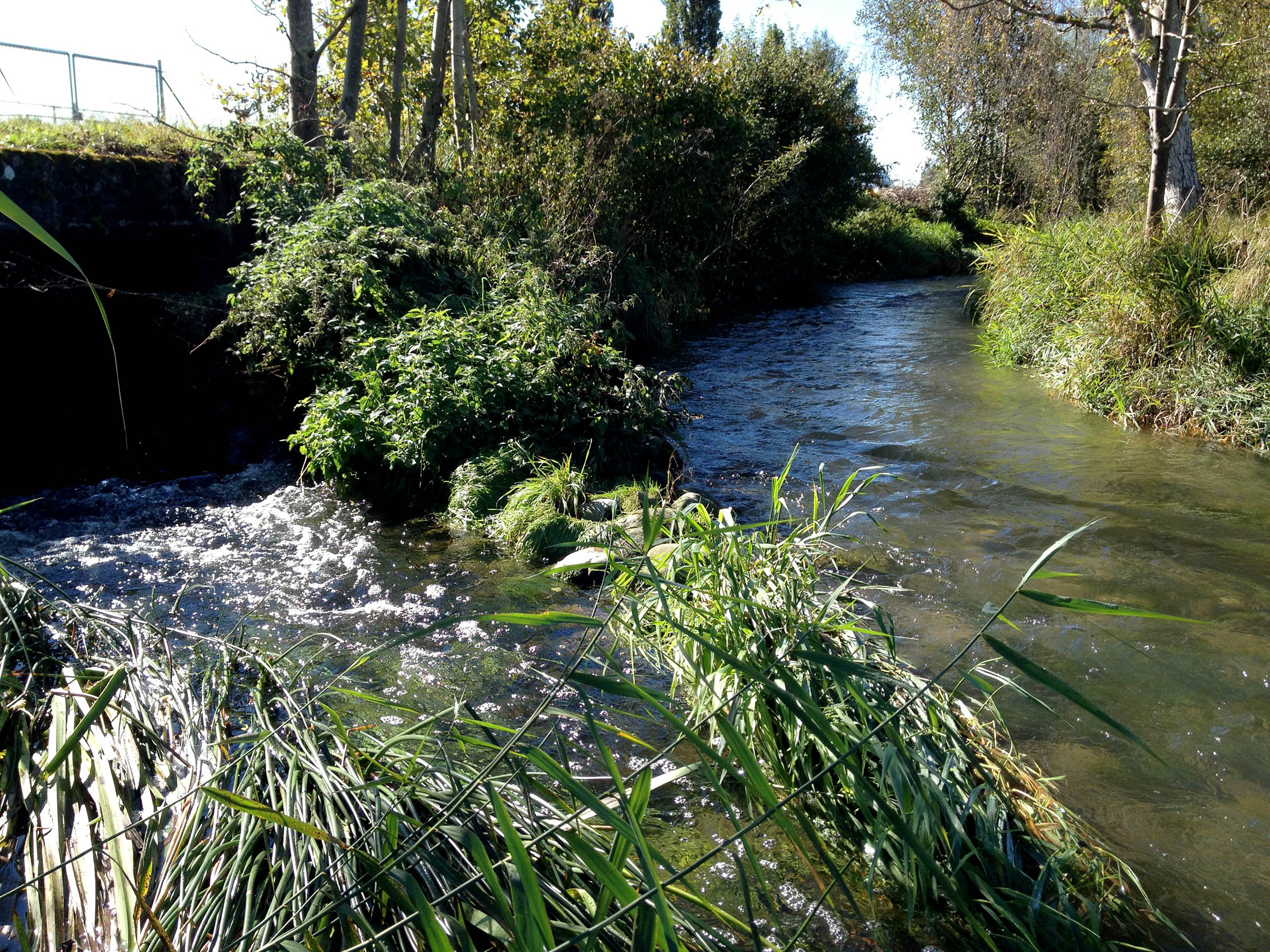
Outlet of the Moossee-Urtenenbach WWTP.
(Photo: Jennifer Schollée, Eawag)

A closer look at the Urtenenbach

After the initial study phase, more detailed investigations were carried out on the Urtenenbach by a smaller (8-strong) team, comprising scientists from Eawag and INERIS (the French National Institute for Industrial Environment and Risks).

Marc Suter, Head of the Bioanalytics Group in Eawag’s Environmental Toxicology department, explains the background: “In the first phase of the study, the project team investigating all four rivers used familiar standard tests and divided the samples into four fractions.” In the second phase, new bioassays were used to study the mode of action of substances and mixtures in more detail. “We also collected far more samples, which were separated on the basis of physicochemical properties into 40 fractions – an extremely high resolution.” The more finely water samples are fractionated, the more clearly can the biological activity observed be attributed to individual compounds.

Precise results thanks to fine fractionation

This method was used to validate the initial study results and to exclude the possibility of laboratory findings being distorted by antagonists. Suter gives an example: “In the second series of tests, estrogenic activity was detected in 20 fractions. In the more crudely separated fractions used in the first test series, it would have been possible for antiestrogens (estrogen antagonists) to mask the effects of estrogens occurring in the same fraction, leading to false‑negative results.” High-resolution fractionation provides a better picture of reality.

Higher glucocorticoid activity

Overall, according to Suter, the results of the first and the second study differed less than had originally been expected. There were, however, some notable differences: “For example, with the aid of finer fractionation, we detected much higher glucocorticoid activity.” Glucocorticoids can have adverse effects on the immune system in humans and animals. This was shown in a zebrafish study carried out by Eawag doctoral student Anita Hidasi as part of the EDA-EMERGE programme (Hidasi et al. 2017  / https://doi.org/10.1016/j.ecoenv.2016.11.024).

Although the second phase of the project required major efforts, it yielded valuable insights: thanks to the combination of existing EDA techniques with new bioassays, Suter says, we now have a better understanding of various adverse effects observed in the laboratory. This is an important step towards improved risk assessment of surface water contaminants – particularly in WWTP effluents. In their conclusions, the scientists also emphasize the need for more research on the effects of glucocorticoids on aquatic organisms.

Financing

EDA-EMERGE is a 4-year Marie Curie ITN project, funded by the European Commission. It aims to train a new generation of young scientists in interdisciplinary techniques.

Publications

Extbase Variable Dump
array(2 items)
   publications => '16830,14458,14084' (17 chars)
   libraryUrl => '' (0 chars)
Extbase Variable Dump
array(3 items)
   0 => Snowflake\Publications\Domain\Model\Publicationprototypepersistent entity (uid=16830, pid=124)
      originalId => protected16830 (integer)
      authors => protected'Sonavane, M.; Schollée, J. E.; Hidasi, A. O.; Creu
         sot, N.; Brion, F.; Suter, M. J. -F.; Hollender,&nb
         sp;J.; Aït-Aïssa, S.
' (179 chars) title => protected'An integrative approach combining passive sampling, bioassays and effect-dir
         ected analysis to assess the impact of wastewater effluent
' (134 chars) journal => protected'Environmental Toxicology and Chemistry' (38 chars) year => protected2018 (integer) volume => protected37 (integer) issue => protected'8' (1 chars) startpage => protected'2079' (4 chars) otherpage => protected'2088' (4 chars) categories => protected'WWTP effluent; passive sampling; endocrine disrupting chemicals (EDCs); embr
         yo toxicity; effect-directed analysis (EDA); LC-MS/MS analysis
' (138 chars) description => protected'Wastewater treatment plant (WWTP) effluents are major sources of endocrine d
         isrupting chemicals (EDCs) and of other chemicals of toxicological concern f
         or the aquatic environment. In this study, we used an integrated strategy co
         mbining passive sampling (Chemcatcher<sup>®</sup>), developmental toxicity
         and mechanism‐based in vitro and in vivo bioassays to monitor the impacts
         of a WWTP on a river. In vitro screening revealed the WWTP effluent as a sou
         rce of estrogen (ER), glucocorticoid (GR), aryl hydrocarbon (AhR) receptor m
         ediated activities, impacting the downstream river site where significant ac
         tivities were also measured, albeit to a lesser extent than in the effluent.
          Effect‐directed analysis (EDA) of the effluent successfully identified th
         e presence of potent estrogens (estrone, 17α‐ethinylestradiol and 17β‐
         estradiol) and glucocorticoids (clobetasol propionate and fluticasone propio
         nate) as the major contributors to the observed in vitro activities, even th
         ough other unidentified active chemicals were likely present. The impact of
         the WWTP was also assessed using zebrafish embryo assays, highlighting its a
         bility to induce estrogenic response through up‐regulation of aromatase pr
         omoter‐dependent reporter gene in the transgenic (cyp19a1b–GFP) zebrafis
         h assay and to generate teratogenic effects at non‐lethal concentrations i
         n the zebrafish embryo toxicity test. This study argues for the use of such
         an integrated approach, combining passive sampling, bioassays and EDA, to co
         mprehensively identify endocrine active compounds and associated hazards of
         WTTP effluents.
' (1611 chars) serialnumber => protected'0730-7268' (9 chars) doi => protected'10.1002/etc.4155' (16 chars) uid => protected16830 (integer) _localizedUid => protected16830 (integer)modified _languageUid => protectedNULL _versionedUid => protected16830 (integer)modified pid => protected124 (integer)
1 => Snowflake\Publications\Domain\Model\Publicationprototypepersistent entity (uid=14458, pid=124) originalId => protected14458 (integer) authors => protected'Tousova,&nbsp;Z.; Oswald,&nbsp;P.; Slobodnik,&nbsp;J.; Blaha,&nbsp;L.; Muz,&
         nbsp;M.; Hu,&nbsp;M.; Brack,&nbsp;W.; Krauss,&nbsp;M.; Di Paolo,&nbsp;C.; Ta
         rcai,&nbsp;Z.; Seiler,&nbsp;T.-B.; Hollert,&nbsp;H.; Koprivica,&nbsp;S.; Ahe
         l,&nbsp;M.; Schollée,&nbsp;J.&nbsp;E.; Hollender,&nbsp;J.; Suter,&nbsp;M.&n
         bsp;J.&nbsp;-F.; Hidasi,&nbsp;A.&nbsp;O.; Schirmer,&nbsp;K.; Sonavane,&nbsp;
         M.; Ait-Aissa,&nbsp;S.; Creusot,&nbsp;N.; Brion,&nbsp;F.; Froment,&nbsp;J.;
         Almeida,&nbsp;A.&nbsp;C.; Thomas,&nbsp;K.; Tollefsen,&nbsp;K.&nbsp;E.; Tufi,
         &nbsp;S.; Ouyang,&nbsp;X.; Leonards,&nbsp;P.; Lamoree,&nbsp;M.; Torrens,&nbs
         p;V.&nbsp;O.; Kolkman,&nbsp;A.; Schriks,&nbsp;M.; Spirhanzlova,&nbsp;P.; Tin
         dall,&nbsp;A.; Schulze,&nbsp;T.
' (715 chars) title => protected'European demonstration program on the effect-based and chemical identificati
         on and monitoring of organic pollutants in European surface waters
' (142 chars) journal => protected'Science of the Total Environment' (32 chars) year => protected2017 (integer) volume => protected601 (integer) issue => protected'' (0 chars) startpage => protected'1849' (4 chars) otherpage => protected'1868' (4 chars) categories => protected'adverse effects; large volume solid phase extraction; EDA-EMERGE; simplified
          effect-directed analysis protocol; environmental health; human health
' (146 chars) description => protected'Growing concern about the adverse environmental and human health effects of
         a wide range of micropollutants requires the development of novel tools and
         approaches to enable holistic monitoring of their occurrence, fate and effec
         ts in the aquatic environment. A European-wide demonstration program (EDP) f
         or effect-based monitoring of micropollutants in surface waters was carried
         out within the Marie Curie Initial Training Network EDA-EMERGE. The main obj
         ectives of the EDP were to apply a simplified protocol for effect-directed a
         nalysis, to link biological effects to target compounds and to estimate thei
         r risk to aquatic biota. <i>Onsite</i> large volume solid phase extraction o
         f 50 L of surface water was performed at 18 sampling sites in four European
         river basins. Extracts were subjected to effect-based analysis (toxicity to
         algae, fish embryo toxicity, neurotoxicity, (anti-)estrogenicity, (anti-)and
         rogenicity, glucocorticoid activity and thyroid activity), to target analysi
         s (151 organic micropollutants) and to nontarget screening. The most pronoun
         ced effects were estrogenicity, toxicity to algae and fish embryo toxicity.
         In most bioassays, major portions of the observed effects could not be expla
         ined by target compounds, especially in case of androgenicity, glucocorticoi
         d activity and fish embryo toxicity. Estrone and nonylphenoxyacetic acid wer
         e identified as the strongest contributors to estrogenicity, while herbicide
         s, with a minor contribution from other micropollutants, were linked to the
         observed toxicity to algae. Fipronil and nonylphenol were partially responsi
         ble for the fish embryo toxicity. Within the EDP, 21 target compounds were p
         rioritized on the basis of their frequency and extent of exceedance of predi
         cted no effect concentrations. The EDP priority list included 6 compounds, w
         hich are already addressed by European legislation, and 15 micropollutants t
         hat may be important for future monitoring of surface waters. The study pres
         ents a novel simplified ...
' (2113 chars) serialnumber => protected'0048-9697' (9 chars) doi => protected'10.1016/j.scitotenv.2017.06.032' (31 chars) uid => protected14458 (integer) _localizedUid => protected14458 (integer)modified _languageUid => protectedNULL _versionedUid => protected14458 (integer)modified pid => protected124 (integer)
2 => Snowflake\Publications\Domain\Model\Publicationprototypepersistent entity (uid=14084, pid=124) originalId => protected14084 (integer) authors => protected'Hidasi,&nbsp;A.&nbsp;O.; Groh,&nbsp;K.&nbsp;J.; Suter,&nbsp;M.&nbsp;J.&nbsp;
         -F.; Schirmer,&nbsp;K.
' (98 chars) title => protected'Clobetasol propionate causes immunosuppression in zebrafish (Danio rerio) at
          environmentally relevant concentrations
' (116 chars) journal => protected'Ecotoxicology and Environmental Safety' (38 chars) year => protected2017 (integer) volume => protected138 (integer) issue => protected'' (0 chars) startpage => protected'16' (2 chars) otherpage => protected'24' (2 chars) categories => protected'endocrine disrupting chemicals; pharmaceuticals; inflammation; bacterial lip
         opolysaccharide
' (91 chars) description => protected'Synthetic glucocorticoids (GCs) are potential endocrine disrupting compounds
          that have been detected in the aquatic environment around the world in the
         low ng/L (nanomolar) range. GCs are used as immunosuppressants in medicine.
         It is of high interest whether clobetasol propionate (CP), a highly potent G
         C, suppresses the inflammatory response in fish after exposure to environmen
         tally relevant concentrations. Bacterial lipopolysaccharide (LPS) challenge
         was used to induce inflammation and thus mimic pathogen infection. Zebrafish
          embryos were exposed to ≤1000 nM CP from ~1 h post fertilization (hpf) to
          96 hpf, and CP uptake, survival after LPS challenge, and expression of infl
         ammation-related genes were examined. Our initial experiments were carried o
         ut using 0.001% DMSO as a solvent vehicle, but we observed that DMSO interfe
         red with the LPS challenge assay, and thus masked the effects of CP. Therefo
         re, DMSO was not used in the subsequent experiments. The internal CP concent
         ration was quantifiable after exposure to ≥10 nM CP for 96 h. The bioconce
         ntration factor (BCF) of CP was determined to be between 16 and 33 in zebraf
         ish embryos. CP-exposed embryos showed a significantly higher survival rate
         in the LPS challenge assay after exposure to ≥0.1 nM in a dose dependent m
         anner. This effect is an indication of immunosuppression. Furthermore, the r
         egulation pattern of several genes related to LPS challenge in mammals suppo
         rted our results, providing evidence that LPS-mediated inflammatory pathways
          are conserved from mammals to teleost fish. <I>Anxa1b</I>, a GC-action rela
         ted anti-inflammatory gene, was significantly down-regulated after exposure
         to ≥0.05 nM CP. Our results show for the first time that synthetic GCs can
          suppress the innate immune system of fish at environmentally relevant conce
         ntrations. This may reduce the chances of fish to survive in the environment
         , as their defense against pathogens is weakened.
' (1949 chars) serialnumber => protected'0147-6513' (9 chars) doi => protected'10.1016/j.ecoenv.2016.11.024' (28 chars) uid => protected14084 (integer) _localizedUid => protected14084 (integer)modified _languageUid => protectedNULL _versionedUid => protected14084 (integer)modified pid => protected124 (integer)
Sonavane, M.; Schollée, J. E.; Hidasi, A. O.; Creusot, N.; Brion, F.; Suter, M. J. -F.; Hollender, J.; Aït-Aïssa, S. (2018) An integrative approach combining passive sampling, bioassays and effect-directed analysis to assess the impact of wastewater effluent, Environmental Toxicology and Chemistry, 37(8), 2079-2088, doi:10.1002/etc.4155, Institutional Repository
Tousova, Z.; Oswald, P.; Slobodnik, J.; Blaha, L.; Muz, M.; Hu, M.; Brack, W.; Krauss, M.; Di Paolo, C.; Tarcai, Z.; Seiler, T.-B.; Hollert, H.; Koprivica, S.; Ahel, M.; Schollée, J. E.; Hollender, J.; Suter, M. J. -F.; Hidasi, A. O.; Schirmer, K.; Sonavane, M.; Ait-Aissa, S.; Creusot, N.; Brion, F.; Froment, J.; Almeida, A. C.; Thomas, K.; Tollefsen, K. E.; Tufi, S.; Ouyang, X.; Leonards, P.; Lamoree, M.; Torrens, V. O.; Kolkman, A.; Schriks, M.; Spirhanzlova, P.; Tindall, A.; Schulze, T. (2017) European demonstration program on the effect-based and chemical identification and monitoring of organic pollutants in European surface waters, Science of the Total Environment, 601, 1849-1868, doi:10.1016/j.scitotenv.2017.06.032, Institutional Repository
Hidasi, A. O.; Groh, K. J.; Suter, M. J. -F.; Schirmer, K. (2017) Clobetasol propionate causes immunosuppression in zebrafish (Danio rerio) at environmentally relevant concentrations, Ecotoxicology and Environmental Safety, 138, 16-24, doi:10.1016/j.ecoenv.2016.11.024, Institutional Repository

Photos

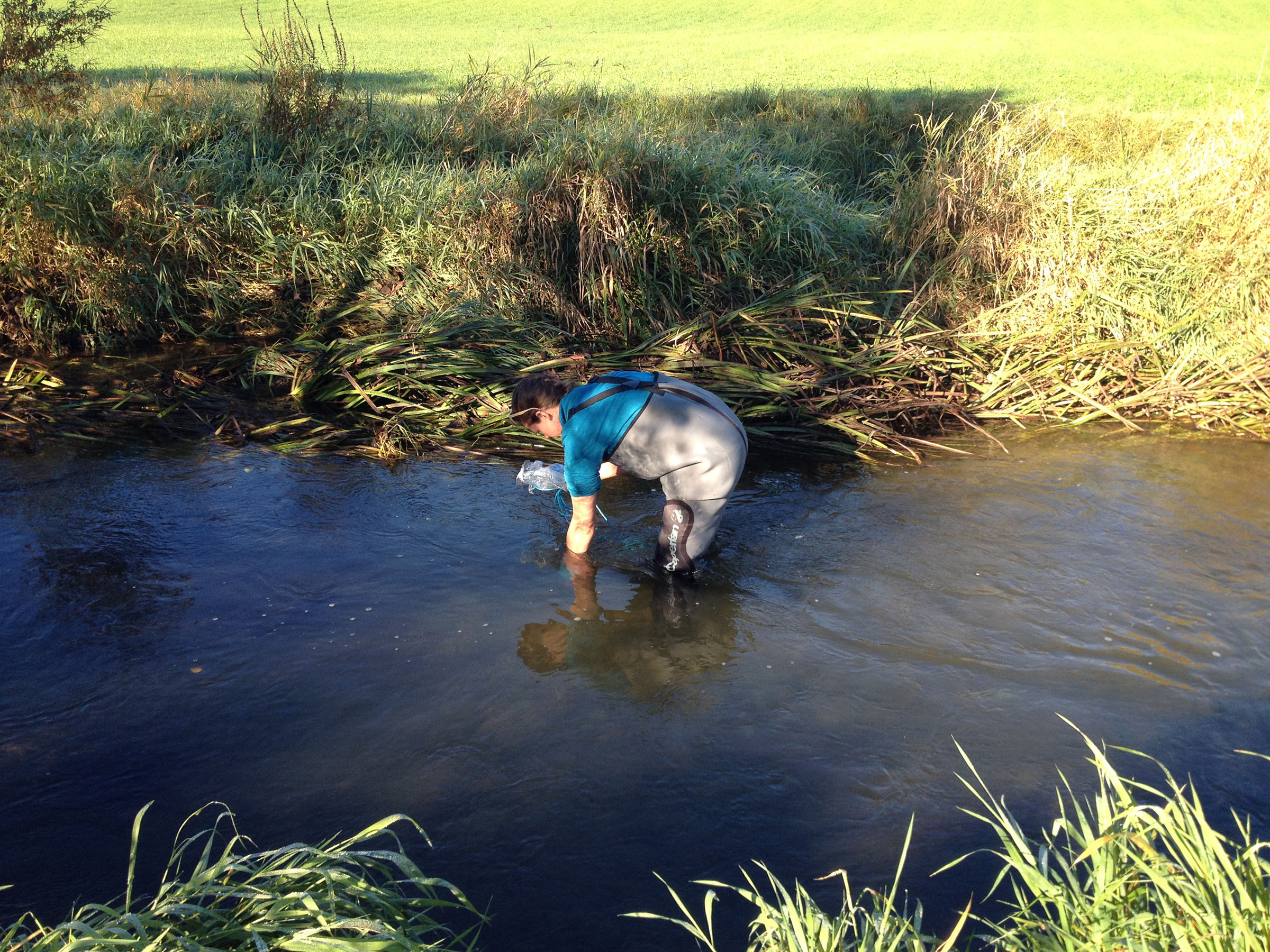
Jennifer Schollée deploying a passive sampler (Chemcatcher) at the Moossee‑Urtenenbach WWTP effluent discharge site. As a doctoral student, Schollée, together with Anita Hidasi, was part of the 7-strong Eawag team participating in EDA-EMERGE. The programme was explicitly designed to train early-career scientists. (Photo: Anita Hidasi, Eawag)
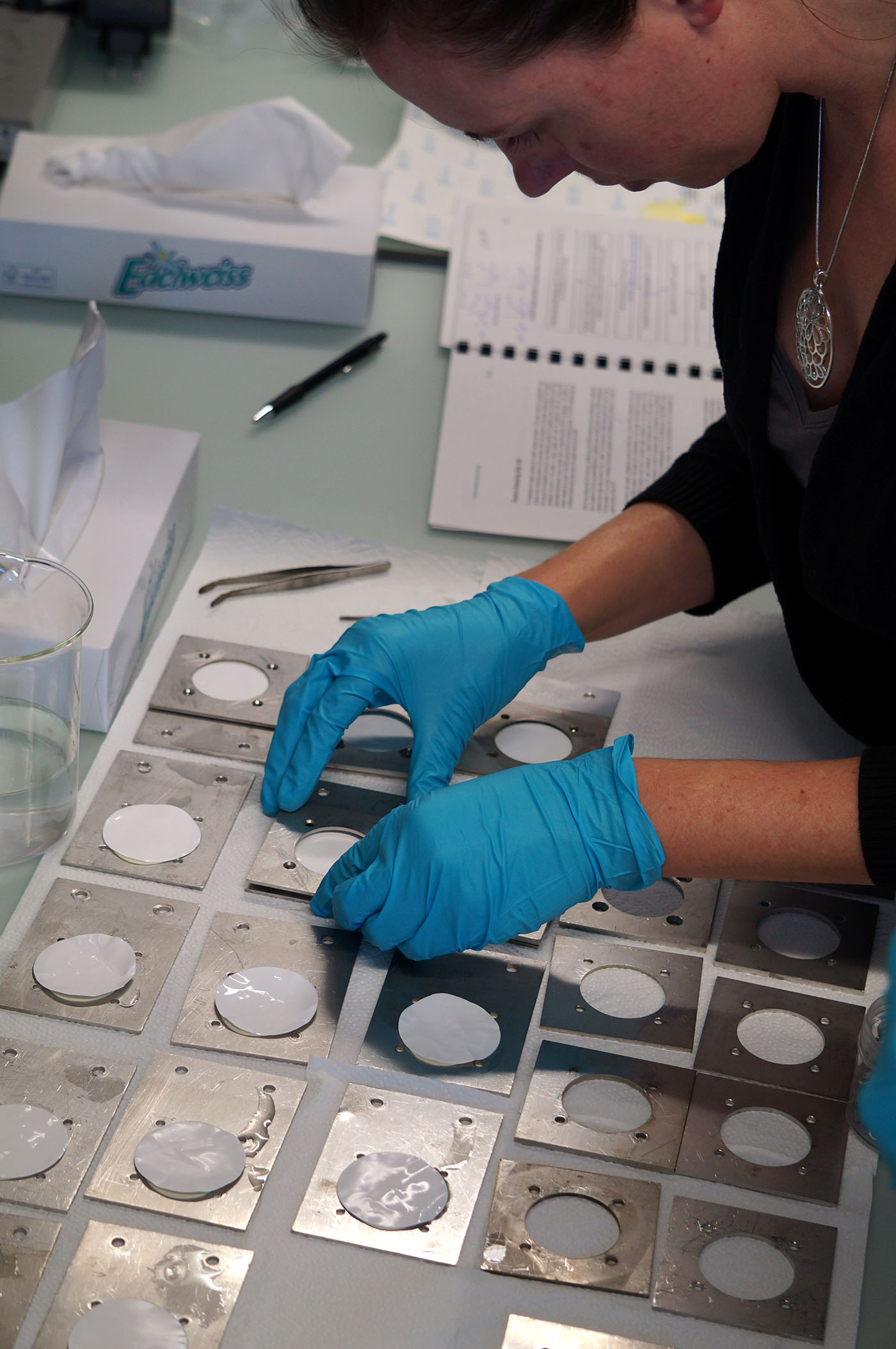
In the laboratory, Eawag doctoral student Jennifer Schollée prepares passive samplers for the second sampling campaign on the Urtenenbach. Passive sampling is used to determine concentrations of water pollutants.
(Photo: Birgit Beck, Eawag)