News Detail
Beavers create habitats for bats
November 13, 2025 |
In the 19th century, beavers were extinct in large parts of Europe, with only a few thousand animals remaining. However, thanks to hunting bans and reintroduction projects, there are now over 1.4 million beavers across Europe, with around 4,900 in Switzerland. By damming streams and felling trees, they create habitats and food for many other creatures, especially fish and other aquatic organisms. Less clear so far is how the beaver's building activity affects animals and ecosystems on land. A team from WSL and Eawag, together with the national beaver specialist unit at info fauna, has now investigated this for bats.
- The study examined how intensively bats hunted in areas with and without beaver dams, how many flying insects were present, and what habitat elements, such as dead trees, were available.
- More bat species, including more endangered species, were found near beaver ponds than in other areas.
- The hunting activity of bats at beaver ponds was 1.6 times higher than in areas without beaver activity, and feeding activity was even 2.3 times higher.
To this end, the researchers compared two sections of eight rivers in the Swiss Plateau, one with a beaver dam and one without any beaver influence. They recorded the echolocation calls of bats hunting insects in order to estimate their numbers, and counted flying insects caught in special traps just above the water surface. They also looked at the quality of the vegetation with and without beavers: the number of standing and fallen dead trees, the plant species and the forest structure, i.e. how patchy and varied the canopy is.
Endangered bat species
On average, five bat species were found per night at beaver ponds and four at other sections of the stream, out of a total of thirty native species in Switzerland. Endangered species on the red list were also more frequently found flying at beaver ponds. The bats also hunted 2.3 times more frequently in beaver territories than in the control sections, which can be deduced from the structure of their echolocation calls. ‘I would not have expected such a significant increase in bat numbers,’ says Valentin Moser, who conducted the study as part of his doctoral thesis at the WSL.
What attracted the bats? On the one hand, it was the more diverse, open tree population and the dead wood in the beaver territories, but also the larger number of insects. ‘The quality of the habitat is better in beaver territories and the amount of food is higher than outside them,’ says Moser. One of the endangered species, the western barbastelle bat, sleeps under flaking pieces of bark on standing dead trees, for example. ‘These are common in beaver systems,’ says Moser. Some of the trees die because beavers fell them, others because of the dammed water. ‘The tree trunks remain standing for years and provide a very valuable, because rare, habitat,’ says Moser.
The researchers published their findings in the Journal of Animal Ecology. They emphasise that beavers can help protect endangered species such as bats as natural supporters. Christof Angst, head of the national beaver office at info fauna, the National Data and Information Centre on Swiss Fauna, agrees: ‘Almost all bats are endangered and are on the Red List. They need support, and beavers seem to be providing just that.’
The National Beaver Centre was responsible for the overall management of the Federal Office for the Environment's beaver research project, which researchers joined as part of the Blue-Green Biodiversity research initiative run by WSL and Eawag. The National Beaver Centre is currently preparing a summary report for the federal government, which will show how best to integrate beavers into nature conservation programmes and what should be avoided in order to prevent future conflicts. ‘Beavers are recreating functional, highly species-rich and resilient water bodies, and they are doing so more cheaply and more effectively than humans with their engineering skills and excavators,’ says Angst.
Blue-Green Biodiversity Research Initiative
The research project «Predator coupling of aquatic and terrestrial ecosystems: the importance of nutritional diversity of prey» contributes to the Blue-Green Biodiversity Research Initiative – an Eawag-WSL collaboration that focuses on biodiversity at the interface of aquatic and terrestrial ecosystems. The initiative is funded by the ETH Board.
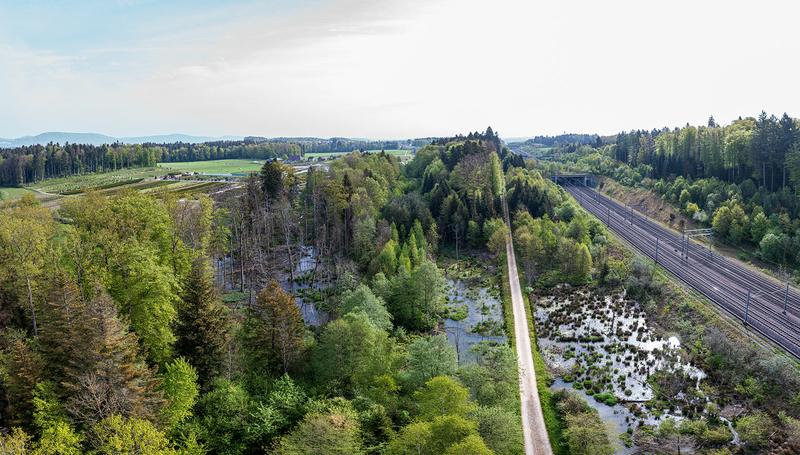
Cover picture: Stagnant water, gaps in the forest and dead trees: bats find good hunting conditions here. (Photo: Christof Angst)