News Detail

Consequences of pesticide use in the tropics

June 27, 2023 | Andri Bryner

While the use of pesticides in industrial countries is being questioned more and more critically, less is known about their consequences on human health and the environment in tropical countries. The interdisciplinary project “Pestrop” is now changing this and also shows where the necessary measures need to be taken.

When it comes to water in the Global South, the focus is usually on microbiological quality. Small wonder, given that diseases, such as cholera or typhoid, spread through contaminated drinking water. Pesticides, on the other hand, are a little-researched topic in tropical regions. However, a team of experts from the fields of environmental chemistry, human toxicology and political science has now investigated which pesticides were used in two test regions in the period from 2017 to 2020 in Costa Rica and Uganda, and which active substances were found in streams and drinking water production. At the same time, research was conducted on how farmers handle pesticides and how well-informed they are about the risks. The team found clear evidence of long-term negative effects of pesticide use on farmers’ health. The project also uncovered deficits in environmental data, inadequate advice to farmers and outdated statutory requirements on pesticide use.
 

Surprising insecticide findings

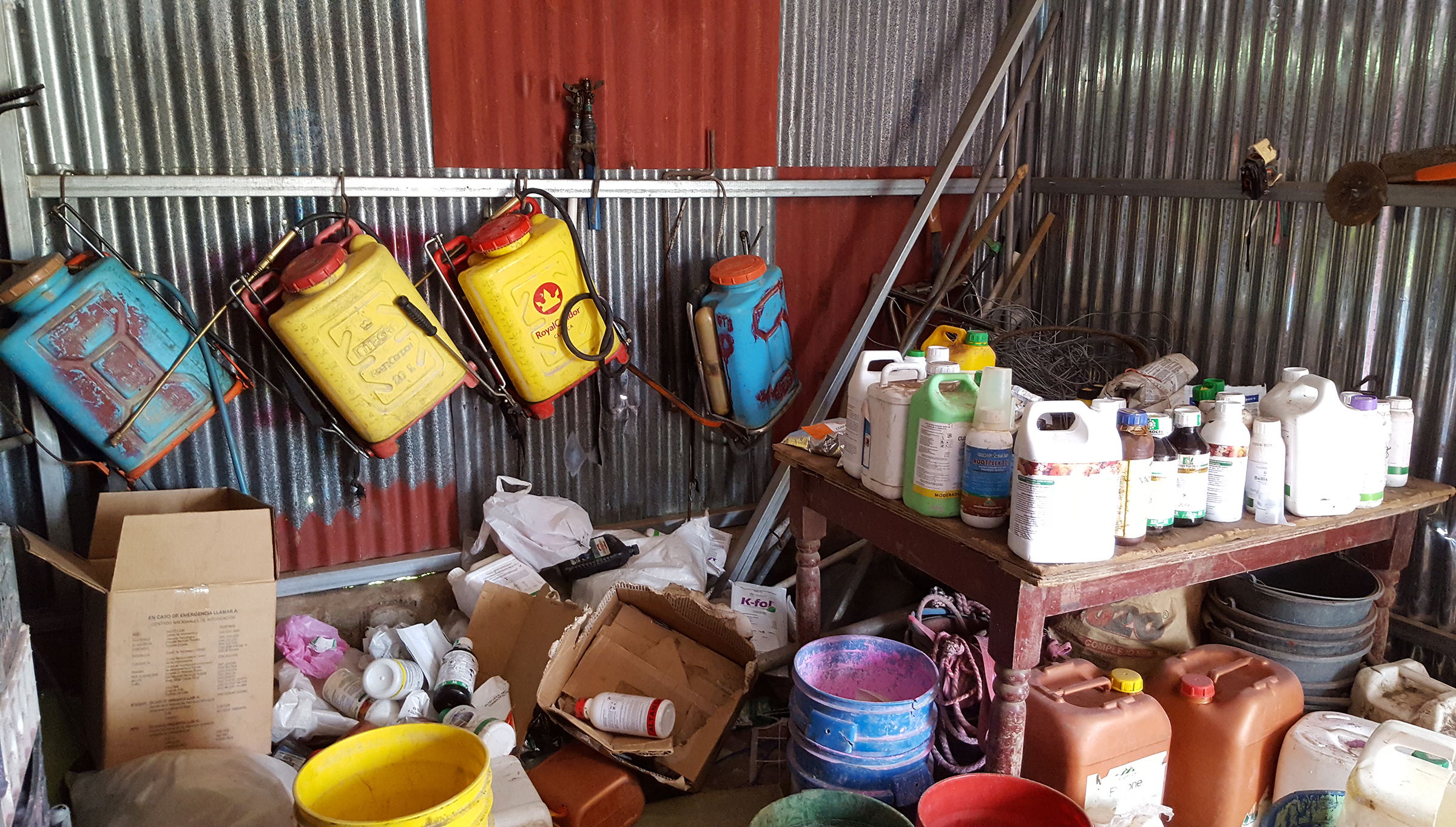
The project focused on “modern”, often polar active substances, such as fungicides and insecticides. In Africa as well as in Central America, there are still hardly any regulations on these. However, it is evident that they are widely used. In individual samples from streams, the researchers found active substances in concentrations that were significantly above the threshold limits as recognised in Switzerland. And problematic concentrations were also found in boreholes and ponds from which the population draws its drinking water. In addition – and this was surprising – the team found substances in the water that are hardly ever sprayed on the fields, including the insecticide chlorpyrifos, which has since been banned in Switzerland. The researchers suspect that the agent is used to control mosquitoes and mites in stables and enters the environment with farmyard manure, for example.

The “Pestrop” project was jointly led by the aquatic research institute Eawag and the Swiss Tropical and Public Health Institute.

Philipp Staudacher on the use of pesticides in developing countries

Lecture at Eawag Infoday 2023

At Eawag’s Info Day "Aquatic research for sustainable development" on 14 September 2023 in Dübendorf, Christian Stamm, Deputy Director of Eawag, will take a closer look at Eawag's research on the use of pesticides in the Global South, but also in Switzerland, and present the research results. In particular, he will explain the conflict of goals between plant protection versus environmental and health protection, identify the causes of the problems and outline possible solution strategies.

Further information on the Eawag’s Info Day programme and registration

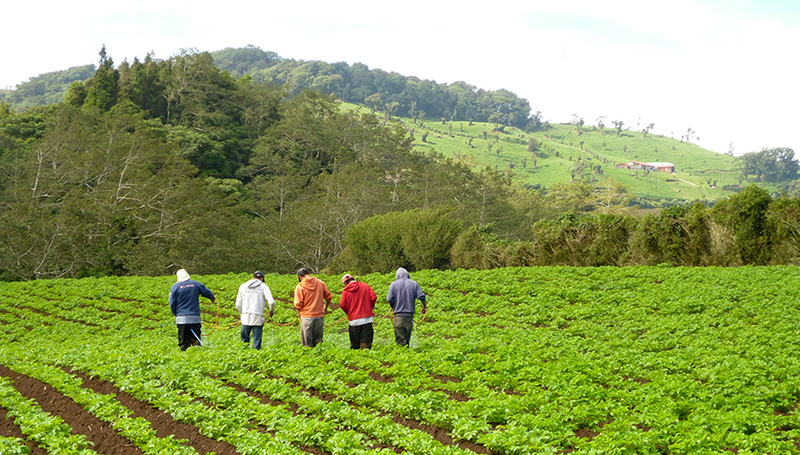
Cover picture: Farmers spraying vegetables in the Zarcero region of Costa Rica. (Photo: Mirko Winkler, Swiss TPH)
 

Original Publication

Extbase Variable Dump
array(3 items)
   publications => '25705' (5 chars)
   libraryUrl => '' (0 chars)
   layout => '0' (1 chars)
Extbase Variable Dump
array(1 item)
   0 => Snowflake\Publications\Domain\Model\Publicationprototypepersistent entity (uid=25705, pid=124)
      originalId => protected25705 (integer)
      authors => protected'Oltramare, C.; Weiss, F. T.; Staudacher, P.; Kibirango,&
         nbsp;O.; Atuhaire, A.; Stamm, C.
' (118 chars) title => protected'Pesticides monitoring in surface water of a subsistence agricultural catchme
         nt in Uganda using passive samplers
' (111 chars) journal => protected'Environmental Science and Pollution Research' (44 chars) year => protected2023 (integer) volume => protected30 (integer) issue => protected'9' (1 chars) startpage => protected'10312' (5 chars) otherpage => protected'10328' (5 chars) categories => protected'smallholder farming; surface water; drinking water; pesticides; passive samp
         ling; environmental monitoring; Uganda; high-resolution mass spectrometry
' (149 chars) description => protected'Convolutional Neural Networks (CNNs) offer an alternative to the image cross
         -correlation methods used in Particle Image Velocimetry (PIV) to reconstruct
          the fluid velocity field from the experimental recording. Despite the flexi
         bility of CNNs, the accuracy and robustness of the standard image processing
          remains unsurpassed for general PIV data. As CNNs are non-linear and typica
         lly entail up to millions of trainable parameters, they require large and ca
         refully designed training datasets to avoid over-fitting and to obtain resul
         ts that are accurate for a wide range of flow conditions and length scales.
         Most training datasets consist of PIV-like data that are generated from disp
         lacement fields resulting from numerical flow simulations, which, in additio
         n of being computationally expensive, may be able to inform the network only
          about relatively few classes of flow problems. To overcome this issue and i
         mprove the accuracy of the velocity reconstructed by CNNs, we propose to tra
         in the networks with synthetic PIV-like data generated from random displacem
         ent fields. The underlying idea is that the training dataset simply needs to
          teach the network about the kinematic relationship between position and vel
         ocity. These kinematic training datasets are computationally inexpensive and
          may allow a much richer variability in terms of length scales by varying th
         e generation parameters. By training a state-of-the-art CNN, we investigate
         the accuracy of the reconstructed displacement and velocity with synthetic a
         nd experimental test cases, such as a sinusoidal flow and wind-tunnel data f
         rom a turbulent-boundary-layer and a cylinder-wake experiment. We demonstrat
         e that kinematic training can drastically improve the accuracy of the CNN an
         d allows the network to outperform conventional cross-correlation methods, b
         eing more robust with respect to data noise and providing reconstructed velo
         city fields that have considerably higher spatial resolution (at pixel level
         ).
' (1978 chars) serialnumber => protected'0944-1344' (9 chars) doi => protected'10.1007/s11356-022-22717-2' (26 chars) uid => protected25705 (integer) _localizedUid => protected25705 (integer)modified _languageUid => protectedNULL _versionedUid => protected25705 (integer)modified pid => protected124 (integer)
Oltramare, C.; Weiss, F. T.; Staudacher, P.; Kibirango, O.; Atuhaire, A.; Stamm, C. (2023) Pesticides monitoring in surface water of a subsistence agricultural catchment in Uganda using passive samplers, Environmental Science and Pollution Research, 30(9), 10312-10328, doi:10.1007/s11356-022-22717-2, Institutional Repository

Funding / cooperations

  • Eawag
  • Swiss Tropical and Public Health Institute (Swiss TPH)
  • University of Bern
  • University of Basel
  • National University of Costa Rica
  • Makerere University, Uganda
  • Uganda National Association of Community and Occupational Health (UNACOH)