
News Detail
Coronavirus lockdowns: lakes became clearer worldwide
April 9, 2026 |
The COVID-19 pandemic created a unique situation for lake research. With the lockdowns imposed worldwide between 2020 and 2022, public life came to a near standstill in many places. Leisure activities and tourism declined drastically, trade and transport collapsed, and industry and agriculture produced less. This exceptional situation enabled researchers to observe directly how human activities affect lake ecosystems and the turbidity of their waters. This provided them with important insights, as turbidity is a key indicator of water quality. Turbid water allows less light to penetrate deep into the water column, thereby inhibiting plant growth and promoting oxygen depletion at the lake bottom.
An international team led by Wenfeng Liu and Defeng Wu from China Agricultural University, Beijing, and Daniel Odermatt from the Swiss Aquatic Research Institute Eawag investigated the turbidity of 774 lakes worldwide between 2017 and 2022. The study was based on satellite data from the European Earth observation programme Copernicus Global Land Service, which the team analysed using statistical models and artificial intelligence. The study was recently published in the journal Nature – Communications Earth & Environment.
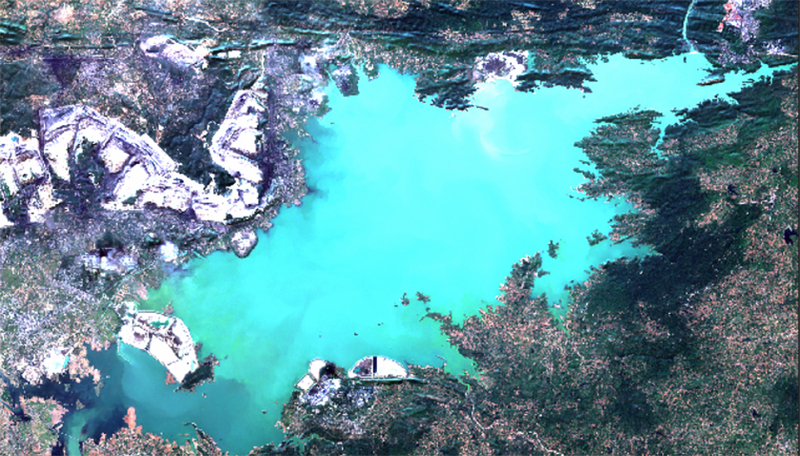
Lake Tharthar is the largest lake in Iraq. It was constructed as a flood retention basin for the Tigris in a depression containing large gypsum deposits. This results in a natural deterioration of water quality, which is further compromised by agricultural, urban and industrial discharges. Although the water level is lower in the 2020 image, the water is clearer than in the previous year. (Satellite image: European Earth observation programme Copernicus Global Land Service)
An unplanned global real-time experiment
‘The pandemic was an unplanned global real-time experiment for us,’ says lead author Defeng Wu. ‘For the first time, we were able to quantify, on a global scale, the extent to which human activity directly influences lake turbidity.’ In 2020, the maximum turbidity of lakes fell by 7.0 per cent on average worldwide compared with 2019. Around 5.9 per cent of this can be directly attributed to pandemic restrictions – independent of climatic influences such as rainfall or wind. When considered individually, 75 per cent of the lakes studied exhibited lower maximum turbidity. 168 lakes even recorded an average decline of 18.6 per cent. The researchers used night-time light observed by satellites as an indicator of human activity – the darker the world, the less active humanity is.
In densely populated regions with strict lockdown rules and intensive agriculture, particularly those with a high proportion of arable land and intensive sheep farming, the decline in turbidity was particularly pronounced. In China, the USA, Central Africa, Russia and Brazil, for example, the researchers found numerous lakes where turbidity had decreased significantly. The situation was different in Canada: there, changes were more frequently caused by climatic factors such as exceptionally heavy snowmelt or by altered runoff. This shows that not every improvement can automatically be attributed to reduced human activity.
Shores and river mouths particularly benefited from lockdowns
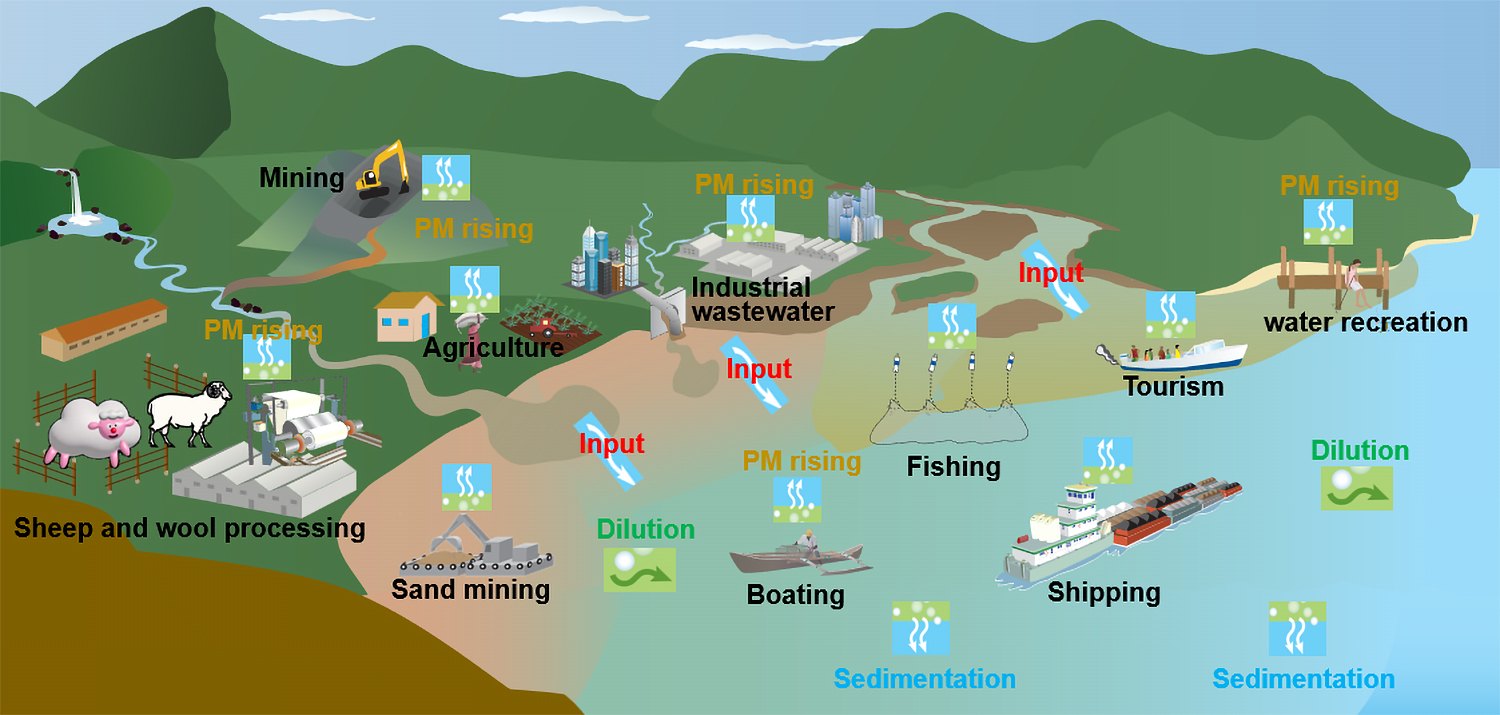
It is also interesting to note where the lakes became clearer: primarily in shore zones and river mouths. The study confirms that these zones are particularly strongly influenced by human activity and runoff from urban areas and agriculture. In the centre of the lakes, however, no changes in turbidity were measurable. This suggests that turbidity there is dominated more by processes within the lake itself rather than by direct inflows from watercourses.
‘The exceptional circumstances during the pandemic show that measures to reduce human impact do indeed improve water quality in lakes – and do so measurably and quickly,’ says Daniel Odermatt. The study identifies possible measures such as stricter regulations for wastewater treatment, the optimisation of urban drainage networks, the mitigation of soil erosion and runoff in agriculture, the promotion of sustainable land management, and effective water protection. ‘However, sustainable solutions are needed, as the study also showed that the improvements were only temporary. With the easing of restrictions in 2022, turbidity rose rapidly again,’ adds Daniel Odermatt.
Govind Ballabh Pant Sagar is India’s largest artificial lake. Its water quality is primarily affected by ash from several coal-fired power stations, which is dumped directly into the lake. During the Covid lockdowns, the impact of this on the lake was visibly reduced. (Satellite image: European Earth observation programme Copernicus Global Land Service)
Cover picture: Satellite image of Govind Ballabh Pant Sagar, India’s largest artificial lake. (Image: European Earth observation programme Copernicus Global Land Service)